---
title: "AI customer service 101: what Singapore businesses need to know"
description: "Learn how AI customer service works, top use cases, key features and rollout steps for Singapore businesses."
canonical: "https://sleekflow.io/en-sg/blog/ai-customer-service"
html_lang: "en-sg"
date_modified: "2026-04-13T06:17:52.520Z"
og_title: "AI customer service in Singapore: a practical guide"
og_description: "Learn how AI customer service works, top use cases, key features and rollout steps for Singapore businesses."
og_image: "https://images.ctfassets.net/tu2uwzoyozk8/jv7U36Ukh9EPuG26vYfRg/37254a153c2feca5c6b003922293bf06/Website-Cover-SleekFlow.jpg?w=1200&q=90"
---
```json
{
"@context": "https://schema.org",
"@type": "BlogPosting",
"headline": "AI customer service in Singapore: a practical guide",
"description": "Learn how AI customer service works, top use cases, key features and rollout steps for Singapore businesses.",
"url": "https://sleekflow.io/en-sg/blog/ai-customer-service",
"dateModified": "2026-04-13T06:17:52.520Z",
"image": "https://images.ctfassets.net/tu2uwzoyozk8/jv7U36Ukh9EPuG26vYfRg/37254a153c2feca5c6b003922293bf06/Website-Cover-SleekFlow.jpg?w=1200&q=90",
"breadcrumb": {
"@type": "BreadcrumbList",
"itemListElement": [
{
"@type": "ListItem",
"position": 1,
"name": "Home",
"item": "https://sleekflow.io/en-sg"
},
{
"@type": "ListItem",
"position": 2,
"name": "Blog",
"item": "https://sleekflow.io/en-sg/blog"
},
{
"@type": "ListItem",
"position": 3,
"name": "AI customer service in Singapore: a practical guide",
"item": "https://sleekflow.io/en-sg/blog/ai-customer-service"
}
]
}
}
```
# AI customer service 101: what Singapore businesses need to know
*Julian Wong — Content Strategist*
## Summary
- In Singapore, AI is moving from experimentation into everyday service operations, helping teams handle more enquiries efficiently.
- AI helps businesses respond faster, tailor replies using customer context, reduce repetitive work for agents, and deliver more consistent support.
- Common wins include FAQ automation, intelligent routing, live agent assist, multilingual support, order updates, and conversation summaries.
- Businesses should begin with one high-volume use case, clean up their knowledge base, build clear human handoff rules, connect systems, and measure outcomes properly.
- AI works best when combined with human support and the right platform. It should not replace service teams, but strengthen them.
**AI customer service** is no longer a side project for service teams in Singapore. It is moving into day-to-day operations. Salesforce says [AI is expected to handle 41% of customer service cases in Singapore](https://www.salesforce.com/ap/news/press-releases/2026/01/13/ai-expected-to-resolve-nearly-half-of-customer-service-cases-in-singapore-by-2027-data-shows/), while service teams also see AI as a way to free up time and build more strategic skills.
At its best, **AI customer service** does not replace support teams. It helps them answer routine queries faster, personalise replies, summarise conversations, route cases intelligently, and stay available across more channels. That matters because customers increasingly expect brands to know who they are and what they need, while also being careful with personal data.
## **Key benefits of AI in customer service**
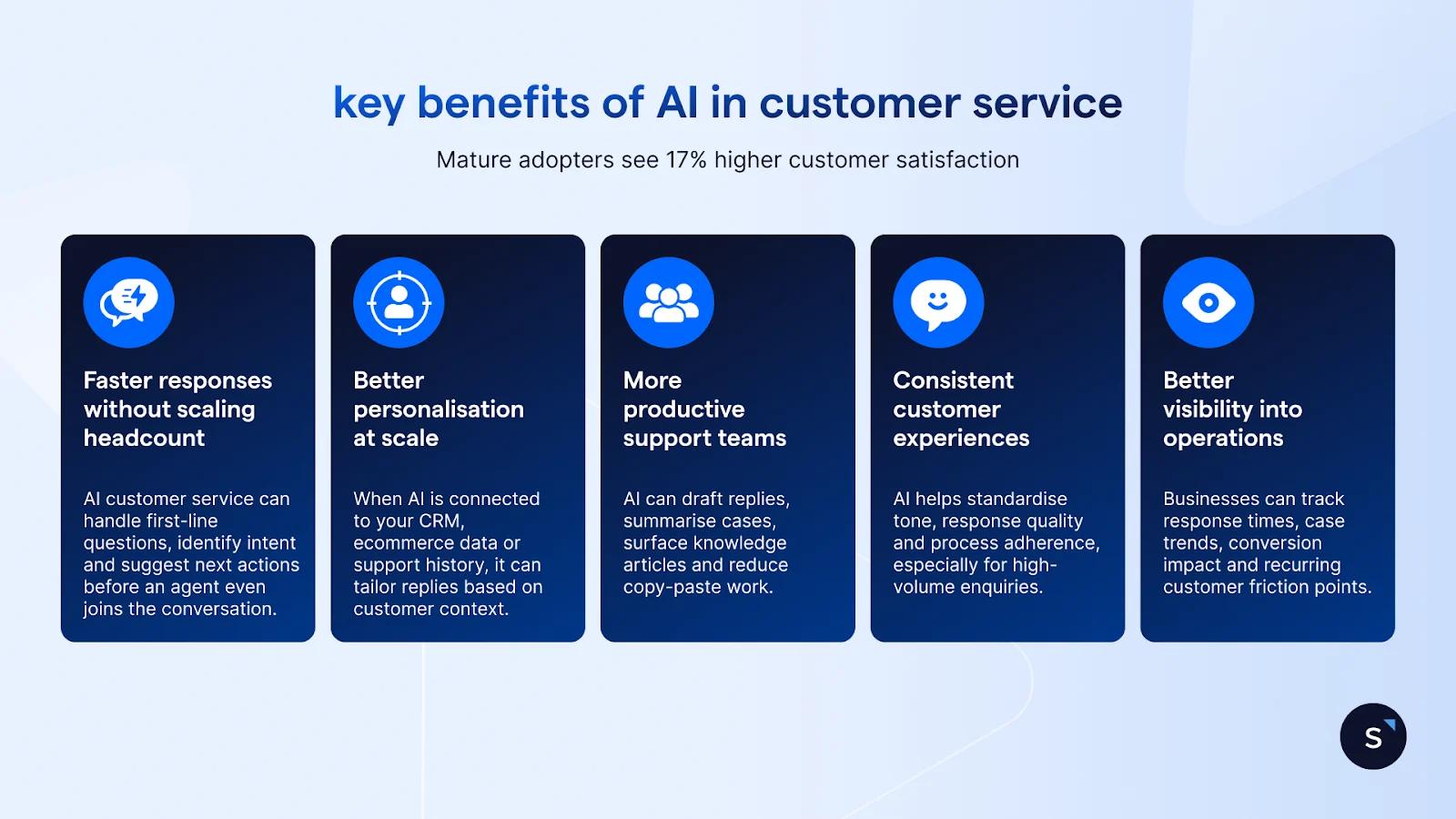
Companies adopting AI more effectively are seeing measurable gains. IBM reports that [mature AI adopters saw 17% higher customer satisfaction](https://www.ibm.com/think/topics/ai-in-customer-service).
### **Faster responses without scaling headcount at the same rate**
Customers do not want to wait for simple answers. **AI customer service** can handle first-line questions, identify intent and suggest next actions before an agent even joins the conversation. That means faster first response times, better 24/7 coverage and less pressure on frontline teams during peak periods.
### **Better personalisation at scale**
When AI is connected to your CRM, ecommerce data or support history, it can tailor replies based on customer context instead of sending generic responses.
### **More productive support teams**
One of the biggest wins is internal, not customer-facing. AI can draft replies, summarise cases, surface knowledge articles and reduce copy-paste work for support teams.
### **A more consistent customer experience**
Human teams vary by shift, workload and experience level. AI helps standardise tone, response quality and process adherence, especially for high-volume enquiries. That is particularly valuable for businesses running support across multiple channels and multiple agents.
### **Better visibility into operations**
AI should not be a black box. It should make support more measurable. With the right reporting layer, businesses can track response times, case trends, conversion impact and recurring customer friction points more clearly.
| **Without AI support** | **With AI customer service** |
| --- | --- |
| Manual triage and repetitive replies | Automated triage and faster first responses |
| Agents spend time searching for context | Customer history and suggested replies surfaced instantly |
| Limited after-hours coverage | 24/7 support for common intents |
| Inconsistent service quality | More consistent tone and workflows |
| Harder to measure service impact | Clearer reporting on response, resolution and outcomes |
## Examples of AI in customer service
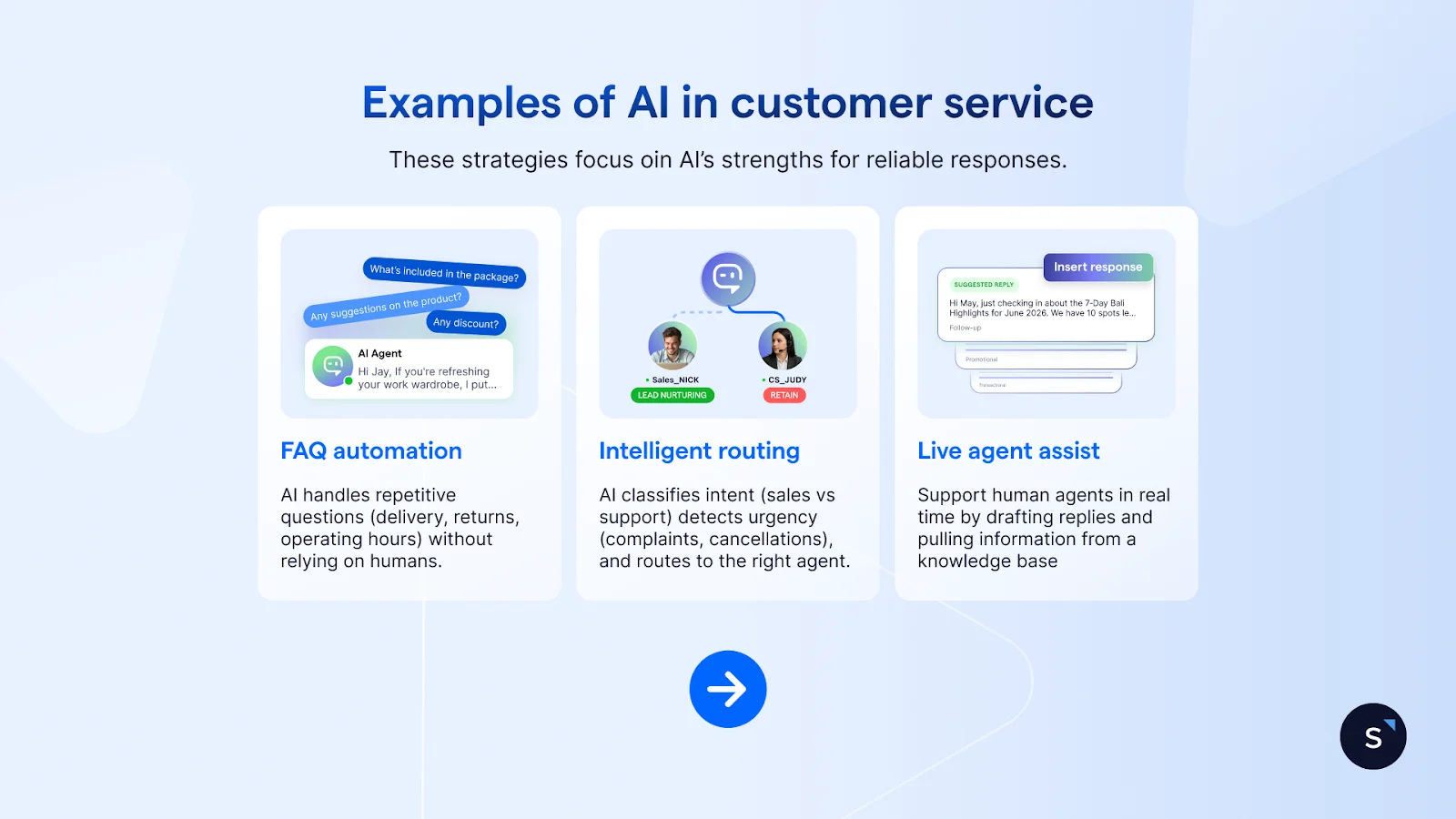
AI has many practical use cases in customer service, such as FAQ handling, multilingual support, conversation summaries, knowledge retrieval, personalisation, intelligent routing and agent assistance. These are the use cases that move fastest from pilot to value.
### **FAQ automation**
AI can answer common and repetitive questions about delivery, returns, opening hours, account access, pricing or appointment policies without sending every conversation to a human. This is one of the fastest ways to reduce inbound pressure while keeping response times low.
### **Intelligent routing and prioritisation**
Not every conversation should go to the same queue. AI can detect intent, urgency or sentiment and route the conversation to the right team or agent faster. That improves both resolution speed and workload balance.
### **Agent assist during live conversations**
AI can support agents in real time by drafting replies, pulling approved information from a knowledge base and summarising previous interactions. This is often the best starting point for businesses that want quality gains without giving AI full autonomy from day one.
###
### **Booking, payment and order updates**
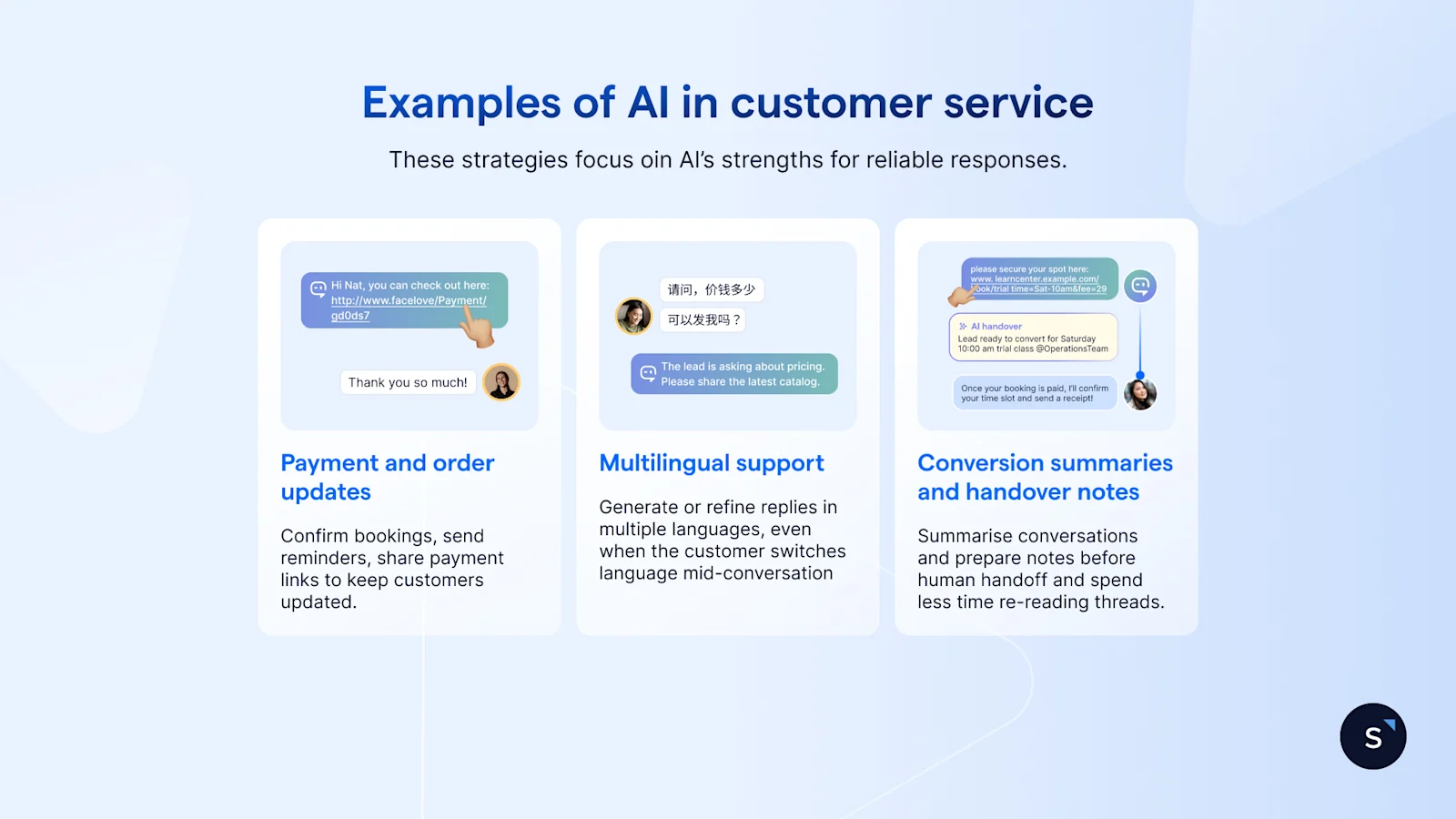
For service-heavy businesses, AI is useful well beyond support. It can confirm bookings, send reminders, share payment links, answer product questions and keep customers updated after a purchase.
### **Multilingual support**
Singapore teams often need to handle customers across different languages and channels. AI can help extend coverage by generating or refining replies in multiple languages, even when the customer switches language mid-conversation
### **Conversation summaries and handover notes**
When AI creates summaries before a human handoff, agents spend less time re-reading threads and more time solving problems.
## **Key features you need in AI customer service**
The real requirement for AI in customer service is not just an AI agent. It is an AI-enabled service system in which channels, knowledge, collaboration, analytics, and governance work together.
| **Feature** | **Why it matters** | **What good looks like** |
| --- | --- | --- |
| Omnichannel inbox | Customers switch channels; teams need one view | WhatsApp, Instagram and live chat managed in one place |
| Knowledge-grounded AI | Reduces inaccurate answers | AI replies based on approved FAQs, policies and product docs |
| Human handoff | Complex or sensitive cases need a person | Rules-based escalation with summaries and context |
| Collaboration tools | Service is rarely handled by one person alone | Internal notes, assignment, shared ownership |
| Ticketing and prioritisation | Prevents important cases getting lost | Status, urgency, due dates, queue control |
| Analytics and CX dashboard | Proves ROI and exposes friction | Response time, resolution, CSAT, case trends, conversion |
| CRM and ecommerce integration | Makes personalisation useful, not superficial | Customer history, order data and lead status available in chat |
| Governance and security | Essential for enterprise confidence | Access control, auditability and clear rules for sensitive data |
## **How to implement AI in customer service strategically**
The biggest mistake is trying to automate everything at once. Stronger teams start with a narrow, high-volume use case and expand only after the workflow, data and handoff rules are stable.
### **1. Start with one journey that already creates load**
Pick a use case such as FAQs, appointment booking, order updates, returns or first-line triage. The goal is not to prove that AI can do everything. The goal is to remove measurable friction quickly.
### **2. Fix your knowledge before you automate your replies**
If the source material is messy, the customer experience will be too. Build from approved policies, service scripts, product information and escalation rules. This is where AI-assisted drafting tools and knowledge-grounded replies become more valuable than generic generation.
### **3. Design human-AI collaboration from day one**
AI should know when to stop. Sensitive complaints, billing disputes, VIP customers or unclear intent should move cleanly to a human.
### **4. Connect the channels and systems that shape the journey**
If support happens in chat but the customer context sits elsewhere, the experience stays fragmented. Connect messaging channels, CRM records, ecommerce activity and service queues so agents and AI are working from the same context. That is also how personalisation becomes relevant instead of shallow.
### **5. Measure service outcomes, not just automation volume**
Track first response time, resolution time, handoff rate, containment, CSAT and revenue-influenced outcomes where relevant.
### **6. Scale only after the first use case is stable**
Once one journey performs consistently, expand into neighbouring use cases such as proactive reminders, post-purchase follow-up, renewal support or agent assist across more channels.
## Real life example: BateriHub uses AI smart replies to handle complex customer enquiries 24/7
[BateriHub transforms customer response with SleekFlow](https://www.youtube.com/watch?v=73yzTxE6_zs)
[BateriHub, an automotive battery retailer and roadside assistance provider in Malaysia,](/en-sg/customer-stories/baterihub) uses SleekFlow’s AI Smart Reply to stay available around the clock for urgent customer enquiries. When drivers reach out with breakdown or jump-start requests, the AI can respond instantly, collect essential details such as location and car type, and prepare the case for human follow-up without leaving customers waiting during critical moments.
This AI is not limited to simple FAQs. BateriHub uploaded its product catalogue and battery compatibility charts into SleekFlow’s knowledge base, allowing the AI to handle more complex questions and recommend the right battery model based on vehicle details. This helped BateriHub improve response times by 17x, cut spam leads to less than 1%, and increase conversions by 22% within three months.
## Transform customer conversations into better outcomes with SleekFlow’s AI-native omnichannel platform
If your business wants **AI customer service** that works across messaging channels rather than being confined to a single, disconnected widget, SleekFlow is built for that model. With[ WhatsApp Business API](/en-sg/channels-integrations/whatsapp), [AI agents](/en-sg/agentflow) and AI-assisted replies, together with [Analytics](/en-sg/analytics) to help you track performance, teams can automate routine service, escalate complex cases cleanly, and deliver better customer satisfaction.
### What is the best first use case for AI customer service?
The best place to start is with a high-volume, low-risk journey that already puts pressure on your team. For most businesses, that means FAQs, order or booking updates, appointment reminders, simple triage, or after-hours enquiries. These use cases are easier to train and measure, and more likely to quickly improve response times without compromising service quality.
### What happens when AI gives the wrong answer?
That usually points to weak source content, missing guardrails or poor escalation logic. The fix is to ground AI in approved knowledge, define clear handoff triggers and keep human review for high-risk or sensitive intents.
### Can regulated or high-trust industries use AI in customer service?
Yes— but only when the platform is built with the right controls. SleekFlow is ISO 27001- and SOC 2 Type II-certified, and its security stack includes role-based access control, data masking, IP whitelisting, and audit logs. That makes it a strong fit for businesses operating in regulated environments that need tighter access controls, traceability, and protection for sensitive customer data.
### Which channels should Singapore businesses prioritise first?
Start where service demand already happens. For many businesses, that means WhatsApp and website live chat, then Instagram or other messaging channels where customer intent is high. The right answer is usually channel mix, not channel obsession. SleekFlow’s messaging setup is designed around that omnichannel approach.
### How do you know whether AI customer service is actually working?
Do not judge it by automation volume alone. The better test is whether it improves service outcomes that customers and managers actually care about: first response time, resolution time, handoff quality, repeat contact rate, customer satisfaction, and, where relevant, conversion or retention. In practice, successful AI customer service should reduce friction for customers while giving agents better context and more time for complex cases.