---
title: "AI Engine 101: How it works, use cases, and why it matters for modern businesses"
description: "Learn what an AI engine is, how it works, key use cases, and how Singapore businesses can use AI to drive revenue."
canonical: "https://sleekflow.io/en-sg/blog/ai-engine"
html_lang: "en-sg"
date_modified: "2026-05-12T07:19:47.651Z"
og_title: "AI Engine 101: How it works and why it matters"
og_description: "Learn what an AI engine is, how it works, key use cases, and how Singapore businesses can use AI to drive revenue."
og_image: "https://images.ctfassets.net/tu2uwzoyozk8/jv7U36Ukh9EPuG26vYfRg/37254a153c2feca5c6b003922293bf06/Website-Cover-SleekFlow.jpg?w=1200&q=90"
---
```json
{
"@context": "https://schema.org",
"@type": "BlogPosting",
"headline": "AI Engine 101: How it works and why it matters",
"description": "Learn what an AI engine is, how it works, key use cases, and how Singapore businesses can use AI to drive revenue.",
"url": "https://sleekflow.io/en-sg/blog/ai-engine",
"dateModified": "2026-05-12T07:19:47.651Z",
"image": "https://images.ctfassets.net/tu2uwzoyozk8/jv7U36Ukh9EPuG26vYfRg/37254a153c2feca5c6b003922293bf06/Website-Cover-SleekFlow.jpg?w=1200&q=90",
"breadcrumb": {
"@type": "BreadcrumbList",
"itemListElement": [
{
"@type": "ListItem",
"position": 1,
"name": "Home",
"item": "https://sleekflow.io/en-sg"
},
{
"@type": "ListItem",
"position": 2,
"name": "Blog",
"item": "https://sleekflow.io/en-sg/blog"
},
{
"@type": "ListItem",
"position": 3,
"name": "AI Engine 101: How it works and why it matters",
"item": "https://sleekflow.io/en-sg/blog/ai-engine"
}
]
}
}
```
# AI Engine 101: How it works, use cases, and why it matters for modern businesses
*Julian Wong — Content Strategist*
Artificial intelligence is no longer a future-facing experiment for Singapore businesses. It is already changing how companies answer enquiries, qualify leads, personalise campaigns, recommend products, detect churn, and support customers across WhatsApp, Instagram, live chat, and email.
[IMDA’s Singapore Digital Economy Report ](https://www.imda.gov.sg/resources/press-releases-factsheets-and-speeches/factsheets/2025/ar-sgde-2025)found that AI adoption among SMEs rose from 4.2% in 2023 to 14.5% in 2024, while adoption among non-SMEs increased from 44% to 62.5%. Globally, [McKinsey’s 2025 State of AI report](https://www.mckinsey.com/capabilities/quantumblack/our-insights/the-state-of-ai) found that 88% of organisations now use AI regularly in at least one business function.
Behind these tools sits the **AI engine**, the operating system that turns data, context, models, rules, workflows, and feedback into real business action.
## **What is an AI engine?**
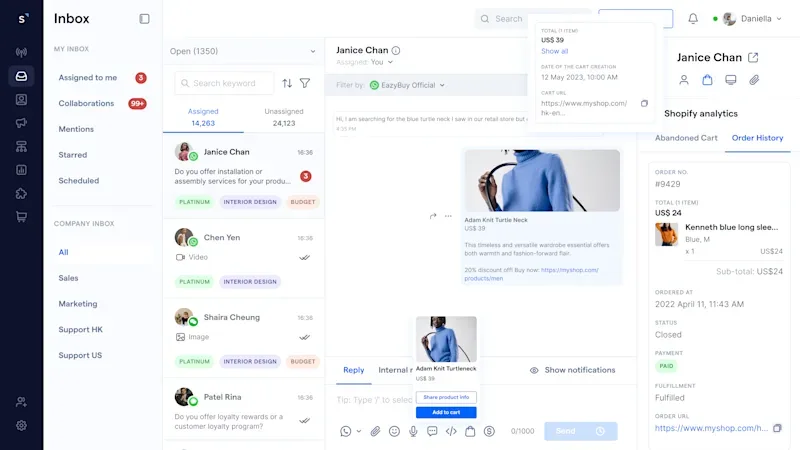
An **AI engine** is the business-ready layer that makes AI useful in the real world. A model may generate an answer, but the engine decides what information the model can access, what action should happen next, what rules must be followed, and when a human should step in.
For example, when a customer messages a retailer on WhatsApp asking, “Is this item available in size M?”, the **AI engine** may:
1. Read the message.
1. Identify the customer’s intent.
1. Check product availability through Shopify or another commerce platform.
1. Generate a helpful reply.
1. Recommend a matching product.
1. Update the customer profile.
1. Route the conversation to a sales rep if purchase intent is high.
This is why modern businesses should evaluate AI based on execution, not just text generation.
## **AI engine vs AI model vs LLM vs AI agent**
These terms are often used interchangeably, but they are not the same.
| **Term** | **What it means** | **Business role** | **Example** |
| --- | --- | --- | --- |
| **AI engine** | The full system that processes data, applies models, runs workflows, and improves over time | Powers end-to-end business execution | A customer engagement engine that replies, routes, recommends, and updates CRM records |
| AI model | The algorithm trained to recognise patterns or generate outputs | Produces predictions, classifications, or responses | A model that predicts churn risk |
| LLM | A large language model trained on large volumes of text and other data | Understands and generates natural language | A model that drafts replies or summarises conversations |
| AI agent | An AI system that can reason, use tools, and take action within defined goals | Completes multi-step tasks | An agent that qualifies leads, books appointments, and hands off to sales |
[Google Cloud defines LLMs](https://cloud.google.com/ai/llms) as statistical language models trained on massive amounts of data to generate, translate, summarise, answer questions, and support chatbot experiences. IBM also describes LLMs as deep learning models capable of understanding and generating natural language and other content.
A practical way to think about it: the model is the brain, the LLM is a language-specialised brain, the agent is the teammate, and the **AI engine** is the full operating system that lets everything work safely inside the business.
## **How an AI engine works**
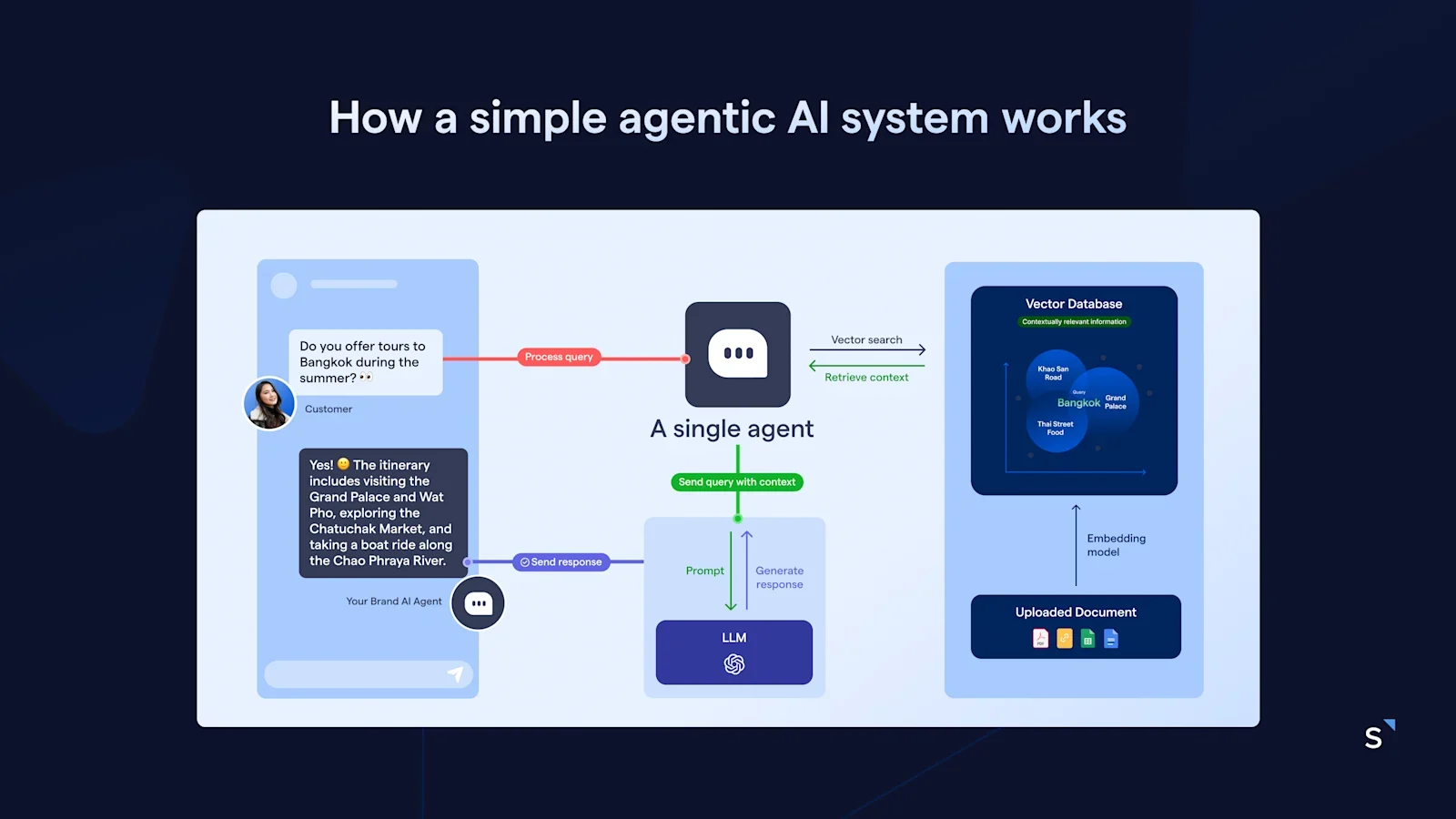
### **1. Data comes in**
The engine receives inputs from customer messages, website events, CRM records, purchase history, behavioural signals, support tickets, and campaign activity. This matters because customer journeys are rarely linear. A lead may click an Instagram ad, ask a question on WhatsApp, browse the website, abandon a cart, then return through live chat.
### **2. The engine interprets context**
The **AI engine** identifies intent, urgency, sentiment, risk, customer stage, and relevance. It does not just read the latest message. A strong engine considers conversation history, customer value, past purchases, preferences, and open tickets.
### **3. The model generates a prediction or response**
The model may produce a reply, lead score, product recommendation, summary, routing decision, or next-best action.
### **4. Rules and workflows decide what happens next**
This is where the engine becomes commercially useful. It can:
- Send an instant reply
- Assign a lead to the right salesperson
- Escalate a complaint to support
- Trigger an abandoned cart follow-up
- Recommend a product
- Update a CRM field
- Start a nurture campaign
### **5. Feedback improves future performance**
Analytics, human corrections, conversation outcomes, and updated knowledge help the **AI engine** improve. [Singapore’s Model AI Governance Framework for Generative AI](https://aiverifyfoundation.sg/wp-content/uploads/2024/06/Model-AI-Governance-Framework-for-Generative-AI-19-June-2024.pdf) highlights the importance of accountability, data quality, testing, security, transparency, and continuous improvement when deploying generative AI systems.
## **Core components of an AI engine**
A strong **AI engine** usually includes the following layers:
| **Component** | **What it does** |
| --- | --- |
| Data layer | Connects customer data, CRM records, tickets, order history, and behavioural signals |
| Model layer | Generates predictions, responses, classifications, and recommendations |
| Knowledge base or memory | Grounds answers in approved company information and past context |
| Orchestration layer | Coordinates models, tools, APIs, workflows, and business rules |
| Integrations and APIs | Connects with Shopify, HubSpot, Salesforce, payment tools, and internal systems |
| Guardrails and governance | Controls what AI can say, do, access, and escalate |
| Analytics and feedback loop | Measures accuracy, conversion, containment, handoff quality, and business outcomes |
## **Types of AI engines**
### **Predictive AI engines**
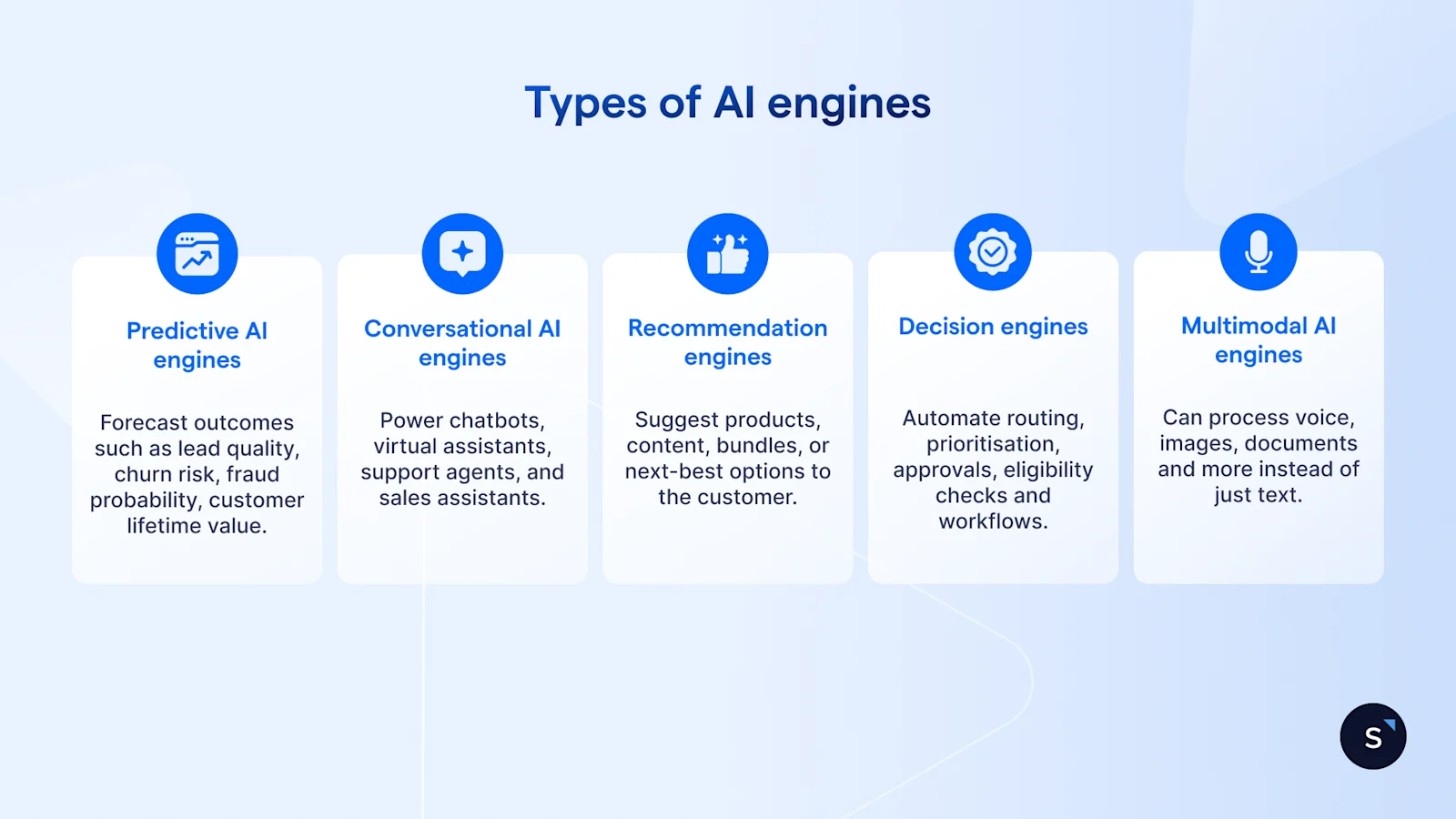
Predictive engines forecast outcomes such as lead quality, churn risk, fraud probability, customer lifetime value, campaign performance, or inventory demand.
### **Conversational AI engines**
Conversational engines power chatbots, virtual assistants, support agents, and sales assistants. They are especially useful for businesses that manage high volumes of enquiries across WhatsApp, Instagram, Facebook Messenger, live chat, and email.
### **Recommendation engines**
Recommendation engines suggest products, content, bundles, offers, or next-best actions based on customer context and behaviour.
### **Decision engines**
Decision engines automate routing, prioritisation, approvals, eligibility checks, and operational workflows.
### **Multimodal AI engines**
Multimodal engines understand more than text. They can process voice, images, screenshots, documents, product photos, receipts, and PDFs, making them useful for service, insurance, healthcare, retail, and logistics workflows.
## **Business use cases for AI engines**
For businesses, the biggest value comes when AI supports revenue, retention, and customer experience, not just internal productivity.
An **AI engine** can help teams:
- Qualify leads automatically based on budget, urgency, product interest, and intent
- Reply to customer enquiries across WhatsApp, Instagram, live chat, and email
- Route conversations to the right sales or support team
- Suggest products based on customer context and purchase history
- Send follow-ups after abandoned carts
- Summarise conversations for sales and support teams
- Identify churn risk from repeated complaints or support patterns
- Optimise campaign timing and personalisation
In short, [AI supports qualification, routing, follow-up, scheduling, CRM updates, and re-engagement](/en-sg/blog/ai-sales-automation), which is distinct from simple chatbots from hybrid agents that combine retrieval, tools, workflows, and guardrails.
## **What makes an AI engine effective in customer conversations?**
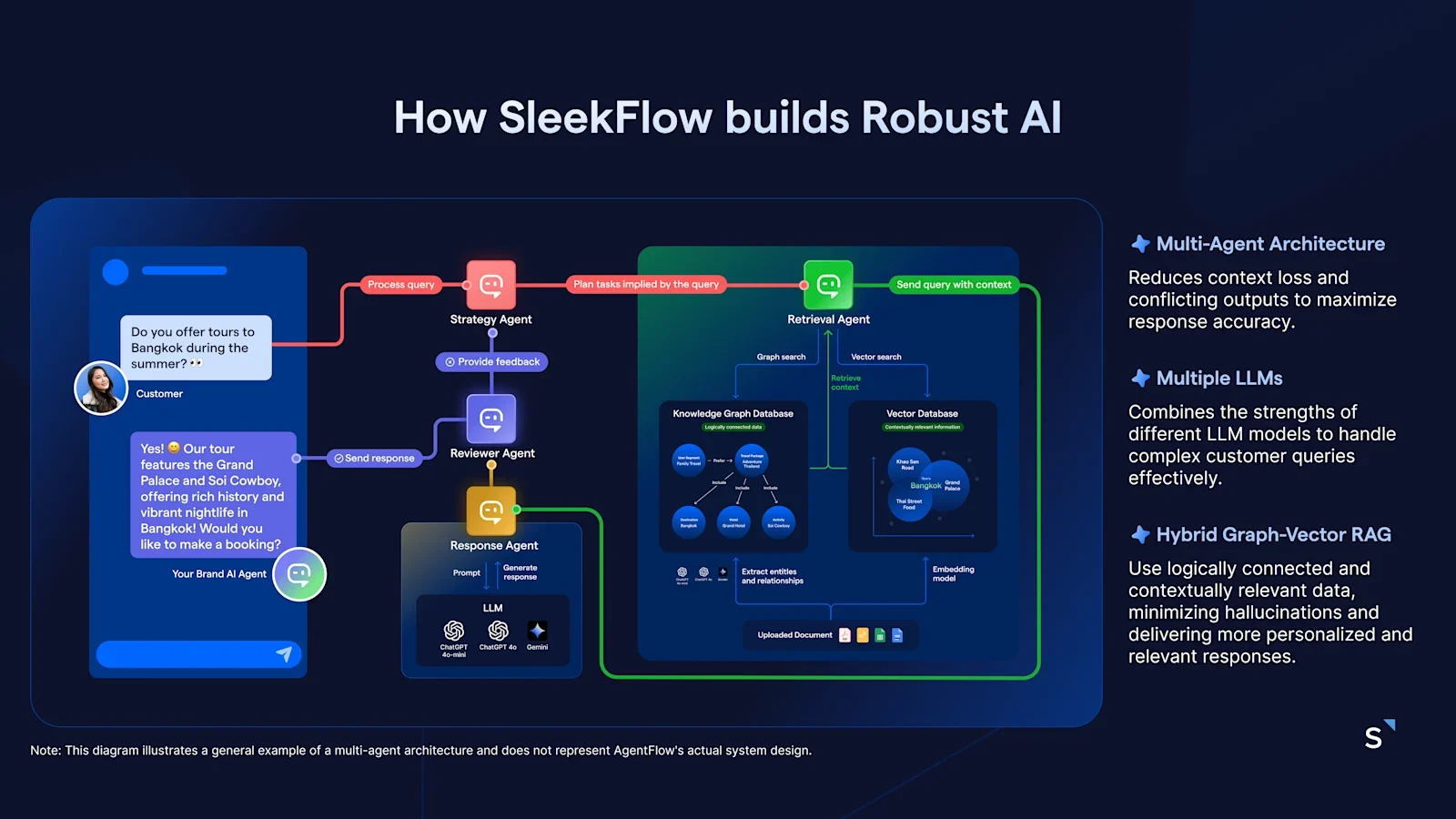
The best conversational **AI engines** are not generic answer bots. They are connected, contextual, action-oriented, and measurable.
An effective engine needs:
- **Access to first-party customer data**, including CRM, purchase, and support history
- **Omnichannel conversation history**, so customers do not repeat themselves
- **Workflow execution**, not just text generation
- **Knowledge grounding**, so answers come from approved business information
- **Human handoff**, especially for high-value, sensitive, or complex cases
- **Analytics and continuous improvement**, so teams can measure quality and revenue impact
This is why[ SleekFlow AgentFlow](/en-sg/agentflow) is built for customer-facing execution. It lets B2C brands create AI agents across channels and the customer lifecycle, including inbound agents for sales enquiries, support requests, qualification, appointment booking, and issue resolution. AgentFlow also supports structured AI knowledge, visible AI reasoning, human feedback, self-improving memory, and integrations with Shopify, HubSpot, and Salesforce.
## **How to choose an AI engine for your business**
Before choosing a platform, define the business outcome first. A vague goal like “use AI” is not enough. A better goal is “reduce first response time on WhatsApp”, “qualify inbound leads before sales handoff”, or “recover abandoned carts automatically”.
Use this checklist:
| **Evaluation area** | **What to ask** |
| --- | --- |
| Use case | Which workflow should AI improve first? |
| Data access | Can the engine access CRM, orders, tickets, and conversation history? |
| Channels | Does it work across WhatsApp, Instagram, live chat, email, and other key channels? |
| Integrations | Can it connect with Shopify, HubSpot, Salesforce, payment tools, and internal APIs? |
| Governance | Can teams set permissions, guardrails, escalation rules, and human review? |
| Execution | Can it take action, or does it only generate text? |
| Analytics | Can you measure conversion, response time, handoff rate, CSAT, and revenue? |
| Scalability | Can it support multiple teams, brands, markets, and workflows? |
For businesses using WhatsApp as a key customer channel,[ SleekFlow’s WhatsApp Business API solution](/en-sg/channels-integrations/whatsapp) supports AI agents for lead qualification, product recommendations, CRM updates, retargeting campaigns, order updates, support triage, and human handoff within the chat thread.
## **How SleekFlow uses AI engines to drive business revenue**
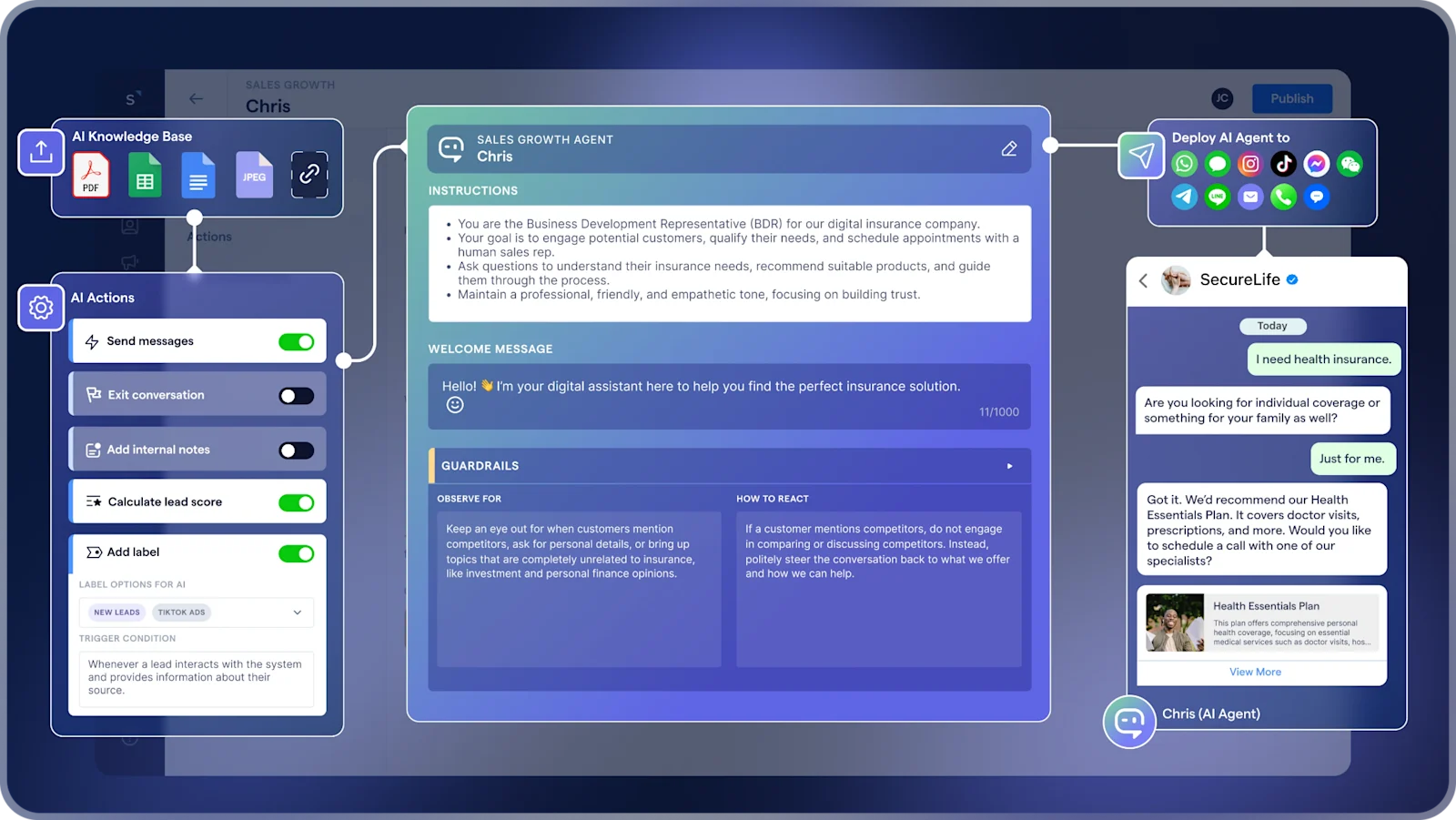
SleekFlow’s approach to AI is built around one belief: AI should not stop at answering questions. It should move conversations closer to conversion, retention, and customer satisfaction.
With SleekFlow, businesses can:
- Centralise conversations from WhatsApp, Instagram, live chat, and other channels
- Use AI agents to qualify leads and answer common questions
- Recommend products based on context
- Route high-intent customers to the right team
- Automate follow-ups, abandoned cart recovery, and loyalty campaigns
- Summarise conversations for faster human handoff
- Connect AI workflows with CRM and e-commerce systems
- Measure chat performance, response speed, and conversion impact
SleekFlow unifies AI agents, omnichannel messaging, CRM-style customer context, automation, integrations, and analytics, giving businesses the infrastructure to turn customer conversations into measurable revenue.
### Is an AI engine the same as an AI agent?
No. An AI agent is usually one part of an AI engine. The agent interacts with users and may take actions, while the engine includes data, models, workflows, integrations, guardrails, analytics, and feedback loops.
### What are examples of AI engines in business?
Examples include lead scoring engines, conversational AI engines, product recommendation engines, fraud detection engines, customer support automation engines, campaign optimisation engines, and churn prediction engines.
### Do AI engines require machine learning?
Most modern AI engines use machine learning, but not every part of the system is machine learning-based. Many engines combine machine learning models with rules, workflows, APIs, human review, and analytics.
### Can AI engines work across WhatsApp, chat, and email?
Yes, provided the platform supports omnichannel messaging and integrations. This is especially important in Singapore, where customers often move between social ads, messaging apps, websites, and human sales teams before buying.
### How do companies measure AI engine performance?
Common metrics include first response time, resolution time, lead qualification rate, conversion rate, handoff rate, containment rate, CSAT, repeat purchase rate, churn risk reduction, campaign ROI, and revenue influenced by AI-assisted conversations.