---
title: "Brand strategy: the framework, and what changes in 2026"
description: "The brand strategy framework in 6 components, plus the 7th 2026 adds: keeping your AI agent's voice on-brand, reply by reply."
canonical: "https://sleekflow.io/en-sg/blog/brand-strategy"
html_lang: "en-sg"
date_modified: "2026-09-17T11:10:35.134Z"
og_title: "Brand strategy framework: what changes in 2026"
og_description: "The brand strategy framework in 6 components, plus the 7th 2026 adds: keeping your AI agent's voice on-brand, reply by reply."
og_image: "https://images.ctfassets.net/tu2uwzoyozk8/1NaRTfXBVS93D9FNqzRMIE/450a42f48e82c1c58f1dfaeccb95c720/pasted-image-1.png?fm=webp&q=90&w=1200"
---
```json
{
"@context": "https://schema.org",
"@type": "Article",
"headline": "Brand strategy framework: what changes in 2026",
"description": "The brand strategy framework in 6 components, plus the 7th 2026 adds: keeping your AI agent's voice on-brand, reply by reply.",
"url": "https://sleekflow.io/en-sg/blog/brand-strategy",
"dateModified": "2026-09-17T11:10:35.134Z",
"image": "https://images.ctfassets.net/tu2uwzoyozk8/1NaRTfXBVS93D9FNqzRMIE/450a42f48e82c1c58f1dfaeccb95c720/pasted-image-1.png?fm=webp&q=90&w=1200",
"breadcrumb": {
"@type": "BreadcrumbList",
"itemListElement": [
{
"@type": "ListItem",
"position": 1,
"name": "Home",
"item": "https://sleekflow.io/en-sg"
},
{
"@type": "ListItem",
"position": 2,
"name": "Blog",
"item": "https://sleekflow.io/en-sg/blog"
},
{
"@type": "ListItem",
"position": 3,
"name": "Brand strategy framework: what changes in 2026",
"item": "https://sleekflow.io/en-sg/blog/brand-strategy"
}
]
}
}
```
# Brand strategy: the framework, and what changes in 2026
*Julian Wong — Content Strategist*
## Summary
- Marketers building a brand strategy in 2026 now need a 7th component, consistent voice inside AI-generated conversations.
- Edelman's 2026 Trust Barometer found 88% of shoppers rank brand trust as important as quality.
- A style guide describes tone for a person, but an AI agent needs written rules, limits, and audits.
- Write the AI agent's tone rules down as explicit instructions, then test them against real customer questions.
- Treat brand voice in AI replies as a governed, audited system, not a one-time style guide handoff.
Most branding work still stops at the style guide: logo usage, colour codes, three tone-of-voice adjectives, and a slide on "brand touchpoints" listing the website, the shopfront, and the odd billboard. None of those touchpoints talk back.
Your AI agent does, and it now handles a genuine share of the conversations customers have with your business. This guide covers the standard **brand strategy** framework, then the one change in 2026 most decks have not caught up to yet.
## **What is brand strategy?**
Brand strategy is the long-term plan that defines what a business stands for, who it serves, and how it wants to be recognised, so every decision, from pricing to a customer service reply, points in the same direction.
It sits above any single campaign: a campaign sells a product this quarter, while brand work decides what the business is allowed to say, in whose voice, for years at a time.
Done well, it answers three questions first:
- Why does the business exist beyond profit?
- Who is it actually for?
- What makes it different from the next option a customer could pick instead?
The stakes are not abstract. Edelman's 2026 Trust Barometer found[ 88% of shoppers](https://www.edelman.com/trust/2026/trust-barometer/special-report-brands) rank trusting a brand as an important or critical purchase factor, matching how much they weigh quality and value.
## **Brand strategy vs marketing strategy**
Brand strategy sets the identity a business commits to for years. Marketing strategy is the shorter-term plan for reaching an audience and hitting a number, built inside the boundaries it sets.
Confusing the two is expensive: a business that treats brand work as "just marketing" rewrites its identity every time a campaign underperforms.
| | **Brand strategy** | **Marketing strategy** |
| --- | --- | --- |
| **Time horizon** | Multi-year | Quarterly or campaign-length |
| **Core question** | Who are we, and for whom | How do we hit this quarter's target |
| **Output** | Positioning, voice, identity system | Campaigns, ads, promotions |
| **Owner** | Founder, brand or CX lead | Marketing or growth team |
| **Changes** | Rarely, deliberately | Often, by design |
## **The 6 components of a brand strategy framework**
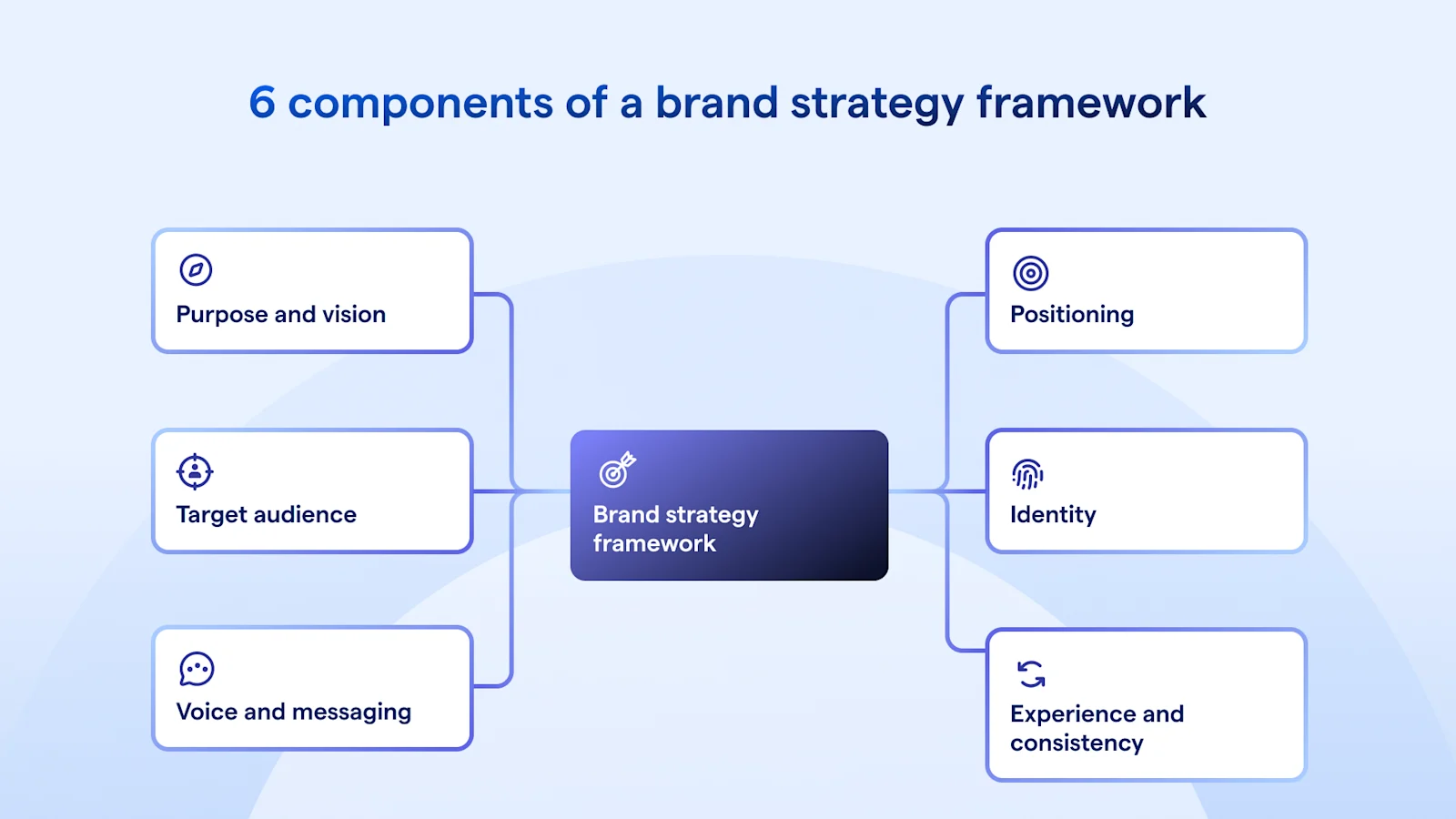
This framework has 6 standing components: purpose, positioning, audience, identity, voice, and consistency. Together they answer why the business exists, who it serves, how it looks and sounds, and whether that holds at every touchpoint.
### **1. Purpose and vision**
Why the business exists beyond making money. A vague purpose ("we care about our customers") does not survive a real decision; a usable one is specific enough to rule things out.
### **2. Positioning**
The distinct place the business occupies for a defined audience, against defined alternatives. If the statement could apply to a competitor with the name swapped, it is not positioning yet.
### **3. Target audience**
Who the business is actually built for, by the job the customer hires it to do, not a demographic slide. A brand aimed at "everyone" ends up recognisable to no one.
### **4. Identity**
The name, logo, colour system, and visual language, plus the verbal identity, the words a business reaches for by default. A customer recognises these before reading a single word of copy.
### **5. Voice and messaging**
The tone, vocabulary, and messaging pillars that stay constant across every asset, warm or clipped, formal or plain. Voice is how the identity sounds once it starts talking.
### **6. Experience and consistency**
Whether purpose, positioning, and voice show up the same way at every touchpoint, a website, a WhatsApp reply, a receipt. Most teams get this right on paper and lose it in practice.
## **How to build a brand strategy**
Building a brand strategy follows a strict sequence, since each component depends on the one before it: skip ahead to a logo before the audience is defined, and the identity work gets redone twice.
1. **Define the purpose.** One paragraph on why the business exists and where it wants to be in three years, a new hire could repeat it back.
1. **Nail the audience.** Describe who the business serves, by the job they need done, not a broad demographic.
1. **Write the positioning statement.** For this audience, in this category, here is how the business differs, and the proof.
1. **Build the identity system.** Visual and verbal identity, documented together, not a logo file sitting apart from the tone guide.
1. **Set the voice and messaging pillars.** The words the business reaches for by default, and the ones it avoids.
1. **Govern consistency.** Decide who checks a new touchpoint against the brand before it ships, humans and AI agents alike, and how often.
## **What changed in 2026: your AI agent is now a brand touchpoint**
An AI agent replying on WhatsApp or Instagram is now a brand touchpoint like any other, except it writes something new every time instead of repeating an approved line, which is why the old style-guide model does not cover it on its own.
[Meta Business Agent went global ](https://about.fb.com/news/2026/06/meta-business-agent/)on 3 June 2026 across WhatsApp, Instagram, and Messenger, fielding enquiries, product suggestions, and transactions directly inside the chat.
For a B2C brand running on messaging channels, the AI agent handling those chats can now hold more customer conversations in a week than every campaign that quarter reaches. Each of those replies carries the brand's voice, or breaks it.
### Why the old framework fails
A style guide describes voice for a person who reads it once and exercises judgement on the rest.
An AI agent has no judgement to exercise. It generates a reply from its instructions, its knowledge base, and the context in front of it, so voice has to be specified, constrained, and audited, not merely described. Below is an example put into practice:
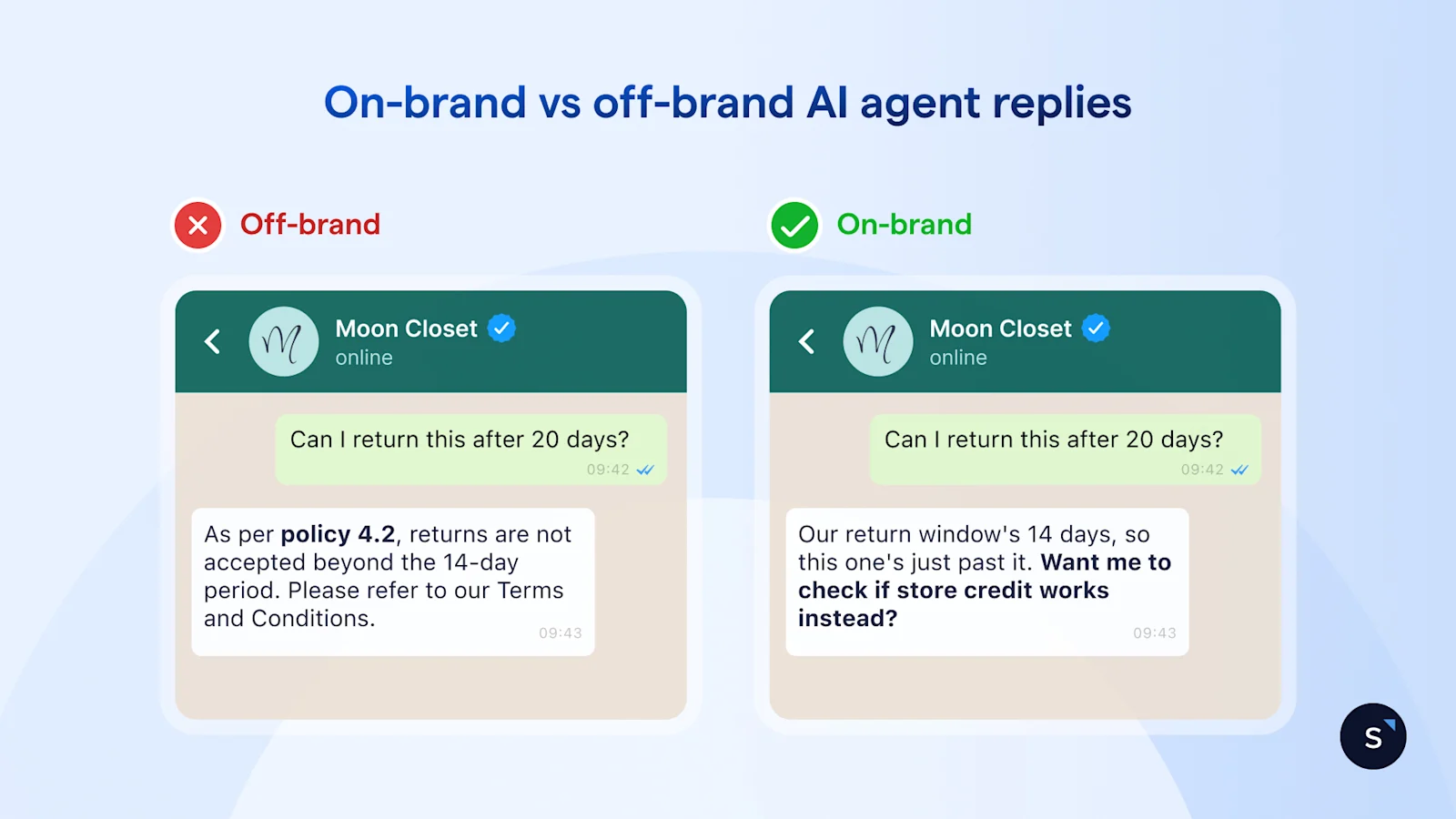
A customer asks the same brand, on the same channel, "Can I return this after 20 days?"
- On-brand: "Our return window's 14 days, so this one's just past it. Want me to check if store credit works instead?"
- Off-brand: "As per policy 4.2, returns are not accepted beyond the 14-day period. Please refer to our Terms and Conditions."
Both replies are accurate. Only one sounds like the brand wrote it.
## **The 7th component: brand voice in AI-generated conversations**
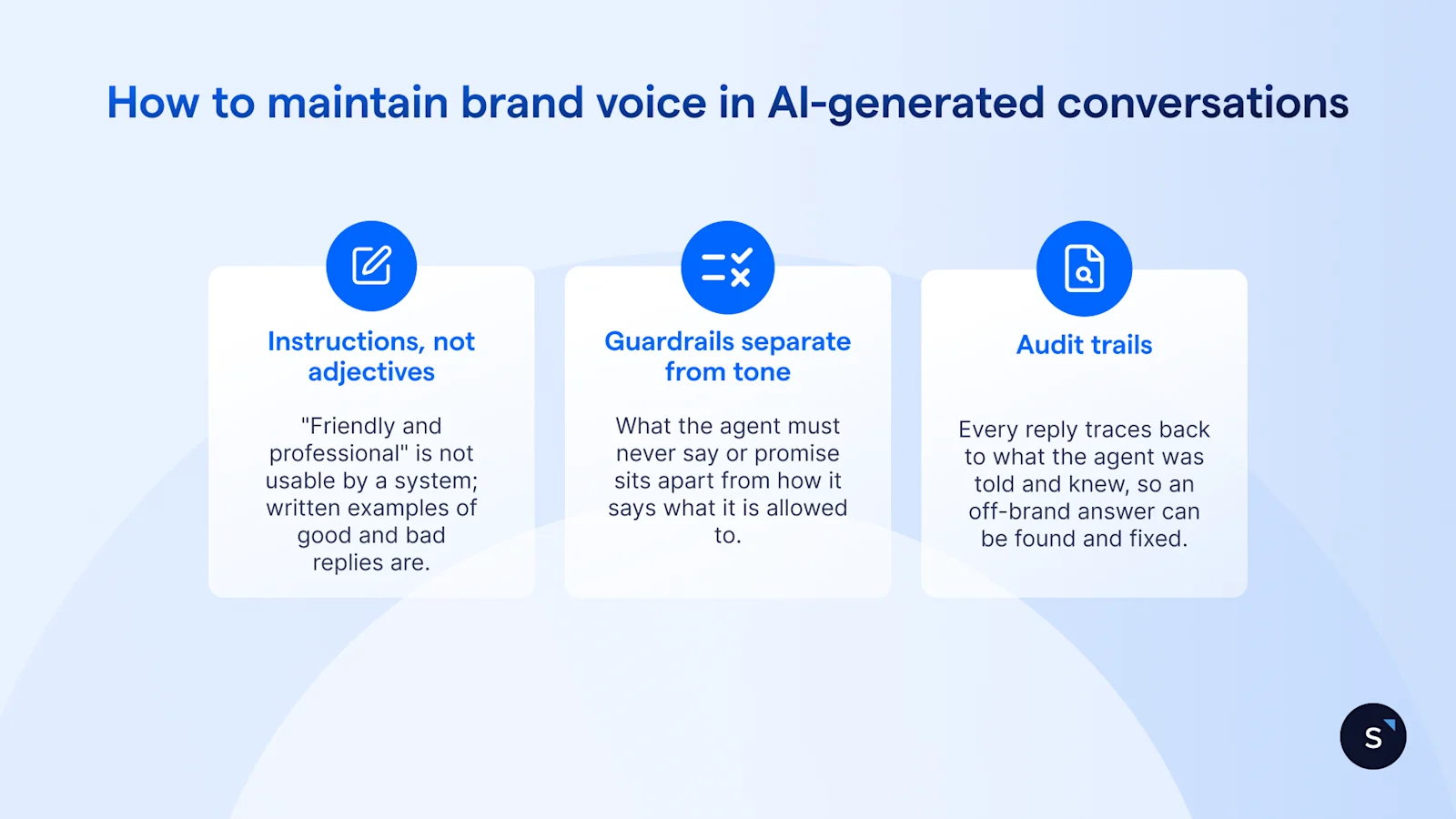
The 7th component is brand voice inside AI-generated conversations, standing apart from consistency (component 6) because consistency assumes a human wrote the touchpoint once and someone checked it before it shipped. An AI agent produces a new, unreviewed touchpoint on every reply, so it needs its own controls:
- **Instructions, not adjectives.** "Friendly and professional" is not usable by a system; written examples of good and bad replies are.
- **Guardrails, separate from tone.** What the agent must never say or promise sits apart from how it says what it is allowed to.
- **An audit trail.** Every reply traces back to what the agent was told and knew, so an off-brand answer can be found and fixed, not just apologised for.
## **How SleekFlow can help maximise your brand strategy**
SleekFlow AI covers the customer conversation itself, sales, marketing, and support, across WhatsApp, Instagram, and the other channels brand voice has to hold consistent, including[ AgentFlow](https://sleekflow.io/en-sg/agentflow), its AI agent platform.
You write [the agent's tone rules and guardrails](https://sleekflow.io/en-sg/blog/ai-agent-instructions) once, in plain language, the same way you would brief a new hire.
Every reply then draws on that brief plus your approved knowledge base and shows its source. A drifting reply is traceable and fixable, not a mystery in a transcript.
### Real-life example: How SACES deploys AI agents as part of its brand strategy
SACES, a Singapore air-conditioning and electrical firm, runs enquiries from WhatsApp, Facebook, and Instagram through one AI agent grounded in its FAQs, manufacturer brochures, and service rates.
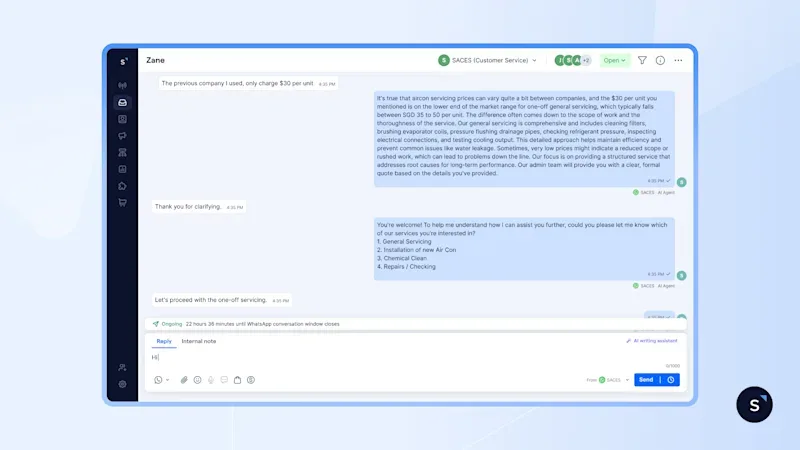
When a customer flagged a lower quote from a competitor, the agent didn't argue the price down. It explained what was included, highlighted the value proposition and the customer booked anyway.
Results:
- 75% of AI-qualified leads convert to bookings
- Over 60% of incoming enquiries handled by the AI agent
- 90% faster response time, down from several days to within 24 hours
[Read the full case study →](https://sleekflow.io/customer-stories/saces)
## See it for yourself
See how SleekFlow's AI agents turn conversations into revenue with AgentFlow.
[Book a demo](https://sleekflow.io/en-sg/book-a-demo)
[View pricing](https://sleekflow.io/en-sg/pricing)
### What is a brand strategy framework?
The structured set of decisions, purpose, positioning, audience, identity, voice, and consistency, that defines what a business stands for and keeps every touchpoint aligned to it, instead of relying on one founder's instinct.
### What is the difference between brand strategy and marketing strategy?
Brand strategy sets the identity a business commits to for years, who it serves, what it stands for, how it sounds. Marketing strategy is the shorter-term plan for reaching an audience, built inside those boundaries.
### Why does an AI agent count as a brand touchpoint?
It generates a new customer-facing reply every time it responds, on channels like WhatsApp and Instagram, so its tone and accuracy shape how the brand is experienced just as much as a website or an ad does.
### How do you keep an AI agent on-brand?
Write its tone rules as explicit instructions and worked examples rather than adjectives, separate hard guardrails on what it must never say from tone guidance, and keep an audit trail so an off-brand reply can be traced and corrected.
### How often should a brand strategy be reviewed?
Purpose and positioning should rarely change; review voice, identity application, and AI agent instructions quarterly against real customer conversations, since drift shows up in replies before it shows up in a survey.
### Can a small business have a real brand strategy?
Yes. The 6 components scale to a paragraph each for a small team, and the 7th, AI agent voice, matters just as much once that business runs a WhatsApp AI agent of any size.