---
title: "CSAT scores: how to measure customer satisfaction and act on what you find"
description: "What is a CSAT score, how do you calculate it, and how do you turn data into better CX?"
canonical: "https://sleekflow.io/en-sg/blog/csat-score"
html_lang: "en-sg"
date_modified: "2026-06-30T10:37:50.552Z"
og_title: "CSAT score: how to measure customer satisfaction"
og_description: "What is a CSAT score, how do you calculate it, and how do you turn data into better CX?"
og_image: "https://images.ctfassets.net/tu2uwzoyozk8/jv7U36Ukh9EPuG26vYfRg/37254a153c2feca5c6b003922293bf06/Website-Cover-SleekFlow.jpg?w=1200&q=90"
---
```json
{
"@context": "https://schema.org",
"@type": "Article",
"headline": "CSAT score: how to measure customer satisfaction",
"description": "What is a CSAT score, how do you calculate it, and how do you turn data into better CX?",
"url": "https://sleekflow.io/en-sg/blog/csat-score",
"dateModified": "2026-06-30T10:37:50.552Z",
"image": "https://images.ctfassets.net/tu2uwzoyozk8/jv7U36Ukh9EPuG26vYfRg/37254a153c2feca5c6b003922293bf06/Website-Cover-SleekFlow.jpg?w=1200&q=90",
"breadcrumb": {
"@type": "BreadcrumbList",
"itemListElement": [
{
"@type": "ListItem",
"position": 1,
"name": "Home",
"item": "https://sleekflow.io/en-sg"
},
{
"@type": "ListItem",
"position": 2,
"name": "Blog",
"item": "https://sleekflow.io/en-sg/blog"
},
{
"@type": "ListItem",
"position": 3,
"name": "CSAT score: how to measure customer satisfaction",
"item": "https://sleekflow.io/en-sg/blog/csat-score"
}
]
}
}
```
# CSAT scores: how to measure customer satisfaction and act on what you find
*Julian Wong — Content Strategist*
## Summary
- A CSAT score is calculated by dividing the number of satisfied responses (typically ratings of 4 or 5 out of 5) by total responses and multiplying by 100, giving you a percentage you can track over time.
- A CSAT score is calculated by dividing the number of satisfied responses (typically ratings of 4 or 5 out of 5) by total responses and multiplying by 100, giving you a percentage you can track over time.
- Benchmarking without context is weak: a 78% CSAT in professional services is underperformance; the same score in telecom or airlines is competitive.
- CSAT should be measured across every touchpoint (live chat, onboarding, post-purchase, help articles) rather than reserved for support tickets.
- AI improves CSAT by accelerating first responses, detecting dissatisfaction before surveys close, and surfacing the root causes behind score drops.
Your support team closed 200 tickets this month. Response times look fine. But three key accounts have quietly stopped re-ordering.
Something went wrong between the numbers and the customer's actual experience, and a well-run **CSAT measurement programme** is often what catches it before it turns into churn.
This guide covers how CSAT works, how to calculate and analyse it properly, and how to turn raw scores into actions that measurably improve customer experience.
## **What is CSAT?**
**Customer Satisfaction Score (CSAT)** is a CX metric that measures how satisfied a customer is with a specific interaction, product, or service. It is collected through a short post-interaction survey, typically asking: "How satisfied were you with your experience today?" Customers respond on a scale of 1 to 5 (or sometimes 1 to 3 or 1 to 10), and only the positive responses are counted in the final percentage.
CSAT is a transactional metric. It captures how a customer felt about one specific moment, not their long-term relationship with your brand. That makes it precise and fast to collect, but also limited on its own. Pair it with operational data, and it becomes a genuinely useful management tool.
## **How is CSAT calculated?**
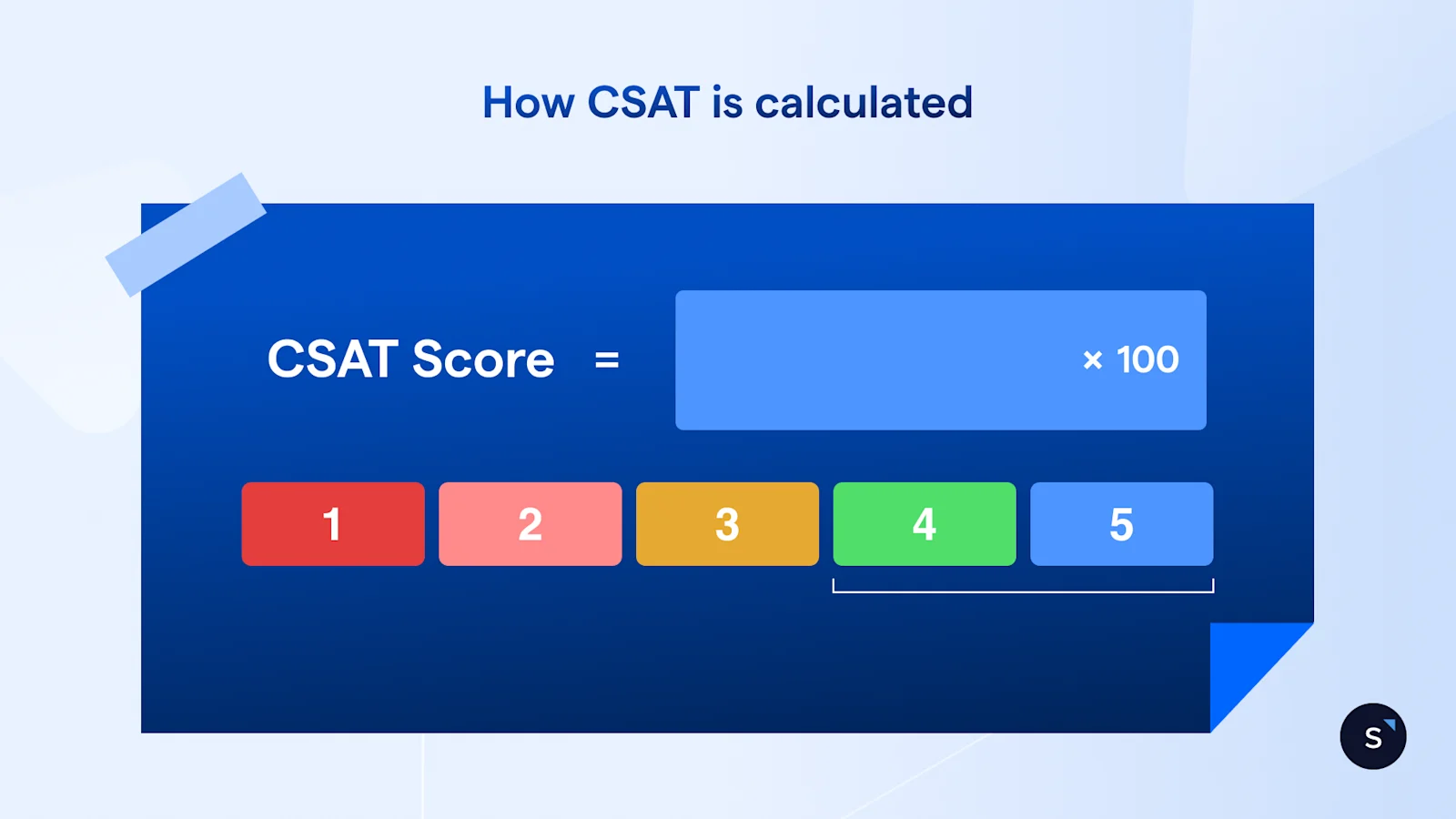
The formula is straightforward:
**(Number of satisfied responses ÷ Total responses) × 100 = CSAT score (%)**
**What counts as "satisfied":** on a 5-point scale, responses of 4 or 5. On a 10-point scale, responses of 9 or 10. Neutral and negative responses are excluded from the numerator.
**Example:**
- 80 customers rate their support interaction
- 64 give a score of 4 or 5
- CSAT = (64 ÷ 80) × 100 = **80%**
| **Scale used** | **"Satisfied" threshold** | **Best suited for** |
| --- | --- | --- |
| 1 to 3 | Score of 3 | Quick mobile surveys |
| 1 to 5 | Scores of 4 and 5 | Most common; strong resolution |
| 1 to 10 | Scores of 9 and 10 | More granular; lower response rates |
| Emoji or stars | Top 1 to 2 tiers | High-volume consumer channels |
One caution: not all teams define "satisfied" the same way. If you use CSAT across multiple channels or vendors, confirm everyone is counting the same tier before you compare results.
## **What does CSAT actually tell you?**
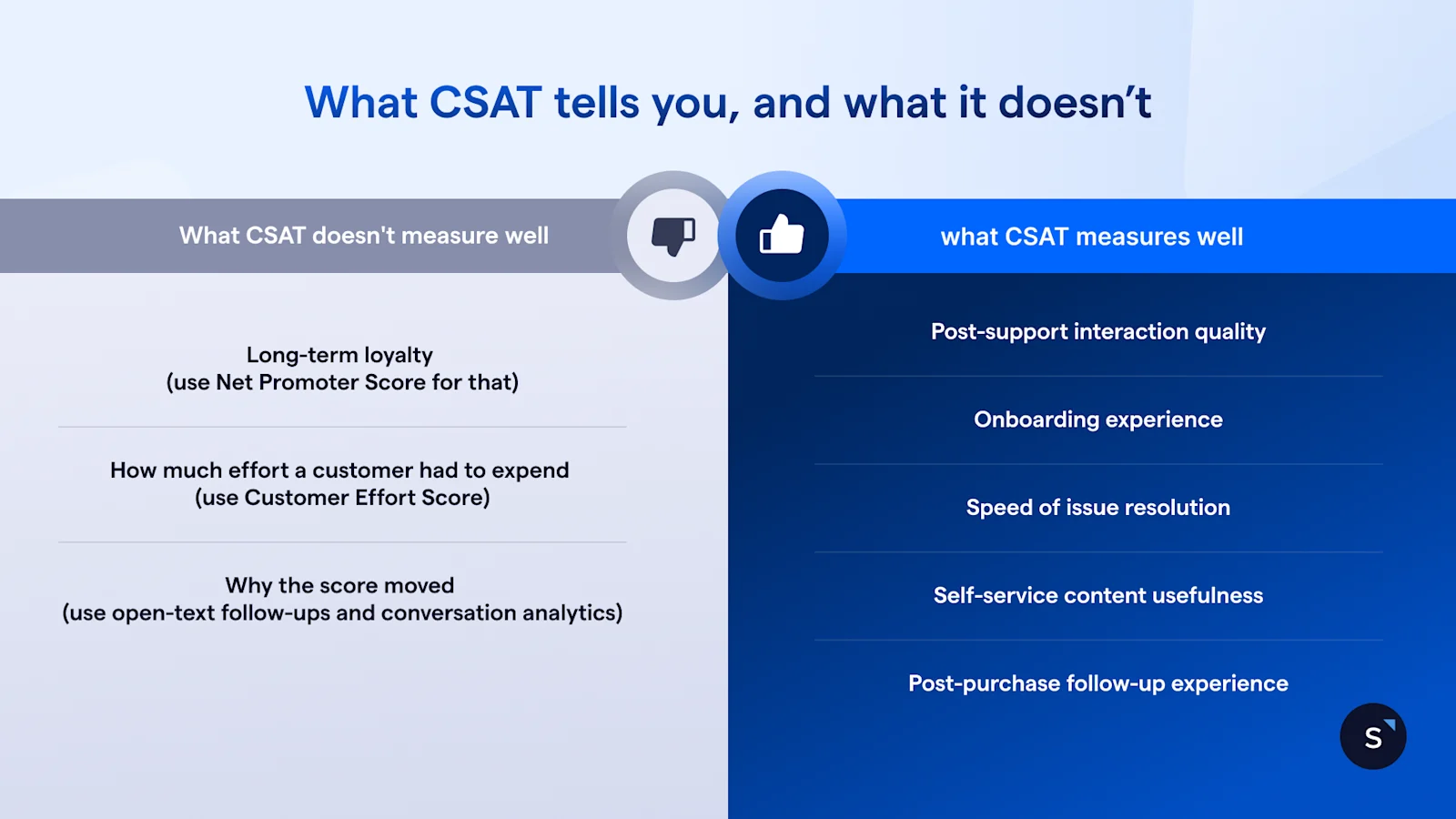
CSAT tells you how a customer felt about a specific interaction. What it does not tell you is why they felt that way, whether they will return, or how that interaction compares to others across your team.
That gap is not a weakness of CSAT; it is just scope. Think of CSAT as the signal that something happened, positive or negative. The follow-up analysis is what tells you what to do about it.
**What CSAT measures well:**
- Post-support interaction quality
- Onboarding experience
- Speed of issue resolution
- Self-service content usefulness
- Post-purchase follow-up experience
**What CSAT does not measure well:**
- Long-term loyalty (use Net Promoter Score for that)
- How much effort a customer had to expend (use Customer Effort Score)
- Why the score moved (use open-text follow-ups and conversation analytics)
## **When should you measure CSAT?**
The right trigger for a CSAT survey is any meaningful, discrete interaction where the customer's experience can be evaluated cleanly. These are the moments worth measuring:
- **After a support conversation resolves** (live chat, WhatsApp, email, phone)
- **After onboarding or account setup completes**
- **After a purchase or delivery is confirmed**
- **After a customer reads a help article** (single-question rating)
- **After a product return or complaint is handled**
- **After a proactive outreach or re-engagement campaign**
A few timing rules that apply across all of these: send the survey while the interaction is still fresh, within one to two hours where possible. Waiting 24 hours or more cuts response rates significantly and introduces recall bias. For WhatsApp and messaging channels, the survey can be sent in the same thread immediately after the conversation closes.
## **Best CSAT survey questions to ask**
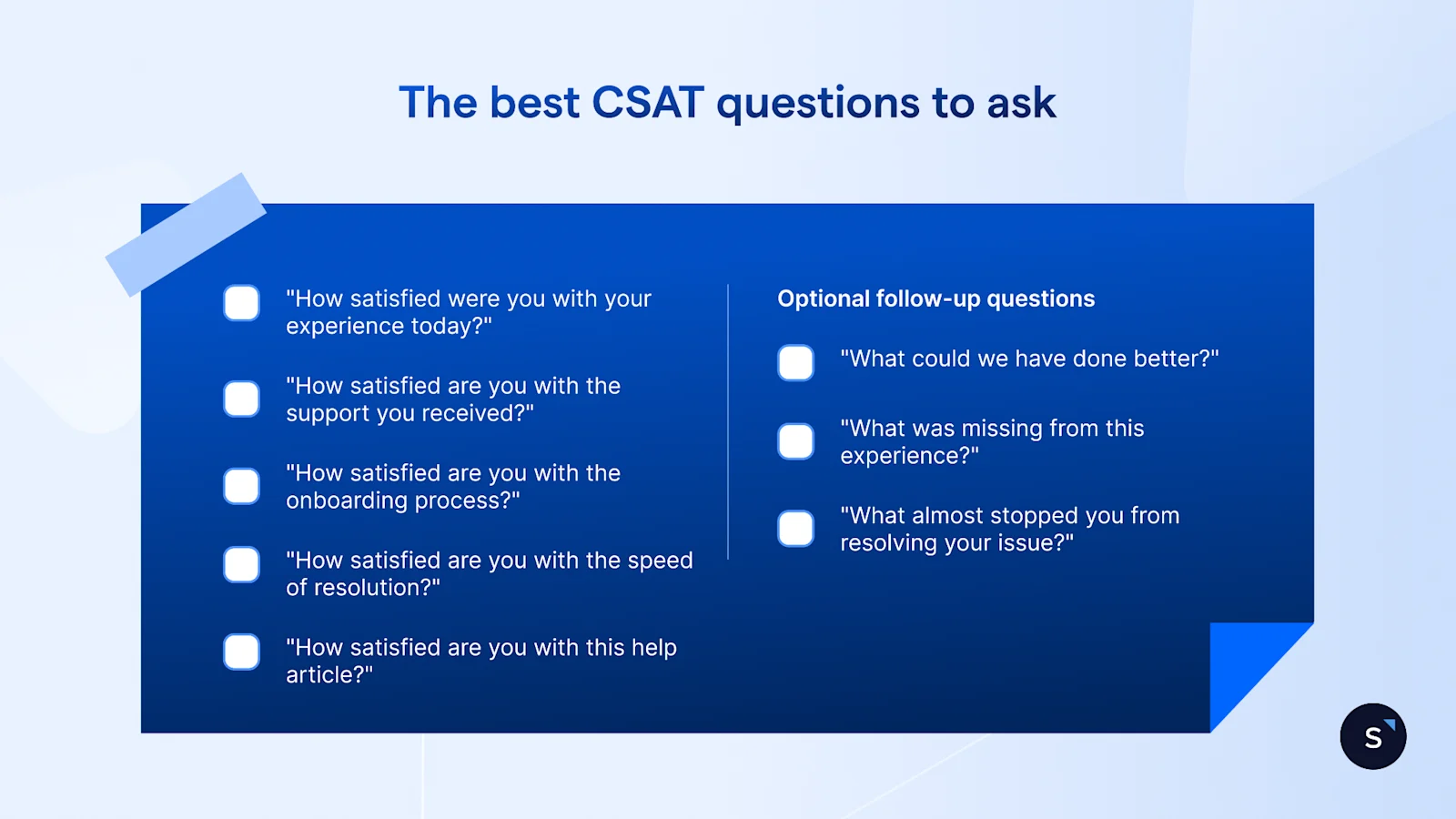
The primary question carries most of the weight. Keep it short, use plain language, and avoid phrasing that implies a right answer.
### **Core questions**
**"How satisfied were you with your experience today?"** The broadest and most versatile. Use this for general post-interaction surveys.
**"How satisfied are you with the support you received?"** More specific to customer service. Better when the survey follows a support ticket or chat resolution.
**"How satisfied are you with the onboarding process?"** Use after onboarding completes, not midway through. Gives a clean retrospective signal.
**"How satisfied are you with the speed of resolution?"** A targeted version that isolates response time as a variable. Useful when you have data showing slow resolution is affecting retention.
**"How satisfied are you with this help article?"** Sent in-context after a customer reads a knowledge base article. Low-friction, high-volume signal for your self-service content quality.
### **Optional follow-up questions**
A single follow-up open-text question can unlock the context your score alone won't give you. These work well as optional additions:
- "What could we have done better?"
- "What was missing from this experience?"
- "What almost stopped you from resolving your issue?"
The third option is particularly useful for self-service and onboarding flows. It surfaces friction points that satisfied customers might not think to mention, because they resolved them, but only barely.
## **What is a good CSAT score?**
There is no universal answer. A 78% score can be excellent in one industry and below average in another. Here are some orientation points:
| **CSAT range** | **General interpretation** |
| --- | --- |
| Below 60% | Significant experience problems needing immediate attention |
| 60% to 74% | Below average; improvement is needed |
| 75% to 85% | Most industries consider this range "good" |
| Above 85% | Strong; considered competitive across most sectors |
For broader context, the American Customer Satisfaction Index (ACSI) national score fell to 76.7 in Q1 2026, down 0.3% year-on-year, and roughly the same level as 2013. Satisfaction has been broadly flat for over a decade despite significant CX investment. That context matters: you are operating in an environment where most customers are marginally satisfied at best.
**The more important principle: benchmark against your own baseline first.**
A score of 80% is only meaningful if you know whether it is trending up, down, or flat from your previous measurement. Trend direction is a cleaner signal than any single number, because it controls for industry norms, channel mix, and your specific customer profile.
Benchmarking against competitors without that baseline is a good way to feel confident about problems you have not found yet.
## **How to analyse CSAT data properly**
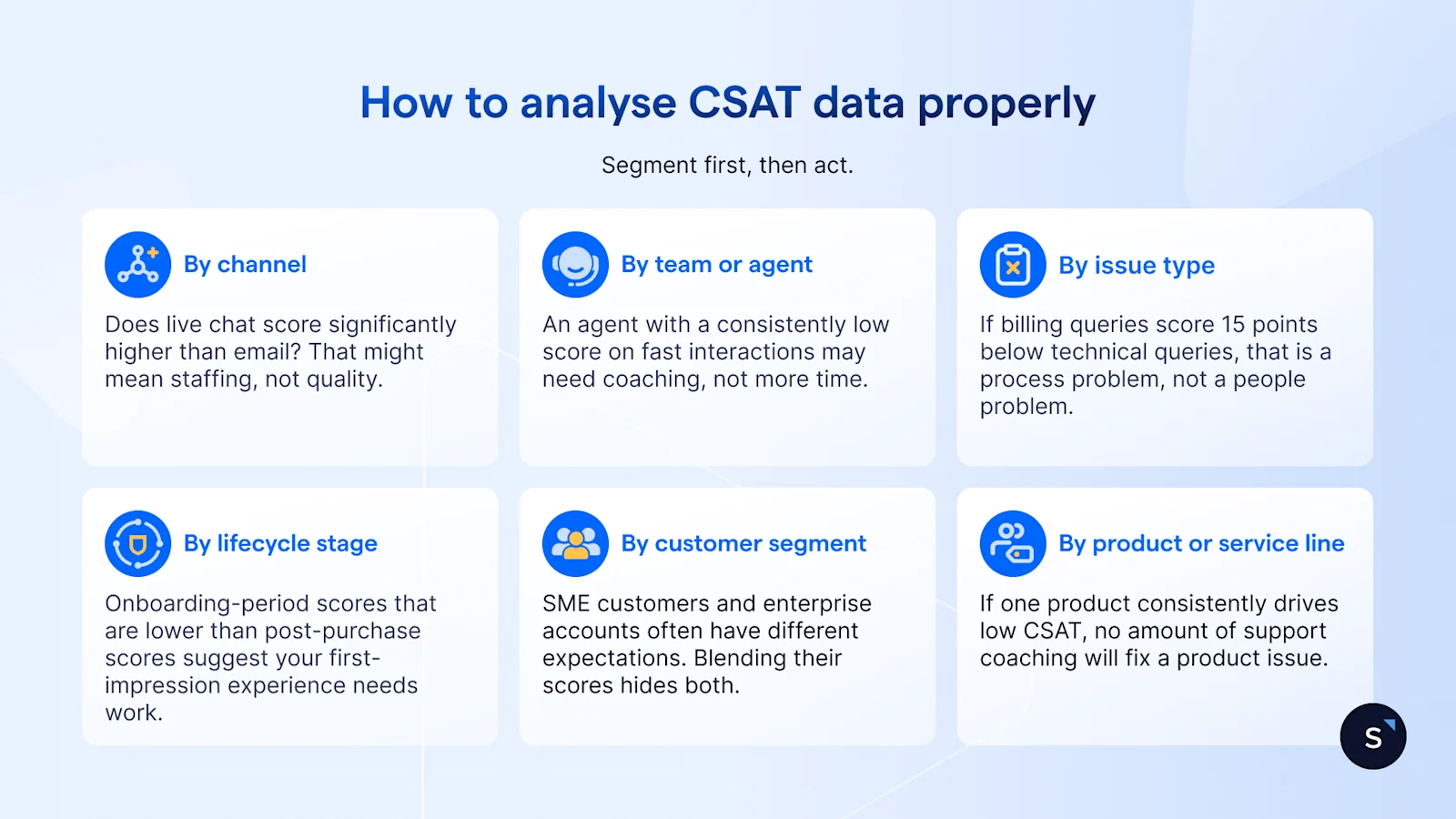
A score sitting in a dashboard without context is a number, not an insight. The analysis is where the value comes from.
### **Segment first, then act**
Run your CSAT data through these dimensions before drawing any conclusions:
- **By channel:** Does live chat score significantly higher than email? That might mean staffing, not quality.
- **By team or agent:** An agent with a consistently low score on fast interactions may need coaching, not more time.
- **By issue type:** If billing queries score 15 points below technical queries, that is a process problem, not a people problem.
- **By lifecycle stage:** Onboarding-period scores that are lower than post-purchase scores suggest your first-impression experience needs work.
- **By customer segment:** SME customers and enterprise accounts often have different expectations. Blending their scores hides both.
- **By product or service line:** If one product consistently drives low CSAT, no amount of support coaching will fix a product issue.
### **Combine score data with operational signals**
CSAT data become significantly more actionable when read alongside:
| **Metric** | **What it adds to CSAT** |
| --- | --- |
| Open-text comments | The "why" behind the score |
| Resolution time | Whether speed drives satisfaction in your context |
| Repeat contact rate | How often customers come back with the same issue |
| Churn or retention data | Whether satisfaction scores predict actual customer behaviour |
| First contact resolution | Whether one-touch resolution improves scores |
One practical workflow: pull the bottom 10% of scores for the previous two weeks, read the accompanying comments, and tag them by root cause. Most teams find three to five recurring issues within the first pass. Those are your priorities.
## **How to improve your CSAT score**
Score improvements come from fixing the things that predictably lower satisfaction. These are the interventions with the clearest track records.
### **Reduce wait times**
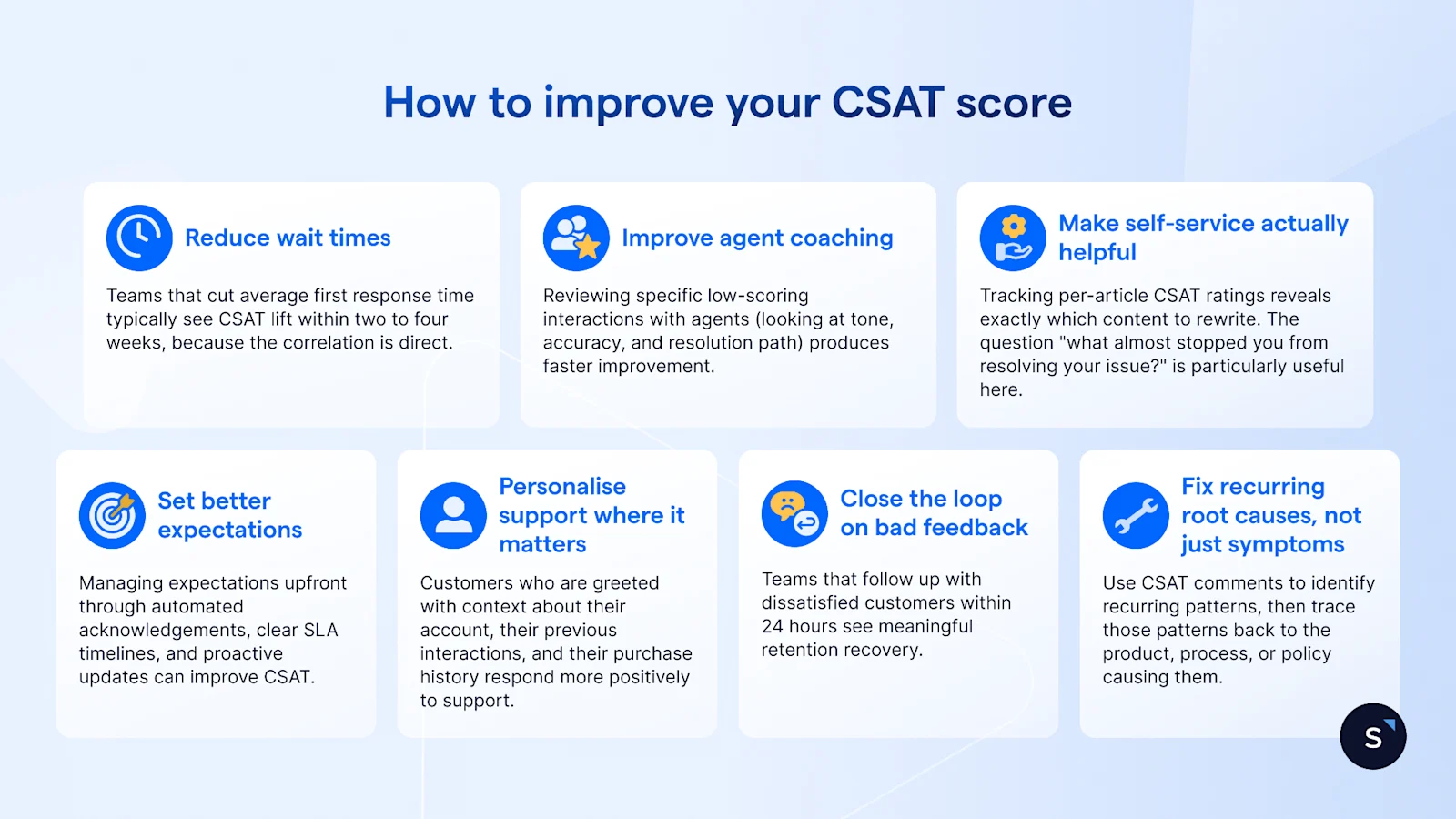
Wait time is one of the strongest predictors of low customer satisfaction scores, particularly in live chat and messaging. Teams that cut average first response time typically see CSAT lift within two to four weeks, because the correlation is direct. This is not about adding headcount; it is about smarter routing, coverage alignment, and automation of first-touch acknowledgement.
### **Improve agent coaching**
Coaching that [uses actual conversation data](/en-sg/blog/customer-experience-intelligence#for-cx-leaders) outperforms coaching that uses aggregate scores. Reviewing specific low-scoring interactions with agents (looking at tone, accuracy, and resolution path) produces faster improvement than a monthly CSAT debrief. Make coaching specific and frequent rather than general and quarterly.
### **Make self-service actually helpful**
Help centre articles that leave customers more confused than before they arrived generate low satisfaction ratings at the end of the interaction, even when no human agent was involved. Tracking per-article CSAT ratings reveals exactly which content to rewrite. The question "what almost stopped you from resolving your issue?" is particularly useful here.
### **Set better expectations**
A customer who expects resolution in 24 hours and gets it in 18 hours is satisfied. A customer who expects resolution in two hours and gets it in 18 hours is not. Managing expectations upfront (through automated acknowledgements, clear SLA timelines, and proactive updates) can improve CSAT without changing actual resolution speed at all.
### **Personalise support where it matters**
Customers who are greeted with context about their account, their previous interactions, and their purchase history respond more positively to support, even when the issue takes just as long to resolve. The perception of effort matters. Agents with full conversation history in a[ unified inbox](/en-sg/inbox) can personalise at speed.
### **Close the loop on bad feedback**
A customer who leaves a score of 2 out of 5 and receives no follow-up has a worse impression than the one who received the low-scoring interaction in the first place. Closing the loop (reaching out, acknowledging the experience, and confirming what changed) converts detractors at a measurably higher rate than any passive improvement. Teams that follow up with dissatisfied customers within 24 hours see meaningful retention recovery.
### **Fix recurring root causes, not just symptoms**
The most common failure mode in CSAT improvement programmes is addressing surface symptoms without diagnosing root causes. If 30% of your low scores come from a specific billing query type, retraining agents to handle it better is a partial fix. Fixing the process that generates the query in the first place (unclear invoicing, a missing payment confirmation step) eliminates the issue entirely. Use CSAT comments to identify recurring patterns, then trace those patterns back to the product, process, or policy causing them.
## **How AI can help improve CSAT**
AI contributes to CSAT improvement at multiple points in the support workflow, not just at the automation layer.
**Faster first responses.** AI agents can acknowledge and begin handling incoming conversations immediately, eliminating the dead time between a customer's first message and their first meaningful reply. In messaging channels like WhatsApp, where customers have high immediacy expectations, this alone moves CSAT.
**Smarter routing.** AI that detects intent, urgency, and customer tier routes conversations to the right agent or team on the first touch, rather than after a transfer that resets the customer's experience.
**Self-service suggestions.** AI can surface relevant help articles and resolution paths before the customer waits for a human agent. When self-service actually resolves the issue, CSAT for that interaction is typically higher than an equivalent human-handled ticket, because effort is lower.
**Agent assist.** Real-time AI assistance gives agents suggested replies, relevant customer history, and knowledge base hits in context, reducing the time agents spend searching and improving response accuracy. Less fumbling, more confidence, better scores.
**Summary and handoff support.** When conversations transfer between agents or teams, AI-generated summaries mean the receiving agent starts with full context. Customers do not have to repeat themselves. That alone is one of the most commonly cited CSAT frustrations.
**Pattern detection from comments and tickets.** AI text analysis tools can process large volumes of conversation data and surface recurring themes, emerging issues, and sentiment shifts that manual review would miss. The question is not just "what was the score?" but "why is the score moving?" AI answers the second question at scale.
SleekFlow's[ AgentFlow](/en-sg/agentflow) combines AI agents, smart routing, and real-time agent assist across WhatsApp, Instagram, live chat, and other messaging channels. For teams where messaging drives a significant share of support volume, the combination of faster first response and context-aware handling has a direct CSAT effect.
## **CSAT across the multi-channel customer experience**
CSAT should not live only in support tickets. Every meaningful touchpoint is a measurement opportunity, and teams that restrict CSAT surveys to one channel get a partial picture that can be actively misleading.
Consider what a complete CSAT programme looks like:
| **Touchpoint** | **Trigger for survey** | **What it measures** |
| --- | --- | --- |
| Live chat | Conversation closure | Agent quality, speed, resolution |
| WhatsApp support | Conversation closure | Messaging-specific support experience |
| Email support | 30 minutes after resolution | Async support quality |
| Onboarding | Completion of onboarding sequence | First-impression and setup experience |
| Help centre articles | Post-read rating prompt | Content quality and self-service effectiveness |
| Post-purchase | 24 hours after delivery confirmation | Product satisfaction and purchase experience |
| After a complaint or return | Resolution confirmation | Recovery effectiveness |
Businesses using messaging channels as their primary support layer often find that satisfaction scores from WhatsApp and Instagram DM differ meaningfully from scores collected via email. Messaging customers have higher immediacy expectations. If you are only measuring post-ticket email surveys, you may be missing a significant pool of dissatisfied customers.
## **How SleekFlow helps teams improve CSAT across channels**
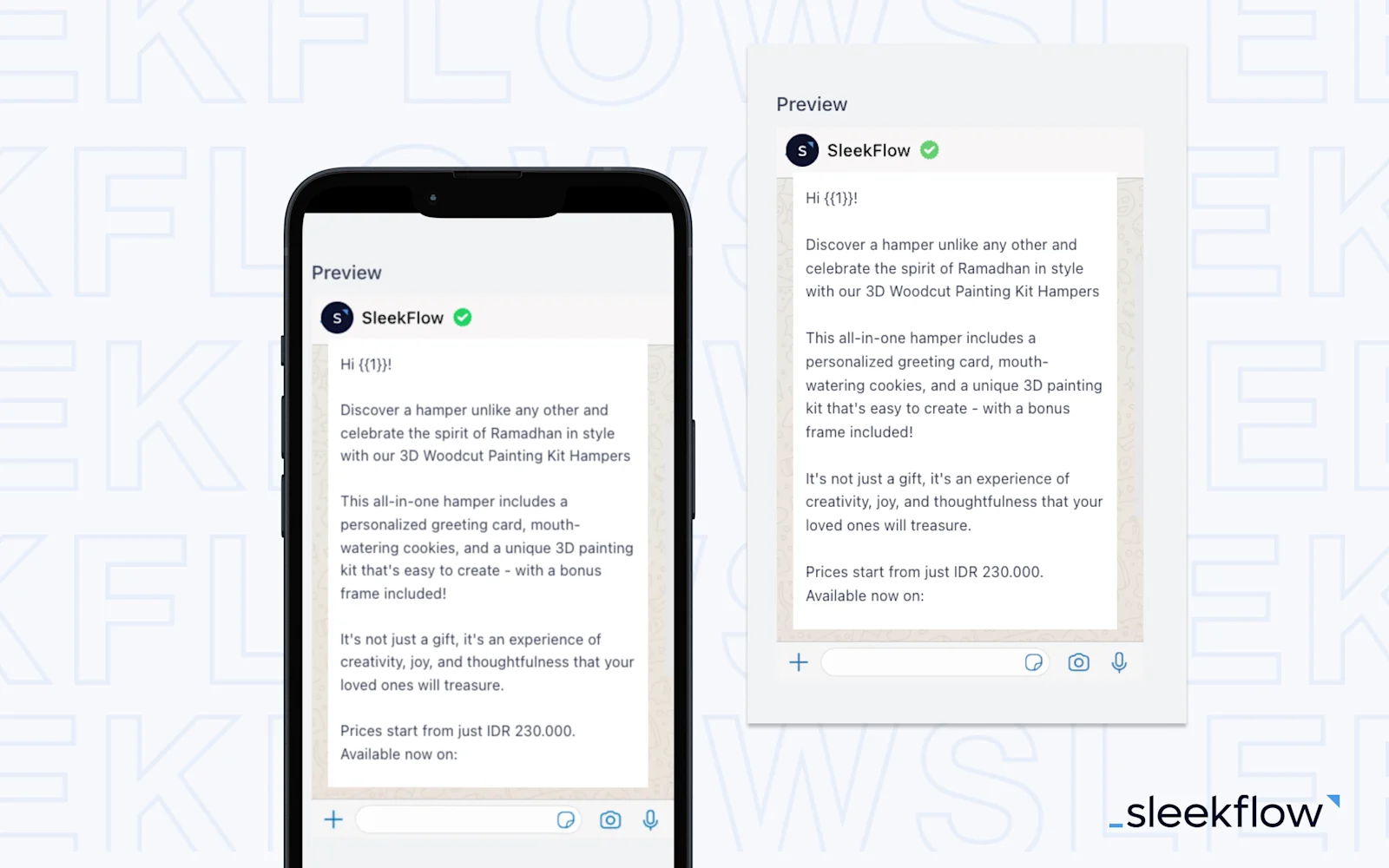
SleekFlow is built for teams that run support, sales, and post-purchase engagement through messaging channels (WhatsApp Business API, Instagram, Facebook Messenger, live chat, and more), all within a single platform.
The connection to CSAT is direct. When customers reach out on WhatsApp and receive an immediate AI-acknowledged response, when their previous conversation history is visible to the agent picking up the chat, and when a Flow Builder automation follows up 24 hours later with a satisfaction survey, the CSAT improvement does not require a separate system or a separate workflow.
**Bartega**, a lifestyle brand managing events and workshops, used SleekFlow to automate post-event satisfaction surveys through WhatsApp. By replacing manual survey dispatch with automated follow-ups triggered immediately after each event, they increased[ survey response rates by up to 35%](/en-sg/blog/whatsapp-manager), giving their team more CSAT data to act on, with less operational overhead.
For teams that want to go deeper than scores, SleekFlow's[ CX Intelligence](/en-sg/blog/customer-insight-tools) surfaces AI-generated insights directly from conversation data: recurring themes, risk signals, and satisfaction patterns across every chat, without requiring a survey response. It answers not just "what was the score?" but "why is it moving?"
### What is CSAT?
CSAT, or Customer Satisfaction Score, is a metric that measures how satisfied a customer is with a specific interaction, product, or service. It is collected through a short survey question, scored on a scale of 1 to 5 (or similar), and expressed as a percentage of positive responses.
### How do you calculate CSAT?
Divide the number of satisfied responses (ratings of 4 or 5 on a 5-point scale) by the total number of responses, then multiply by 100. For example: 64 satisfied responses out of 80 total = 80% CSAT.
### What is a good CSAT score?
Most industries consider 75% to 85% good, and above 85% strong. However, scores vary significantly by industry, channel, and customer segment. The American Customer Satisfaction Index (ACSI) reported a national score of 76.7 in Q1 2026, which gives a useful cross-industry baseline. What matters most is tracking your own trend over time.
### When should you send a CSAT survey?
After any meaningful interaction where a customer's experience can be evaluated cleanly: post-support resolution, post-purchase, post-onboarding, or after a help article. Send within one to two hours of the interaction while the experience is still fresh.
### What is the difference between CSAT and NPS?
CSAT measures satisfaction with a specific interaction. Net Promoter Score (NPS) measures long-term loyalty by asking how likely a customer is to recommend your business. CSAT is a transactional metric; NPS is a relationship metric. Both are useful, but they answer different questions.
### What are the limits of CSAT?
CSAT captures how a customer felt about one specific moment, not their overall relationship with your brand. Response rates can be low, and customers who feel neutral are less likely to respond, skewing results towards the extremes. Scores alone do not explain why satisfaction moved; that analysis requires open-text comments, operational data, and conversation analysis.
### How do you improve CSAT?
The most reliable levers are: reducing first response time, closing the loop on low scores within 24 hours, improving agent coaching with conversation-level data, fixing recurring root causes rather than surface symptoms, and setting accurate expectations before resolution begins.
### Can AI help improve CSAT?
Yes, across multiple points in the workflow. AI accelerates first response, routes conversations more accurately, assists agents in real time, and detects satisfaction patterns at scale without relying solely on survey responses. Teams using AI agents report faster resolution times and improved first-contact resolution rates, both of which correlate with higher CSAT.
## Want to outcompete your peers with SleekFlow's help?
Book your personalised demo with SleekFlow today and unlock the potential of seamless communication
[Book a Demo](https://sleekflow.io/en-sg/book-a-demo)
[View Pricing](https://sleekflow.io/en-sg/pricing)