---
title: "Customer-centric marketing: Strategy, examples, and how to build campaigns that drive loyalty and revenue"
description: " Learn how to build customer-centric marketing campaigns that improve loyalty, retention, and revenue in Singapore."
canonical: "https://sleekflow.io/en-sg/blog/customer-centric-marketing"
html_lang: "en-sg"
date_modified: "2026-05-29T03:27:26.771Z"
og_title: "Customer-centric marketing strategy guide"
og_description: " Learn how to build customer-centric marketing campaigns that improve loyalty, retention, and revenue in Singapore."
og_image: "https://images.ctfassets.net/tu2uwzoyozk8/jv7U36Ukh9EPuG26vYfRg/37254a153c2feca5c6b003922293bf06/Website-Cover-SleekFlow.jpg?w=1200&q=90"
---
```json
{
"@context": "https://schema.org",
"@type": "BlogPosting",
"headline": "Customer-centric marketing strategy guide",
"description": " Learn how to build customer-centric marketing campaigns that improve loyalty, retention, and revenue in Singapore.",
"url": "https://sleekflow.io/en-sg/blog/customer-centric-marketing",
"dateModified": "2026-05-29T03:27:26.771Z",
"image": "https://images.ctfassets.net/tu2uwzoyozk8/jv7U36Ukh9EPuG26vYfRg/37254a153c2feca5c6b003922293bf06/Website-Cover-SleekFlow.jpg?w=1200&q=90",
"breadcrumb": {
"@type": "BreadcrumbList",
"itemListElement": [
{
"@type": "ListItem",
"position": 1,
"name": "Home",
"item": "https://sleekflow.io/en-sg"
},
{
"@type": "ListItem",
"position": 2,
"name": "Blog",
"item": "https://sleekflow.io/en-sg/blog"
},
{
"@type": "ListItem",
"position": 3,
"name": "Customer-centric marketing strategy guide",
"item": "https://sleekflow.io/en-sg/blog/customer-centric-marketing"
}
]
}
}
```
# Customer-centric marketing: Strategy, examples, and how to build campaigns that drive loyalty and revenue
*Julian Wong — Content Strategist*
## Summary
- Customer-centric marketing focuses on customer needs, behaviour, lifecycle stage, and channel preference instead of sending the same campaign to every contact.
- Rising acquisition costs and fragmented attention make personalisation essential, especially when customers move between WhatsApp, Instagram, live chat, email, SMS, and other touchpoints.
- Strong customer-centric campaigns require unified customer data, including purchase history, support context, conversation intent, and campaign engagement.
- AI helps scale customer-centric marketing by detecting intent, summarising customer context, personalising replies, triggering next-best actions, and improving response speed.
- SleekFlow supports customer-centric execution through omnichannel inboxes, Flow Builder automations, segmentation, broadcasts, AI replies, CRM/e-commerce integrations, and analytics.
## **What is customer-centric marketing?**
**Customer-centric marketing** is a marketing approach built around customer needs, context, behaviour, and preferences, rather than brand-first campaign calendars. Instead of sending the same promotion to every contact, customer-centric teams use data, conversations, purchase history, lifecycle stage, and intent signals to decide what to say, when to say it, and where to say it.
The goal is simple: deliver more relevant experiences across the full customer journey so your business can improve conversion, loyalty, and customer lifetime value.
[Bloomreach defines customer-centricity](https://www.bloomreach.com/en/blog/customer-centric-marketing) as moving beyond an “average” customer understanding and creating value at a one-to-one level. That framing matters because Singapore customers are highly connected and expect brands to remember context, not restart the conversation every time they switch from WhatsApp to Instagram or website chat
## **Why customer-centric marketing matters more now**
**Customer-centric marketing** has become a growth requirement because the economics of marketing have changed. Brands can no longer rely on broad campaigns, disconnected channels, or one-off promotions to keep revenue growing.
- **Customer acquisition cost is rising:** WordStream’s 2025 Google Ads benchmarks show that the average[ cost per lead increased from US$66.69 in 2024 to US$70.11 in 2025](https://www.wordstream.com/blog/2025-google-ads-benchmarks). With leads becoming more expensive, missed enquiries, slow replies, and low-quality follow-ups directly affect revenue.
- **Attention is fragmented:** customers move between WhatsApp, Instagram, Messenger, live chat, email, SMS, and in-store touchpoints, especially in connected markets like Singapore, which means brands need consistent experiences across WhatsApp, Instagram, Messenger, live chat, email, SMS, and sales conversations.
- **Customers expect relevance:** McKinsey found that [**71% of consumers expect personalised interactions**](https://www.mckinsey.com/capabilities/growth-marketing-and-sales/our-insights/the-value-of-getting-personalization-right-or-wrong-is-multiplying), while **76% feel frustrated** when brands fail to deliver them.
- **Loyalty is harder to earn:** Customers can compare alternatives instantly, switch channels easily, and walk away when a brand does not remember their context. A customer who has already purchased, submitted a support request, or asked about a product should not receive the same message as a cold prospect.
- **Repeat revenue matters more than one-off transactions:** customer-centric marketing helps businesses build timely, personalised journeys that increase conversion, retention, and lifetime value.
## **What makes marketing customer centric?**
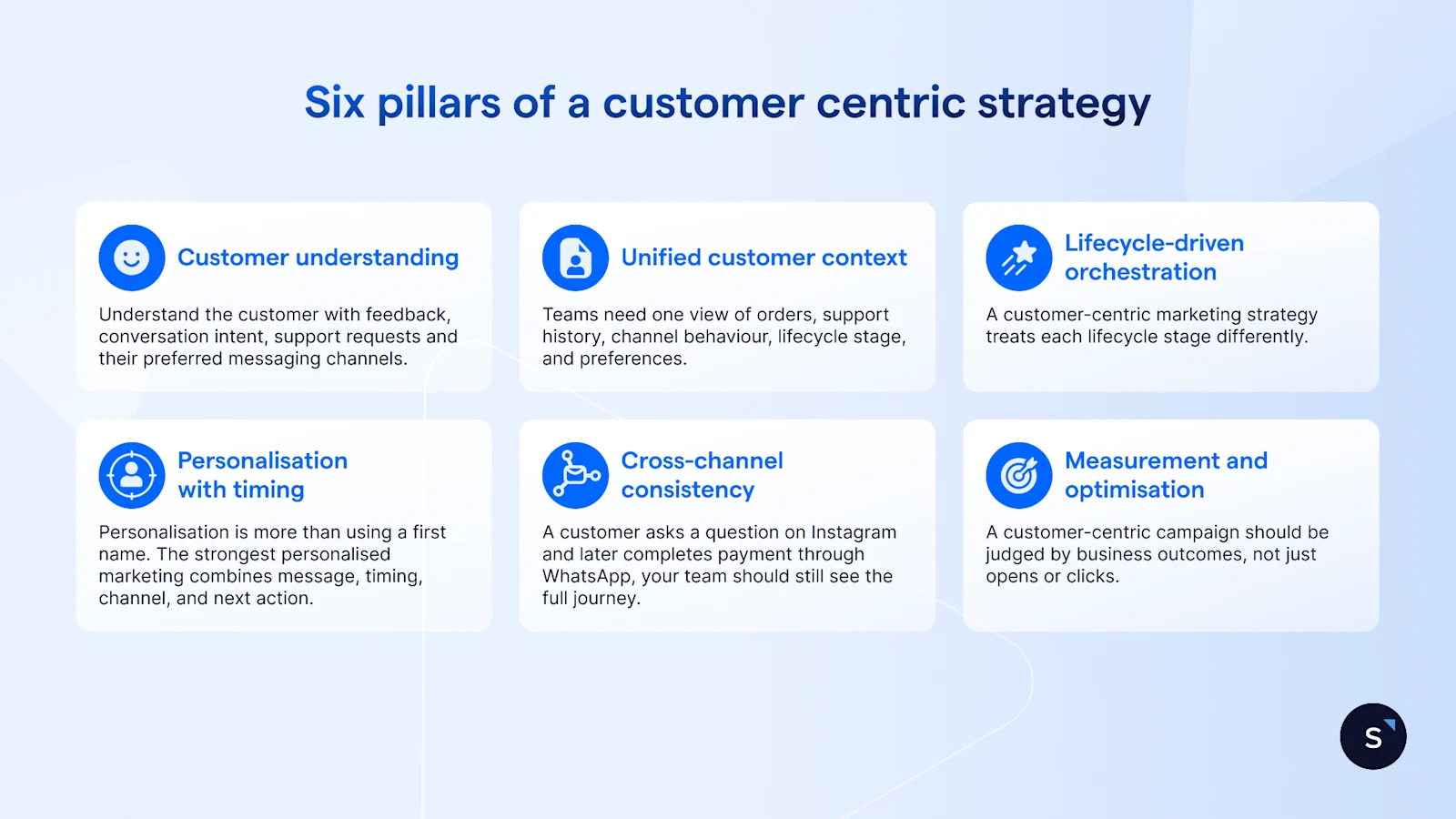
### **Customer understanding**
Strong **customer-centric marketing** starts with customer understanding. This includes:
- Feedback and survey responses
- Website and product behaviour
- Purchase history
- Conversation intent
- Support requests
- Campaign engagement
- Preferred messaging channels
In practice, a customer asking about delivery delays should not receive the same “new customer discount” as someone browsing for the first time. Their intent is different, so the next message should be different too.
### **Unified customer context**
Customer data should not live separately in sales, support, e-commerce, and marketing tools. Teams need one view of orders, support history, channel behaviour, lifecycle stage, and preferences.
Omnichannel conversation platforms bring customer journeys across WhatsApp, Instagram, live chat, and other messaging channels into one workflow, with customer data connected across online and offline channels.
### **Lifecycle-driven orchestration**
A **customer-centric marketing strategy** treats each lifecycle stage differently:
| **Lifecycle stage** | **Campaign focus** | **Example trigger** |
| --- | --- | --- |
| New lead | Fast qualification | Form submitted or WhatsApp inquiry received |
| Active buyer | Conversion support | Product viewed, cart started, quote requested |
| At-risk customer | Re-engagement | No purchase or reply for 30–60 days |
| Repeat buyer | Loyalty | Second purchase, membership milestone |
| Advocate | Referral and review | Positive CSAT or repeat high-value order |
### **Personalisation with timing**
Personalisation is more than using a first name. The strongest **personalised marketing** combines message, timing, channel, and next action.
For example, a customer who abandons a cart at 10pm should not wait two days for a generic email. A better experience is a timely WhatsApp follow-up with the exact product, an answer to the likely objection, and a link to complete checkout.
### **Cross-channel consistency**
Your website, WhatsApp, Instagram, Messenger, email, SMS, support, and sales conversations should feel connected. If a customer asks a question on Instagram and later completes payment through WhatsApp, your team should still see the full journey.
### **Measurement and optimisation**
A customer-centric campaign should be judged by business outcomes, not just opens or clicks. Track:
- **Revenue generated**
- **Customer lifetime value**
- **Repeat purchase rate**
- **Conversion rate**
- **Engagement rate**
- **Average first response time**
- **Drop-off points**
- **Support-to-sales opportunities**
## **What customer-centric marketing looks like in practice**
Here is how a customer-centric journey works compared with a traditional campaign.
| **Scenario** | **Brand-first approach** | **Customer-centric approach** |
| --- | --- | --- |
| New lead submits a form | Add to email nurture list | Send a fast WhatsApp response with context and qualification questions |
| Cart is abandoned | Wait for a batch reminder | Trigger a relevant message with product, incentive, or support option |
| Repeat customer browses again | Show first-time buyer promo | Offer loyalty-first treatment or personalised cross-sell |
| Support ticket is resolved | End the interaction | Trigger CSAT, review, reorder, or retention flow |
| Sales follows up | Manually check notes | Use the same customer context across marketing and sales |
## **How to build a customer-centric marketing strategy**
###
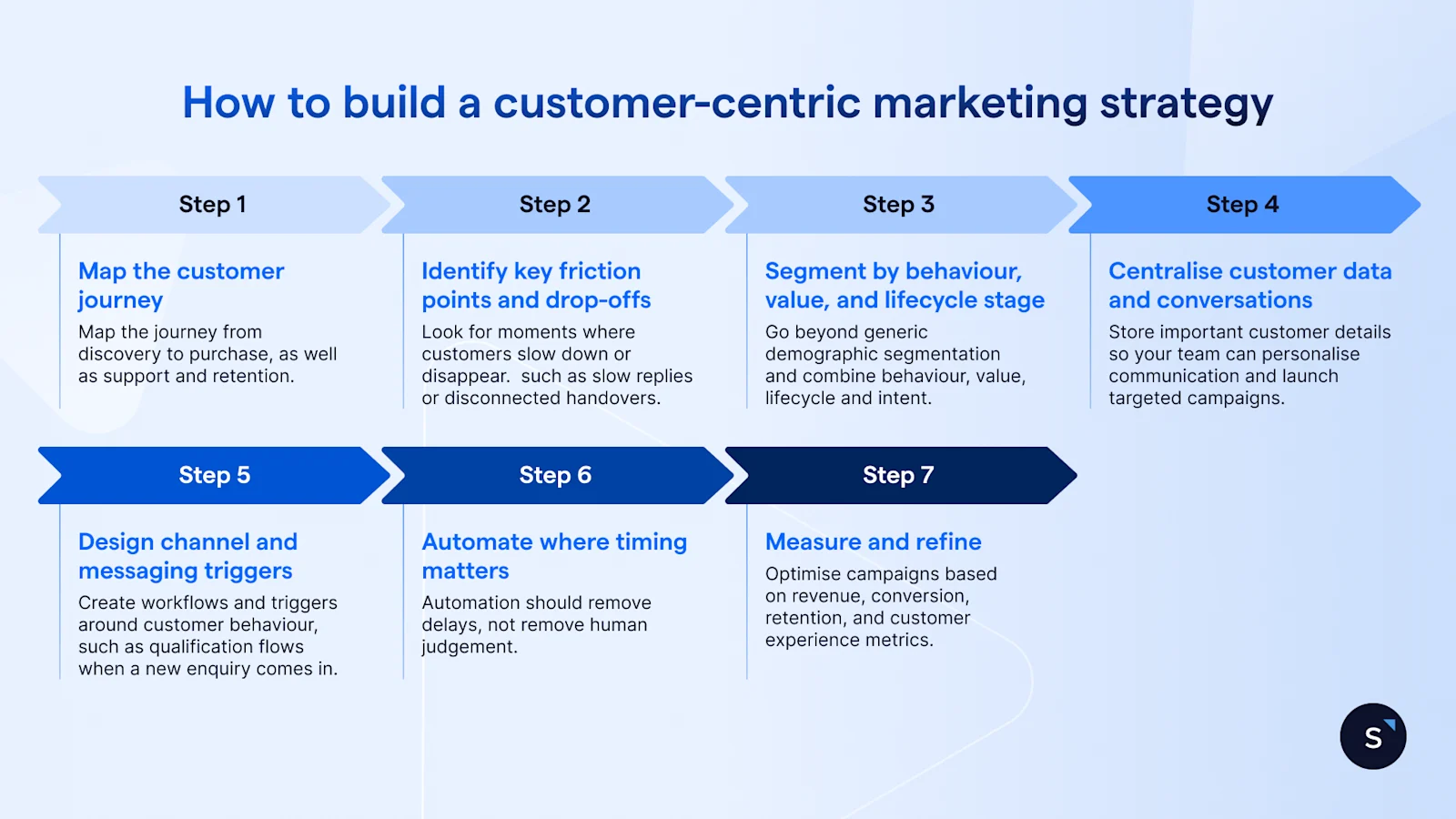
### **1. Map the customer journey**
Start with the real customer journey, not your internal funnel. For Singapore businesses, this may include:
- Discovery through Instagram, TikTok, Google, or referrals
- Inquiry through WhatsApp, live chat, or Messenger
- Comparison through product pages, reviews, or sales chat
- Purchase through e-commerce checkout, payment link, or in-store visit
- Support through messaging channels
- Retention through loyalty campaigns, reminders, and replenishment offers
### **2. Identify key friction points and drop-offs**
Look for moments where customers slow down or disappear. Common friction points include slow replies, repeated questions, missing order context, unclear pricing, abandoned carts, and disconnected handovers between marketing, sales, and support.
### **3. Segment by behaviour, value, and lifecycle stage**
Avoid relying only on demographic segmentation. A better **customer-centric marketing strategy** combines:
- Behaviour: viewed product, clicked campaign, abandoned cart
- Value: high-value customer, repeat buyer, low-frequency buyer
- Lifecycle: lead, first-time customer, loyal customer, inactive customer
- Intent: pricing question, support issue, booking request, renewal interest
### **4. Centralise customer data and conversation signals**
Store details such as name, phone number, email, properties, labels, lists, and purchase history, helping your team personalise communication and target campaigns. Marketers can also segment VIP customers, sales reps can see past inquiries, and support agents can avoid asking for information the customer has already given.
### **5. Design channel and messaging triggers**
Create [workflows and triggers ](/en-sg/flow-builder)around customer behaviour. Examples include:
- New WhatsApp inquiry → send qualification flow
- Abandoned cart → send product-specific reminder
- Order fulfilled → send care instructions and review request
- Support ticket resolved → send CSAT and loyalty offer
- Inactive customer → send personalised win-back campaign
### **6. Automate where timing matters**
Automation should remove delays, not remove human judgement, such as when a new FAQ enquiry appears in WhatsApp. SleekFlow’s Flow Builder supports triggers, conditions, and actions for automating messages, routing conversations, updating contacts, and integrating with external platforms.
### **7. Measure business outcomes and refine**
Optimise campaigns based on revenue, conversion, retention, and customer experience metrics. Open rate alone is not enough. A campaign that gets fewer clicks but more repeat purchases is usually stronger than a high-open campaign with no revenue impact.
## **How AI makes customer-centric marketing more scalable**
AI helps customer-centric teams move faster without losing context.
AI can:
- Identify customer intent from conversation history
- Trigger the right response at the right moment
- Personalise campaign copy and follow-ups
- Summarise customer context for sales and support teams
- Recommend next best actions
- Improve retention across conversational channels
SleekFlow’s AI, [AgentFlow](/en-sg/agentflow), includes an AI Knowledge Base, AI Smart Reply, and AI Writing Assistant. Its Smart Reply uses conversation history and knowledge base materials to generate context-aware responses, while teams can use AI for support automation, marketing messages, and sales lead engagement.
## **How SleekFlow helps your customer-centric marketing**
SleekFlow helps Singapore businesses turn **customer-centric marketing** from a strategy into day-to-day execution.
With SleekFlow, marketing, sales, and support teams can:
- Manage WhatsApp, Instagram, Messenger, live chat, SMS, and more [in one omnichannel inbox](/en-sg/inbox)
- Build personalised journeys with [Flow Builder](/en-sg/flow-builder)
- Segment customers using contact data, labels, lists, purchase history, and conversation behaviour
- Send targeted [broadcasts and retargeting campaigns](/en-sg/broadcast-campaign)
- Use AI to draft replies, summarise context, and support lead engagement
- Connect customer conversations with CRM, e-commerce, and payment workflows
- [Track response time](/en-sg/analytics), campaign performance, and conversion outcomes
## Start for free\!
Grow your revenue and turn chats into conversions with AI agents. Try SleekFlow for free, forever.
[Start for Free\!](https://app.sleekflow.io/en?screen_hint=signup)
[View pricing](https://sleekflow.io/en-sg/pricing)
### What is customer-centric marketing?
Customer-centric marketing is a strategy that builds campaigns around customer needs, behaviour, context, and preferences. It focuses on relevant experiences across the full customer journey.
### How is customer-centric marketing different from personalised marketing?
Personalised marketing usually refers to tailoring content, offers, or recommendations. Customer-centric marketing is broader. It includes personalisation, but also journey design, timing, channel choice, service context, retention, and business measurement.
### Why is customer-centric marketing important?
It helps businesses improve conversion, loyalty, retention, and customer lifetime value. It is especially important in Singapore, where customers are highly active on social and messaging channels.
### What are the key pillars of a customer-centric marketing strategy?
The key pillars are customer understanding, unified customer context, lifecycle orchestration, personalisation with timing, cross-channel consistency, and measurement.
### How does AI support customer-centric marketing?
AI can detect intent, personalise responses, summarise context, trigger next steps, and help teams respond faster across messaging channels.
### What tools help with customer-centric marketing?
Useful tools include omnichannel inboxes, CRM systems, marketing automation platforms, conversational AI, analytics dashboards, e-commerce integrations, and messaging platforms such as WhatsApp Business API.
### How do you measure customer-centric marketing success?
Measure revenue, conversion rate, customer lifetime value, repeat purchase rate, response time, engagement, retention, CSAT, and drop-off points.
### What is the difference between retention and loyalty?
Retention means customers continue buying or using your service. Loyalty means they prefer your brand, engage repeatedly, recommend you, and are less likely to switch when competitors offer similar products.