---
title: "Customer centric: what it means and how to build a customer-centric business"
description: "Learn what customer centric means, why it drives growth, and how Singapore businesses can build customer-centric journeys with AI."
canonical: "https://sleekflow.io/en-sg/blog/customer-centric"
html_lang: "en-sg"
date_modified: "2026-05-26T08:12:18.263Z"
og_title: "Customer centric business: meaning and strategy"
og_description: "Learn what customer centric means, why it drives growth, and how Singapore businesses can build customer-centric journeys with AI."
og_image: "https://images.ctfassets.net/tu2uwzoyozk8/jv7U36Ukh9EPuG26vYfRg/37254a153c2feca5c6b003922293bf06/Website-Cover-SleekFlow.jpg?w=1200&q=90"
---
```json
{
"@context": "https://schema.org",
"@type": "BlogPosting",
"headline": "Customer centric business: meaning and strategy",
"description": "Learn what customer centric means, why it drives growth, and how Singapore businesses can build customer-centric journeys with AI.",
"url": "https://sleekflow.io/en-sg/blog/customer-centric",
"dateModified": "2026-05-26T08:12:18.263Z",
"image": "https://images.ctfassets.net/tu2uwzoyozk8/jv7U36Ukh9EPuG26vYfRg/37254a153c2feca5c6b003922293bf06/Website-Cover-SleekFlow.jpg?w=1200&q=90",
"breadcrumb": {
"@type": "BreadcrumbList",
"itemListElement": [
{
"@type": "ListItem",
"position": 1,
"name": "Home",
"item": "https://sleekflow.io/en-sg"
},
{
"@type": "ListItem",
"position": 2,
"name": "Blog",
"item": "https://sleekflow.io/en-sg/blog"
},
{
"@type": "ListItem",
"position": 3,
"name": "Customer centric business: meaning and strategy",
"item": "https://sleekflow.io/en-sg/blog/customer-centric"
}
]
}
}
```
# Customer centric: what it means and how to build a customer-centric business
*Julian Wong — Content Strategist*
## Summary
- Customer centricity means designing the business around customer needs, not just improving customer service. It affects sales, marketing, support, product, operations, and technology decisions.
- A customer-centric business reduces friction across the full journey, from first enquiry to repeat purchase. Customers shouldn’t need to repeat themselves, switch channels unnecessarily, or wait too long for answers.
- Centralised customer data is the foundation. When conversations, orders, CRM records, and support history are connected, teams can personalise interactions, follow up faster, and resolve issues with better context.
- AI and automation help businesses scale customer-centric experiences by handling FAQs, routing conversations, summarising chats, detecting trends, and supporting agents, while still keeping human escalation available for complex cases.
- SleekFlow supports customer centricity by unifying messaging channels, AI agents, CRM/e-commerce integrations, ticketing, analytics, and secure collaboration, helping businesses turn conversations into sales, support, and loyalty opportunities.
Singapore customers expect brands to respond quickly, remember context, and make every interaction feel effortless. That expectation is not limited to support. It affects marketing, sales, product, operations, data privacy, and the tools teams use every day.
A **customer centric** business puts customer needs at the centre of decision-making. [Zendesk defines customer centricity](https://www.zendesk.com/sg/blog/customer-experience/engagement/customer-centric-business/) as understanding consumers and making business decisions based on their needs, but the strongest brands go further: they turn customer insight into workflows, team habits, technology choices, and measurable growth outcomes.
## **What does customer centric mean?**
**Customer centric** means designing your business around what customers are trying to achieve. It is more than “good customer service” because it does not begin only when a customer has a problem. It begins when a prospect first sees your ad, sends a message, compares options, places an order, needs help, gives feedback, and decides whether to buy again.
A customer-centric company asks:
- What does the customer need next?
- What context should our team already know?
- Which step creates unnecessary effort?
- Where can automation help without making the experience feel cold?
- What feedback should change our product, operations, or messaging?
This affects every function. Product teams use feedback to prioritise improvements. Support teams resolve issues with full context. Marketing sends relevant messages instead of generic blasts. Sales teams follow up based on real intent. Operations remove handoffs that slow customers down.
| **Concept** | **What it means** | **Business risk when misunderstood** |
| --- | --- | --- |
| **Customer centric** | Decisions start from customer needs and outcomes. | Teams optimise internal goals while customers face friction. |
| Customer service | How support is delivered when customers need help. | Service becomes reactive instead of proactive. |
| Customer experience | How the full journey feels across every touchpoint. | Teams fix isolated moments but miss journey-wide problems. |
| Product-centric | Decisions are driven mainly by product capability. | The product may be strong, but not aligned with customer outcomes. |
A product-centric company may ask, “What can our product do?” A **customer centric** company asks, “What result does the customer need, and how can our product, people, AI, and processes help them get there faster?”
## **Why customer centricity matters for business growth**
Customer centricity is often linked to loyalty, but its impact is broader. When customers experience less friction, they convert faster, stay longer, buy more often, and refer others.
McKinsey found that [71% of consumers expect personalised interactions, ](https://www.mckinsey.com/capabilities/growth-marketing-and-sales/our-insights/the-value-of-getting-personalization-right-or-wrong-is-multiplying)while 76% feel frustrated when this does not happen. It also found that companies that excel at personalisation generate 40% more revenue from those activities than average players.
A strong **customer centric** strategy supports:
- **Higher conversion**, because customers get answers at the right moment.
- **Stronger retention**, because teams act before frustration becomes churn.
- **Lower churn**, because recurring issues are identified and fixed.
- **Higher customer lifetime value**, because personalisation improves relevance.
- **More referrals**, because effortless experiences are easier to recommend.
- **Better product-market fit**, because customer feedback shapes priorities.
- **Less journey friction**, because teams share context instead of operating in silos.
## **What a customer-centric business looks like in practice**
A **customer centric** business is easy to recognise because customers do not have to work hard to be understood.
In practice, this means:
- Customers do not repeat themselves when they move from Instagram DM to WhatsApp or live chat.
- Sales, marketing, and support share customer context.
- Feedback influences workflows, campaigns, and product priorities.
- Messages are timely, relevant, and based on lifecycle stage.
- AI handles routine enquiries, but complex or high-value cases move smoothly to a human agent.
- Service is fast, but still personalised.
This is where technology becomes strategic. By[ centralising conversations from major messaging channels ](/en-sg/inbox)such as WhatsApp, Instagram, Facebook Messenger, WeChat, SMS, and live chat into one inbox, teams can manage conversations without switching across apps.
## **The six pillars of a customer-centric strategy**
### **Customer understanding**
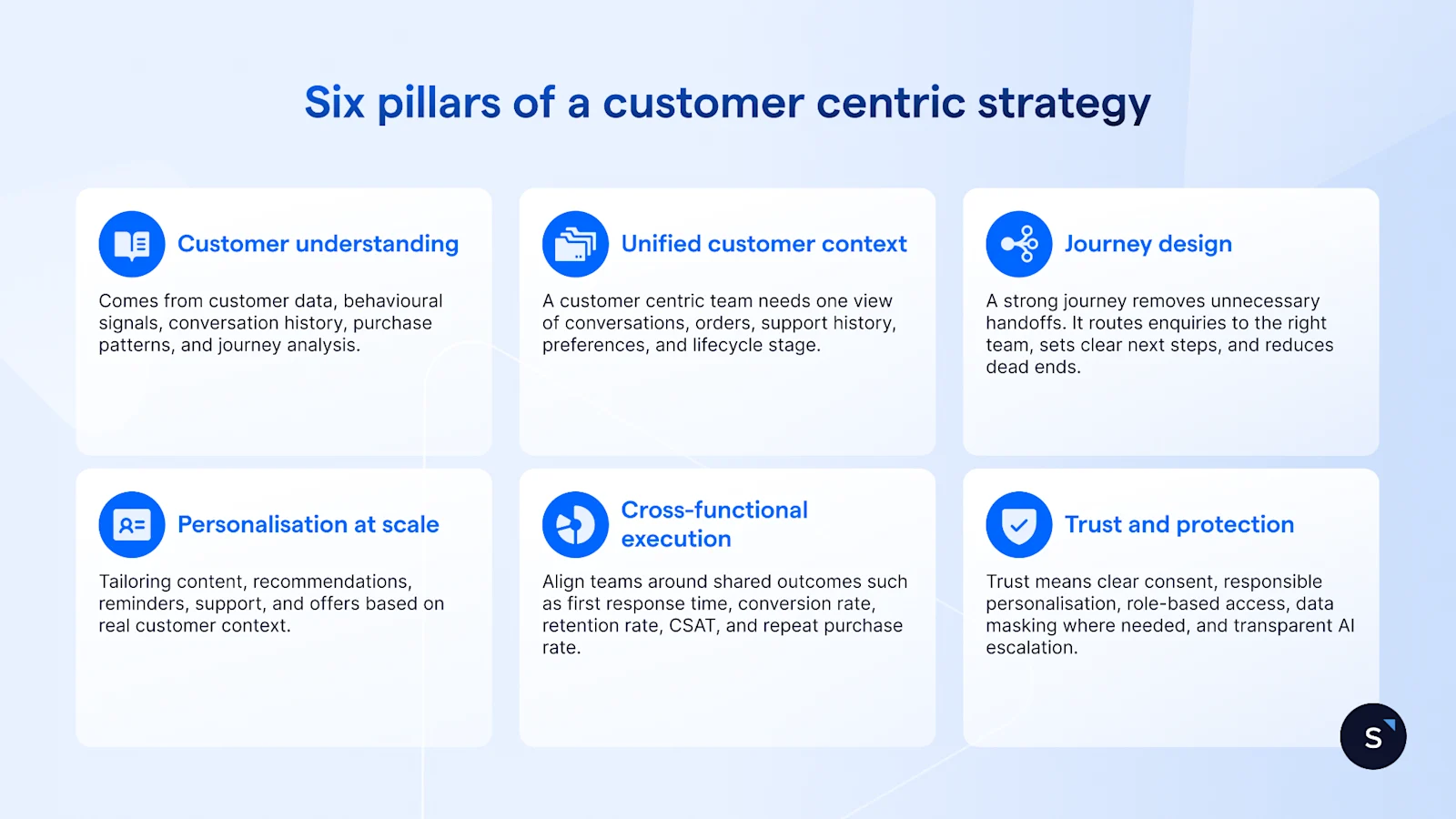
Customer understanding comes from customer data, behavioural signals, conversation history, purchase patterns, and journey analysis. Do not rely only on surveys as customer conversations often reveal objections, intent, urgency, and emotional signals that dashboards miss.
### **Unified customer context**
A **customer centric** team needs one view of conversations, orders, support history, preferences, and lifecycle stage. Without this, customers get fragmented experiences.
SleekFlow creates seamless, personalised customer journeys across messaging channels such as WhatsApp, Instagram, and live chat, with AI capabilities for marketing, sales, and support teams.
### **Journey design**
A strong journey removes unnecessary handoffs. It routes enquiries to the right team, sets clear next steps, and reduces dead ends. For example, a WhatsApp enquiry should be able to move from product question to recommendation, payment link, order update, and post-purchase support without forcing the customer to restart elsewhere.
### **Personalisation at scale**
Personalisation is not just using a first name. It means tailoring content, recommendations, reminders, support, and offers based on real customer context. Real use cases include personalised broadcasts based on customer behaviour, and AI agents that remember the customer’s past conversation.
### **Cross-functional execution**
Customer centricity fails when each team owns only one part of the journey. Sales need a support history. Support needs order information. Marketing needs lifecycle and preference data. Product needs feedback. Leaders should align teams around shared outcomes such as first response time, conversion rate, retention rate, CSAT, and repeat purchase rate.
### **Trust and protection**
A customer-centric company protects the customer while serving them. For customer engagement teams, trust means clear consent, responsible personalisation, role-based access, data masking where needed, and transparent AI escalation.
**How to become more customer-centric: a step-by-step plan**
### **1. Audit your current customer journey**
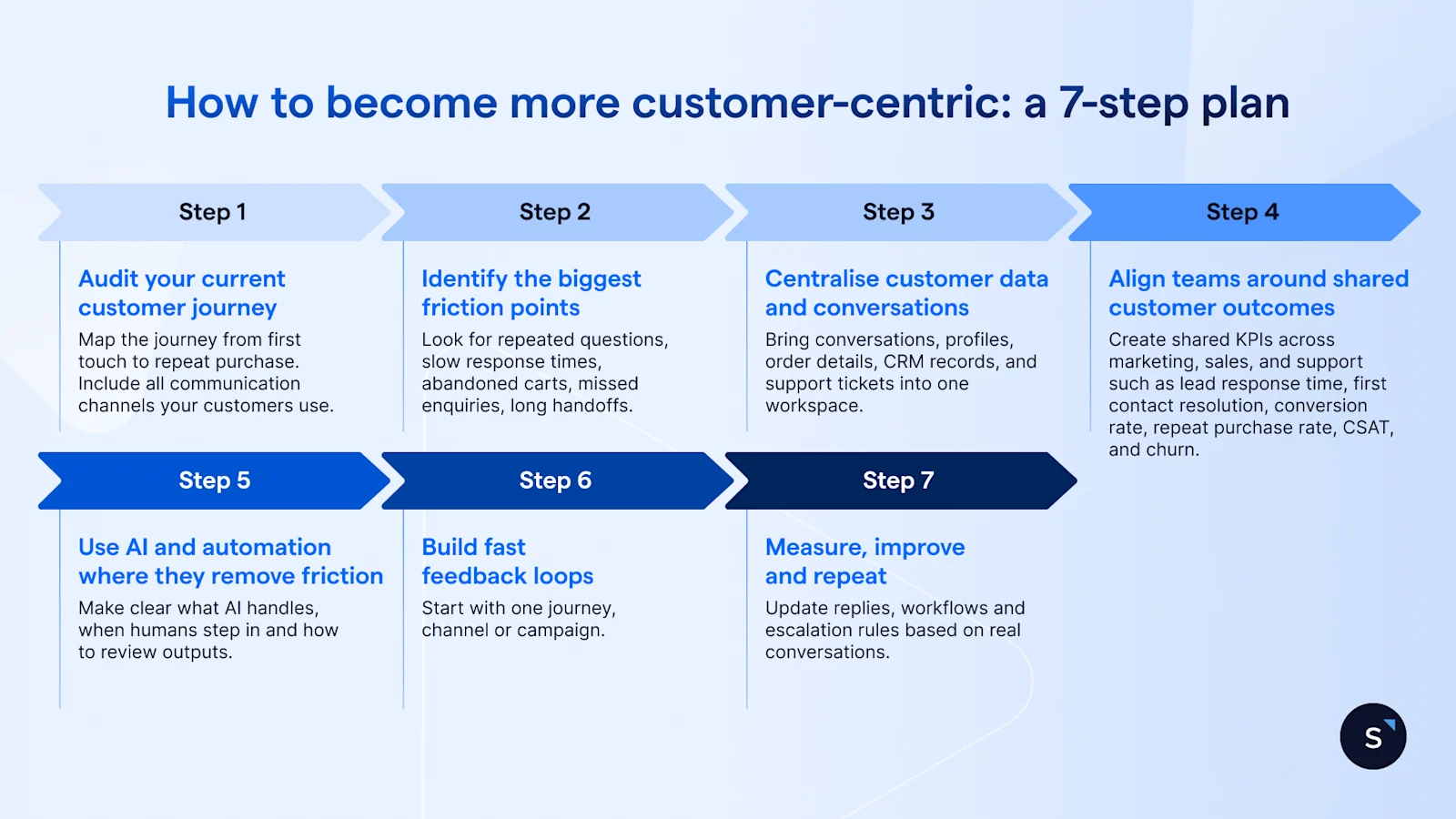
Map the journey from first touch to repeat purchase. Include WhatsApp, Instagram, Messenger, live chat, email, CRM, e-commerce, payment, and support.
### **2. Identify the biggest friction points**
Look for repeated questions, slow response times, abandoned carts, missed enquiries, long handoffs, and customers being asked for the same information twice.
### **3. Centralise customer data and conversations**
Bring conversations, profiles, order details, CRM records, and support tickets into one workspace. This is the foundation for personalised service and smarter automation.
### **4. Align teams around shared customer outcomes**
Create shared KPIs across marketing, sales, and support. For example, measure lead response time, first contact resolution, conversion rate, repeat purchase rate, CSAT, and churn.
### **5. Use AI and automation where they remove friction**
Automate FAQs, routing, qualification, reminders, summaries, and follow-ups. Keep human escalation available for sensitive, complex, or high-value cases.
### **6. Build fast feedback loops**
Use conversation topics, complaint trends, CSAT responses, and sales objections to improve campaigns, product pages, scripts, and workflows.
### **7. Measure, improve, and repeat**
Customer centricity must be measured as a growth system, not treated as a one-off service project.
## **Why centralised customer data is the foundation of customer centricity**
Customer centricity is difficult when customer conversations live in separate tools across WhatsApp, Instagram, Messenger, web chat, email, CRM, and e-commerce platforms.
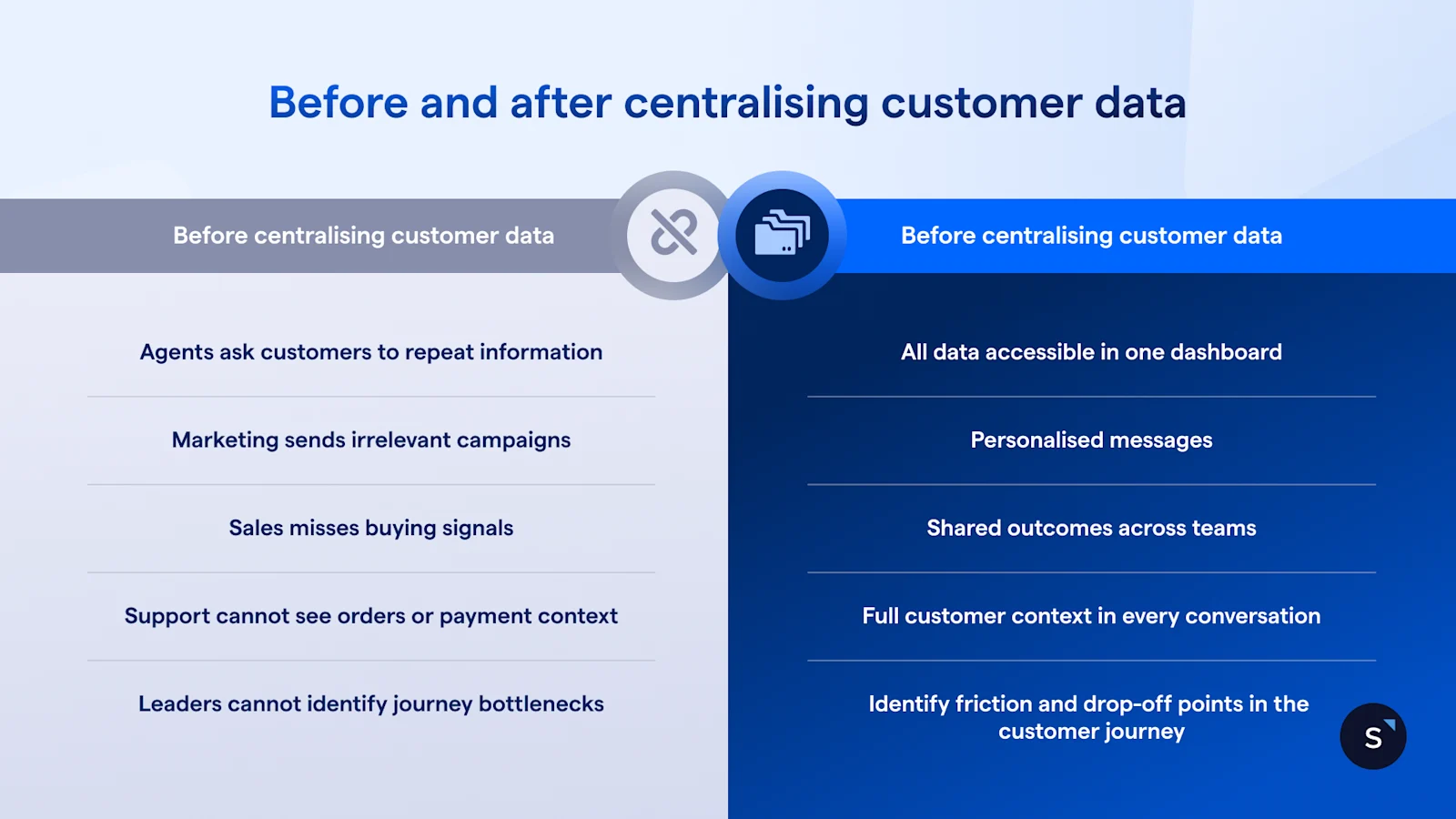
When data is fragmented:
- Agents ask customers to repeat information.
- Marketing sends irrelevant campaigns.
- Sales misses buying signals.
- Support cannot see order or payment context.
- Leaders cannot identify journey bottlenecks.
Centralisation turns customer conversations into a shared operating layer. SleekFlow’s CRM integration documentation explains that connecting CRM systems helps keep customer information synchronised, reduces manual data entry, automates workflows, and improves customer experience with real-time data.
## **How AI supports customer centricity without removing the human touch**
AI should make the journey faster and more relevant, not less human. [Zendesk’s CX Trends report](https://www.zendesk.com/sg/newsroom/articles/2025-cx-trends-report/) found that CX trendsetters using AI with empathy and personalisation saw 33% higher customer acquisition rates, 22% higher customer retention rates, and 49% higher cross-sell revenue.
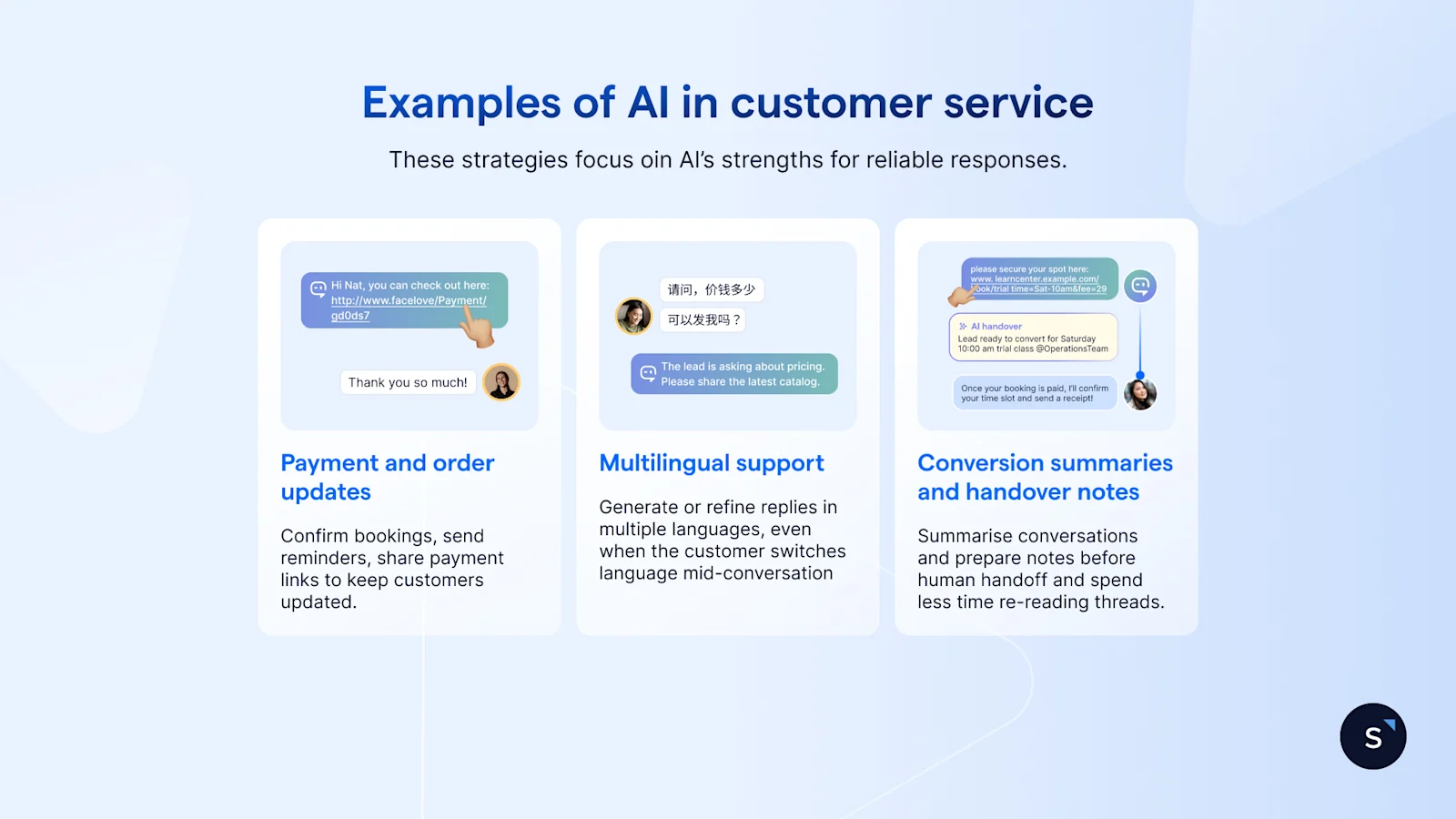
AI can support a **customer centric** strategy through:
- **Instant replies** for common questions.
- **Routing and prioritisation** based on urgency, intent, or customer value.
- **Conversation summaries** so agents understand context quickly.
- **Agent assistance** for tone, suggested replies, and next best actions.
- **Personalisation** based on lifecycle stage, order history, and preferences.
- **Trend detection** from recurring conversation topics.
- **Human-in-the-loop escalation** for complex, sensitive, or high-value cases.
## **How SleekFlow helps businesses become more customer centric**
SleekFlow is built for businesses that want every customer conversation to become a better sales, service, and loyalty opportunity.
With SleekFlow, teams can:
- Unify WhatsApp, Instagram, live chat, Messenger, SMS, and other channels in one workspace.
- Use AI agents to qualify leads, answer enquiries, recommend products, and route conversations.
- Connect customer conversations with CRM, e-commerce, payment, and support systems.
- Use ticketing to prioritise support requests by urgency, status, type, owner, and channel.
- Track conversation performance, response time, conversion events, and engagement.
- Support secure collaboration with access control, data masking, and workspace security features.
## Real-life example: How Loft Home uses SleekFlow for more reliability post-purchase
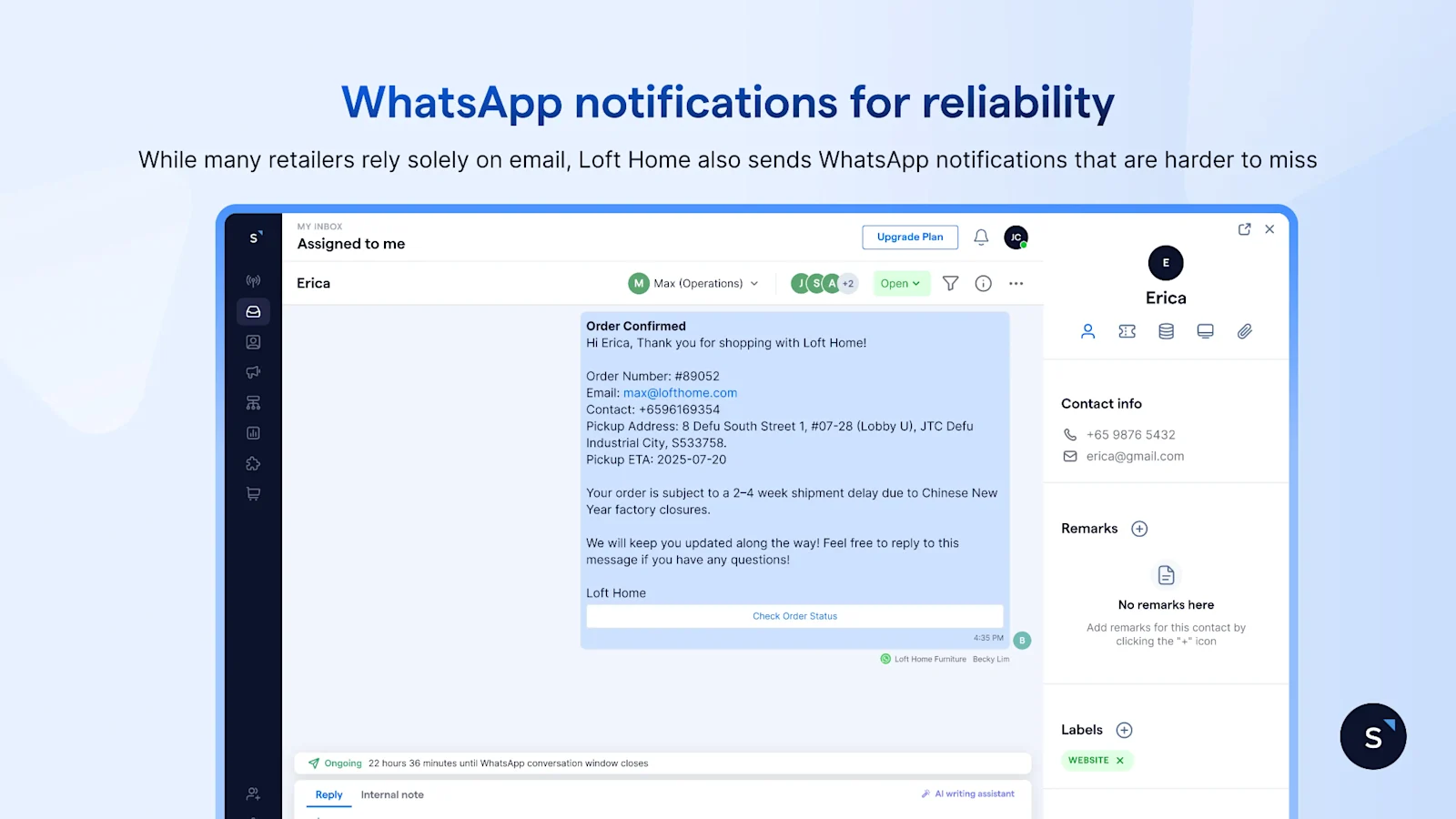
For a customer centric business, the post-purchase journey matters just as much as the sale. Singapore furniture retailer [Loft Home uses SleekFlow with Shopify](/en-sg/customer-stories/loft-home) to automate WhatsApp and email updates for order confirmations and shipping notifications, helping customers stay informed about important delivery details. This is especially valuable for high-consideration purchases like furniture, where customers want reassurance that their order is confirmed, scheduled, and on track.
With SleekFlow, these Shopify order details are also visible in the customer conversation, so agents can respond with full context when customers ask follow-up questions.
### Why is customer centricity important?
Customer centricity helps businesses increase conversion, retention, customer lifetime value, referrals, and product-market fit by reducing friction and improving relevance across the full journey.
### How do you build a customer-centric culture?
Start with shared customer outcomes. Give teams access to the same customer context, review feedback regularly, reward journey improvements, and make every department responsible for customer impact.
### How do you measure customer centricity?
Measure first response time, resolution time, CSAT, NPS, conversion rate, repeat purchase rate, churn, customer lifetime value, referral rate, and recurring complaint themes.
### How does AI support customer centricity?
AI supports customer centricity by replying instantly, routing enquiries, summarising conversations, assisting agents, personalising messages, and identifying trends. The key is to keep human escalation available when judgement, empathy, or approval is required.
### What tools help businesses become more customer centric?
The most useful tools are omnichannel inboxes, CRM integrations, AI agents, marketing automation, ticketing systems, analytics dashboards, e-commerce integrations, and data protection controls. For Singapore businesses, the strongest starting point is centralising conversations and customer data across WhatsApp, Instagram, Messenger, live chat, and CRM.
## Start for free\!
Grow your revenue and turn chats into conversions with AI agents. Try SleekFlow for free, forever.
[Start for Free\!](https://app.sleekflow.io/en?screen_hint=signup)
[View pricing](https://sleekflow.io/en-sg/pricing)