---
title: "Customer engagement: definition, how to strategise, and benefits (Singapore)"
description: "Define customer engagement, build a strategy for Singapore, and see real examples of higher conversion, ROI, and faster responses."
canonical: "https://sleekflow.io/en-sg/blog/customer-engagement"
html_lang: "en-sg"
date_modified: "2026-04-13T06:27:47.413Z"
og_title: "Customer engagement: definition, strategy & benefits"
og_description: "Define customer engagement, build a strategy for Singapore, and see real examples of higher conversion, ROI, and faster responses."
og_image: "https://images.ctfassets.net/tu2uwzoyozk8/jv7U36Ukh9EPuG26vYfRg/37254a153c2feca5c6b003922293bf06/Website-Cover-SleekFlow.jpg?w=1200&q=90"
---
```json
{
"@context": "https://schema.org",
"@type": "BlogPosting",
"headline": "Customer engagement: definition, strategy & benefits",
"description": "Define customer engagement, build a strategy for Singapore, and see real examples of higher conversion, ROI, and faster responses.",
"url": "https://sleekflow.io/en-sg/blog/customer-engagement",
"dateModified": "2026-04-13T06:27:47.413Z",
"image": "https://images.ctfassets.net/tu2uwzoyozk8/jv7U36Ukh9EPuG26vYfRg/37254a153c2feca5c6b003922293bf06/Website-Cover-SleekFlow.jpg?w=1200&q=90",
"breadcrumb": {
"@type": "BreadcrumbList",
"itemListElement": [
{
"@type": "ListItem",
"position": 1,
"name": "Home",
"item": "https://sleekflow.io/en-sg"
},
{
"@type": "ListItem",
"position": 2,
"name": "Blog",
"item": "https://sleekflow.io/en-sg/blog"
},
{
"@type": "ListItem",
"position": 3,
"name": "Customer engagement: definition, strategy & benefits",
"item": "https://sleekflow.io/en-sg/blog/customer-engagement"
}
]
}
}
```
# Customer engagement: definition, how to strategise, and benefits (Singapore)
*Julian Wong — Content Strategist*
## Summary
-
In Singapore, customers live in chat. [**80.1% of Singaporeans use WhatsApp monthly**,](https://wearesocial.com/sg/blog/2025/02/digital-2025-top-digital-and-social-media-trends-in-singapore/) and it’s the most-used social platform locally. That reality changes how you win attention, qualify leads, convert sales, and support customers—because your best “customer experience” moments increasingly happen inside conversations, not on webpages.
Below is a practical guide to defining **customer engagement**, building a strategy, and learning from examples you can apply in Singapore.
## What is customer engagement?
**Customer engagement** is the act of creating positive, connected interactions across the entire customer journey, not just single transactions. It is not to be confused with other related concepts such as customer experience, or customer satisfaction.
Three useful ways to define it (and why they matter for strategy):
- Positive experiences across the full journey.
- Connected experiences + a feedback loop across teams and systems.
- An ongoing relationship that goes beyond the transaction.
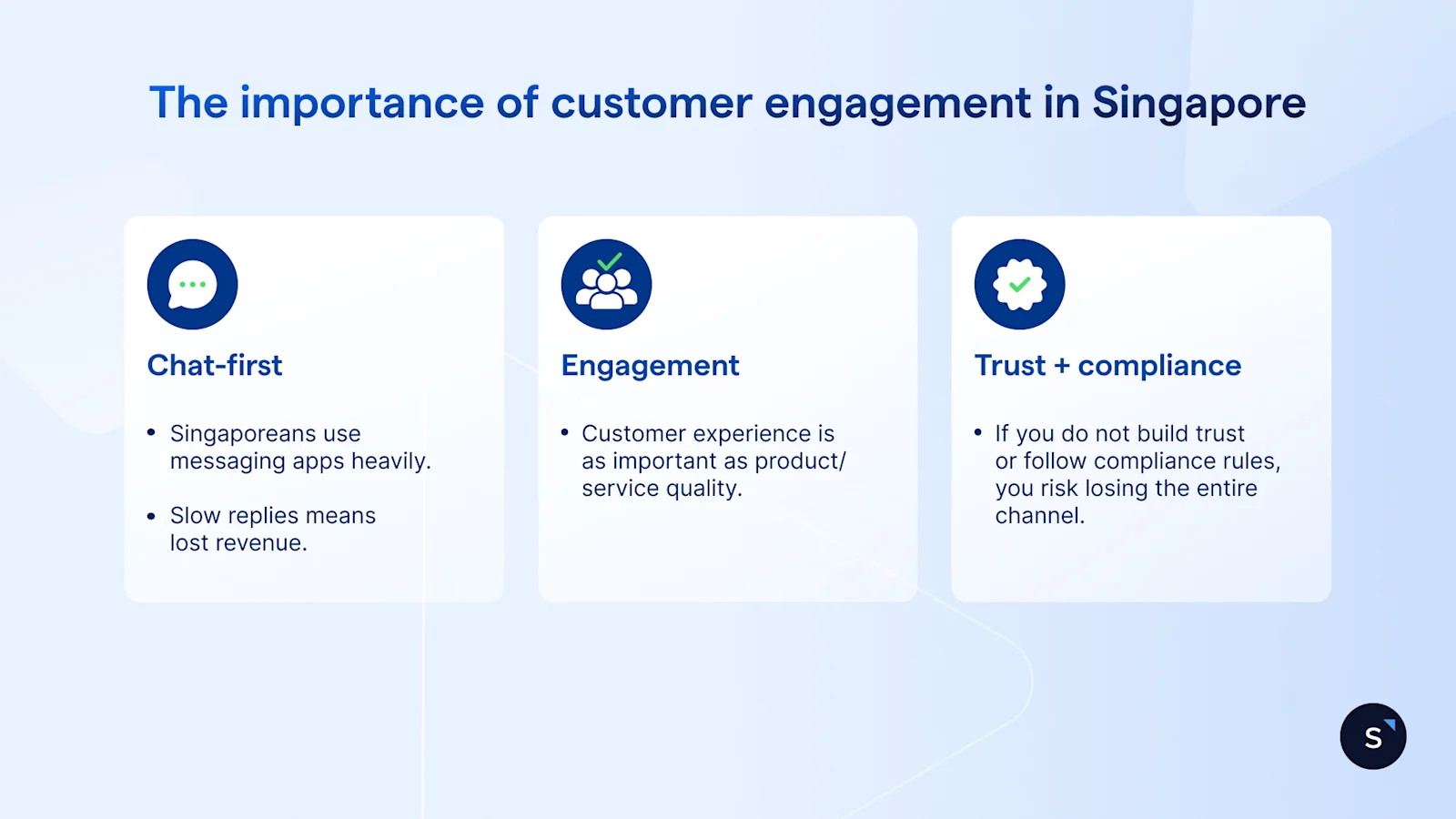
## **The importance of customer engagement in Singapore**
### **1) Singapore is messaging-first, and expectations are immediate**
Singaporeans use messaging apps heavily, and WhatsApp dominates local usage. When customers message, they often expect a near-real-time response. [Zendesk reports **72% of customers want immediate service**.](https://www.zendesk.com/sg/blog/customer-experience-statistics/) If your replies are slow or inconsistent, customers don’t “wait”—they move.
### **2) Engagement is now a revenue driver, not a “nice-to-have”**
[**80% of customers say experience is as important as products/services**](https://www.salesforce.com/service/digital-customer-engagement-platform/what-is-customer-engagement/), and customers expect consistency across departments. In practice, that means engagement impacts:
- Lead-to-sale conversion (fewer drop-offs)
- Basket size (cross-sell/upsell in chat)
- Retention (renewals, repeat orders)
- Cost to serve (automation + better routing)
### **3) Trust + compliance are part of engagement (PDPA + WhatsApp rules)**
In Singapore, engagement also includes messaging the *right* way. If customers block or report your messages, your engagement doesn’t just decline—you risk reduced reach and disruption to the channel you rely on most.
- [PDPC](https://www.pdpc.gov.sg/-/media/files/pdpc/pdf-files/advisory-guidelines/ag-on-key-concepts/advisory-guidelines-on-key-concepts-in-the-pdpa-17-may-2022.pdf) emphasises the need to notify purposes and obtain valid consent for the collection, use, and disclosure of personal data.
- [WhatsApp’s Business Messaging Policy](https://business.whatsapp.com/policy) requires respecting opt-out/block requests and avoiding spam or misleading messages.
## **How do you build a strategy for customer engagement?**
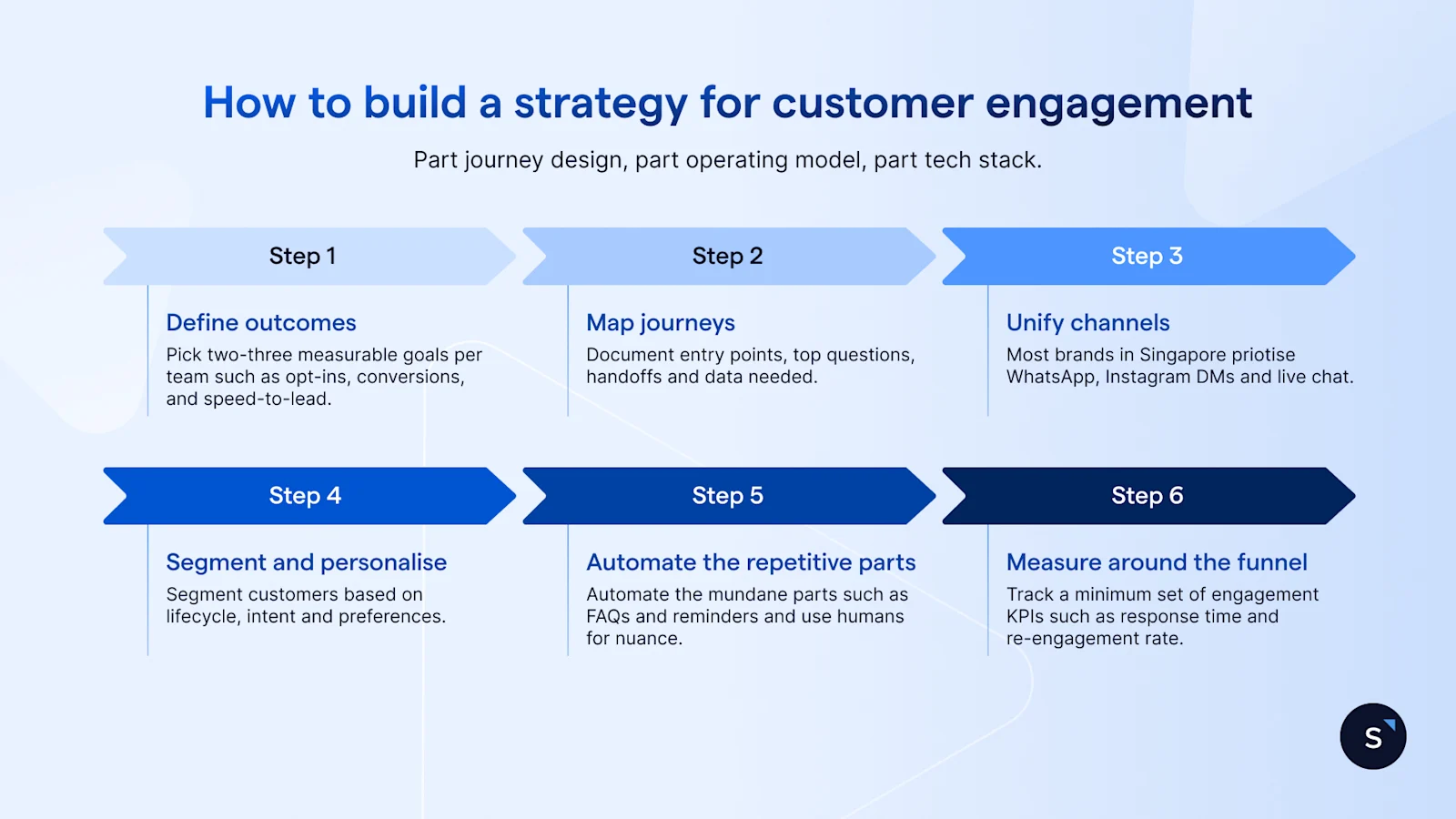
A strong **customer engagement strategy** is part journey design, part operating model, part tech stack.
### **1) Define outcomes (not channels)**
Pick 2–3 measurable goals per team:
- Marketing: opt-ins, campaign conversion, ROI
- Sales: qualified leads, speed-to-lead, close rate
- Support: first response time, resolution time, CSAT
**Quick checklist**
- ✅ What action should customers take next (buy, book, renew, refer)?
- ✅ What “moment of truth” must you win (first response, payment, resolution)?
### **2) Map your conversation journeys**
For each key journey, document:
- Entry points (Click-to-WhatsApp ads, website chat, QR in-store)
- Top questions (pricing, availability, delivery, returns)
- Handoffs (bot → agent → specialist)
- Data needed (order ID, preferred outlet, language)
### **3) Choose channels, then unify them**
For SG, most brands prioritise:
- WhatsApp (sales + support)
- Instagram DMs (discovery + lead gen)
- Website live chat (high intent)
SleekFlow [unifies these channels in a single inbox](/en-sg/inbox), so agents don’t app-switch or lose context.
### **4) Segment and personalise**
Use segmentation that customers understand:
- Lifecycle: new lead / first-time buyer / repeat / churn risk
- Intent: browsing / ready-to-buy / needs support
- Preferences: language, outlet, product category
In Singapore, be sure to keep the tone respectful and clear; avoid overly familiar personalisation unless the customer expects it.
### **5) Automate the repeatable, keep humans for nuance**
Automation should do the heavy lifting:
- FAQ capture + intent routing
- Appointment booking, order updates, and reminders
- Lead qualification forms inside chat
If you’re using WhatsApp to chat with your customer, keep forms inside the app rather than sending customers elsewhere to prevent lead drop-offs.
### **6) Measure around the funnel**
Track a minimum set of engagement KPIs:
- **Response time** (first response + average)
- **Response rate** (did customers reply?)
- **Conversion rate** (purchase/booking/renewal)
- **Re-engagement** (repeat conversations, returning customers)
- **Quality** (CSAT, escalation rate)
## Example of good customer engagement strategies
### Pristine Aroma uses WhatsApp Broadcasts to send targeted discount codes
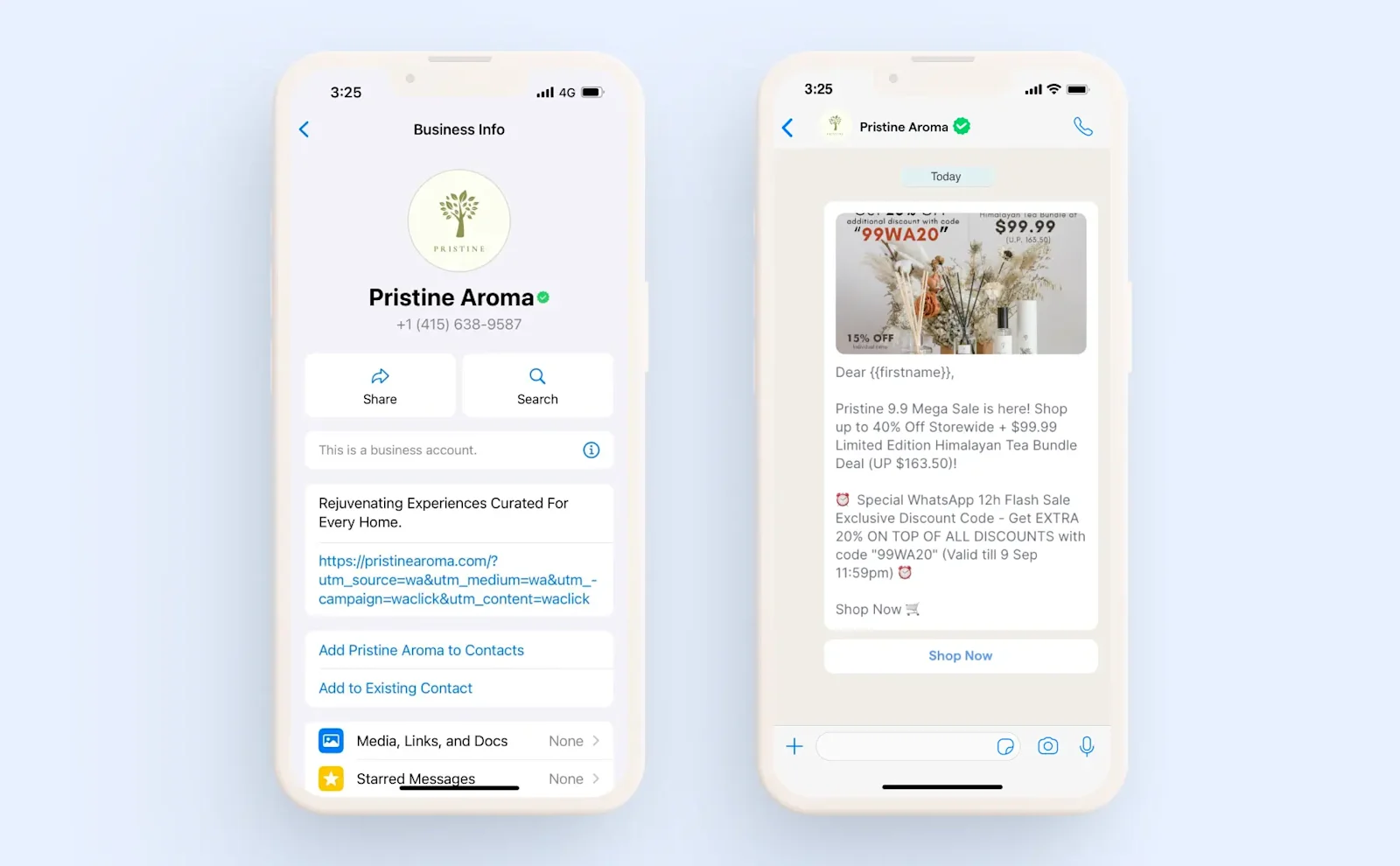
Pristine Aroma used **WhatsApp Broadcast** to turn their time-sensitive 9.9 promotion into measurable revenue. Instead of pushing customers to a generic landing page, they sent a targeted message with a unique discount code and a trackable link—so customers could move from “message received” to “checkout” with minimal steps.
**Why it worked:**
- **Clear, immediate value**: the broadcast included a **discount code**, giving customers a strong reason to act now.
- **Strong trust signals**: The Meta-verified **blue** **tick** sent a strong credibility signal that can reduce buyer hesitation.
- **Measurement built in**: **UTM tracking** made it easy to connect broadcast traffic to conversions and ROI.
- **Designed for the channel**: WhatsApp is where customers already read and reply fast— so the campaign met them in a familiar, low-friction environment.
**Results**:
- **18% conversion rate**
- **13X ROI**
- **56% open rate** and **16% click-through rate
**
## Cellini moves customer engagement seamlessly from offline-to-online with WhatsApp QR codes
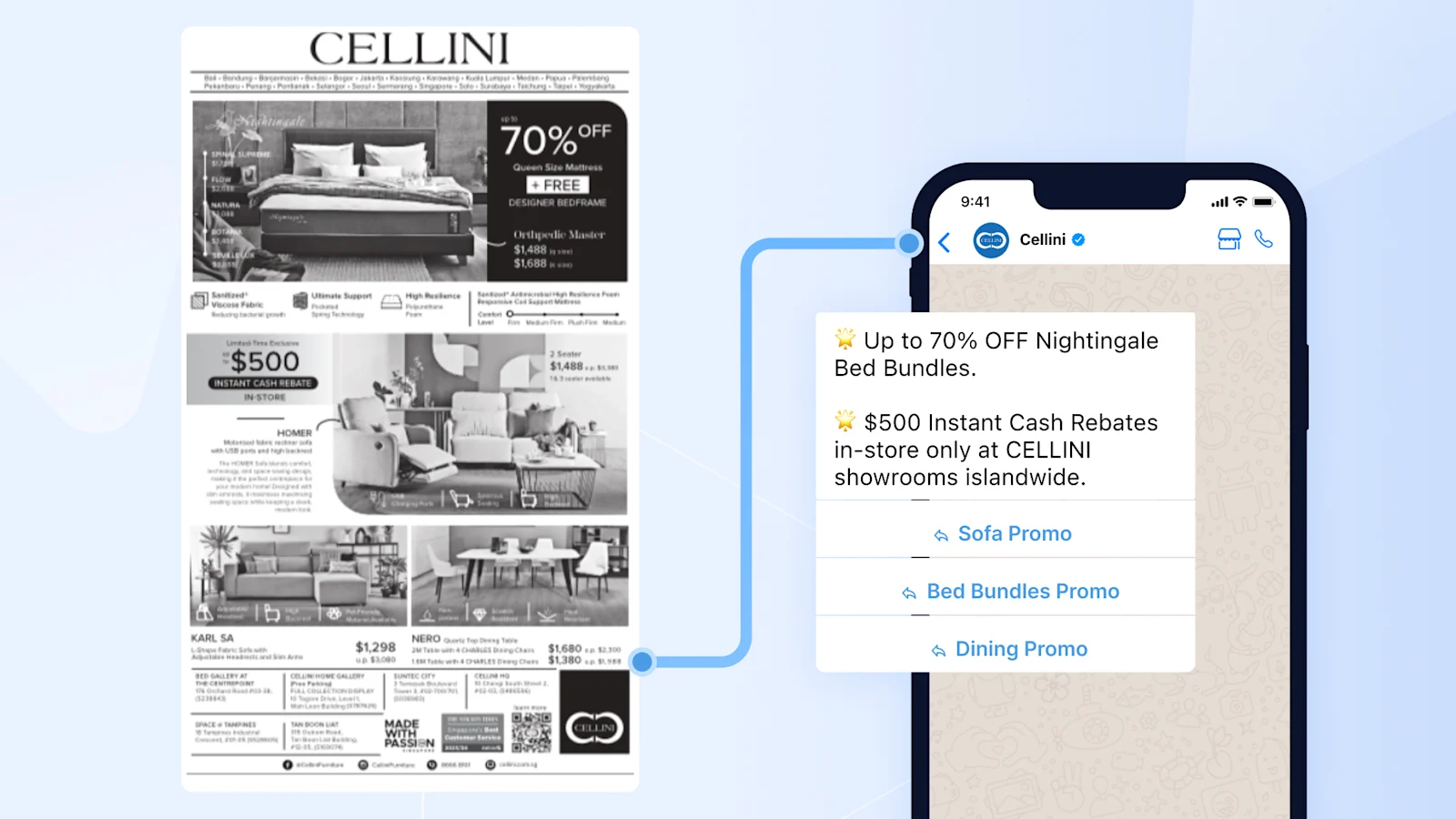
Cellini Singapore used a simple offline-to-online (O2O) play: a newspaper ad with a WhatsApp QR code that took customers straight into a chat. Scanning the code triggered an automated workflow that guided customers through the promotion and captured them as leads for retargeting.
**Why it worked**
- **Chat starts instantly** (no landing-page drop-off): customers move from “interest” to “conversation” with one tap/scan.
- **Lead data captured inside the conversation** using **WhatsApp Flows** (structured in-chat forms for sign-ups/offers), making it easier for customers to complete actions without leaving WhatsApp.
- **Follow-up broadcasts kept the brand top-of-mind**: Cellini used personalised, segmented broadcast messages, informed by sales-team feedback and campaign data, to re-engage customers at the right time.
**Results:**
- **1K+ monthly enquiries**
- **90% time saved**
- **> S$10K generated from one campaign**
## How SleekFlow can help your customer engagement strategy
SleekFlow’s omnichannel conversational AI suite for **customer engagement** helps teams manage conversations, automation, and AI across channels. If your team is already receiving enquiries via WhatsApp, Instagram, and web chat but struggling with slow replies, messy handovers, or inconsistent follow-ups, SleekFlow can help you unify conversations, automate journeys, and safely scale personalisation.
## Start for free\!
Grow your revenue and turn chats into conversions with AI agents. Try SleekFlow for free, forever.
[Start for Free\!](https://app.sleekflow.io/en?screen_hint=signup)
[View pricing](https://sleekflow.io/en-sg/pricing)
### What if a customer messages us on WhatsApp but hasn’t explicitly opted in to marketing?
You can still respond to the customer’s enquiry as a service interaction, but you shouldn’t treat that as permission to send promotional messages later. For Singapore, keep PDPA consent in mind and separate “service replies” from “marketing broadcasts”, using a clear opt-in prompt if you want to add them to future promotions.
### How should we handle customers who switch channels mid-conversation (Instagram DM → WhatsApp → web chat)?
Channel-switching often breaks context and creates privacy risks. The safest approach is to define a lightweight identity-matching rule (e.g., phone number, email, or order ID) before continuing the case across channels. If you can’t match confidently, treat it as a new case and ask one verification question before discussing account-specific details.
### What if our automation gives the wrong answer or the customer asks something sensitive (refund disputes, legal threats, regulated topics)?
Create an escalation policy for “high-risk intents” that triggers when automation stops, and a trained human takes over. Sensitive areas should use approved templates and controlled responses so your team doesn’t accidentally promise exceptions, quote incorrect policy, or create inconsistent commitments that are hard to reverse later.
### What if a customer asks to delete their data, withdraw consent, or requests a copy of what you hold about them?
Treat this as a formal privacy request rather than a normal support chat. Acknowledge the request, verify the requester’s identity before discussing any account-specific details, and route it to your Data Protection Officer (or designated owner) with a proper case record. Keep the conversation factual and avoid making promises on timelines in-chat; instead, confirm the next step (e.g., you’ll follow up via an approved channel) and ensure marketing messaging stops immediately if they’ve withdrawn consent.
### What if customers message outside business hours—should we reply instantly or wait?
If you can’t staff 24/7, you can still protect the experience by replying immediately with an acknowledgement that clearly sets expectations. A good after-hours message confirms you’ve received the enquiry, states the next response time window, and offers self-serve options for common urgent issues (tracking, payment problems, rescheduling) so customers don’t feel ignored.