---
title: "Customer intelligence: a practical guide for businesses"
description: "Learn how customer intelligence, AI, and CRM can work together to unify data and personalise journeys in Singapore."
canonical: "https://sleekflow.io/en-sg/blog/customer-intelligence-guide"
html_lang: "en-sg"
date_modified: "2026-04-13T10:59:37.433Z"
og_title: "customer intelligence guide for businesses"
og_description: "Learn how customer intelligence, AI, and CRM can work together to unify data and personalise journeys in Singapore."
og_image: "https://images.ctfassets.net/tu2uwzoyozk8/jv7U36Ukh9EPuG26vYfRg/37254a153c2feca5c6b003922293bf06/Website-Cover-SleekFlow.jpg?w=1200&q=90"
---
```json
{
"@context": "https://schema.org",
"@type": "BlogPosting",
"headline": "customer intelligence guide for businesses",
"description": "Learn how customer intelligence, AI, and CRM can work together to unify data and personalise journeys in Singapore.",
"url": "https://sleekflow.io/en-sg/blog/customer-intelligence-guide",
"dateModified": "2026-04-13T10:59:37.433Z",
"image": "https://images.ctfassets.net/tu2uwzoyozk8/jv7U36Ukh9EPuG26vYfRg/37254a153c2feca5c6b003922293bf06/Website-Cover-SleekFlow.jpg?w=1200&q=90",
"breadcrumb": {
"@type": "BreadcrumbList",
"itemListElement": [
{
"@type": "ListItem",
"position": 1,
"name": "Home",
"item": "https://sleekflow.io/en-sg"
},
{
"@type": "ListItem",
"position": 2,
"name": "Blog",
"item": "https://sleekflow.io/en-sg/blog"
},
{
"@type": "ListItem",
"position": 3,
"name": "customer intelligence guide for businesses",
"item": "https://sleekflow.io/en-sg/blog/customer-intelligence-guide"
}
]
}
}
```
# Customer intelligence: a practical guide for businesses
*Julian Wong — Content Strategist*
## Summary
- Customer intelligence turns customer data into clear action by showing what matters about each customer and what to do next.
- Customer intelligence helps businesses understand behaviour, preferences, intent, and risk across the customer journey.
- Customer intelligence works best when data from conversations, purchases, bookings, and support interactions is connected in one view.
- Customer intelligence allows teams to personalise marketing, improve sales follow-up, and deliver faster, more relevant support.
- AI-powered customer intelligence helps businesses uncover patterns, predict needs, and act on insights faster at scale.
**Customer intelligence** is what turns customer data into action. For businesses in Singapore, that matters because buyers increasingly expect fewer handoffs, less repetition, and more relevant experiences across sales, support, and marketing. Salesforce found that **7**[**5% of Singapore consumers expect consistent interactions across departments**](https://www.salesforce.com/ap/news/press-releases/2024/11/27/new-research-shows-how-ai-agents-can-step-in-as-consumer-trust-slips-in-singapore) and **71% prefer using fewer touchpoints** to get information or complete a task.
A [modern **cloud CRM**](/en-sg/blog/cloud-crm) is often the foundation for that work. It gives teams shared access to customer records over the internet, integrates with other systems, and helps keep data current across departments. But a cloud CRM alone is not **customer intelligence**. The intelligence layer comes from connecting data, interpreting behaviour and using those insights to drive the next best action.
## **What customer intelligence is**
**Customer intelligence** is the process of collecting customer data, identifying patterns in it, and using those patterns to improve how you market, sell, and support. In practice, it helps teams understand needs, preferences, intent, risk and lifetime value, then act on that knowledge in ways the customer actually notices.
| **Term** | **Main job** | **Best question it answers** |
| --- | --- | --- |
| **Customer intelligence** | Turns customer data into insight and action | What should we do next for this customer or segment? |
| **CRM** | Manages relationships, records and workflows | What is happening with this customer right now? |
| **CDP** | Unifies customer data from multiple sources | What do we know about this customer across channels? |
| **Cloud CRM** | Delivers CRM as SaaS over the internet | How do teams access and use customer data at scale? |
A useful way to think about it is this: **CRM** is your operational system, **CDP** is your data unification layer, **customer intelligence** is the decision layer, and **cloud CRM** is the delivery model that makes the operational layer more flexible and accessible.
## **How customer intelligence works**
A practical **customer intelligence** workflow usually looks like this:
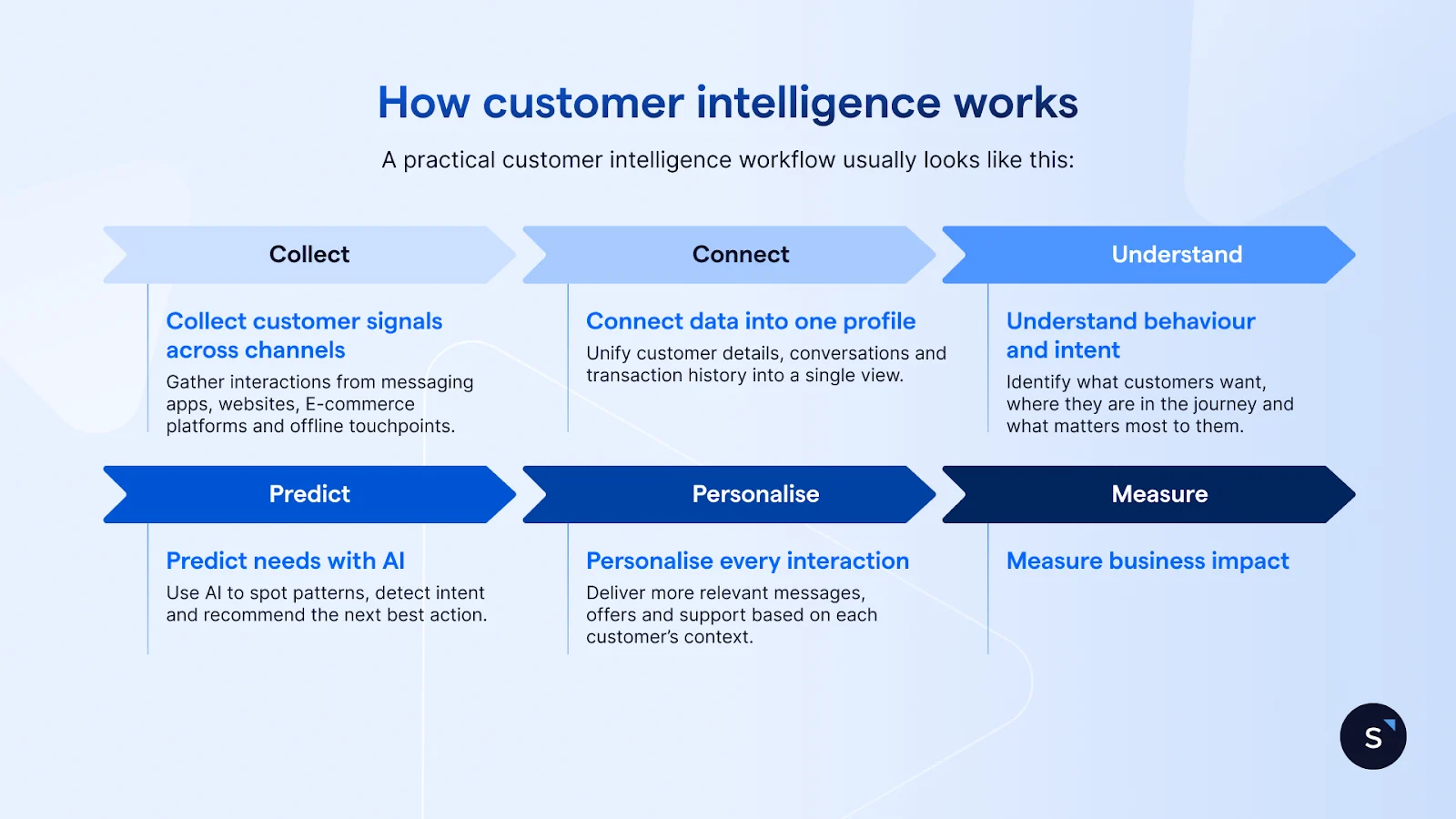
The work starts by capturing data from the places customers already use: website forms, WhatsApp, Instagram, live chat, orders, bookings, support tickets, and CRM records. A strong platform then connects those signals into a single profile, so the team does not treat one customer like five separate people. A good CRM should be able to do this by surfacing conversations, orders, and bookings side by side for a more complete customer view.
Next comes activation. Once profiles are unified, businesses can segment by behaviour, purchase history, lifecycle stage, sentiment, or intent, then trigger follow-ups, reminders, retargeting, lead routing, or service escalations. This is where your channels and integrations all come together to connect the data.The final step is measurement. Good **customer intelligence** systems do not stop at message sends or open rates. They help teams connect conversations to conversion, retention, renewal, ticket resolution, and revenue influence
## **How AI is changing customer intelligence**
**AI** is changing **customer intelligence** in three important ways: it can interpret unstructured conversation data, identify high-value patterns faster than manual review, and recommend or automate the next action.
Good [AI text analysis](/en-sg/blog/ai-text-analysis) can turn chat transcripts into structured insight through sentiment analysis, theme clustering, and trend detection, which is especially useful for teams that already receive rich feedback through WhatsApp and live chat.
This matters because many companies already have the raw data but still lack visibility. AI helps surface why customers are dropping off, which objections recur, which support issues are rising, and where service friction hurts conversion. On a modern platform, that can translate into smarter lead qualification, better routing, stronger product recommendations, and faster service recovery.
For Singapore businesses, the trust layer matters just as much as the automation layer. [64% of Singapore consumers say AI makes trust more important](https://www.salesforce.com/ap/news/press-releases/2024/11/27/new-research-shows-how-ai-agents-can-step-in-as-consumer-trust-slips-in-singapore), 76% want to know if they are communicating with an AI agent, and 60% are more likely to use one if there is a clear escalation path to a person. That means the best AI customer intelligence strategy is not “replace humans”; it is “let AI handle speed and pattern recognition while humans handle judgment, exceptions, and relationship moments”.
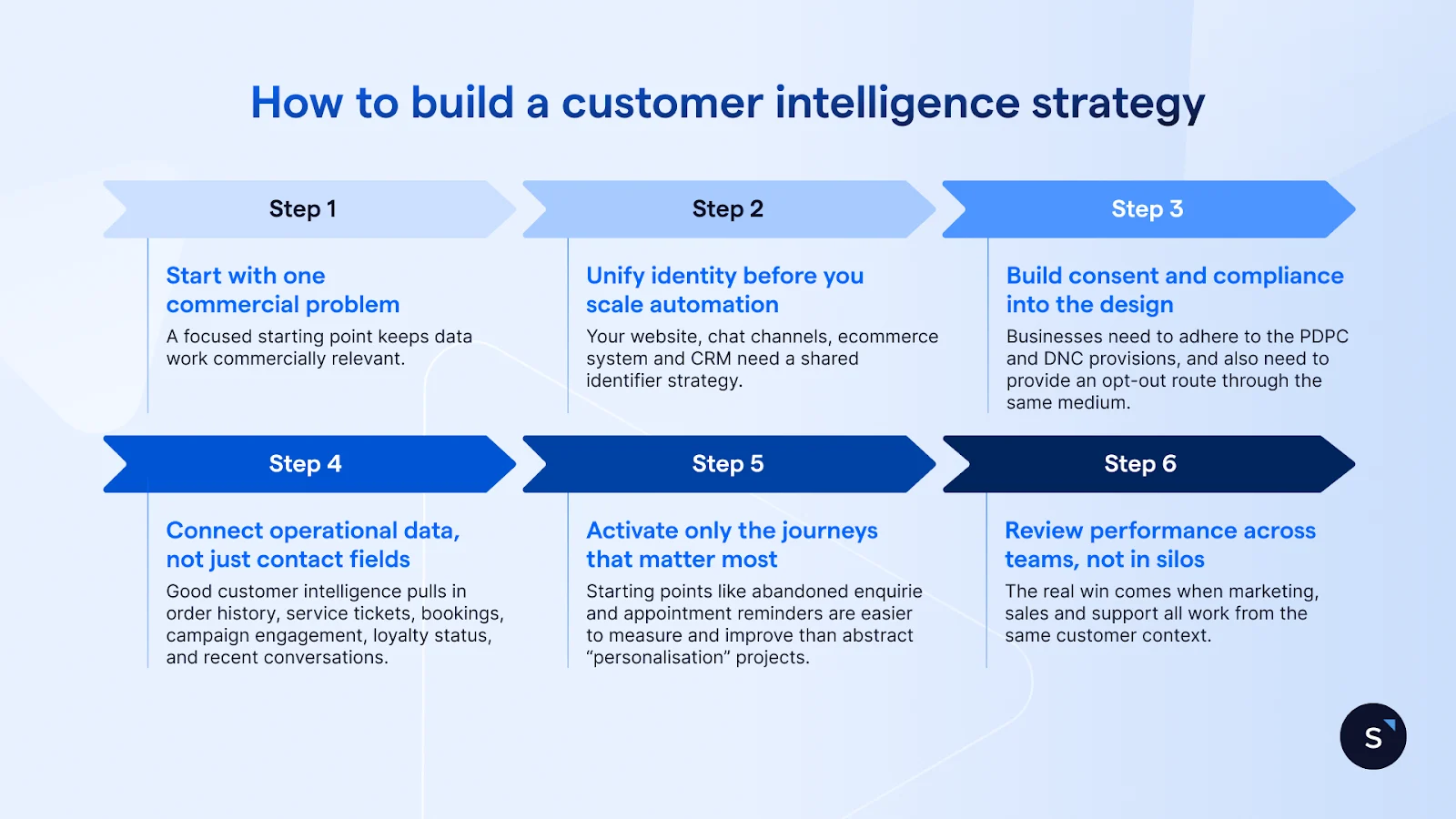
## **How to build a customer intelligence strategy**
### **1. Start with one commercial problem**
Do not begin with tooling. Begin with one business question: Which leads are most likely to convert? Which customers are at risk of churn? Which service issues are hurting repeat purchase? A focused starting point keeps data work commercially relevant.
### **2. Unify identity before you scale automation**
Your website, chat channels, ecommerce system, and CRM need a shared identifier strategy. Phone number, email, loyalty ID, or account ID all work, but you need a clear rule for matching records. Without that, personalisation becomes guesswork. **CDPs** and well-integrated **cloud CRMs** exist to solve exactly this problem.
### **3. Build consent and compliance into the design**
For Singapore businesses, compliance is not a post-launch clean-up task. The PDPC states that the DNC provisions generally prohibit marketing messages to Singapore telephone numbers listed in the DNC Registry, unless you have clear and unambiguous consent. Businesses also need to provide an opt-out route through the same medium, stop sending within 21 days of an opt-out request, and take responsibility for personal data under their control.
### **4. Connect operational data, not just contact fields**
Good **customer intelligence** goes beyond names and phone numbers. It pulls in order history, service tickets, bookings, campaign engagement, loyalty status, and recent conversations.
### **5. Activate only the journeys that matter most**
High-impact starting points are usually abandoned enquiries, lead qualification, appointment reminders, renewal nudges, VIP retargeting and post-purchase service recovery. These are easier to measure and improve than abstract “personalisation” projects.
### **6. Review performance across teams, not in silos**
The real win comes when marketing, sales, and support all work from the same customer context. CRM systems centralise customer data and support cross-department collaboration, while integration removes silos and keeps teams working from current information.
## **How to measure customer intelligence success**
You do not measure **customer intelligence** by the amount of data you collect. You measure it by the quality of the decisions and outcomes it improves.
| **KPI** | **What it shows** | **Why it matters** |
| --- | --- | --- |
| Lead-to-qualified lead rate | Whether intelligence improves targeting and routing | Shows if better context is producing better sales conversations |
| First response time | How quickly teams engage customers | Strong proxy for chat-based conversion and service quality |
| Conversion or renewal rate | Whether personalisation and follow-up are working | Best commercial proof of value |
| Repeat purchase/retention | Whether customer context improves long-term relationships | Shows intelligence beyond first-sale activity |
| Campaign revenue influence | Whether targeted outreach drives commercial return | Connects messaging to revenue |
| Resolution time / first contact resolution | Whether support teams have enough context to solve faster | Links customer data quality to service efficiency |
SleekFlow’s [analytics dashboards](/en-sg/analytics) are built to track customer journey events, conversion steps and performance trends so teams can optimise based on actual outcomes, not assumptions.
## Real life examples of customer intelligence in businesses
### **Marketing: smarter segmentation and re-engagement**
[Awfully Chocolate in Singapore](/en-sg/customer-stories/awfully-chocolate) is a strong example of **customer intelligence** in action. With Shopify data syncing into SleekFlow, the team can view recently viewed products, purchase history and customer preferences alongside conversations, then use that context for personalised support and targeted promotional broadcasts. The result: **2X faster response**, **2K+ new enquiries monthly** and a **90% read rate**.
### **Sales and renewals: route, qualify and recover demand faster**
[HKBN used targeted WhatsApp campaigns and automation](/en-sg/customer-stories/hkbn) to reach customers who were difficult to contact by phone. By combining segmentation, automation and team access in one operational flow, the business achieved a **95% read rate**, **50% response rate** and **35% renewal success rate** in a renewal campaign. That is not just messaging efficiency; it is **customer intelligence** improving revenue outcomes.
### **Support and operations: keep context next to the conversation**
[**Sun and Moon Massage**](/en-sg/customer-stories/sunandmoon-use-case) shows how **customer intelligence** improves service operations in practice: by giving teams visibility into appointment data and customer conversations in one place, the business increased successful bookings by **30%**. For support and operations teams, that means less tab-switching, less repeated questioning, and faster action, because bookings, tickets, and other customer records sit next to the conversation rather than being scattered across systems.
## Want to see how SleekFlow can enhance your sales process?
Book a demo today and experience the power of AI-driven conversational intelligence firsthand.
[Start free](https://app.sleekflow.io/en?screen_hint=signup)
[View pricing](https://sleekflow.io/en-sg/pricing)
### What is the best first use case for AI customer service?
The best place to start is with a high-volume, low-risk journey that already puts pressure on your team. For most businesses, that means FAQs, order or booking updates, appointment reminders, simple triage, or after-hours enquiries. These use cases are easier to train and measure, and more likely to quickly improve response times without compromising service quality.
### What happens when AI gives the wrong answer?
That usually points to weak source content, missing guardrails or poor escalation logic. The fix is to ground AI in approved knowledge, define clear handoff triggers and keep human review for high-risk or sensitive intents.
### Can regulated or high-trust industries use AI in customer service?
Yes, but only when the platform is built with the right controls. SleekFlow is ISO 27001-certified and SOC 2 Type II certified, and its security stack includes role-based access control, data masking, IP whitelisting and audit logs. That makes it a strong fit for businesses operating in regulated environments that need tighter access controls, traceability and protection for sensitive customer data.