---
title: "Customer lifecycle stages: how to map, measure, and act on each one"
description: "The 5 customer lifecycle stages explained, with the metric, action, and automation that keeps each stage accurate."
canonical: "https://sleekflow.io/en-sg/blog/customer-lifecycle-stages"
html_lang: "en-sg"
date_modified: "2026-08-13T07:50:25.136Z"
og_title: "Customer lifecycle stages: the 5 stages explained"
og_description: "The 5 customer lifecycle stages explained, with the metric, action, and automation that keeps each stage accurate."
og_image: "https://images.ctfassets.net/tu2uwzoyozk8/2DeR3KfpimPx4sE9Nvz2y4/b6e6adab2fa33deb6e83921b1c6dce0a/pasted-image-1.png?fm=webp&q=90&w=1200"
---
```json
{
"@context": "https://schema.org",
"@type": "Article",
"headline": "Customer lifecycle stages: the 5 stages explained",
"description": "The 5 customer lifecycle stages explained, with the metric, action, and automation that keeps each stage accurate.",
"url": "https://sleekflow.io/en-sg/blog/customer-lifecycle-stages",
"dateModified": "2026-08-13T07:50:25.136Z",
"image": "https://images.ctfassets.net/tu2uwzoyozk8/2DeR3KfpimPx4sE9Nvz2y4/b6e6adab2fa33deb6e83921b1c6dce0a/pasted-image-1.png?fm=webp&q=90&w=1200",
"breadcrumb": {
"@type": "BreadcrumbList",
"itemListElement": [
{
"@type": "ListItem",
"position": 1,
"name": "Home",
"item": "https://sleekflow.io/en-sg"
},
{
"@type": "ListItem",
"position": 2,
"name": "Blog",
"item": "https://sleekflow.io/en-sg/blog"
},
{
"@type": "ListItem",
"position": 3,
"name": "Customer lifecycle stages: the 5 stages explained",
"item": "https://sleekflow.io/en-sg/blog/customer-lifecycle-stages"
}
]
}
}
```
# Customer lifecycle stages: how to map, measure, and act on each one
*Julian Wong — Content Strategist*
## Summary
- The 5 customer lifecycle stages are awareness, engagement, conversion, retention, and loyalty.
- Every stage needs its own metric, or you cannot tell where customers are stalling.
- Customer lifecycle management is the strategy; a customer database is the system that stores it.
- Retention economics justify the work, because small retention gains compound into large profit gains.
- Stage records go stale within weeks when agents update them by hand, so automation is a data-accuracy requirement.
A shopper messages your Instagram at 11pm asking whether you deliver to Punggol. Your team replies, she buys, and she is delighted. Then 9 months pass, she has not bought again, and her contact record still says "new lead."
Nothing broke. The record simply stopped reflecting reality the moment the sale closed, which is what happens when a lifecycle stage is a label someone types rather than a state the system tracks.
## **What is customer lifecycle management?**
**Customer lifecycle management** is a strategy that tracks and guides customers through every stage of their relationship with a business, from first awareness to long-term loyalty. It assigns a metric and an action to each stage, so teams can see where customers stall and step in before they leave.
| | **Customer lifecycle management** | **Customer database (CRM)** |
| --- | --- | --- |
| **What it is** | The approach to moving customers through stages | The system that stores contacts, deals, and history |
| **Owns** | Stage definitions, metrics, and triggers | Records, fields, and reporting |
| **Answers** | "Where is this customer, and what happens next?" | "What do we know about this customer?" |
| **Fails when** | Stages are undefined or unmeasured | Data is entered late, partially, or never |
One is the plan, the other is where the plan is written down. Plenty of teams own the database and have no lifecycle strategy.
## **What are the 5 customer lifecycle stages?**
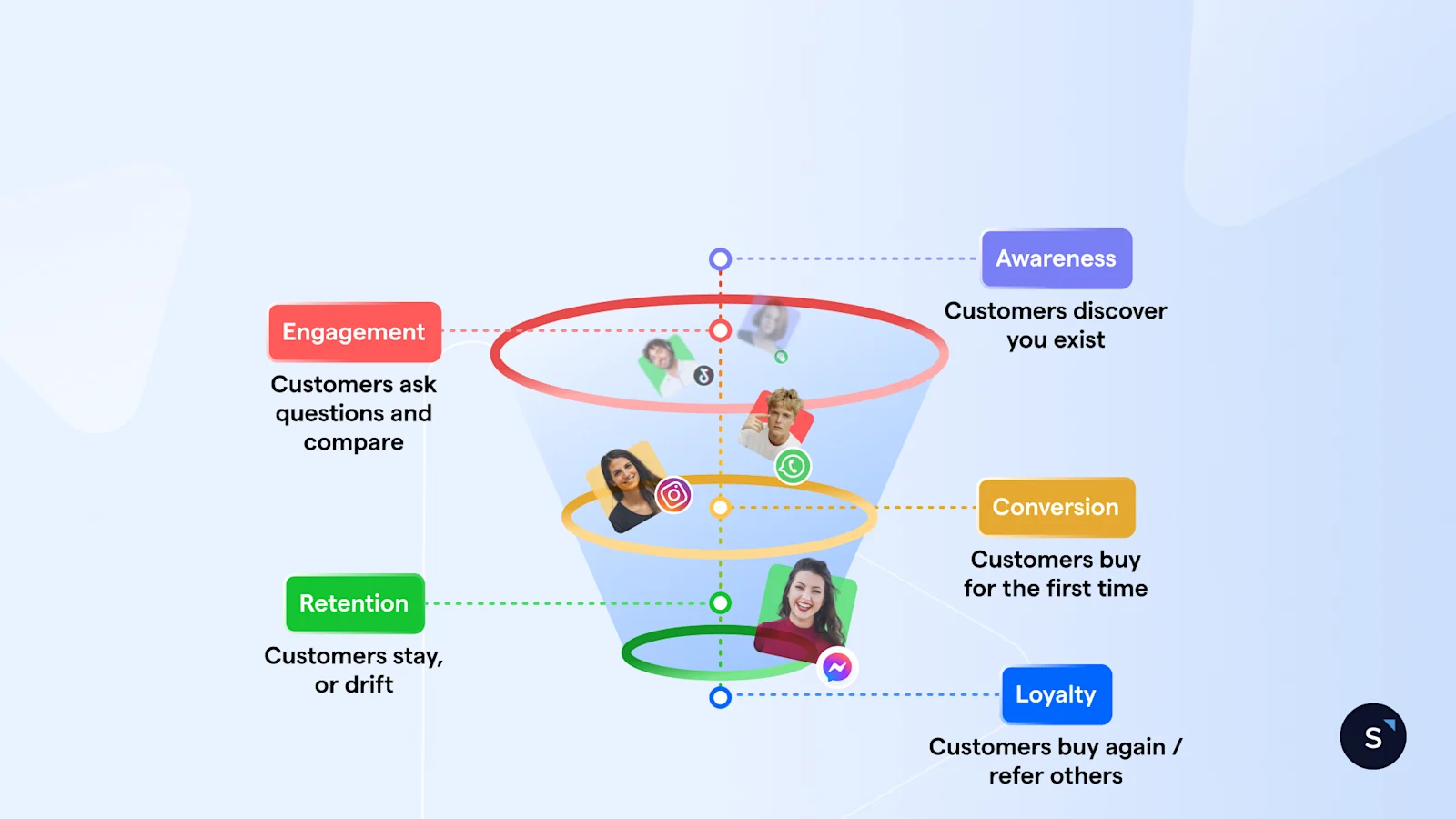
The 5 **customer lifecycle stages** are awareness, engagement, conversion, retention, and loyalty. Each describes a different relationship with your business, from a stranger who has just discovered you to a repeat buyer who recommends you. Naming them matters less than giving each one a metric and an owner.
| **Stage** | **What is happening** | **Metric that tells you it works** | **Typical action** |
| --- | --- | --- | --- |
| **Awareness** | The customer discovers you exist | Reach, impressions, new enquiries | Be findable and answer fast |
| **Engagement** | They ask questions and compare | Reply rate, conversation depth | Qualify and personalise |
| **Conversion** | They buy for the first time | Conversion rate, average order value | Remove friction at checkout |
| **Retention** | They stay, or they drift | Repeat purchase rate, churn | Follow up after the order |
| **Loyalty** | They buy again and refer others | Customer lifetime value, referral rate | Reward and ask for advocacy |
The stages are not strictly linear: a retained customer can go quiet, then re-enter engagement when a friend mentions your new product. The labels are yours to change, too. A confinement caterer and a car dealership do not share a funnel.
## **Why customer lifecycle stages matter for Singapore businesses**
Singapore is close to saturated online.[ 98.4% of the population used the internet and 90.6% held a social media identity](https://datareportal.com/reports/digital-2026-singapore) in DataReportal's Digital 2026 report, and[ 14.8% of total retail sales were online in December 2025](https://data.gov.sg/datasets/d_65e4d47c3616d251f9a84ec1ad28f43c/view) according to SingStat. Acquisition is expensive here because everyone is already reachable, and already being reached.
That pushes the value to the back half of the lifecycle. Bain's Fred Reichheld put it plainly:[ an increase in customer retention rates of 5% increases profits by 25% to 95%](https://www.bain.com/contentassets/29f74ec417fa4e36a1d7d7e7479badc5/loyalty_rules_chapter_one.pdf). Lifecycle stages earn their keep by making retention and loyalty visible instead of assumed.
Relevance is the second argument. McKinsey's 2021 personalisation research found[ 71% of consumers expect personalised interactions and 76% get frustrated without them](https://www.mckinsey.com/capabilities/growth-marketing-and-sales/our-insights/the-value-of-getting-personalization-right-or-wrong-is-multiplying). Treat the figure as a direction rather than a 2026 measurement. Knowing someone's stage is what separates a relevant message from a generic one.
## **How to manage the customer lifecycle, step by step**
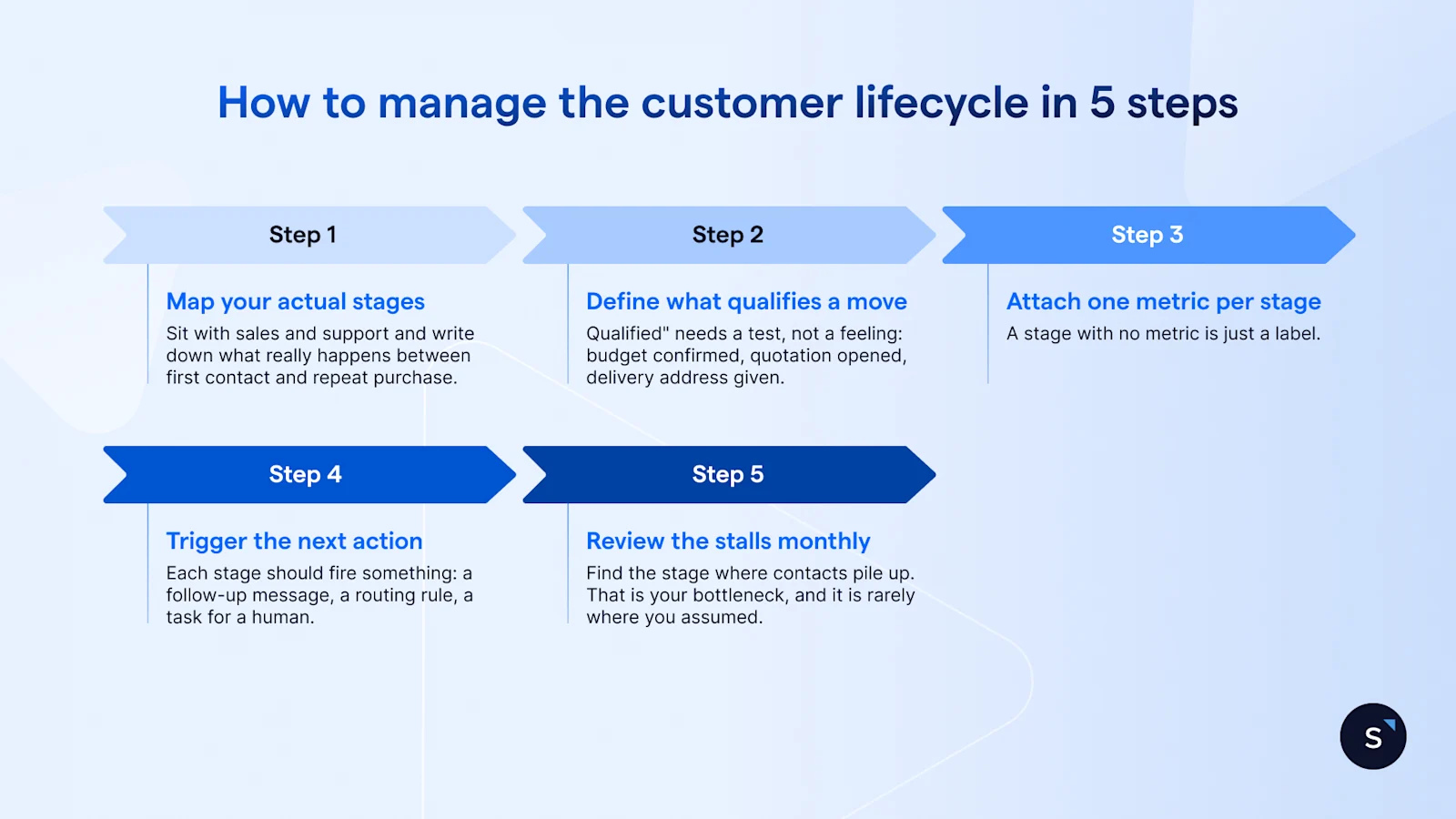
Managing the **stages of the customer lifecycle** means defining your stages, attaching a metric and a trigger to each, keeping the stage field current, and reviewing monthly where customers get stuck. 5 steps, short to describe and hard to sustain, because the work is maintenance, not design.
1. **Map your actual stages.** Sit with sales and support and write down what really happens between first contact and repeat purchase. Use their words.
1. **Define what qualifies a move.** "Qualified" needs a test, not a feeling: budget confirmed, quotation opened, delivery address given.
1. **Attach one metric per stage.** A stage with no metric is a label.
1. **Trigger the next action.** Each stage should fire something: a follow-up message, a routing rule, a task for a human.
1. **Review the stalls monthly.** Find the stage where contacts pile up. That is your bottleneck, and it is rarely where you assumed.
## **Customer lifecycle management best practices**
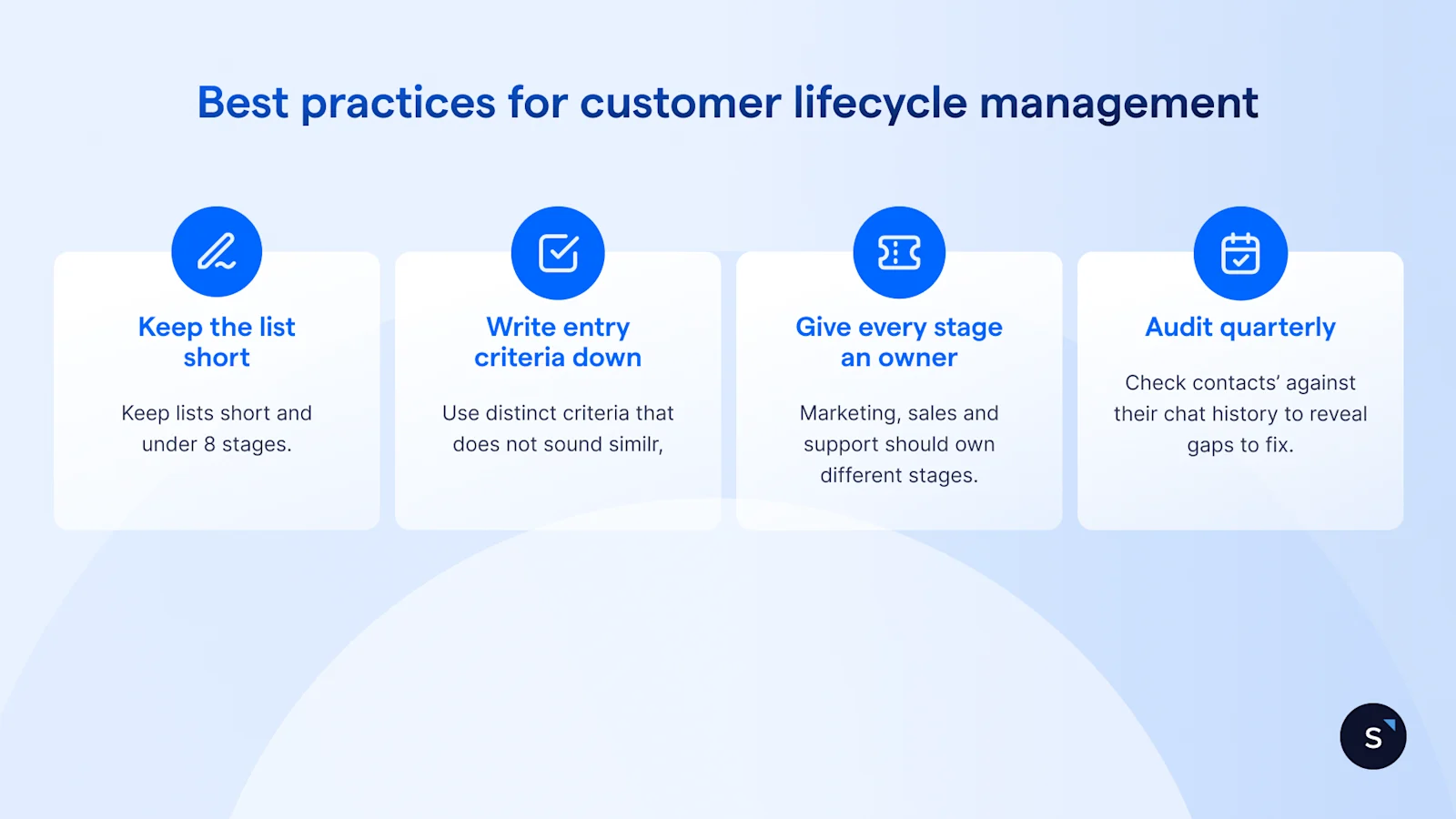
Good **customer lifecycle management** comes down to fewer stages than you think, clear entry criteria, current data, and one named owner per stage. Most programmes fail on the third: the stage model is sound, and the records behind it are weeks behind reality.
- **Keep the list short.** Under 8 stages. A 14-stage funnel is a form nobody fills in.
- **Write the entry criteria down.** If two agents would classify the same contact differently, the criteria are too vague.
- **Give every stage an owner.** Marketing owns awareness and engagement, sales owns conversion, support owns retention and loyalty.
- **Audit quarterly.** Check 20 contacts' stages against their chat history. The gap is the real state of your programme.
## **How automation and AI keep lifecycle data current**
Automation keeps lifecycle data accurate by reading what happened in a conversation and updating the stage without waiting for an agent to remember. AI transition rules can move a contact from engagement to conversion when a payment link is opened, or flag a retention-stage customer who has gone silent, so the record follows behaviour, not intention.
Manual updates depend on an agent finishing a conversation, remembering the field exists, and choosing the right value. Under real message volume, that third step is the first to go.
## **How SleekFlow helps you manage the customer lifecycle**
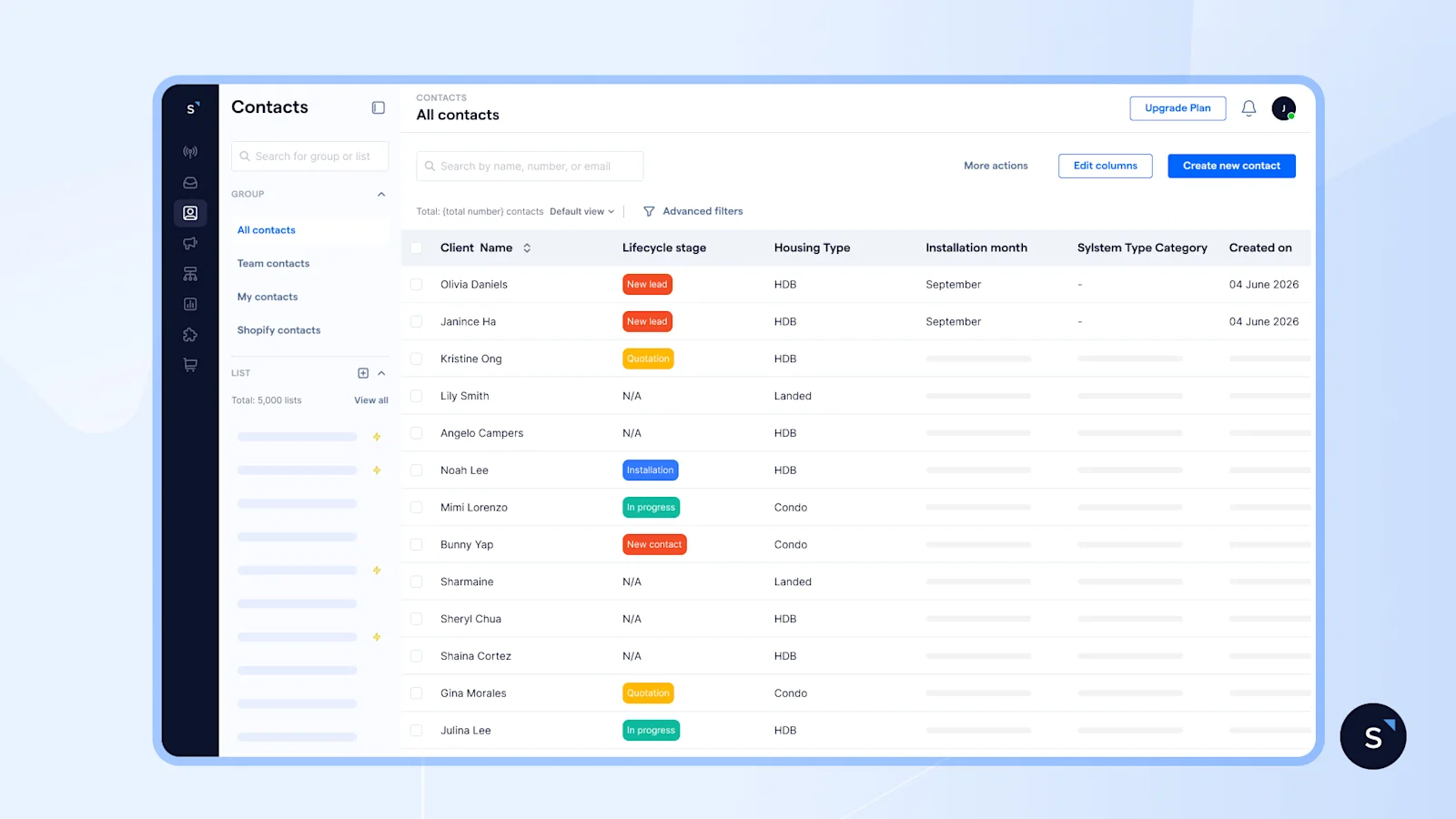
SleekFlow is the AI suite for revenue-driving conversations, built for teams whose customers arrive by message, not by form. It handles lifecycle stages where the conversation already happens, on WhatsApp, Instagram, Messenger, and live chat, so the stage updates as part of the conversation instead of after it.
Its[ lifecycle management and Kanban view](https://sleekflow.io/en-sg/blog/lifecycle-management) lets you define your own stages, see deal value at each, and set natural-language rules that move a contact when the conversation meets your criteria.
[AgentFlow](https://sleekflow.io/agentflow), the AI agent product inside the suite, works the conversation itself: qualifying inbound leads, booking appointments, and resolving issues, with its reasoning visible so you can check its decisions.
**SACES** (Solar Air-Conditioning & Electrical Services), a family-run Singapore air-conditioning business trading for more than 30 years, handled enquiries across WhatsApp, Facebook, and Instagram with no single view of who was new and who was returning. It now uses contact management and lifecycle stages to track where each customer sits, logs service history against the contact, and labels contacts by job type and status. AI agents qualify and score inbound enquiries before a human picks them up.
Results:
- 75% enquiry-to-booking conversion
- 90% faster response time
- More than 60% of incoming enquiries handled by AI agents
[Read the full case study →](https://sleekflow.io/customer-stories/saces)
## **Start with one stage**
Pick the stage where contacts pile up, define what moves someone out of it, and measure it for a month. That single change surfaces more than a full redesign will. To see stage transitions handled inside the conversation itself,[ book a SleekFlow demo](https://sleekflow.io/en-sg/book-a-demo).
## Start with one stage
Pick the stage where contacts pile up, define what moves someone out of it, and measure it for a month. That single change surfaces more than a full redesign will. To see stage transitions handled inside the conversation itself, book a personalised demo.
[Book a Demo](https://sleekflow.io/en-sg/book-a-demo)
[View Pricing](https://sleekflow.io/en-sg/pricing)
### What is customer lifecycle management?
Customer lifecycle management is the practice of tracking and guiding customers through each stage of their relationship with a business, from first awareness to long-term loyalty. It assigns a metric to each stage and uses that data to improve retention, personalise engagement, and raise lifetime value rather than treating every customer alike.
### What are the 5 stages of the customer lifecycle?
The 5 customer lifecycle stages are awareness, engagement, conversion, retention, and loyalty. Awareness is first discovery, engagement is active interaction, conversion is the first purchase, retention is keeping them satisfied afterwards, and loyalty is when they buy again and recommend you.
### What is the difference between customer lifecycle management and a CRM?
A CRM is the software that stores customer data, contacts, and interaction history. Customer lifecycle management is the broader strategy of moving customers through each stage. The CRM is the tool; lifecycle management is the approach that uses it, plus your channels and data, to manage the relationship.
### How do you measure customer lifecycle stages?
Assign one metric per stage. Awareness tracks reach and new enquiries, engagement tracks reply rate, conversion tracks conversion rate and average order value, retention tracks repeat purchase and churn, and loyalty tracks lifetime value and referrals. Read them together to find where customers stall.
### How does automation help with customer lifecycle management?
Automation keeps stage data current and cuts manual admin. AI can update a contact's stage from what happens in the conversation, trigger the right follow-up, and surface customers who have gone quiet. Teams act on real-time data instead of records weeks out of date, which is where manual tracking breaks.