---
title: "Email marketing campaigns: a guide to higher ROI"
description: "Learn how to build email campaigns that drive opens, clicks, and revenue. Includes AI tactics, campaign examples, and a step-by-step build guide."
canonical: "https://sleekflow.io/en-sg/blog/email-marketing-campaigns"
html_lang: "en-sg"
date_modified: "2026-06-23T10:27:45.481Z"
og_title: "Email marketing campaigns: a guide to higher ROI"
og_description: "Learn how to build email campaigns that drive opens, clicks, and revenue. Includes AI tactics, campaign examples, and a step-by-step build guide."
og_image: "https://images.ctfassets.net/tu2uwzoyozk8/jv7U36Ukh9EPuG26vYfRg/37254a153c2feca5c6b003922293bf06/Website-Cover-SleekFlow.jpg?w=1200&q=90"
---
```json
{
"@context": "https://schema.org",
"@type": "Article",
"headline": "Email marketing campaigns: a guide to higher ROI",
"description": "Learn how to build email campaigns that drive opens, clicks, and revenue. Includes AI tactics, campaign examples, and a step-by-step build guide.",
"url": "https://sleekflow.io/en-sg/blog/email-marketing-campaigns",
"dateModified": "2026-06-23T10:27:45.481Z",
"image": "https://images.ctfassets.net/tu2uwzoyozk8/jv7U36Ukh9EPuG26vYfRg/37254a153c2feca5c6b003922293bf06/Website-Cover-SleekFlow.jpg?w=1200&q=90",
"breadcrumb": {
"@type": "BreadcrumbList",
"itemListElement": [
{
"@type": "ListItem",
"position": 1,
"name": "Home",
"item": "https://sleekflow.io/en-sg"
},
{
"@type": "ListItem",
"position": 2,
"name": "Blog",
"item": "https://sleekflow.io/en-sg/blog"
},
{
"@type": "ListItem",
"position": 3,
"name": "Email marketing campaigns: a guide to higher ROI",
"item": "https://sleekflow.io/en-sg/blog/email-marketing-campaigns"
}
]
}
}
```
# Email marketing campaigns: a guide to higher ROI
*Julian Wong — Content Strategist*
## Summary
- Email delivers $36 to $42 per $1 spent, higher than paid search and social advertising.
- Automated, behaviour-triggered emails account for 2% of sends but drive 30% of email revenue.
- Subject lines, preview text, and CTAs are the three highest-impact levers on campaign performance.
- AI can lift open rates by up to 26% through subject line generation and smarter audience segmentation.
- Email campaigns perform better when connected to WhatsApp or SMS, not run as isolated sends.
## **What is an email marketing campaign?**
A campaign is not a single send. It is a coordinated series of emails aligned to one goal, with a defined audience, a planned sequence, and a clear call to action at each step.
A one-off promotional email is a broadcast. A three-email abandoned cart sequence, timed across 48 hours and triggered by behaviour, is a campaign. The latter consistently outperforms the former on open rate, click-through rate, and revenue per send.
## **What makes an email marketing campaign high-performing?**
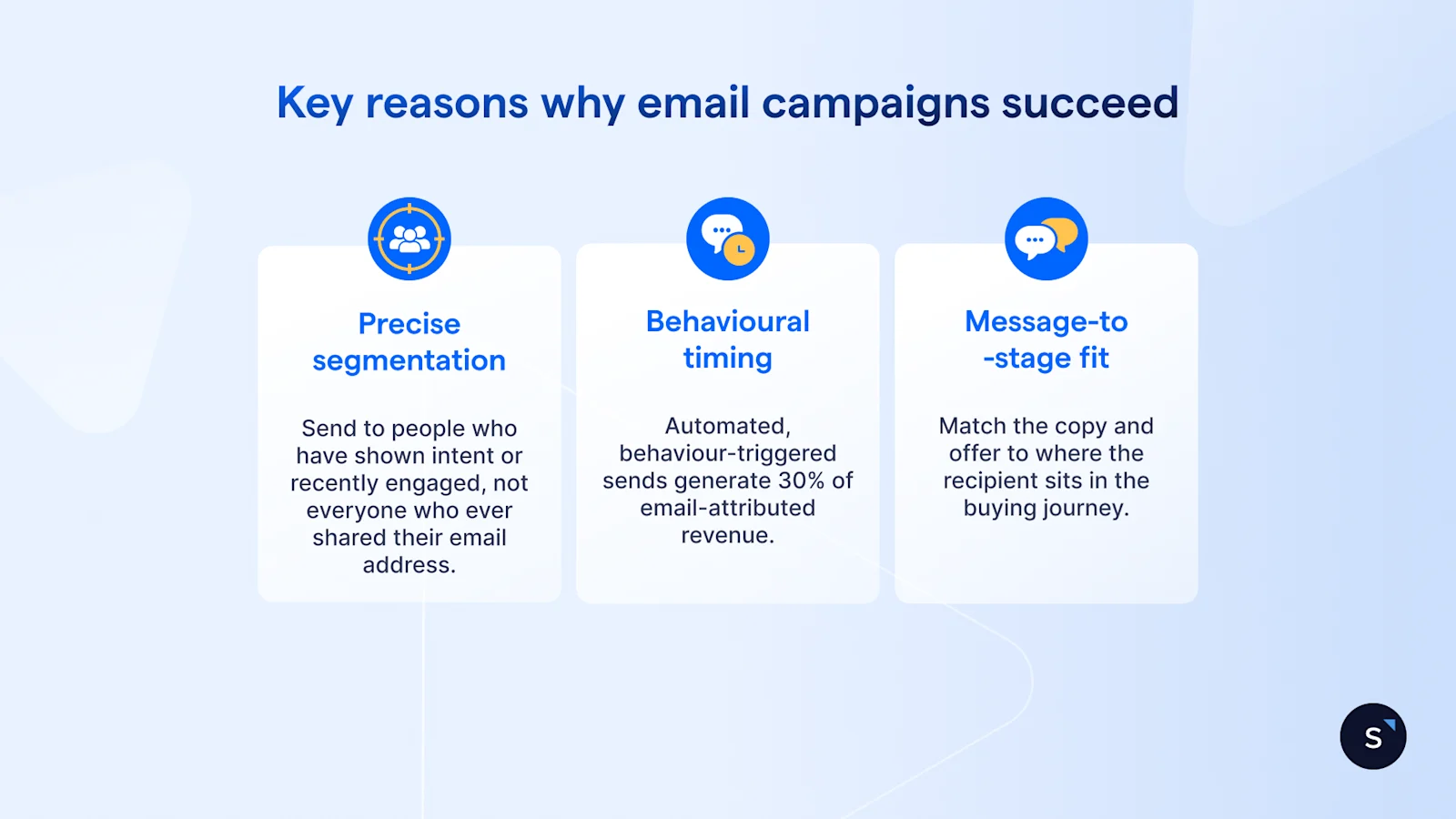
Most campaigns underperform for the same three reasons: wrong audience, wrong message, wrong timing.
- **Precise segmentation.** A well-segmented list outperforms a broad one. Send to people who have shown intent or recently engaged, not everyone who ever shared their email address.
- **Behavioural timing.**[ Automated, behaviour-triggered sends](https://www.omnisend.com/blog/email-marketing-statistics/) make up 2% of all email volume but generate 30% of email-attributed revenue.
- **Message-to-stage fit.** Match the copy and offer to where the recipient sits in the buying journey. A welcome email and a re-engagement email have different jobs.
## **How to choose the right type of email campaign**
The right campaign type depends on where your audience sits in the customer lifecycle.
| **Campaign type** | **Primary goal** | **Key metric** |
| --- | --- | --- |
| Welcome series | Build trust, set expectations | Open rate, list retention |
| Promotional campaign | Drive sales or sign-ups | Conversion rate, revenue |
| Abandoned cart | Recover lost sales | Recovery rate, revenue per send |
| Re-engagement | Reactivate cold subscribers | Click rate, unsubscribe rate |
| Post-purchase | Upsell, build loyalty | Repeat purchase rate |
| Nurture / drip series | Move leads through the funnel | CTR, qualified leads |
## **How to build an email marketing campaign, step by step**
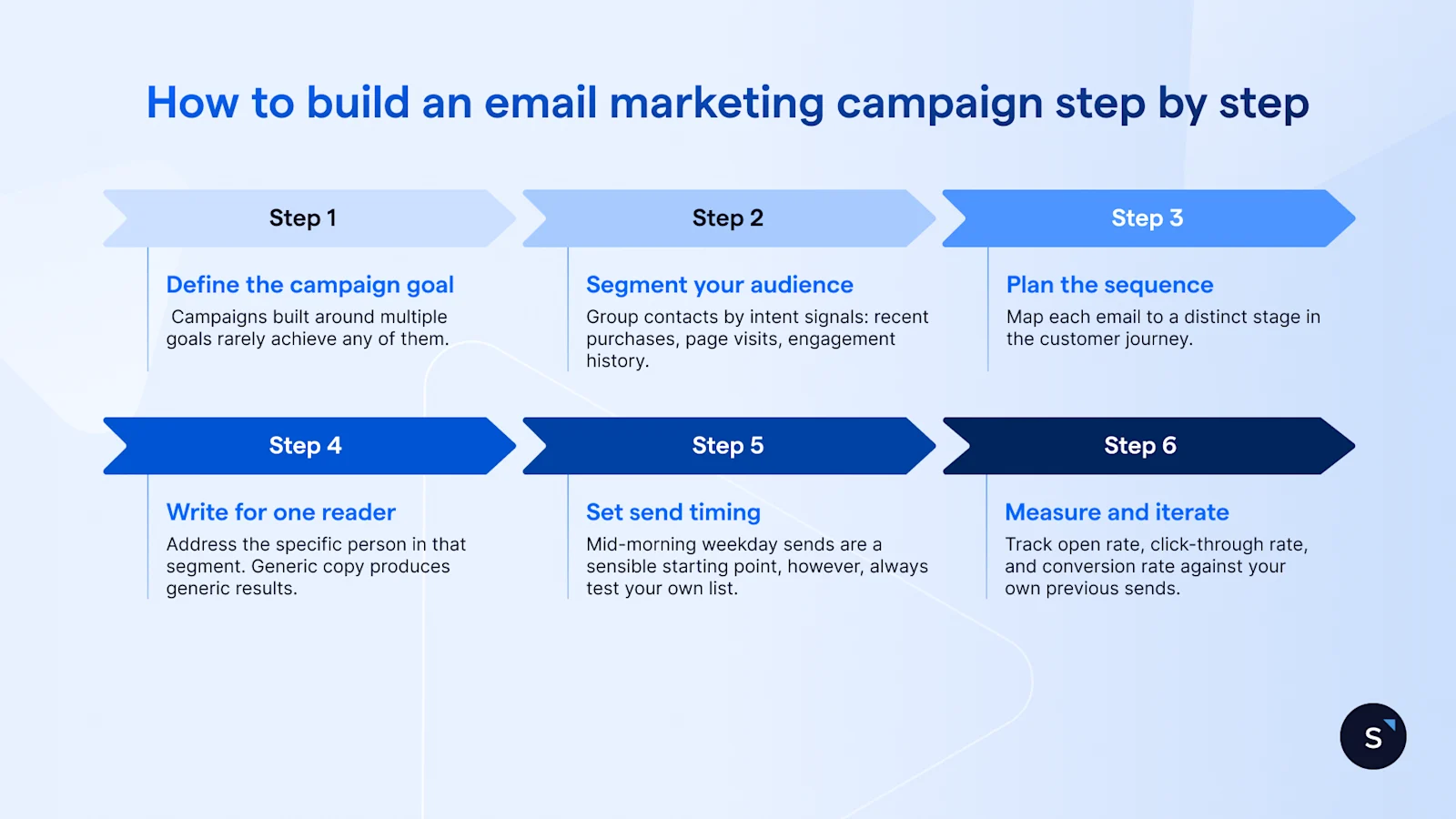
**Step 1: Define one clear goal.** Revenue, sign-ups, re-engagement. Campaigns built around multiple goals rarely achieve any of them.
**Step 2: Segment your audience.** Group contacts by intent signals: recent purchases, page visits, engagement history.
**Step 3: Plan the sequence.** Map each email to a distinct stage in the customer journey. Most effective campaigns run three to five emails.
**Step 4: Write for one reader.** Address the specific person in that segment. Generic copy produces generic results.
**Step 5: Set send timing.** For Singapore-based audiences, mid-morning weekday sends are a sensible starting point. Always test your own list.
**Step 6: Measure and iterate.** Track open rate, click-through rate, and conversion rate against your own previous sends, not industry averages.
## **Subject lines, preview text, and CTA: the three biggest performance levers**
### **Subject lines**
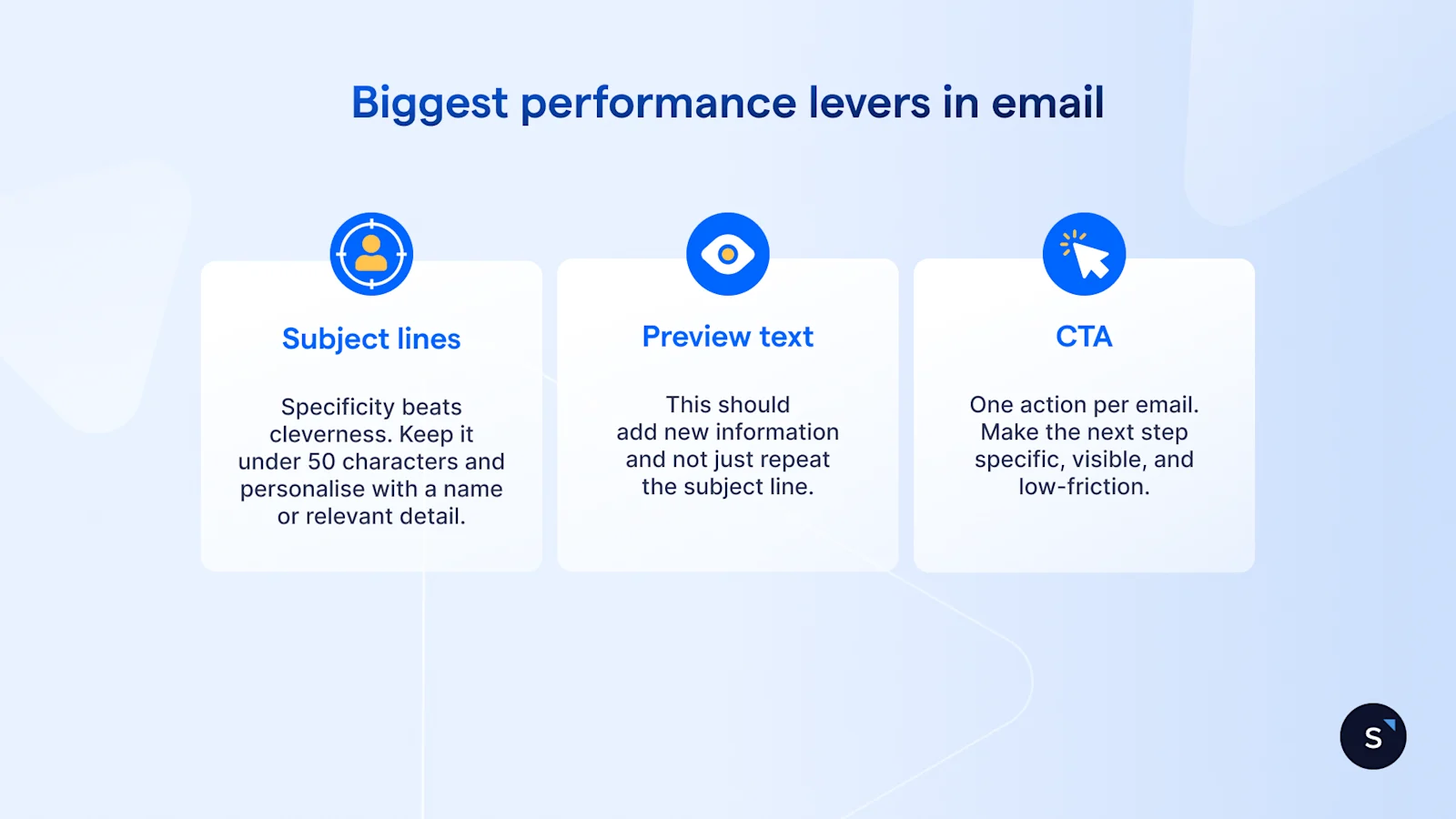
**Specificity beats cleverness.** "3 seats left this Friday" outperforms "Big news inside" on every split test.
Keep subject lines under 50 characters so they display in full on mobile, where[ 55% of email opens now happen](https://designmodo.com/email-marketing-roi-statistics/). Personalising with a recipient's name or relevant detail lifts engagement. Skip the excessive punctuation and spam trigger words.
### **Preview text**
Preview text is the 40 to 90 characters visible alongside the subject line in most inboxes. It should add new information, not repeat the subject line.
**Weak:** "Email from \[Company Name\]" **Stronger:** "Your October member offer expires Friday"
### **CTA**
One email. One action. "See the offer" outperforms "Click here" because it tells the reader exactly what they get. Multiple CTAs dilute clicks. Make the next step specific, visible, and low-friction.
| **Goal** | **Campaign type** | **What it looks like** |
| --- | --- | --- |
| Improve open rate | Subject line A/B test series | Two variants to 20% of the list each; winner sent to remaining 60% |
| Recover conversions | Three-email abandoned cart flow | Email 1 at 1 hour (reminder), Email 2 at 24 hours (social proof), Email 3 at 48 hours (urgency) |
| Maximise welcome ROI | Five-email welcome flow | Day 1: welcome, Day 3: best content, Day 7: social proof, Day 14: soft offer, Day 21: hard offer |
| Multi-channel engagement | Email plus messaging trigger | Email opens, no click: trigger WhatsApp follow-up. Email converts: remove from messaging sequence |
### **How to campaign for open rate improvement**
Test subject lines with a 20/20/60 split: two variants to 20% of the list each, the winner to the remaining 60%. Run this on every major send for two months and open rates will improve.
### **How to campaign for conversion recovery**
A three-email abandoned cart sequence spaced across 48 hours typically recovers 5 to 15% of carts. The third email, which introduces urgency or a small incentive, carries the most weight.
### **How to campaign for welcome flow ROI**
New subscribers are at peak engagement. A five-email sequence that builds trust before making an offer consistently outperforms a single "thanks for signing up" send. The welcome series is the most underinvested flow in most businesses.
### **How to campaign for multi-channel engagement**
Some customers open the email but convert later on WhatsApp or live chat. Connecting email engagement data to a follow-up messaging sequence turns a stalled send into a completed sale.
## **Email should not work alone: connect campaigns to your wider customer journey**
Some customers open your email on a commute and come back later, via WhatsApp, a chatbot, or live chat. Others need a more direct nudge, and email is too passive for a time-sensitive offer. A WhatsApp message to contacts who have not opened after 24 hours converts differently from a second email reminder.
The core principle: **channels should share context.** When a customer engages via email, that behaviour should inform what they receive next. Campaigns built across connected channels consistently outperform isolated email sequences, because customers do not experience your marketing one channel at a time.
## **How SleekFlow can help you run better email marketing campaigns**
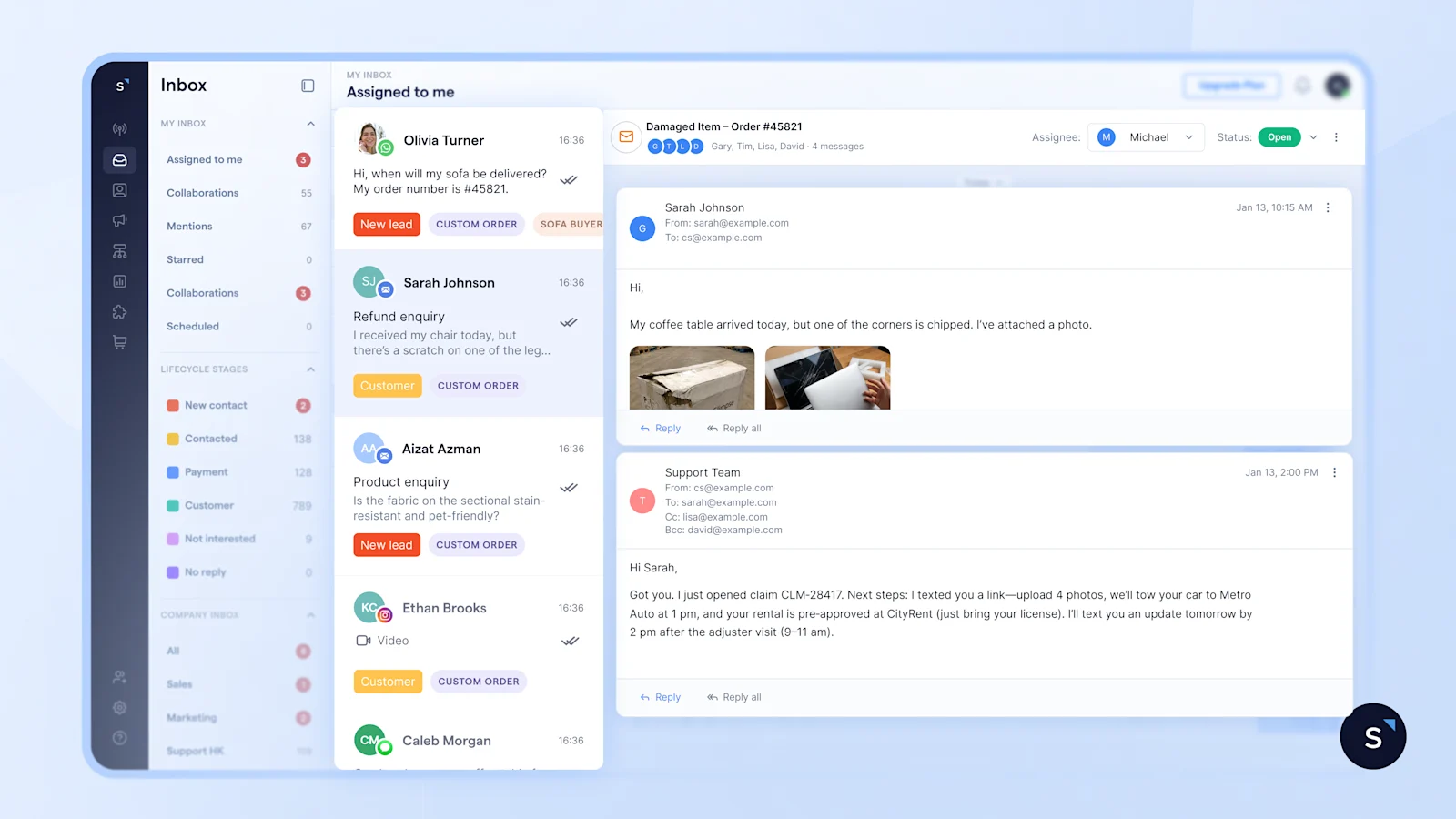
SleekFlow's AI Suite supports email alongside WhatsApp, Instagram, SMS, and live chat, all from one platform. You can build **email campaigns** and connect them to your wider messaging stack without maintaining separate contact lists or rebuilding flows in two places.
Key capabilities:
- Build and send email campaigns from the same[ Flow Builder](/en-sg/broadcast-campaign) used for WhatsApp and SMS sequences
- Trigger WhatsApp or SMS follow-ups based on email behaviour: opened but did not click, did not open, or converted
- Deploy[ AgentFlow](/en-sg/agentflow) to handle inbound replies from email or chat, with full contact context carried across every channel
### What is an email marketing campaign?
A planned series of emails sent to a defined audience to achieve one specific goal, such as driving purchases, welcoming new subscribers, or recovering abandoned carts. It differs from a one-off send in that it is sequenced, timed, and tied to a measurable outcome.
### What makes an email campaign successful?
Segmented audiences, a clear single goal, personalised copy, and strong subject lines. The highest-ROI campaigns also connect email behaviour to follow-up sequences on WhatsApp or SMS for contacts who engaged but did not convert.
### How many emails should be in a campaign?
It depends on the goal. Promotional campaigns typically run three emails. Welcome series perform well at five. Abandoned cart sequences are most effective at three, spaced across 48 hours.
### What is the difference between a campaign and an email flow?
A campaign is time-bound, usually tied to a promotion or event. A flow is triggered by subscriber behaviour, such as a cart abandonment or a sign-up. They work best together: campaigns fill the calendar, flows handle the lifecycle moments in between.
### What metrics matter most for email campaigns?
Click-through rate and conversion rate are the most reliable signals. Apple Mail Privacy Protection inflates open rates for a significant share of iOS users, so opens alone are no longer a dependable performance measure.
### How often should I send marketing emails?
Most B2C brands send one to four times per month for promotional content. Sending more is fine if each email delivers clear value. Sending more to compensate for low engagement accelerates list decay rather than fixing it.
### How does AI improve email campaigns?
AI helps with subject line generation, send-time optimisation, segmentation, and dynamic personalisation. AI-assisted subject lines produce 26% higher open rates than manually written alternatives, based on 2026 industry data.
### Should email campaigns be connected to SMS or messaging apps?
Yes. Customers who open but do not convert are still warm leads. A WhatsApp or SMS follow-up triggered by email engagement consistently outperforms a second email for time-sensitive offers.