---
title: "Fast response in Singapore: benchmarks, targets, and the new cost of speed"
description: "Fast response benchmarks by channel for teams, plus what Meta's 1 Oct 2026 WhatsApp pricing means for your SLA and budget."
canonical: "https://sleekflow.io/en-sg/blog/fast-response-time-benchmarks"
html_lang: "en-sg"
date_modified: "2026-09-10T05:26:39.559Z"
og_title: "Fast response in Singapore: 2026 benchmarks and real cost"
og_description: "Fast response benchmarks by channel for teams, plus what Meta's 1 Oct 2026 WhatsApp pricing means for your SLA and budget."
og_image: "https://images.ctfassets.net/tu2uwzoyozk8/2mZWkMvQV2k191dcyMVjac/fff4de7073dd6497fd04b23a223cd9b7/pasted-image-1.png?fm=webp&q=90&w=1200"
---
```json
{
"@context": "https://schema.org",
"@type": "Article",
"headline": "Fast response in Singapore: 2026 benchmarks and real cost",
"description": "Fast response benchmarks by channel for teams, plus what Meta's 1 Oct 2026 WhatsApp pricing means for your SLA and budget.",
"url": "https://sleekflow.io/en-sg/blog/fast-response-time-benchmarks",
"dateModified": "2026-09-10T05:26:39.559Z",
"image": "https://images.ctfassets.net/tu2uwzoyozk8/2mZWkMvQV2k191dcyMVjac/fff4de7073dd6497fd04b23a223cd9b7/pasted-image-1.png?fm=webp&q=90&w=1200",
"breadcrumb": {
"@type": "BreadcrumbList",
"itemListElement": [
{
"@type": "ListItem",
"position": 1,
"name": "Home",
"item": "https://sleekflow.io/en-sg"
},
{
"@type": "ListItem",
"position": 2,
"name": "Blog",
"item": "https://sleekflow.io/en-sg/blog"
},
{
"@type": "ListItem",
"position": 3,
"name": "Fast response in Singapore: 2026 benchmarks and real cost",
"item": "https://sleekflow.io/en-sg/blog/fast-response-time-benchmarks"
}
]
}
}
```
# Fast response in Singapore: benchmarks, targets, and the new cost of speed
*Julian Wong — Content Strategist*
## Summary
- Meta starts charging per WhatsApp service message from 1 October 2026, at Singapore's utility rate of US$0.016 each, after a free monthly allowance of 1,000 messages per phone number.
- A fast response now has two costs: the time a customer waits, and from October, the message itself, so speed and message count both belong in your SLA.
- WhatsApp's 72-hour free entry-point window for Click to WhatsApp ads stays free for message delivery, making it the cheapest place to put an AI agent.
- Practical first-response targets vary sharply by channel: under 2 minutes for WhatsApp and live chat, under 4 business hours for email, 80% of calls answered within 20 seconds.
- Resolving a query in one message instead of five doesn't just look tidier, it cuts the WhatsApp bill for that conversation to a fifth.
*This article discusses WhatsApp Business Platform pricing, which is set by Meta and changes on its own schedule. Figures below are current as of publication; confirm current rates against Meta's developer documentation and your own BSP contract before budgeting.*
You've had the demo call where the sales rep swore they'd reply "instantly," and then watched three days pass before a real answer showed up in your WhatsApp inbox. Every Singapore team messaging customers on WhatsApp is about to feel that gap more directly, because from 1 October 2026 it isn't just a service problem. It's a billing event.
This guide sets out what counts as a **fast response** by channel in 2026, the benchmarks worth aiming for, and how to build a response time target you can actually afford once WhatsApp replies stop being free.
### **What is customer response time?**
Customer response time is the time between a customer's message and your first reply, tracked separately from resolution time, which covers how long the whole issue takes to close. It's the number that decides whether a customer stays in the conversation or gives up and tries somewhere else.
Most teams report an average, but the average hides the problem. A handful of messages answered overnight can drag the average up while every daytime customer still waits a reasonable amount, so the more honest number to track is the median, alongside a percentile figure such as "90% of messages answered within X minutes."
Response time and resolution time get conflated often enough that it's worth stating plainly: replying fast to say "let me check" is a good response time and a bad resolution if nothing follows. Both numbers matter, and neither substitutes for the other.
### **What does a fast response mean in 2026?**
A **fast response** in 2026 means replying inside the window a customer formed their expectation on, and that window keeps shrinking because messaging apps trained people to expect near-real-time replies from friends, not just from businesses. What counted as fast on email five years ago now reads as slow on WhatsApp.
[Researchers at Bielefeld University who analysed 3.4 million personal WhatsApp and Instagram messages](https://arxiv.org/html/2605.03687v1) found that 68.9% of WhatsApp messages between individuals got a reply within five minutes, against 43.6% on Instagram. That's personal chat behaviour, not customer service, but it's the exact habit your customers bring into a support thread: they're used to WhatsApp being fast, and they judge your business against the same clock.
The result is a widening gap between channels. WhatsApp and live chat now sit in the minutes bracket, email in the hours bracket, and a business that treats every channel with the same target is either overspending on email or under-delivering on WhatsApp.
### **Customer response time benchmarks by channel**

Response time expectations vary by channel because the underlying medium sets the pace: a synchronous chat window invites an instant reply, an email inbox doesn't. The table below sets a practical first-response target per channel, alongside what that reply now costs a Singapore business from 1 October 2026.
| **Channel** | **What customers expect** | **Practical first-response target** | **What each reply costs from 1 Oct 2026** |
| --- | --- | --- | --- |
| WhatsApp, customer-initiated | A reply in minutes, not hours | Under 2 minutes | US$0.016 per service message (SG rate), free for the first 1,000 sent per phone number each month |
| WhatsApp, opened by a Click to WhatsApp ad | Same as above | Under 2 minutes | Free for 72 hours from the entry point |
| Live chat on site | A reply within a couple of minutes | Under 1 minute | No Meta charge, agent time only |
| Instagram and Messenger DM | Slower than WhatsApp, still same-day | Under 30 minutes | No Meta per-message charge under this update |
| Email | Same working day, ideally within hours | Under 4 business hours | No per-message charge |
| Phone | An answer without a long queue | 80% of calls answered in 20 seconds | Telco cost only |
## WhatsApp's two clocks
WhatsApp runs two windows at once, and mixing them up is the single most common SLA-planning mistake. A conversation a customer starts themselves opens a 24-hour customer service window, in which service and in-window utility replies become billable from October. A conversation that starts from a[ Click to WhatsApp ad](https://developers.facebook.com/docs/whatsapp/pricing/updates-to-pricing/) or a Facebook Page call-to-action opens a separate 72-hour free entry-point window, where message delivery stays free regardless of category, though a third-party AI agent replying in that window is still billed as a normal service message once it isn't Meta's own Business Agent.

The instinct to treat every WhatsApp reply the same way is the instinct that costs money from October. Knowing which window a conversation opened in is the first input into any SLA you set.
#### **Why phone and email get looser targets**
Phone and email get looser targets because the medium sets a different expectation: a caller accepts a short queue, and an email sender accepts the same working day. The 80% of calls answered in 20 seconds standard is the long-running call-centre convention, though[ call-centre trade press has pointed out that nobody can pin down exactly where it originated](https://www.callcentrehelper.com/service-level-relevant-134996.htm), and it's increasingly criticised for what it lets happen to the remaining 20% of callers. Treat it as a widely used starting point, not gospel.
### **Why customer response time now has a price in Singapore**
From 1 October 2026, every WhatsApp service and in-window utility reply a Singapore business sends costs money, at **US$0.016** per message once the free monthly allowance of 1,000 messages per phone number runs out. The practical effect: a five-message back-and-forth to resolve one query now costs five times what a single, complete reply costs, because[ Meta bills per message sent, not per conversation resolved](https://developers.facebook.com/docs/whatsapp/pricing/updates-to-pricing/).
Run the maths and it's not abstract. Five short bubbles, "Hi," "let me check," "can you share your order number," "found it," "here's your answer," bill at US$0.08 total. One message doing the same job bills at US$0.016. Same resolution, five times the cost, and that's before counting the extra minutes the customer spent waiting between bubbles.
This is the shift our[ full breakdown of WhatsApp Business API pricing in Singapore](https://sleekflow.io/en-sg/blog/whatsapp-business-price) covers in detail: campaigns aren't the only cost centre any more. Every everyday conversation is now one too, and the number of messages it takes to close a query has become a cost lever in its own right, not just a service quality one.
### **How to set a response time SLA you can fund**

A response time SLA only holds if it's costed before it's promised, which means starting from your actual message volume rather than a target that sounds reasonable in a meeting. Five steps turn a speed target into a number finance will sign off on.
#### **1. Baseline your message volume before October**
Pull 90 days of message volume from WhatsApp Manager, split by category (service, utility, marketing), to get a pre-October baseline. This tells you what's about to become billable and how much of it there is, before you commit to any target.
#### **2. Know your conversation entry points**
Split conversations by how they started, because CTWA-opened chats run on a free 72-hour clock and everything else runs on the standard 24-hour window that becomes billable from October. Blending the two hides how much of your volume is actually free.
#### **3. Set tiered targets by intent, not one blanket number**
A sales enquiry, a delivery complaint, and a billing question don't carry the same urgency, so a single response time target for all inbound traffic either overspends on the low-stakes ones or under-serves the urgent ones. Set the target per intent, not per channel alone.
#### **4. Cost the target before you commit to it**
Multiply your expected in-window replies by WhatsApp’s published rate to get a monthly figure, and check that number before the target goes live, not after the first invoice. A team sending 4,000 in-window replies a month, for example, pays nothing on the first 1,000 and roughly US$48 on the remaining 3,000, a modest number on its own that scales quickly with volume and message count.
#### **5. Set a messages-per-resolution ceiling alongside the time target**
Speed alone doesn't control spend, message count does, so pair every response time target with a ceiling on how many messages a conversation is allowed to take. A team can hit a 2-minute reply target and still overspend badly if every reply comes in three short bubbles instead of one complete message.
## Best practices for cutting customer response time without raising cost

The fastest way to cut cost after October isn't replying faster, it's replying in fewer messages, since a flat per-message rate rewards resolution efficiency over reply speed alone.
**Resolve in fewer messages, not faster messages.** Train agents and AI flows to send one complete answer instead of a burst of short bubbles. Same warmth, a third of the cost, if a three-message exchange becomes one.
**Route CTWA and Facebook CTA traffic to AI first.** An[ AI sales agent](https://sleekflow.io/en-sg/agentflow/inbound-ai-agent) can qualify a lead, answer questions, and book a next step entirely inside the free 72-hour window, while a human agent would be replying on the clock that costs money from October.
**Use WhatsApp Flows to collect several fields in one exchange.** A return request that would normally take five separate questions, name, order number, reason, preferred resolution, contact details, collapses into a single[ WhatsApp Flow](https://sleekflow.io/en-sg/blog/whatsapp-flows) the customer fills in once.
**Report median first response time, not the average.** A few overnight replies can drag an average up without reflecting what most customers actually experience, so track the median and a percentile figure alongside it.
**Set an after-hours policy that commits to a specific time.** "We'll reply during business hours" is vague enough to feel like no promise at all. "We reply by 9am the next business day" sets an expectation a customer can actually plan around.
**Audit automated flows for non-template replies that will become billable.** Any auto-reply, confirmation, or drip sequence sent as a free-form message inside the customer service window is billable from October, so check what your flows are actually sending before the invoice tells you.
### **How SleekFlow helps teams respond faster**
SleekFlow is the AI suite for revenue-driving conversations. It unifies WhatsApp, Instagram, Messenger, live chat, email, and more into one inbox, with AI agents built to answer inside the free windows before a reply ever becomes billable.
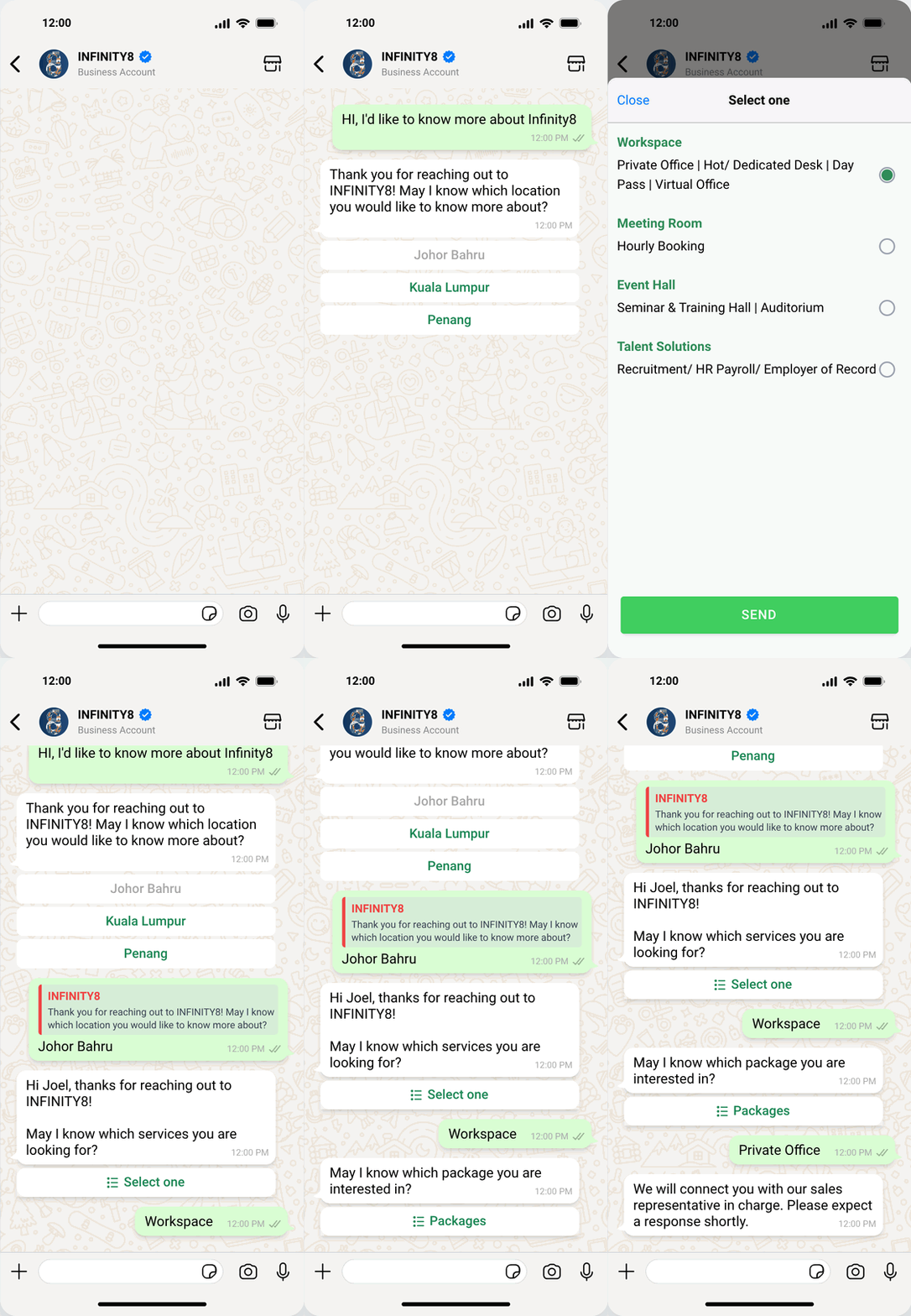
Infinity8, a coworking operator in Malaysia using SleekFlow, ran every inbound WhatsApp enquiry through one shared phone number, forwarding screenshots manually between agents.
Results, after automating lead routing and qualification with SleekFlow's Flow Builder:
- Response time cut from over 2 hours to under 5 minutes
- Lead qualification handled automatically before a human ever joins the thread
- After-hours leads captured instead of lost overnight
[Read the full case study →](https://sleekflow.io/en-sg/customer-stories/infinity8)
## Reach new speed limits with SleekFlow
If your response time target is about to meet a per-message bill for the first time, book a demo to see how AI agents inside SleekFlow answer WhatsApp, Instagram, and live chat before a reply becomes a line item.
[Book a Demo](https://sleekflow.io/en-sg/book-a-demo)
[View Pricing](https://sleekflow.io/en-sg/pricing)
### What is a good customer response time in 2026?
A good customer response time depends on the channel. On WhatsApp and live chat, customers expect a reply in minutes, so a target under two minutes is realistic for teams using automation. Email tolerates four business hours. Phone is measured differently, usually as the share of calls answered within 20 seconds.
### What does fast response mean in customer service?
A fast response means acknowledging a customer's message quickly enough that they stay in the conversation rather than contacting a competitor. In practice it's measured as first response time, the gap between the customer's message and your first reply. Speed alone isn't enough. A fast reply that answers nothing still loses the customer.
### Will WhatsApp replies cost money from October 2026?
Yes, for businesses on the WhatsApp Business Platform. From 1 October 2026, Meta charges per message for non-template service replies and for utility templates sent inside the 24-hour customer service window, after a free allowance of 1,000 service messages per phone number each month. Replies inside a 72-hour free entry-point window, opened by a Click to WhatsApp ad or a Facebook Page CTA, stay free.
### How do you calculate first response time?
Add up the time between each customer's first message and your first reply, then divide by the number of conversations. Most inbox and helpdesk tools calculate this automatically. Report the median alongside the average, because a handful of overnight messages can pull an average far above what a typical customer actually experiences.
### Does an AI agent reduce WhatsApp costs after the pricing change?
It can, but not by making replies free. From 1 October 2026, a reply from your own AI is billed as a service message at the same rate as a human reply. The saving comes from resolving in fewer messages and from handling more conversations inside the free 72-hour entry-point window.
### Is a faster response always better?
No. Below a certain point, extra speed stops changing the outcome and starts costing money, which matters more now that each reply is billable. Prioritise speed where a delay loses revenue, such as sales enquiries and delivery problems. Slower, more complete replies are fine for billing questions and general admin.