---
title: "Omnichannel customer service: strategy, benefits, examples, and best practices"
description: "Learn how an omnichannel customer service improves speed, consistency and retention for Singapore businesses."
canonical: "https://sleekflow.io/en-sg/blog/omnichannel-customer-service"
html_lang: "en-sg"
date_modified: "2026-04-17T10:02:55.730Z"
og_title: "Guide to omnichannel customer service"
og_description: "Learn how an omnichannel customer service improves speed, consistency and retention for Singapore businesses."
og_image: "https://images.ctfassets.net/tu2uwzoyozk8/jv7U36Ukh9EPuG26vYfRg/37254a153c2feca5c6b003922293bf06/Website-Cover-SleekFlow.jpg?w=1200&q=90"
---
```json
{
"@context": "https://schema.org",
"@type": "BlogPosting",
"headline": "Guide to omnichannel customer service",
"description": "Learn how an omnichannel customer service improves speed, consistency and retention for Singapore businesses.",
"url": "https://sleekflow.io/en-sg/blog/omnichannel-customer-service",
"dateModified": "2026-04-17T10:02:55.730Z",
"image": "https://images.ctfassets.net/tu2uwzoyozk8/jv7U36Ukh9EPuG26vYfRg/37254a153c2feca5c6b003922293bf06/Website-Cover-SleekFlow.jpg?w=1200&q=90",
"breadcrumb": {
"@type": "BreadcrumbList",
"itemListElement": [
{
"@type": "ListItem",
"position": 1,
"name": "Home",
"item": "https://sleekflow.io/en-sg"
},
{
"@type": "ListItem",
"position": 2,
"name": "Blog",
"item": "https://sleekflow.io/en-sg/blog"
},
{
"@type": "ListItem",
"position": 3,
"name": "Guide to omnichannel customer service",
"item": "https://sleekflow.io/en-sg/blog/omnichannel-customer-service"
}
]
}
}
```
# Omnichannel customer service: strategy, benefits, examples, and best practices
*Julian Wong — Content Strategist*
## Summary
- Omnichannel customer service keeps context, history, and next steps connected across channels.
- It reduces customer effort, speeds up resolution, and improves consistency.
- For Singapore teams, the strongest channel mix usually includes WhatsApp, Instagram, live chat, email, and phone, supported by AI and automation.
- The best software combines a unified inbox, routing, conversation history, CRM integration, ticketing, analytics, and strong governance.
Customers already move fluidly between websites, messaging apps, social media, email, and phone. [In Singapore, there are 5.61 million internet users, ](https://datareportal.com/reports/digital-2025-singapore)10.5 million mobile connections, and 5.16 million social media user identities, so support journeys rarely remain on a single channel.
That is why **omnichannel customer service** has become the standard. It connects every interaction across channels so a customer can start on live chat, continue on WhatsApp, and finish by email or phone without losing context. The payoff is clear: [73% of consumers want to start on one channel and continue on another without having to start over](https://www.zendesk.com/sg/blog/2022-the-year-of-customer-service-led-growth), and 93% are willing to spend more with companies that don't make them repeat themselves.
## **What is omnichannel customer service?**
**Omnichannel customer service** is a support model that connects customer conversations, identities, and interaction history across channels. Instead of treating WhatsApp, Instagram, email, live chat, and phone as separate queues, it gives agents a single view of the customer and a continuous service journey. That is the core distinction of omnichannel support.
| **Criteria** | **Omnichannel customer service** | **Multichannel customer service** |
| --- | --- | --- |
| Data flow | Shared across channels | Separate by channel |
| Customer context | Preserved | Often fragmented |
| Agent visibility | One customer view | Partial channel-by-channel view |
| Customer effort | Lower | Higher |
| Resolution speed | Faster | Slower |
| Personalisation | Stronger | Limited |
| Consistency | More consistent | Varies by team or tool |
The real difference is not the number of channels. It is whether the business keeps the journey connected.
## **Why omnichannel customer service matters now**
Customers expect continuity. They do not think in terms of departments, queue structures, or channel silos. As mentioned earlier, 73% of customers want to switch channels without repeating themselves and are willing to pay more to avoid doing so. Support now influences retention, repeat purchase, and revenue quality.
For Singapore businesses, the pressure is even sharper because digital adoption is so high and social platforms are deeply embedded in everyday communication. Customers are already on mobile, already on social, and already used to switching channels mid-journey.
## **Key benefits of omnichannel customer service**
###
| **Benefit** | **Business impact** |
| --- | --- |
| Faster resolution | Less back-and-forth and fewer repeat contacts |
| Lower customer effort | Better CSAT and less frustration |
| More consistent service | Stronger brand trust across touchpoints |
| Better agent productivity | Less tool switching and less manual triage |
| Better personalisation | More relevant replies and recommendations |
| Better retention | Higher loyalty and repeat purchase potential |
| Better reporting | Clearer visibility across the full journey |
### **Faster resolution with full customer context**
When agents can see past chats, orders, notes, and routing history in one place, they solve issues faster and with fewer handoffs. That is exactly why unified customer context sits at the heart of omnichannel support.
### **Lower customer effort across channels**
Customers should not have to repeat their problem every time they switch from Instagram to email or from chat to voice. Lower effort is one of the most direct drivers of satisfaction and loyalty.
### **More consistent service quality**
Connected tools let teams standardise tone, routing, knowledge, and escalation logic across channels. That makes service feel like one brand experience, not five disconnected ones.
### **Better agent productivity**
Agents work better when they do not need to jump between tabs, copy details manually, or reconstruct the conversation from scratch. A true **unified inbox** reduces operational drag and makes coaching easier.
### **Better personalisation**
When conversation history and CRM data are displayed alongside the chat, support becomes more relevant. Agents can respond based on known preferences, previous purchases, account status, or recent activity.
### **Better retention and repeat purchase potential**
Great support protects revenue. Customers stay longer and spend more when service feels easy, continuous, and trustworthy.
### **Stronger reporting across the whole journey**
Journey-level reporting shows where customers wait, where handoffs fail, which channels drive resolution, and where automation helps or hurts. That is far more useful than separate channel dashboards.
## **Best channels in an omnichannel customer service strategy**
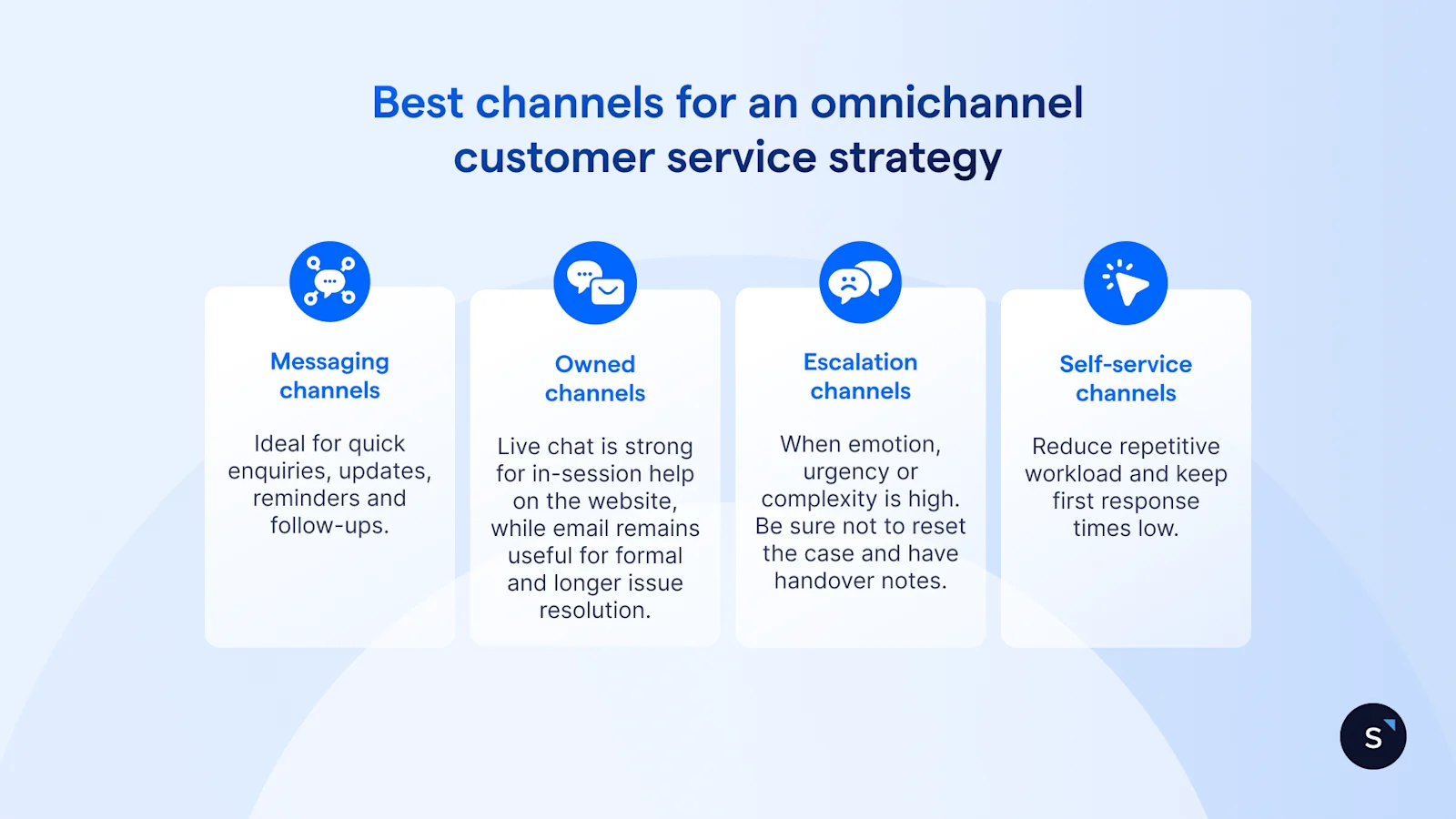
A strong **omnichannel customer service strategy** does not mean adding every channel. It means choosing the channels your customers already use, then connecting them properly. For most Singapore businesses, that usually means a messaging-first mix supported by owned channels, escalation paths, and self-service.
### **Messaging channels for fast, conversational support**
WhatsApp, Facebook Messenger, Instagram DM, and SMS are ideal for quick enquiries, updates, reminders, and follow-ups. They fit naturally into mobile-first customer behaviour and work especially well when the team can route, collaborate, and reply from one workspace.
### **Owned channels for structured support**
Live chat, email, and a help centre or self-service portal still matter. Live chat is strong for in-session help on the website, while email remains useful for formal summaries, approvals, attachments, and longer issue resolution.
### **Escalation channels for urgent or complex issues**
Phone, voice or IVR, and video support matter when emotion, urgency, or complexity is high. The key is that escalation should not reset the case. The next agent should inherit the transcript, notes, and status.
### **Self-service and automation layers**
An **AI chatbot**, FAQ centre, workflow automation, and agent assist tools reduce repetitive workload and keep first response times low. The best setup uses AI for FAQs, triage, summaries, and next-best replies, then hands complex or sensitive cases to a human.
## **What good omnichannel customer service looks like in practice**
### **Customer starts on live chat, finishes on WhatsApp**
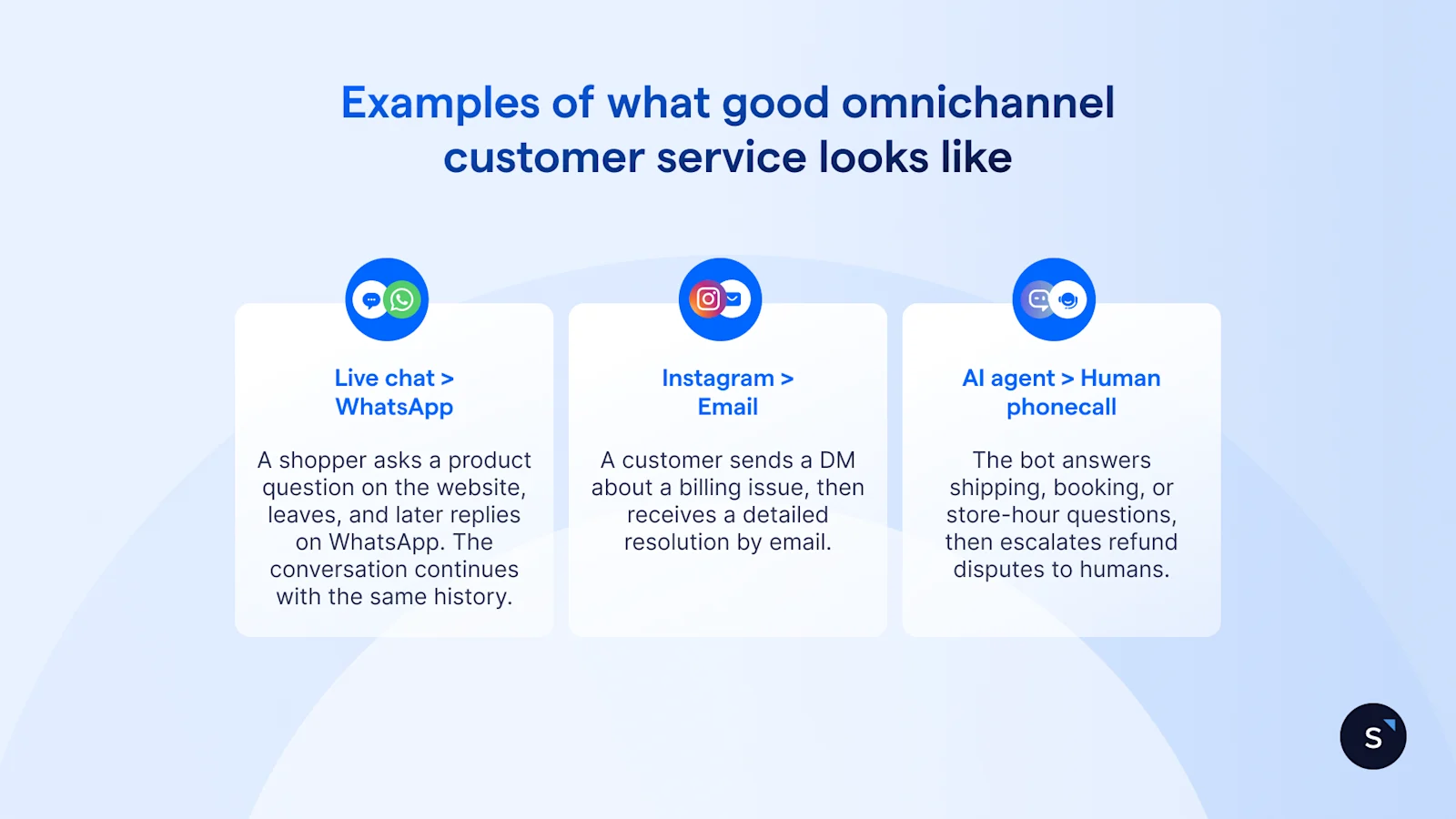
A shopper asks a product question on the website, leaves, and later replies on WhatsApp. The conversation continues with the same history, so the agent picks up instantly rather than starting over.
### **Customer asks on Instagram, gets resolved by email with full context**
A customer sends a DM about a billing issue, then receives a detailed resolution by email. The support team does not copy details manually because the case history already follows the handoff.
### **AI chatbot handles FAQs, human agent takes over a complex issue and calls**
The bot answers questions about shipping, booking, or store hours, then escalates refund disputes or exceptions to a human, attaching the summary and captured details. He then follows up with a phone call.
## **How to build an omnichannel customer service strategy**
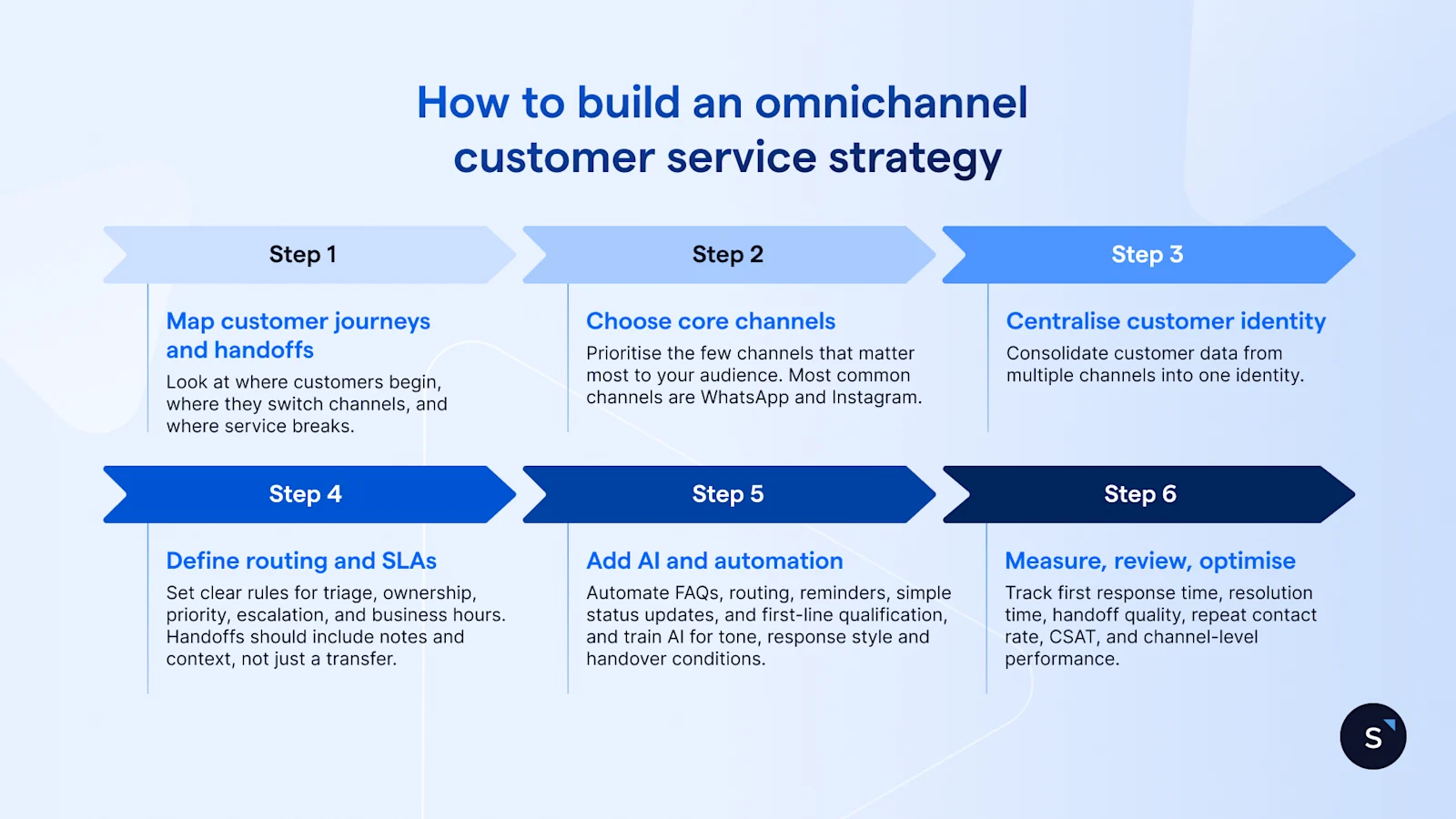
### **Step 1: Map your customer journeys and channel handoffs**
Start with real journeys, not internal org charts. Look at where customers begin, where they switch channels, and where service breaks.
### **Step 2: Choose the core channels you actually need**
Prioritise the few channels that matter most to your audience. In many Singapore use cases, that means WhatsApp, Instagram, and live chat.
### **Step 3: Centralise customer identity and conversation history**
Consolidate customer data from multiple channels into one identity. Without shared identity and shared history, you do not have omnichannel support. You just have multiple inboxes.
### **Step 4: Define routing, SLAs, and handoff rules**
Every channel should follow clear rules for triage, ownership, priority, escalation, and business hours. Handoffs should include notes and context, not just a transfer.
### **Step 5: Add AI and automation to repetitive workflows**
Automate FAQs, routing, reminders, simple status updates, and first-line qualification. Keep refunds, disputes, and complex exceptions human-led and train AI for tone, response style, and handover conditions.
### **Step 6: Measure, review, and optimise continuously**
Track first response time, resolution time, handoff quality, repeat contact rate, CSAT, and channel-level performance.
## ****
| **Capability** | **Why it matters** |
| --- | --- |
| **Unified inbox** | Keeps conversations visible in one workspace |
| CRM integration | Brings customer data beside the chat |
| Conversation history | Preserves context across channels |
| Channel coverage | Supports the apps customers already use |
| Routing and assignment | Sends cases to the right team quickly |
| Workflow automation | Reduces manual triage and repetitive tasks |
| **AI chatbot/agent** assist | Improves speed without losing control |
| Analytics and reporting | Tracks service outcomes, not just activity |
| Access controls | Protects sensitive customer data |
| Compliance and security | Supports governance and safer operations |
| Ease of use | Improves adoption for frontline teams |
A shared inbox alone is not enough. The right **omnichannel customer service software** also needs automation, reporting, governance, and integrations to keep the customer journey connected end-to-end.
## **Use SleekFlow for omnichannel customer journeys**
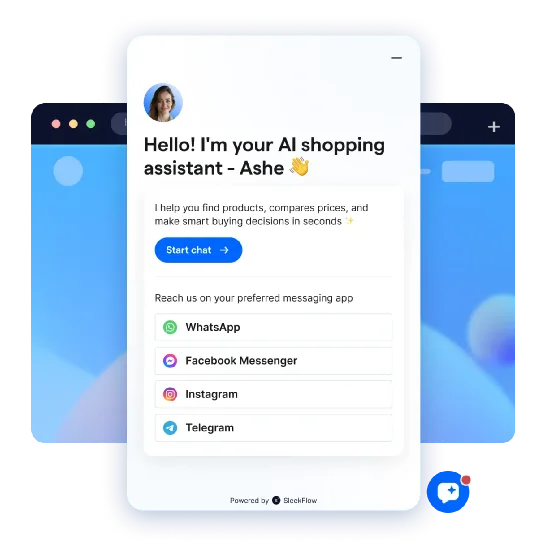
SleekFlow is built for chat-first customer journeys. On the platform, you can centralise conversations, keep customer context visible, automate repetitive work, and support human handoffs with AI rather than replacing them.
For service teams, that translates into a practical stack: an **omnichannel inbox** for cross-channel conversations, live chat for website support, **Flow Builder** for routing and automation, ticketing for structured case management, analytics for performance visibility, CRM integrations for customer context, and governance features such as role-based access, IP allowlisting, and data masking.
### What is omnichannel customer service?
It is a support approach that keeps customer conversations connected across channels, so history and context follow the customer.
### What is the difference between omnichannel and multichannel customer service?
Multichannel customer service offers several channels, but they often operate separately. Omnichannel customer service connects those channels into one continuous journey.
### What channels should be included in omnichannel support?
Most teams should combine messaging channels such as WhatsApp and Instagram with live chat, email, self-service, and a voice escalation path.
### How does omnichannel customer service improve customer satisfaction?
It reduces repetition, shortens wait times, and makes service feel more consistent across the whole journey.
### How does omnichannel customer service improve ROI?
It improves productivity, protects retention, reduces avoidable repeat contacts, and supports better conversion from service conversations.
### What are the biggest challenges in omnichannel customer service?
The biggest issues are siloed tools, fragmented data, weak handoff processes, poor routing, and inconsistent governance.
### What KPIs should support teams track?
Track first response time, resolution time, repeat contact rate, CSAT, handoff quality, ticket backlog, and journey-level conversion or retention outcomes.
### How is omnichannel customer service different from a shared inbox?
A shared inbox centralises messages. Omnichannel service goes further by adding identity resolution, history, routing, automation, analytics, and structured handoffs.
### Can small businesses use omnichannel customer service?
Yes. The right way to start is narrow: pick two or three high-impact channels, centralise history, automate one repetitive workflow, and expand from there.
### What role does AI play in omnichannel support?
AI should handle FAQs, triage, summaries, and response suggestions, while human agents take over sensitive, high-value, or exception-heavy cases.
## Sitemap
See the full [sitemap](https://sleekflow.io/en-sg/sitemap.md) for all pages.