---
title: "What is lead scoring? The 5-signal model and 10 tools to run it "
description: "What is lead scoring? See the 5 signals top models track, how 10 tools compare in 2026, and how to build your own."
canonical: "https://sleekflow.io/en-sg/blog/what-is-lead-scoring"
html_lang: "en-sg"
date_modified: "2026-07-13T11:34:46.295Z"
og_title: "What is lead scoring? The 5-signal model and top tools"
og_description: "What is lead scoring? See the 5 signals top models track, how 10 tools compare in 2026, and how to build your own."
og_image: "https://images.ctfassets.net/tu2uwzoyozk8/jv7U36Ukh9EPuG26vYfRg/37254a153c2feca5c6b003922293bf06/Website-Cover-SleekFlow.jpg?w=1200&q=90"
---
```json
{
"@context": "https://schema.org",
"@type": "Article",
"headline": "What is lead scoring? The 5-signal model and top tools",
"description": "What is lead scoring? See the 5 signals top models track, how 10 tools compare in 2026, and how to build your own.",
"url": "https://sleekflow.io/en-sg/blog/what-is-lead-scoring",
"dateModified": "2026-07-13T11:34:46.295Z",
"image": "https://images.ctfassets.net/tu2uwzoyozk8/jv7U36Ukh9EPuG26vYfRg/37254a153c2feca5c6b003922293bf06/Website-Cover-SleekFlow.jpg?w=1200&q=90",
"breadcrumb": {
"@type": "BreadcrumbList",
"itemListElement": [
{
"@type": "ListItem",
"position": 1,
"name": "Home",
"item": "https://sleekflow.io/en-sg"
},
{
"@type": "ListItem",
"position": 2,
"name": "Blog",
"item": "https://sleekflow.io/en-sg/blog"
},
{
"@type": "ListItem",
"position": 3,
"name": "What is lead scoring? The 5-signal model and top tools",
"item": "https://sleekflow.io/en-sg/blog/what-is-lead-scoring"
}
]
}
}
```
# What is lead scoring? The 5-signal model and 10 tools to run it
*Julian Wong — Content Strategist*
## **What is lead scoring?**
Lead scoring is the practice of assigning a numeric value to a lead based on how well it matches your ideal customer profile and how likely it is to convert. The score tells sales and marketing teams which leads deserve immediate attention now, and which need more nurturing before a rep spends time on them.
### **What a lead scoring tool actually does**
A lead scoring tool applies rules or a machine-learning model against your lead data to calculate that score automatically, then updates it as new information comes in: a form fill, a pricing page visit, a product action, a chat reply. The output is usually a number or a band (Cold, Warm, Hot) that determines what happens next: who gets notified, which sequence a lead enters, or whether it's routed straight to a rep.
The quality of a scoring model depends entirely on which signals feed it. That's where most models fall short.
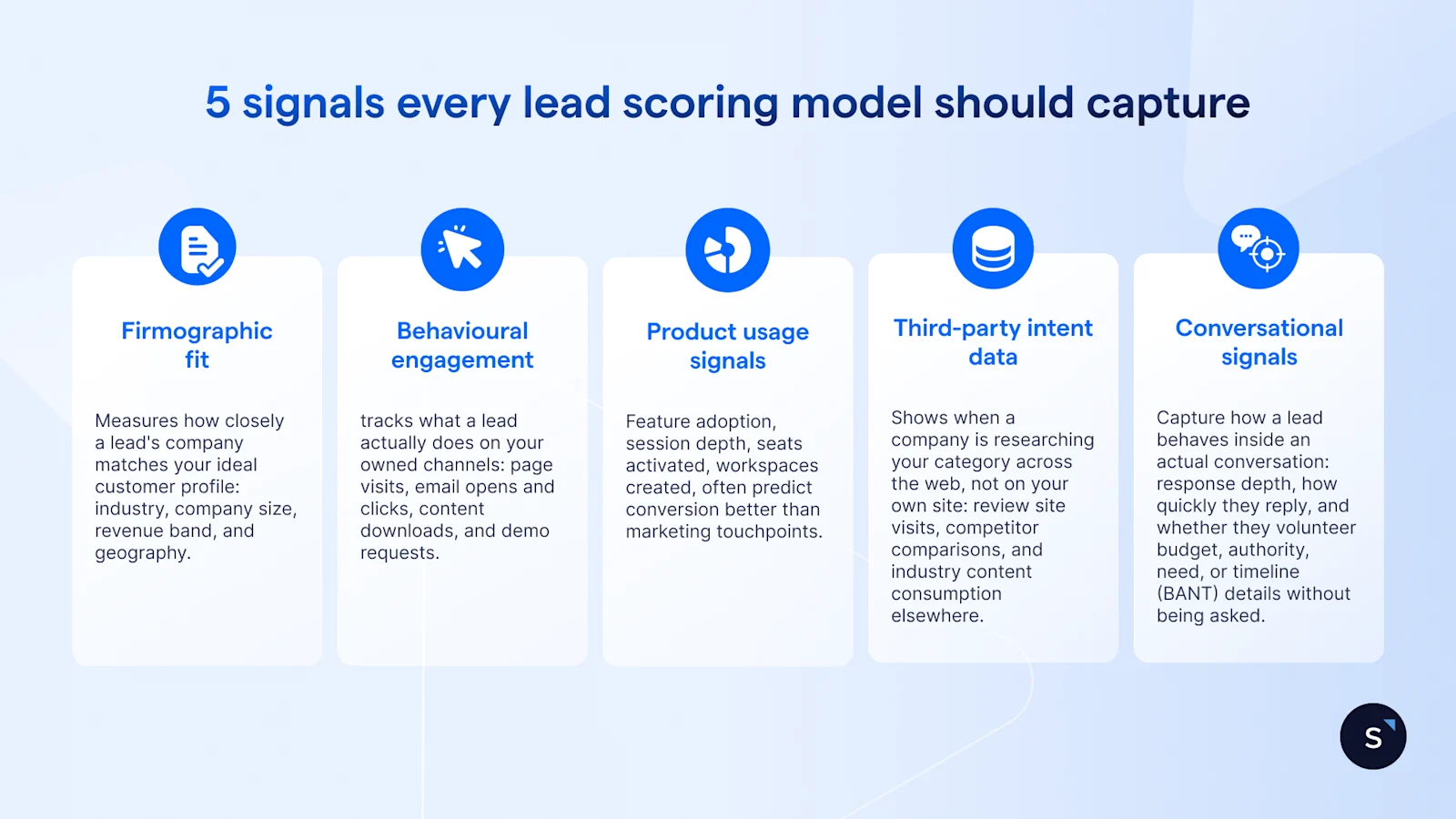
## **The 5 signals every lead scoring model should capture**
### Firmographic fit
Firmographic fit measures how closely a lead's company matches your ideal customer profile: industry, company size, revenue band, and geography. It's the cheapest signal to collect (usually already sitting in your contact records) and the fastest to get wrong if your ICP definition is vague. Store this against a clean customer profile so every team scores against the same criteria, rather than each rep guessing at what "a good fit" looks like.
### Behavioural engagement
Behavioural engagement tracks what a lead actually does on your owned channels: page visits, email opens and clicks, content downloads, and demo requests. This is the traditional core of lead scoring, and it still works, provided the point values reflect what genuinely predicts a sale rather than what's easiest to track. A pricing page visit should carry more weight than an email open; a demo request should carry more weight than a blog view.
### Product usage signals
For product-led growth businesses, product usage signals (feature adoption, session depth, seats activated, workspaces created) often predict conversion better than any marketing touchpoint. A free-trial user who invites three teammates and sets up an integration is a stronger signal than one who reads 5 blog posts. Feeding usage data from tools like Amplitude, Mixpanel, or Segment into your scoring model closes a gap that purely marketing-led scoring always misses.
### Third-party intent data
Third-party intent data shows when a company is researching your category across the web, not on your own site: review site visits, competitor comparisons, and industry content consumption elsewhere. It's the signal most likely to catch a buyer before they've filled out a single form. Dedicated intent providers price this by depth of coverage and account-level detail, and it isn't cheap, so most mid-market teams treat it as a tiebreaker layered on top of first-party data rather than a stand-alone system.
### Conversational signals
This is the signal almost no lead scoring guide covers, and the gap is growing as more B2B buying conversations move to WhatsApp, Instagram DM, and live chat rather than web forms. Conversational signals capture how a lead behaves inside an actual conversation: response depth, how quickly they reply, and whether they volunteer budget, authority, need, or timeline (BANT) details without being asked.[ SleekFlow's AgentFlow](/en-sg/agentflow), for example, lets an AI agent calculate a lead score in real time from criteria you define directly inside the conversation, then hand qualified leads to a human rep automatically.
## **The best lead scoring tools in 2026**
No single tool covers all 5 signals well. The table below compares 10 of the leading options by what they're actually built for.
| **Tool** | **Best for** | **Scoring approach** | **Starting price** |
| --- | --- | --- | --- |
| HubSpot | Teams already running on HubSpot | Manual rules on Professional; AI predictive scoring via Breeze Intelligence on Enterprise | Predictive tier requires Enterprise; manual scoring from Professional |
| Salesforce Einstein | Enterprise sales teams on Sales Cloud | Predictive, 1 to 99 score with a transparent factor breakdown | Sales Cloud Einstein add-on, Enterprise edition and above |
| SleekFlow | Teams whose qualifying conversations happen on WhatsApp, Instagram, or live chat instead of a web form | AI agent-calculated score from conversational criteria you define, weighted per channel | Included with AgentFlow from US$149/month |
| Apollo | Mid-market teams wanting transparent, self-serve scoring inside a prospecting platform | AI auto-scoring from closed-deal data, with fit and behavior broken out separately | Free plan includes AI scores; paid from US$49/user/month |
| 6sense | Enterprise ABM teams scoring whole buying committees, not single contacts | Predictive, account-level scoring aggregating third-party intent, updated daily | Custom pricing only |
| MadKudu | PLG and data-rich B2B teams wanting explainable scoring | Machine-learning model trained on closed-won data plus product usage signals | Custom/enterprise pricing, no free tier |
| Clay | Outbound-heavy B2B teams that need enrichment before they can score anything | Spreadsheet-style formulas layered on waterfall enrichment from 100 or more data providers | Free tier available; paid from US$185/month |
| Clearbit (now HubSpot Breeze) | Existing HubSpot users wanting first-party intent scoring from de-anonymized visitors | Scores accounts on page-level intent tied to identified companies | Folded into HubSpot pricing since acquisition |
| Pipedrive | Small sales teams (5 to 25 reps) who want scoring inside the pipeline they already use | Rules-based points with manual time decay, no predictive layer | Custom scoring on Premium plan (US$79/seat/month) and above |
| ZoomInfo | Teams needing a large contact database with a bolt-on intent signal | Third-party intent layered onto contact and company data | Typically US$15,000 to US$60,000 or more per year, custom quote |
Two data-floor points worth knowing before you commit budget: Salesforce Einstein and HubSpot's predictive scoring both need a substantial volume of historical leads, conversions, and deal history before their models activate, which rules both out for smaller pipelines on day one. Apollo's free plan is the most generous entry point on this list, since it includes AI-generated scores at no cost, where Salesforce and HubSpot both gate predictive scoring behind Enterprise-tier contracts.
## **How to choose a lead scoring tool: a decision framework**
Rather than working through all 10 tools individually, start with how your business actually qualifies leads today.
| **If your business is...** | **Look at** | **Key question to ask** |
| --- | --- | --- |
| A small team living in one sales pipeline daily | Native rules-based scoring (Pipedrive, HubSpot manual scoring) | Can our current sales system handle this without adding a new vendor? |
| Qualifying leads through WhatsApp, Instagram, or live chat first | Conversational scoring inside your messaging platform (SleekFlow AgentFlow) | Where does our first real qualifying conversation actually happen? |
| An outbound-heavy B2B team prospecting cold lists | Enrichment-first scoring (Clay, Apollo) | Is our underlying data even complete enough to score accurately? |
| Selling to large buying committees, not single contacts | Account-level predictive scoring (6sense, Salesforce Einstein) | Are we scoring the right unit: the contact, or the whole account? |
| A product-led business with a free or trial tier | Usage-based predictive scoring (MadKudu) | Does what people do in-product predict conversion better than what they fill in a form? |
## **How to build your lead scoring model in three steps**
**Step 1: Map your highest-LTV customers backward.** Pull your last 12 to 24 months of closed-won deals. Look at what those accounts had in common before they converted: firmographic traits, the first three actions they took, and which channel the conversation actually happened on. This becomes the template every new lead gets scored against, rather than a generic industry rule set.
**Step 2: Assign signal weights by channel.** Score each signal based on how strongly it correlated with a closed deal in Step 1, not on gut feel.
| **Signal** | **Example action** | **Points** |
| --- | --- | --- |
| Firmographic fit | Matches target industry and company size | +25 |
| Behavioral engagement | Pricing page visit | +15 |
| Behavioral engagement | Demo request | +25 |
| Product usage | Created 3 or more workspaces in trial | +20 |
| Third-party intent | Account surging on a category topic | +10 |
| Conversational | Budget and timeline mentioned in chat | +30 |
| Negative | Competitor email domain | -30 |
| Negative | No activity for 30 days | -15 |
A score above roughly 80 typically signals an MQL; above 130, an SQL ready for a rep. Set your own thresholds against Step 1's data rather than copying these numbers directly.
**Step 3: Set threshold triggers and routing rules.** Decide what happens automatically at each threshold: a Slack alert, a contact record update, a routed handoff to a named rep. Speed matters here more than almost any other variable. Automating the handoff the moment a lead crosses your SQL threshold, rather than waiting for a rep to check a dashboard, is usually the highest-leverage single step in this process.[ SleekFlow's Flow Builder](/en-sg/pricing) can trigger this routing automatically the moment a conversation score crosses your threshold.
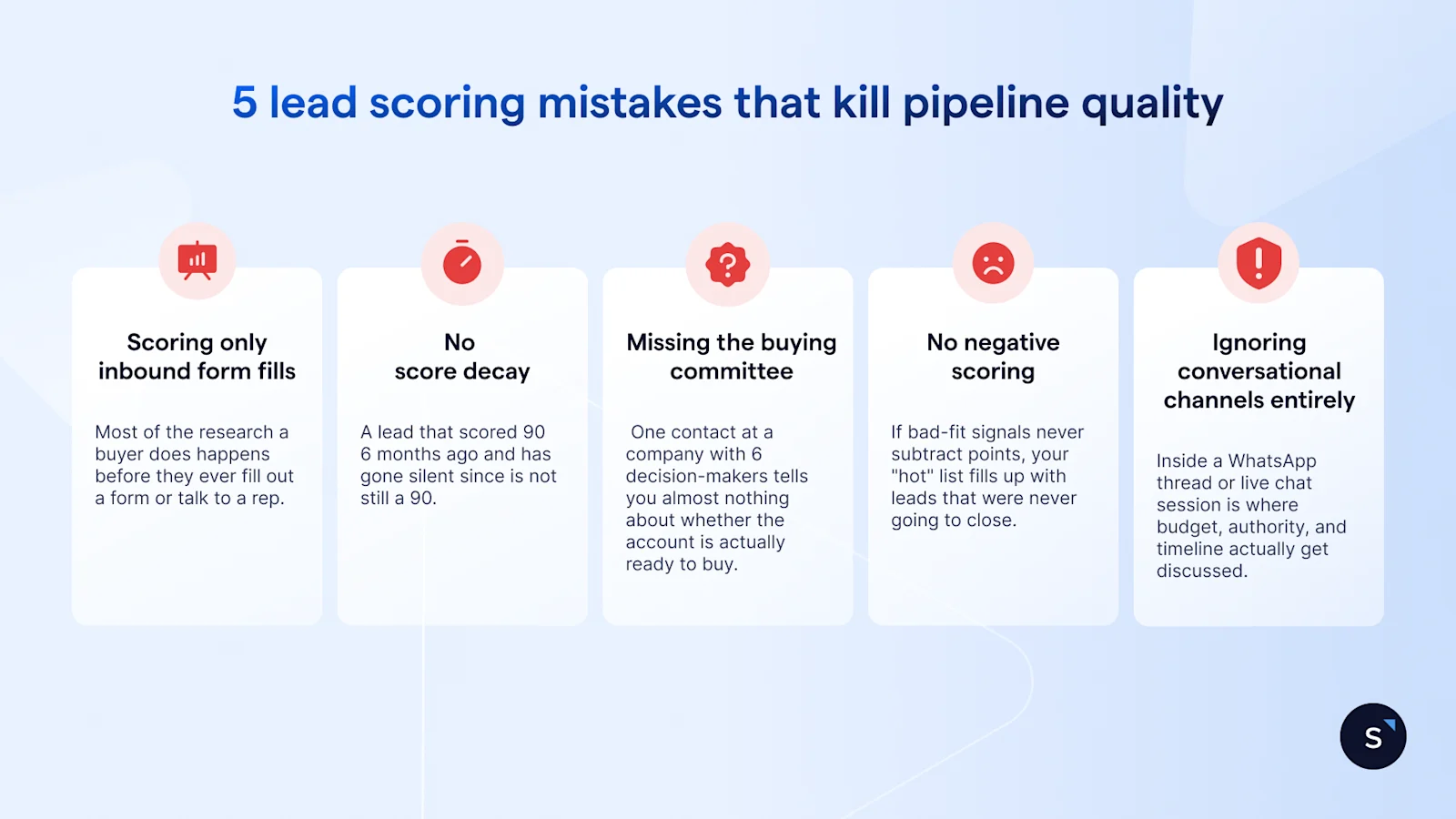
## **5 lead scoring mistakes that kill pipeline quality**
### Scoring only inbound form fills
Most of the research a buyer does happens before they ever fill out a form or talk to a rep, in review sites, competitor comparisons, and conversations with peers, and none of that touches a scoring model that only counts form fills.
### No score decay
A lead that scored 90 6 months ago and has gone silent since is not still a 90. Without automatic decay rules, stale leads stack up at the top of every list your reps see.
### Missing the buying committee
Scoring one contact at a company with 6 decision-makers tells you almost nothing about whether the account is actually ready to buy.
### No negative scoring
If bad-fit signals (a competitor's email domain, a student account, a role with no purchasing authority) never subtract points, your "hot" list fills up with leads that were never going to close.
### Ignoring the conversational channel entirely
Most scoring models never look at what happens inside a WhatsApp thread or live chat session, even when that's where budget, authority, and timeline actually get discussed.
## **Lead scoring and customer intelligence: why the connection matters**
A lead score is a snapshot, a single number calculated at one point in time. Customer intelligence is the ongoing behavioral and conversational profile that feeds every score, updated continuously across every channel a customer touches. Teams that treat these as the same thing tend to end up with a technically accurate score sitting on top of increasingly stale, incomplete data.
A better scoring formula won't fix this on its own. What fixes it is a data layer underneath the score, customer intelligence tools that read every conversation across channels, surface patterns your scoring rules would otherwise miss, and keep the inputs to your model current without someone manually re-tagging contacts every quarter.
## **Score and act on leads automatically with SleekFlow AgentFlow**
Everything above assumes a human eventually reviews the score and decides what to do next. AgentFlow removes that step for the leads that don't need it.
It calculates a lead score from criteria you define directly inside a WhatsApp, Instagram, or live chat conversation, weighs each criterion by the percentage you assign, and hands the conversation to a human rep the moment a lead crosses your threshold, summary included.
[Checkmob](/en-sg/blog/instagram-ai-agent) used this approach to automate first contact and lead qualification, so every lead gets an instant reply and reps only pick up conversations that are already qualified.
### What is the difference between rule-based and predictive lead scoring?
Rule-based scoring assigns fixed points to actions and attributes that a person defines upfront, for example, +15 for a pricing page visit. Predictive scoring uses a machine-learning model trained on your historical closed-won and closed-lost data to work out which factors actually correlate with a sale, then updates those weights automatically as new data comes in.
### What lead score threshold should I use to qualify a lead as an SQL?
There's no universal number. Rather than copying a threshold from another company's model, look at your own closed-won data and find the score above which roughly 25% or more of leads have historically converted to an opportunity. That's your SQL line.
### Can WhatsApp engagement data be used for lead scoring?
Yes. SleekFlow's AgentFlow can calculate a lead score in real time from criteria evaluated inside a WhatsApp, Instagram, or live chat conversation, such as whether a lead is comparing options or showing clear purchase intent, alongside the weight you assign each criterion.
### How often should I recalibrate my lead scoring model?
Most revenue operations teams review and recalibrate quarterly, comparing score distribution against actual closed-won and closed-lost outcomes, and recalibrate immediately after any major shift in ICP, pricing, or lead channel mix.
### What is the difference between lead scoring and customer intelligence?
A lead score is a single number calculated at a point in time. Customer intelligence is the continuously updated behavioral and conversational profile, across every channel, that feeds and improves that score over time.
## Want to outcompete your peers with SleekFlow's help?
Book your personalised demo with SleekFlow today and unlock the potential of seamless communication
[Book a Demo](https://sleekflow.io/en-sg/book-a-demo)
[View Pricing](https://sleekflow.io/en-sg/pricing)