---
title: "WhatsApp customer retention: 6 plays that work when broadcasts stop landing"
description: "Broadcasts are capped, WhatsApp isn't. 6 retention plays that dodge the marketing limit and the Oct 2026 pricing shift. See how SleekFlow helps."
canonical: "https://sleekflow.io/en-sg/blog/whatsapp-customer-retention"
html_lang: "en-sg"
date_modified: "2026-09-11T07:05:25.137Z"
og_title: "WhatsApp retention: 6 plays when broadcasts stop landing"
og_description: "Broadcasts are capped, WhatsApp isn't. 6 retention plays that dodge the marketing limit and the Oct 2026 pricing shift. See how SleekFlow helps."
og_image: "https://images.ctfassets.net/tu2uwzoyozk8/3i0d90LSygNaSGj02kefam/1b59fcd05676a39aa8659e8ef805d58d/pasted-image-1.png?fm=webp&q=90&w=1200"
---
```json
{
"@context": "https://schema.org",
"@type": "Article",
"headline": "WhatsApp retention: 6 plays when broadcasts stop landing",
"description": "Broadcasts are capped, WhatsApp isn't. 6 retention plays that dodge the marketing limit and the Oct 2026 pricing shift. See how SleekFlow helps.",
"url": "https://sleekflow.io/en-sg/blog/whatsapp-customer-retention",
"dateModified": "2026-09-11T07:05:25.137Z",
"image": "https://images.ctfassets.net/tu2uwzoyozk8/3i0d90LSygNaSGj02kefam/1b59fcd05676a39aa8659e8ef805d58d/pasted-image-1.png?fm=webp&q=90&w=1200",
"breadcrumb": {
"@type": "BreadcrumbList",
"itemListElement": [
{
"@type": "ListItem",
"position": 1,
"name": "Home",
"item": "https://sleekflow.io/en-sg"
},
{
"@type": "ListItem",
"position": 2,
"name": "Blog",
"item": "https://sleekflow.io/en-sg/blog"
},
{
"@type": "ListItem",
"position": 3,
"name": "WhatsApp retention: 6 plays when broadcasts stop landing",
"item": "https://sleekflow.io/en-sg/blog/whatsapp-customer-retention"
}
]
}
}
```
# WhatsApp customer retention: 6 plays that work when broadcasts stop landing
*Julian Wong — Content Strategist*
## Summary
- Marketing broadcasts carry a per-user frequency cap and no volume discount, while utility and service messages carry neither.
- From 1 Oct 2026, WhatsApp service messages and in-window utility templates start billing at the local utility rate.
- A Click-to-WhatsApp ad opens a 72-hour free window that survives the pricing change and skips the marketing cap.
- Order confirmations, dispatch updates, and returns windows sent as utility templates sit outside the per-user marketing limit entirely.
- Retail brand Awfully Chocolate halved its WhatsApp response time after building retention around inbound replies, not broadcasts.
Your broadcast list used to convert. Now half of it barely gets read, Meta's per-user cap throttles the rest, and the reply rate on your best template has been sliding for months.
Marketing is the culprit, not the copy. It's the one WhatsApp send Meta actively rations, with a flat rate, no volume discount, and a limit that tightens the moment someone stops opening.
The 6 plays below use message types Meta doesn't cap, and moments the customer opens themselves.
## **What is WhatsApp customer retention?**
WhatsApp customer retention is the practice of keeping existing customers active and buying on WhatsApp, using order updates, service replies, reorder prompts, and targeted offers instead of one-off acquisition sends. Done well, it leans on message types Meta prices and caps differently to broadcasts: utility templates, service replies, and customer-initiated conversations.
Retention earns that shift:[ acquiring a new customer costs 5 to 25 times more than keeping an existing one](https://www.invespcro.com/blog/customer-acquisition-retention/), the real case for running WhatsApp as a retention channel in its own right.
A programme built on the same broadcast tools as a launch campaign inherits the same limits, even though the two jobs need different message types.
## **Why WhatsApp retention campaigns fail to deliver**
WhatsApp retention campaigns fail to deliver when they run entirely on marketing broadcasts, the one category Meta prices flat with no[ volume discount](https://developers.facebook.com/documentation/business-messaging/whatsapp/pricing) and throttles per contact through a frequency limit. A growing list stops converting at the rate it once did.
Meta doesn't publish an exact number for that limit. It[ adjusts to each contact's recent read rate and inbox load](https://developers.facebook.com/documentation/business-messaging/whatsapp/templates/marketing-templates/per-user-limits), so a customer who stopped opening your messages 6 months ago gets capped first. Utility, authentication, and service messages are exempt entirely, which is why every play below leans on one of them.
## **Which retention messages are capped, and which are not**
Marketing templates are the only type carrying both a flat rate and Meta's per-user cap. Utility and authentication templates cost less and unlock volume discounts; service messages and the Click-to-WhatsApp window depend on timing, not category, for their price.
| **Message type** | **Who sends it** | **Subject to the per-user marketing cap?** | **Gets volume discounts?** |
| --- | --- | --- | --- |
| Marketing template (broadcast) | Business, unprompted | Yes | No |
| Marketing template inside an open service window | Business, after the customer replies | No | No |
| Utility template (order, dispatch, returns) | Business | No | Yes |
| Service message (free-form reply) | Business, inside the 24-hour window | No | No |
| Click-to-WhatsApp 72-hour window | Opened by the customer | No | Free, no discount needed |
Lean hardest on the rows WhatsApp doesn't cap.
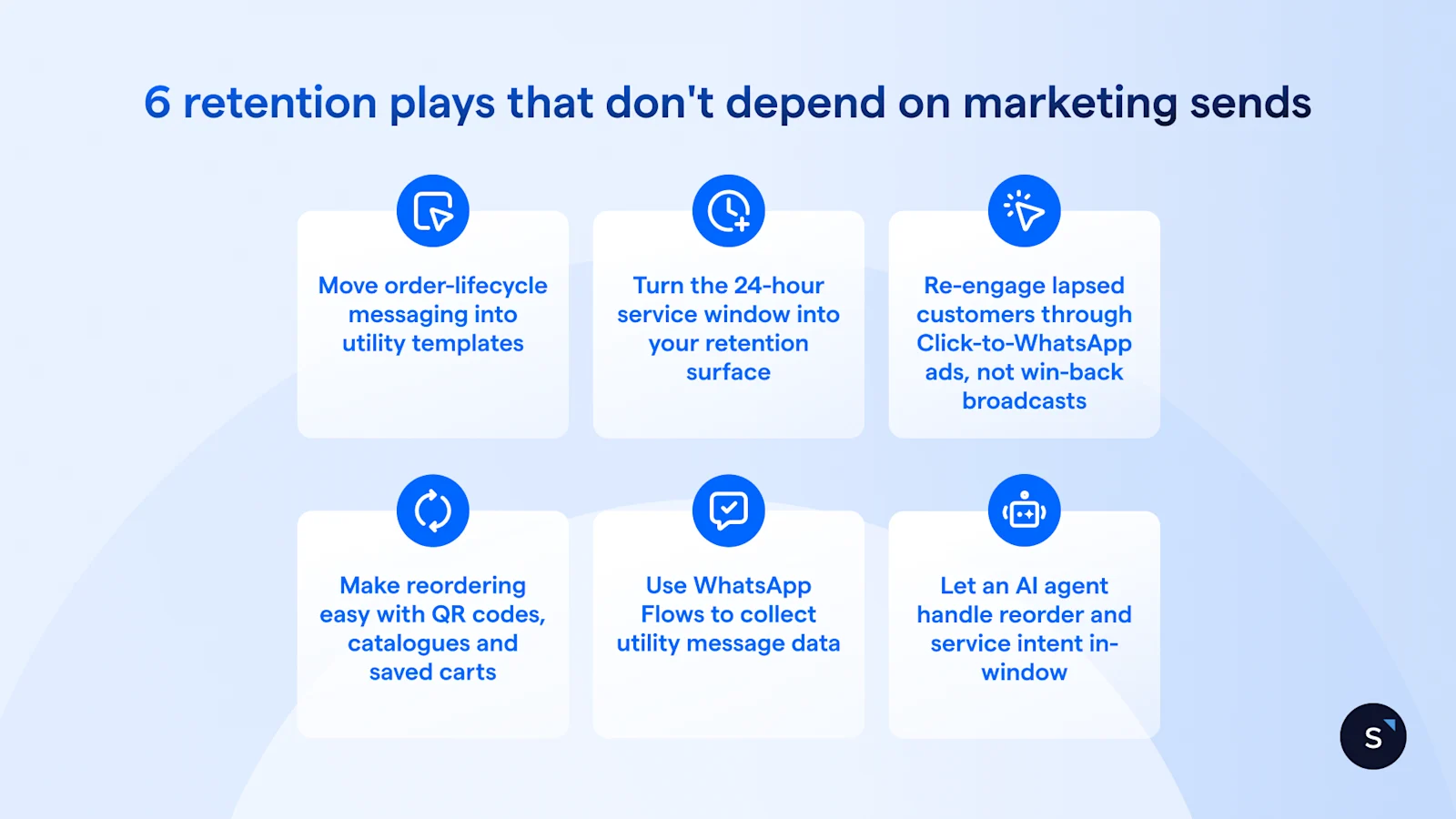
## **6 retention plays that don't depend on marketing sends**
Each swap below trades a capped, flat-rate send for one that Meta prices or delivers differently. None of them touch the marketing broadcast at all.
### **1. Move order-lifecycle messaging into utility templates**
Order confirmation, dispatch, delivery, and the returns window belong in utility templates, not marketing broadcasts. Utility messages sit outside Meta's per-user cap and unlock volume discounts marketing never gets, so the messages a customer actually expects get cheaper as the list grows, not throttled. It's the lowest-effort play here: the content already exists and just needs reclassifying.
### **2. Turn the 24-hour service window into your retention surface**
Any reply a customer sends opens a 24-hour window for messaging freely, the one guaranteed-delivery moment on WhatsApp. Use it to recommend a refill, upsell an add-on, or offer the next booking slot:[ from 1 Oct 2026](https://sleekflow.io/en-sg/blog/whatsapp-business-price) those replies bill at the local utility rate rather than being free, which changes the price, not the value.
### **3. Re-engage lapsed customers through Click-to-WhatsApp ads, not win-back broadcasts**
A win-back broadcast to a lapsed contact still counts against the per-user cap and the flat marketing rate. A Click-to-WhatsApp ad flips the direction: the customer messages first, which[ opens a 72-hour free window](https://help.sleekflow.io/en_US/whatsapp/understanding-click-to-whatsapp-ads-ctwa-and-the-72-hour-free-window) and exempts the conversation from the cap entirely. The trade-off is ad spend, since Meta charges for the click, not the message.
### **4. Make reordering easy with QR codes, catalogues and saved carts**
Reordering costs nothing to trigger when the customer starts it. A WhatsApp catalogue, a saved cart, a QR code on packaging, or a keyword shortcut such as "reorder" all let a repeat customer reopen the conversation, routing the reply through the free service window instead of a broadcast, and counting as a customer-initiated conversation, one of the four numbers worth tracking below.
### **5. Use WhatsApp Flows to collect the data that makes utility messaging legitimate**
[WhatsApp Flows](https://sleekflow.io/en-sg/blog/whatsapp-flows) let a customer fill in preferences, a replenishment cycle, sizing, or a service date in one interactive form instead of a 5-message back-and-forth. A Flow bills at whatever category its template is filed under, so the real saving is every utility message downstream that now fires on real data instead of a guess.
### **6. Let an AI agent handle reorder and service intent in-window**
An[ AI agent](https://sleekflow.io/en-sg/agentflow/inbound-ai-agent) that answers inside the service window turns response speed into the retention lever, instead of send frequency. It can confirm a reorder, check delivery status, or rebook a slot the moment a customer writes in, at any hour, without adding a single broadcast to the send count.
## **Where broadcasts still belong**
Broadcasts still make sense for time-bound campaigns aimed at an engaged segment: a new collection launch, a flash sale, a policy change every customer needs to see by a set date. The economics only break down when broadcasts become the default channel for retention instead of the exception, going out to a list nobody has pruned in a year.
## **How to measure WhatsApp retention properly**
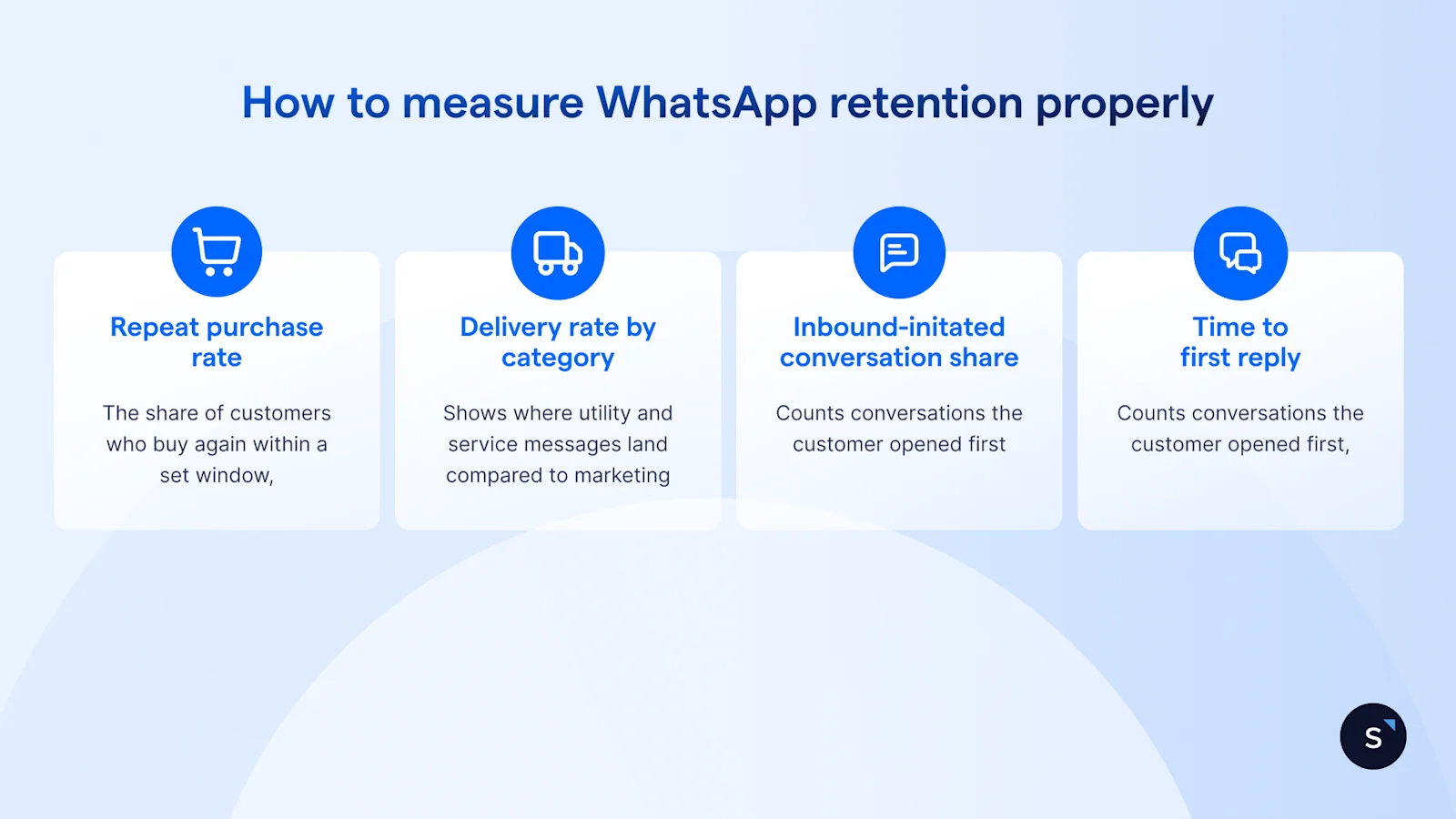
Retention on WhatsApp shows up in four numbers: repeat purchase rate, delivery rate by category, inbound-initiated conversation share, and time to first reply. Together they separate a channel genuinely retaining customers from one just delivering broadcasts nobody opens.
- **Repeat purchase rate**, the share of customers who buy again within a set window, is the outcome every play above is chasing.
- **Delivery rate by category** shows whether utility and service messages land at a materially higher rate than marketing, confirming the cap is doing its job.
- **Inbound-initiated conversation share** counts conversations the customer opened first, through a reorder shortcut, a Flow, or a reply, not a broadcast sent to them.
- **Time to first reply** measures how fast a human or an AI agent answers inside the service window, the speed that makes Play 2 and Play 6 work.
## **How SleekFlow helps keep customers coming back**
SleekFlow is the AI suite for revenue-driving conversations, and the plays above are built into the product rather than left for a team to script by hand.
AgentFlow answers inside the service window automatically, checking orders, confirming reorders, and rebooking service slots the moment a customer writes in. WhatsApp Flows run through the same inbox, feeding preference and replenishment data straight back into utility triggers.
### Real-life example: Awfully Chocolate segments seasonal shoppers for retargeted campaigns to increase repurchase rate
Awfully Chocolate, a Singapore chocolatier, was fielding a growing volume of customer enquiries by hand and needed a system that plugged straight into its Shopify store without asking a lean team to learn something complicated.
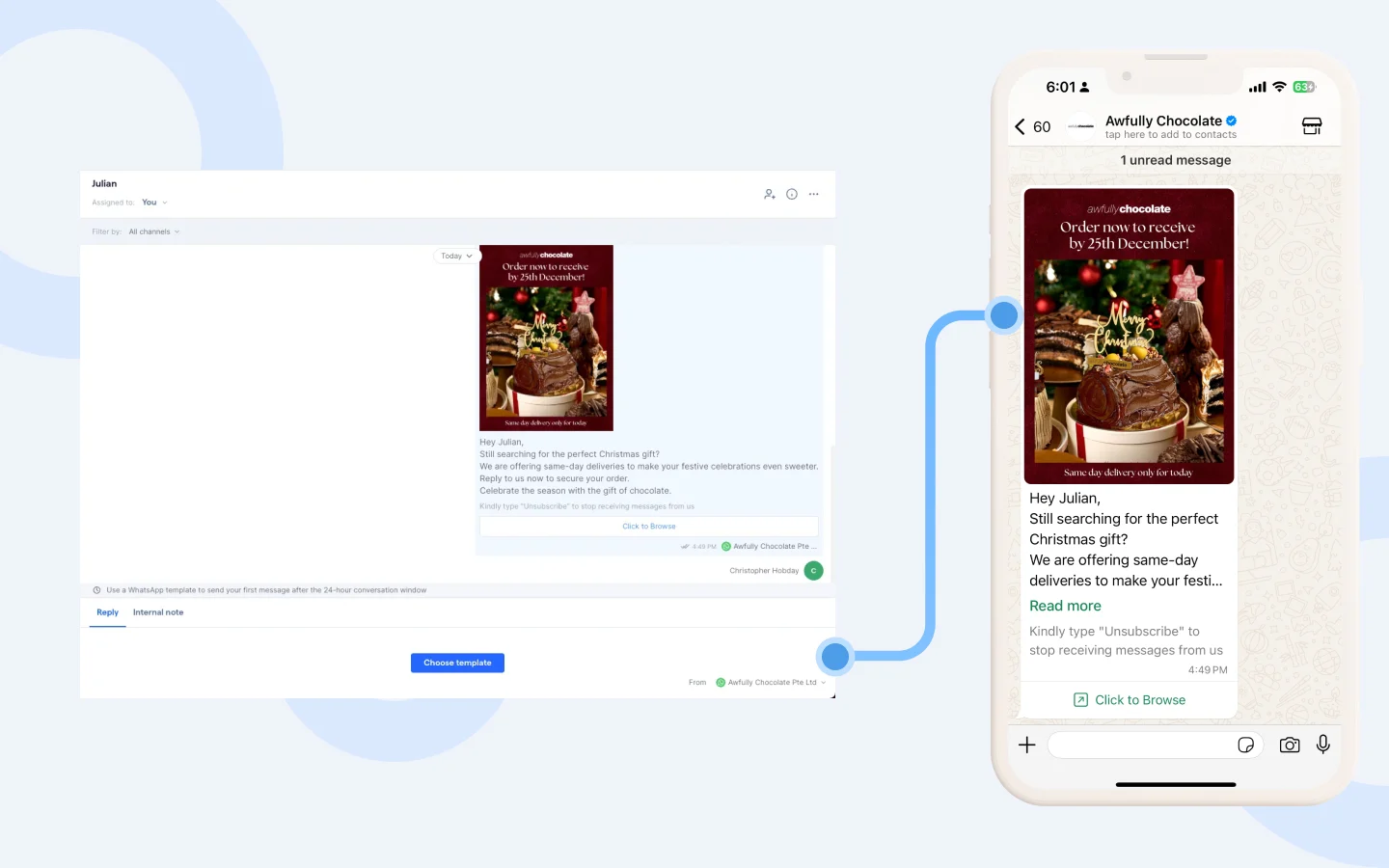
Every website enquiry opts the contact in on WhatsApp, and SleekFlow automatically segments the active ones for personalised broadcast campaigns: re-engaging past leads with exclusive Valentine's Day promotions, and recommending chocolates and desserts from purchase history.
Results:
- Response time cut in half
- 2,000 or more new enquiries handled a month
- A 90% read rate on broadcasts, once broadcasts were reserved for genuinely engaged contacts
[Read the full case study →](https://sleekflow.io/customer-stories/awfully-chocolate)
## You don't need a big budget for WhatsApp retention\.
Book a demo to see the service window, Flows, and reorder automation running on your own WhatsApp number.
[Book a Demo](https://sleekflow.io/en-sg/book-a-demo)
[View Pricing](https://sleekflow.io/en-sg/pricing)
### What is the difference between a WhatsApp utility message and a marketing message?
A utility message ties to a transaction the customer already started, such as an order confirmation, and sits outside Meta's per-user cap while unlocking volume discounts. A marketing message is promotional, billed flat with no volume discount, and subject to that cap once a contact stops engaging.
### Does the 1 Oct 2026 WhatsApp pricing change affect the Click-to-WhatsApp 72-hour window?
No. That free entry window for conversations starting from a Click-to-WhatsApp ad or a Facebook Page call-to-action button stays free after 1 Oct 2026. The change applies only to service messages and in-window utility templates, which start billing at the local utility rate from that date.
### How many marketing messages can I send to one WhatsApp contact?
Meta doesn't publish a fixed number. The per-user limit adjusts to each contact's recent read rate and how full their inbox already is, tightening automatically for a contact who's stopped opening your messages rather than applying one cap to everyone.
### What counts as an inbound-initiated conversation for retention reporting?
Any conversation the customer opens first, through a reorder keyword, a WhatsApp Flow, a saved cart link, or a direct reply, rather than one starting from a broadcast the business sent. A rising share is the clearest sign retention is actually working.
### Can an AI agent reply inside the WhatsApp service window automatically?
Yes. It can answer the moment a customer writes in, confirming a reorder, checking delivery status, or rebooking a slot before the 24-hour window closes. Since that window now bills at the utility rate, a fast reply also means the message is worth what it costs.