AI sales agent: types, use cases & how to choose the right one for your business (2026)


Your sales team can't be online 24/7. Leads message you at 11 pm, follow-ups slip through the cracks, and every hour without a reply is an opportunity your competitor is happy to take. AI sales agents that handle inbound inquiries, qualify leads, and follow up without a human in the room are rapidly becoming the fix.
But there's a catch. Most AI sales agents on the market were designed for outbound email prospecting, cold sequences, volume dialing, and inbox automation. They were not built for how service businesses actually sell: in real conversations, on WhatsApp, Instagram DMs, and Facebook Messenger, with multiple rounds of back-and-forth before a customer commits.
This guide is for sales managers and business owners who need an inbound AI agent built for messaging channels, not another outbound email bot. We'll break down what the right AI sales agent should actually do, what to look for when comparing tools, and how leading platforms stack up, so you can make a confident decision.
Seeing this in action makes the difference clearer than any comparison table. Here's a 3-minute walkthrough of how to set up an AI agent that qualifies leads, recommends products, books demos, and hands off to your team with a full summary, without a human touching the conversation until it counts.
Types of AI sales agents (and which fit messaging-first sales)
Not everything sold as an "AI sales agent" is the same thing. The market currently has four distinct generations of technology, each with meaningfully different capabilities and results when deployed on WhatsApp, Instagram, or SMS. Understanding where each one sits helps you cut through vendor marketing and ask better questions before you buy.
How an AI sales agent works in practice
For most business owners, the black box is the biggest barrier to trust. Here is exactly what happens inside a hybrid AI sales agent from the moment a customer sends a message until the conversation is logged.
Channel intake: Receives messages from WhatsApp, Instagram DM, Messenger, or SMS and normalises them into a single pipeline. Customer history across all channels is accessible in one view.
Intent detection: The LLM reads the message and identifies the customer's actual intent, not just the literal words. "How much?" "Is it pricey?" "What's the damage?" all lead to the same answer.
Retrieval from knowledge base (RAG): Pull the most relevant information from your service catalog, pricing, FAQs, or availability rules. Responses are grounded in your business data, not generic AI guesswork, which keeps answers accurate and on-brand.
Tool & action calls: If action is needed, the agent executes it directly: checks the calendar, creates a CRM contact, confirms a booking, sends a payment link. It doesn't just say it can do something. It does it right there in the same chat thread.
Escalation logic: Monitor for triggers that require a human: explicit requests, repeated confusion, high-value enquiries, or low-confidence answers. When it fires, the full conversation context transfers to the rep instantly.
Conversation memory: Retain the full thread across sessions. A customer returning to a three-day-old WhatsApp conversation picks up exactly where they left off.
Logging & analytics: Every interaction is recorded: response times, intent classifications, actions taken, escalation points, conversion outcomes. This provides the audit trail needed for performance reviews, compliance, and continuous improvement.
What to look for in an AI sales agent for a messaging-first business
Use these five criteria as your buyer's checklist. Before you trial any tool, run it through each of these to see whether it's actually built for the workflow you need.
1. Multi-channel coverage from one inbox
The agent should work across WhatsApp, Instagram DM, Facebook Messenger, and live chat. It surfaces all conversations in a single unified view. If your team is switching between four apps to manage leads, you've already lost conversion efficiency. The unified inbox isn't a nice-to-have; it's foundational.
2. Intelligent human handoff
A good AI sales agent knows when to pass the conversation to a human, and does so gracefully. That means recognising signals like complex pricing negotiations, complaint language, or repeat high-value customers, and then instantly transferring the full conversation context to the right rep. No restarting. No repeating.
3. Multi-turn conversation memory
Unlike basic chatbots that treat every message as a fresh conversation, a proper AI sales agent maintains context throughout an entire interaction. If a lead mentioned they're looking for a course starting in March in their first message, the agent should still know that by message eight. For service sales, where customers ask multiple questions before committing, this capability is non-negotiable.
4. No-code workflow builder
SMB sales teams don't have developers. The platform should allow non-technical users, e.g. sales managers, operations leads, to configure the agent's behaviour, set qualification questions, adjust conversation flows, and define handoff triggers without writing a single line of code. If setup requires an engineer, adoption will stall.
5. WhatsApp Business API and platform compliance built In
Businesses that message customers at scale must remain compliant with WhatsApp Business API policies, Meta's messaging rules, and regional data regulations. This infrastructure should be handled by the platform, not left to the business to figure out on its own. Non-compliance can result in account suspension.
The rule that catches most SMBs off guard:
Within 24 hours of a customer's last message, you can reply freely in any format. Outside that window, you must use a pre-approved Message Template. Promotional broadcasts, follow-ups, and re-engagement sequences all fall into this category.
This is defined directly in Meta's WhatsApp Business Messaging Policy and applies to every business using the WhatsApp Business API, regardless of which platform they use to send messages.
What this means in practice: your AI sales agent platform needs to handle template management, opt-in tracking, and the 24-hour window logic automatically, so your outbound sequences never fire outside policy boundaries without your team having to manually monitor timing. If a vendor doesn't mention this, ask them directly how they manage it.
AI sales agent vs. human sales rep
Here's the question business owners ask us most: "Will this replace my sales team?" The direct answer: no. The honest answer: it will fundamentally change what your sales team spends their time on.
The model that works: AI handles volume and speed, humans handle nuance and closing. According to McKinsey's State of AI report, sales teams that adopt AI automation report up to a 50% reduction in cost-per-lead alongside significant improvements in pipeline quality.
SleekFlow customer Checkmob saw this play out directly: after deploying an AI agent, they
Reduced response time by 70%
Generated more than 20 additional qualified demo bookings per month, without reducing their sales team headcount.
The reps didn't lose their jobs. They stopped doing first-response triage and started doing what they were hired to do: close deals.
AI did not replace people. It allowed people to act like people again.

Mauro Filho
Founder & CEO, Elétron Seguros
Comparing AI sales agent platforms, which one is right for you?
Not all AI sales agents are built for the same workflow. Outbound email agents like Artisan and 11x are purpose-built for cold prospecting — automating SDR activity at scale. They're excellent at what they do. But if your leads come in through messaging apps and your sales process involves back-and-forth qualification before a close, they're the wrong tool for the job entirely. The comparison below is structured around what messaging-first SMBs care most about.
The information below is based on publicly available product positioning from each vendor's own website, reviewed in February 2026.
Sources:
Artisan positions Ava as an outbound tool:"Ava is an AI Sales Agent who automates your entire outbound demand generation process."
11x positions Alice as an outbound tool: "All of your outbound running on autopilot, using the power of AI Agents."
When to choose SleekFlow
SleekFlow is purpose-built for businesses that sell through conversations on WhatsApp, Instagram DM, and Facebook Messenger. If your leads come in through messaging apps and your sales process involves multi-turn qualification, follow-ups, and appointment booking before a close, SleekFlow's inbound AI agent (AgentFlow) is designed specifically for that workflow, not retrofitted from an outbound email tool.
For a deeper, per-tool breakdown of top platforms, read Best AI sales agent: Your ultimate conversion tool
ROI of AI sales agents, is it worth it?
Before calculating ROI, you need the right metrics to track. Here's what service businesses running on messaging should benchmark:
Reply rate improvement: The percentage of inbound messages that receive a response within 5 minutes. Industry data from HubSpot shows that 78% of customers buy from the first company that responds. Baseline this before and after deployment.
Lead qualification rate: What percentage of inbound conversations are progressing to a qualified stage versus going dark? An AI agent should improve this by maintaining consistent follow-up.
Meetings or demos booked: track how many appointments are booked directly through the agent, without human involvement. This is the clearest signal of pipeline impact.
ETS Global, a global education testing services company, deployed SleekFlow's AI agent to handle inbound inquiries across messaging channels. The result:
63% increase in leads handled and a significant improvement in lead response time, without adding headcount.
When you factor in the cost of a missed lead, the ROI calculation becomes straightforward. Read the full ETS Global case study.
So we've trained the AI agent to gather all the information that we've input into it in order to respond to customers in a fast and accurate information. This helped us with time management and efficiency. We've noticed an increase in engagement for around 63% and a significant increase in reply rates.

Sarah Masri
Marketing & Communications Assistant
Guide to set up an AI sales agent with SleekFlow
SleekFlow's AgentFlow is built for non-technical teams, so no developer is required, and no weeks-long implementation is needed. Here's how it works at a high level:
Upload your knowledge base: Add your service details, FAQs, pricing ranges, and common objections so the agent understands your business before their first conversation.
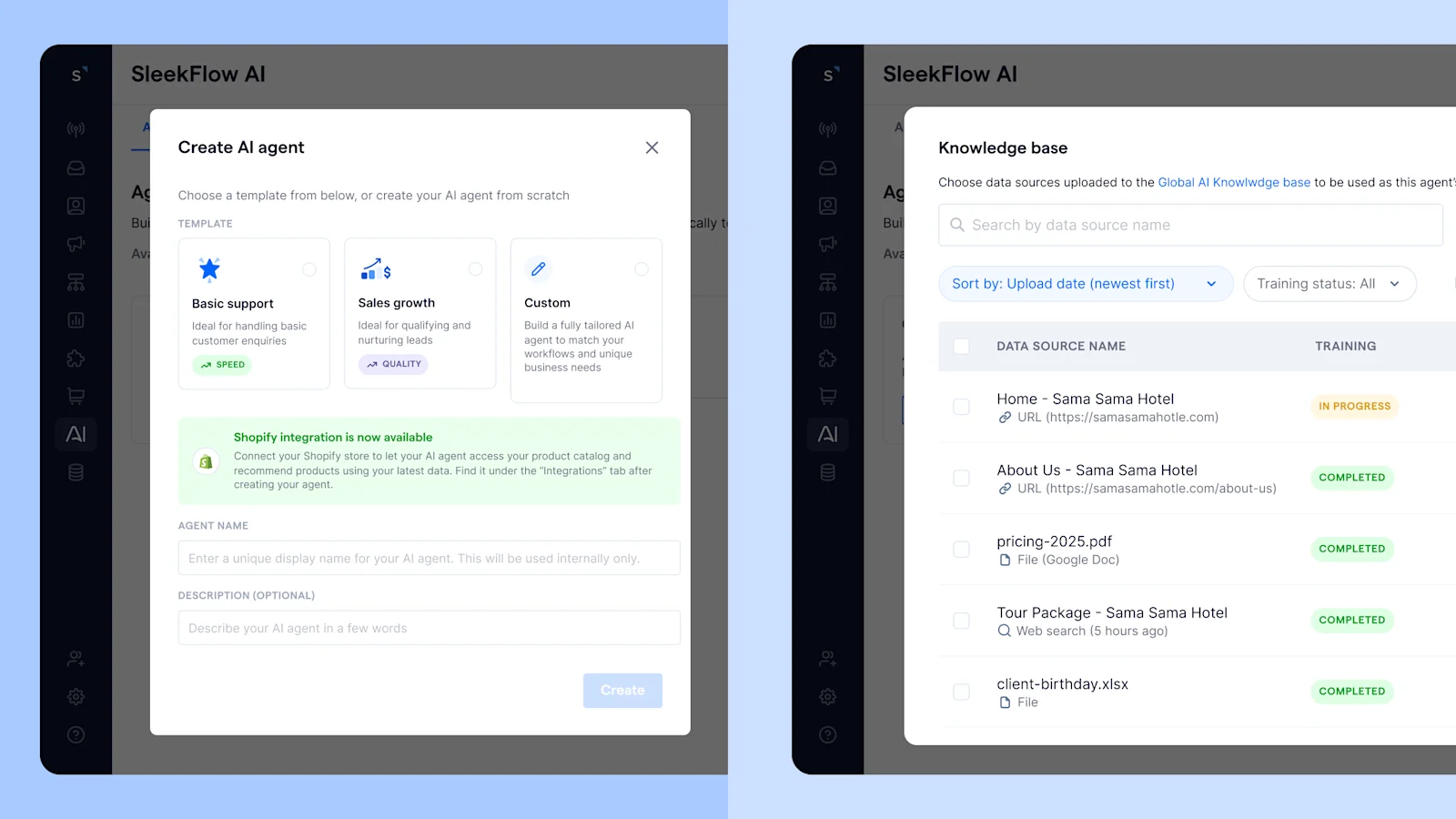
Define your agent's role and playbook: Set the agent's tone, objectives, qualification questions, and conversation boundaries. This determines how it behaves across every lead interaction.
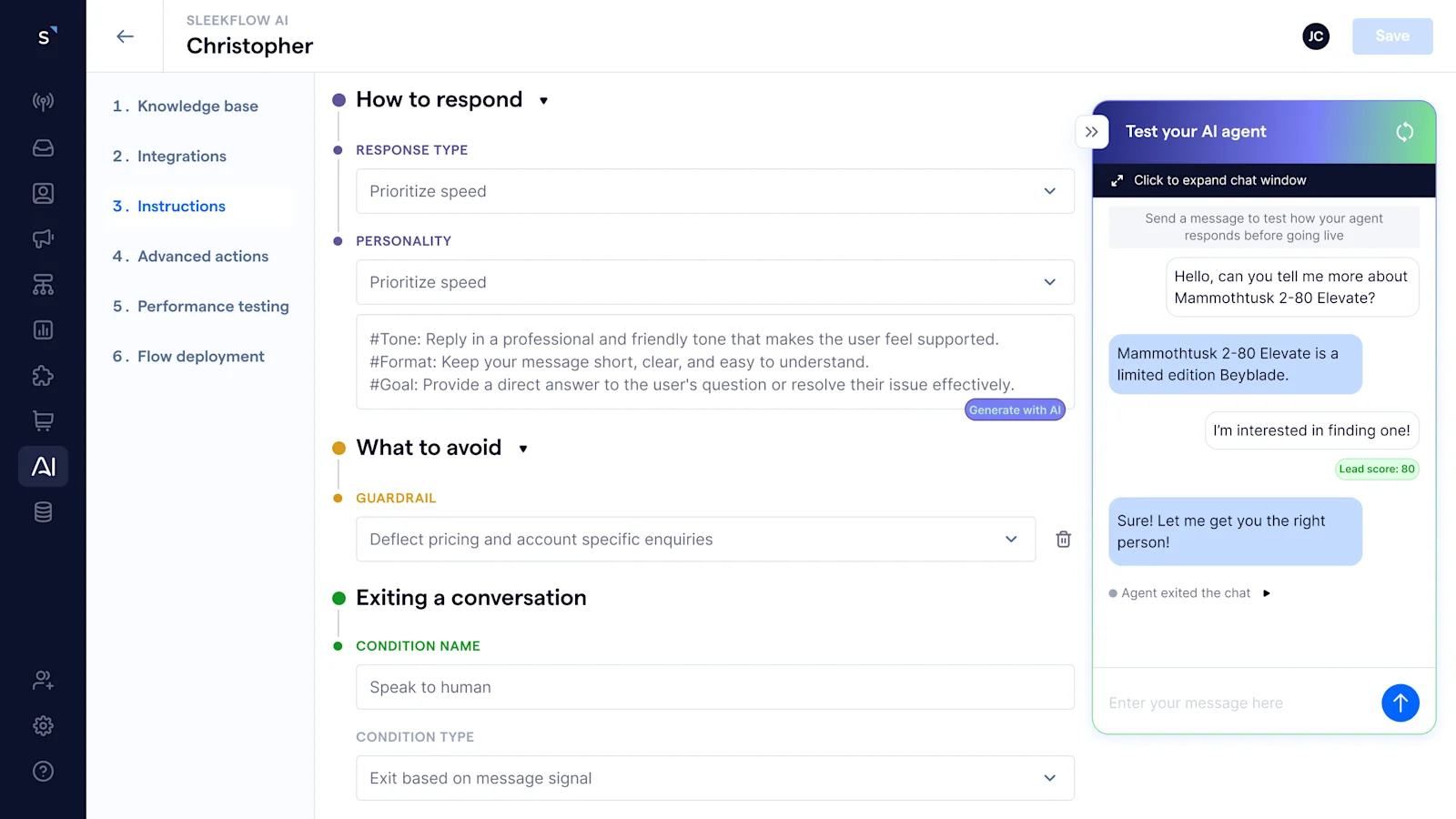
Configure handoff rules: Decide when and how the agent escalates to a human rep. Examples: pricing questions above a certain threshold, repeat customers, or complaint signals.
Test across your channels: Run test conversations on WhatsApp and Instagram before going live. Identify gaps and refine the playbook.
Launch and monitor: Go live and use SleekFlow's analytics dashboard to track response times, handoff rates, qualification quality, and demo bookings.
Elétron Seguros went through this process and found that:
80% of their conversations were handled entirely by the AI agent
only 20% required a human rep.
That meant their sales team's attention was reserved exclusively for the conversations that genuinely needed them. Read the full Elétron Seguros story.
See it for yourself
See how SleekFlow's AI agents turn conversations into revenue with AgentFlow.


