Chatbot vs live chat: Which one actually converts website visitors?


TL; DR: Quick Summary
- Live chat connects website visitors to human agents in real time, making it ideal for complex queries, high-value sales, and sensitive conversations that require empathy and judgment.
- Rule-based chatbots automate simple tasks like FAQs, routing, and order status but rely on scripted decision trees and struggle with unexpected questions.
- Rule-based chatbots automate simple tasks like FAQs, routing, and order status but rely on scripted decision trees and struggle with unexpected questions.
- AI chatbots use advanced language models to handle open-ended conversations, qualify leads, integrate with business systems, and operate 24/7.
- Omnichannel AI chat can continue conversations via channels like WhatsApp or SMS after visitors leave a website, helping businesses capture more leads and improve conversion rates.
You've seen the debate everywhere. Live chat or chatbot? Human agent or AI? While comparison articles pile up, most businesses are still unsure which option is best for them.
Here's why: the definitions have shifted. "chatbot" in 2020 meant something very different from "AI chatbot" today. And "live chat" now spans everything from a human typing in real time to an agentic AI that qualifies leads in seconds and keeps conversations alive across WhatsApp after a visitor closes your website.
In this article, we’ll clear up the confusion—explain what each tool really does, highlight the differences, and show where each one excels.
What is live chat?
Live chat is a real-time messaging channel embedded on a website that connects visitors with a human support or sales agent. Conversations happen instantly via a chat widget, and the agent responds manually. Live chat is best suited for complex, high-value, or emotionally sensitive conversations that require human judgment and empathy.
Technically, it works like this: a visitor opens the chat widget on your website, an agent receives a notification in their dashboard, and they type back in real time. Every conversation is logged, and the agent can pull up customer history, notes, and CRM data while they chat.
Where live chat genuinely shines:
Complex or unusual queries that fall outside any script.
High-stakes sales conversations where a human presence builds trust.
Emotionally sensitive situations: complaints, disputes, frustrated customers.
Late-stage buyers who have already done their research and just need someone to close the deal.
Where live chat genuinely struggles:
After business hours: If no agent is online, the conversation doesn't happen.
Volume spikes: Human agents can typically handle 3–4 concurrent chats before quality drops.
Lead capture when no one is available: A visitor who can't get a response doesn't leave their number; they just leave.
What happens when the tab closes: When a visitor exits your website mid-conversation, there is no way to reconnect. That lead is gone.
What is a chatbot?
A chatbot is software that automates conversations with website visitors. There are two fundamentally different types: rule-based chatbots, which follow pre-written decision trees and can only respond to specific inputs, and AI chatbots, which use large language models to understand open-ended questions, learn from context, and handle complex multi-step conversations.
Most articles compare "chatbot vs live chat", which in practice means a rule-based bot with a decision tree. That's an unfair fight and an increasingly outdated one.
Rule-based chatbots
Rule-based chatbots operate on if/then logic. A visitor asks a question; the bot checks it against a library of keywords or clicks a menu button; the bot returns a pre-written response. There is no real understanding happening, just pattern matching.
What they're good for:
Structured FAQs with predictable, repeatable answers
Routing visitors to the right department
Order status lookups, password reset instructions, and store hours
Simple intake forms before handing off to a human
Where they fail: the moment a visitor asks anything outside the script, the experience collapses. A bad rule-based bot doesn't just fail to help, it actively frustrates visitors and damages your brand's first impression. If you've ever typed a question into a website chatbot and received a completely irrelevant canned response, you've experienced this firsthand.
AI chatbots (agentic AI)
AI chatbots are a different category entirely. Built on large language models, they understand the meaning behind questions rather than matching keywords. They generate dynamic, contextual responses. They learn from your knowledge base, adapt to conversation history, and improve over time.
What modern AI chatbots can do that rule-based bots cannot:
Handle open-ended, multi-step conversations without falling apart
Qualify leads intelligently by asking follow-up questions based on what a visitor says and does
Adapt responses based on which page a visitor is on, how long they've been browsing, and what they've said earlier in the conversation
Integrate with your CRM, product catalog, and booking system to take real actions, not just answer questions
Proactively reach out to visitors based on behavioral triggers rather than waiting to be clicked
Continue conversations across channels like WhatsApp or SMS after a visitor closes your website
An honest caveat: AI chatbots are not a replacement for human agents in every situation. For the most complex, highest-stakes, or emotionally demanding conversations, human judgment still wins. But the gap has closed dramatically since 2022, and the remaining gap is much narrower than most "chatbot vs live chat" articles suggest.
Platforms like AgentFlow make it possible to build these agentic AI workflows that can qualify leads, automate conversations, and trigger real business actions across messaging channels.
Chatbot vs live chat: The honest three-way comparison
Here's the side-by-side view that matters. Notice the column headers: this is a three-way comparison, because rule-based chatbots and AI chatbots are not the same product.
The most important row is in the continuity column. Both human live chat and rule-based chatbots share the same structural flaw: when a visitor closes the browser tab, the conversation is over. You've captured their attention, perhaps even started a meaningful exchange, and then lost them permanently with no way to follow up.
AI live chat with omnichannel continuity solves this by bridging the conversation to WhatsApp or SMS before the tab closes. The visitor's contact details are already captured. The conversation picks up wherever it left off.
Pros and cons of chatbot vs live chat
Human live chat
Rule-based chatbots
AI chatbots
Live chat agents vs AI chatbots: Does AI replace your team?
This is the question behind the question for most people reading this article. The honest answer is no, but AI fundamentally changes what your team should be spending their time on.
The reframe: AI handles 70–80% of repetitive, qualifying, or information-gathering conversations. Your agents handle the 20% that close deals, resolve serious escalations, and build the relationships that keep customers long-term.
The model that works is smart routing, and it looks like this:
Low intent or FAQ → AI resolves fully, no human needed, no cost
Medium intent → AI handles the conversation, flags it for human review, team member can step in if needed
High-value prospect → Immediate human handoff, with full conversation context, visitor behavior history, and qualified lead data already gathered by AI
The result for your team: they stop spending time copy-pasting FAQ answers and start spending time on conversations that actually require them. When an agent receives a handoff, they're not starting from scratch; they have the visitor's browsing history, the questions already asked, and the qualifying information already collected. They can focus entirely on closing.
See how SleekFlow's AI agents qualify and route leads.
When to use chatbot vs live chat: A practical guide
The right answer isn't live chat or chatbot. It's knowing which type of conversation needs which type of response.
Use human live chat when:
A prospect is in the final stage of a high-value purchase decision and needs a human to close the sale.
The conversation involves a complaint, dispute, or emotionally sensitive issue.
You're in a regulated industry (finance, healthcare, legal) where human accountability is required.
The conversation requires judgment calls, exceptions, or creative problem-solving that no playbook covers
Use a rule-based chatbot when:
You want a structured intake form that captures information before routing to a human
Budget is the primary constraint, and your incoming conversations are genuinely simple and repetitive
Use an AI chatbot when:
You want 24/7 coverage without building a 24/7 team
You need to qualify inbound leads before a human gets involved, so your agents only speak to people worth their time
Incoming conversations are varied and open-ended, but don't require enterprise-level negotiation
You want proactive engagement—reaching out to visitors based on their behavior before they bounce, not after they click
You need conversations to survive after the website visit, continuing on the channels your customers already use
The one question that cuts through everything:
Are you losing leads because your team can't respond fast enough, isn't online 24/7, or can't follow up with visitors after they leave? If yes, no amount of human live chat investment will fix that structural problem.
Are you losing leads because conversations are too impersonal, too robotic, or too shallow to build trust? If yes, a rule-based chatbot will make it worse.
Most businesses need both—AI to handle the volume and capture every visitor, and humans to handle the conversations that close deals. The question is how intelligently those two layers work together.
Why is SleekFlow AI Growth Widget the best webchat tool for your business
Here's what most articles miss: the real debate isn't human versus AI. It's reactive versus proactive.
Every tool covered so far—human live chat, rule-based chatbots, and most AI chatbots—shares one fundamental design assumption: they wait. But 97% of visitors leave without clicking anything, taking your ad spend and SEO investment with them.
Proactive AI engagement reaches out first, captures contact details before visitors leave, and continues the conversation on WhatsApp or SMS after the tab closes. The closed tab is no longer the end of the lead.
The real question to ask about any live chat or chatbot tool:
Does it engage visitors proactively before they bounce?
Does it capture contact details when no agent is available?
Does it continue the conversation beyond your website?
See how SleekFlow's AI Growth Widget solves all three.
How to implement live chat and AI together
For most businesses, the right setup isn't a choice between live chat and AI. It's a layered system where both work together, each handling what it does best.
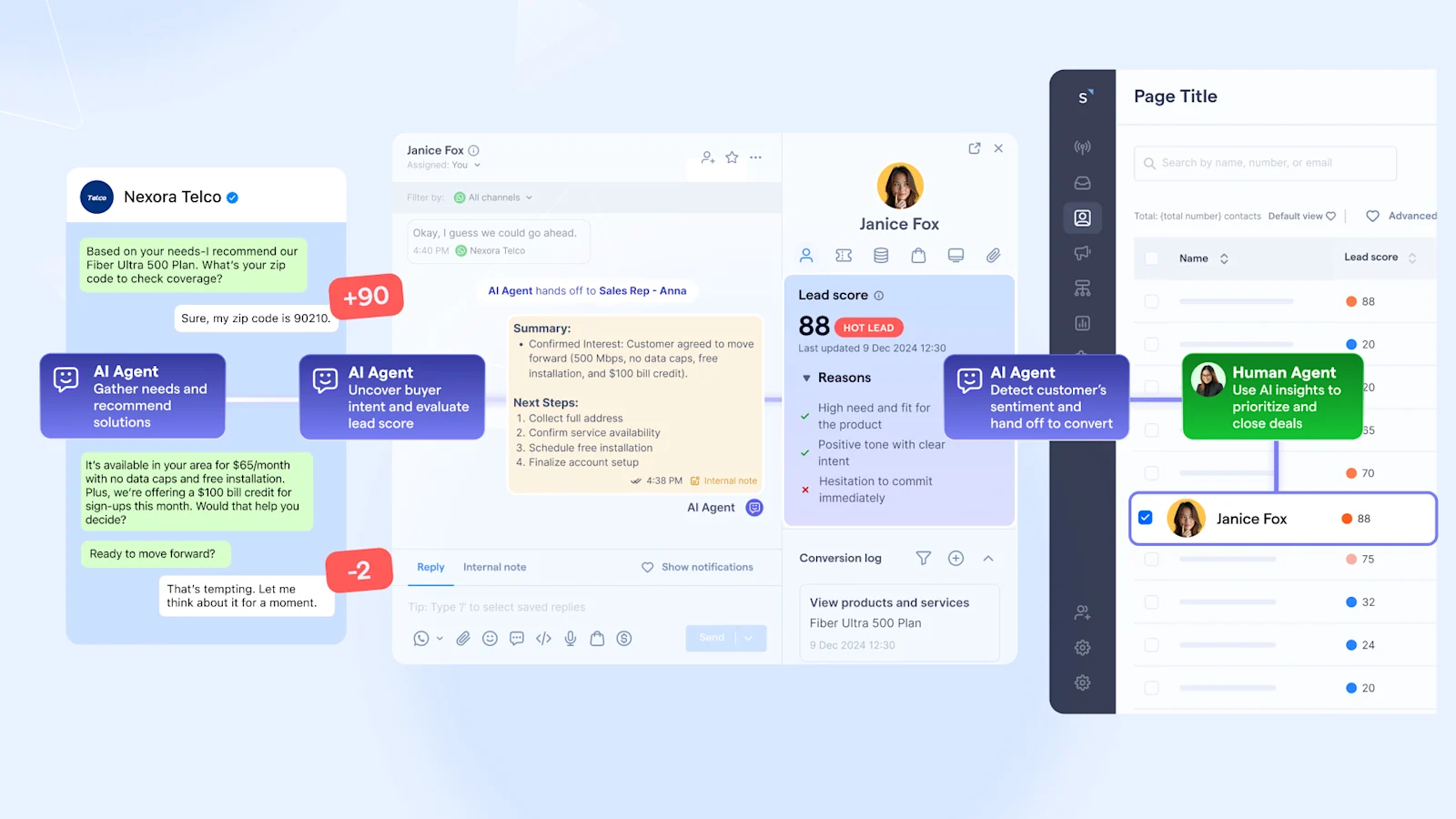
Here's the model:
Stage 1: AI handles first contact
Proactive greetings are triggered by page behavior—the right message appears on the right page at the right time, without waiting for the visitor to click anything. This works 24/7 with no agent required.
Stage 2: AI qualifies and captures
The AI agent asks intelligent qualifying questions, collects contact details (name, email, phone number, company, use case—whatever your sales process requires), and scores the visitor's intent based on what they say and how they behave. This happens automatically, in natural conversation, not through a rigid form.
Stage 3: Smart routing decides what happens next
FAQ or low-intent query → AI resolves it fully.
Medium-intent conversation → AI handles, flags for human review.
High-value prospect → immediate handoff to the right sales rep, with the full conversation history, visitor behavior data, and qualified lead information already waiting.
Stage 4: Your human team closes
When an agent receives a handoff from AI, they're not starting a cold conversation. They see every page the visitor browses, how long the visitor spends on each, what the visitor asks the AI, and what information has already been collected. They can go straight to the conversation that matters.
Stage 5: Omnichannel follow-up
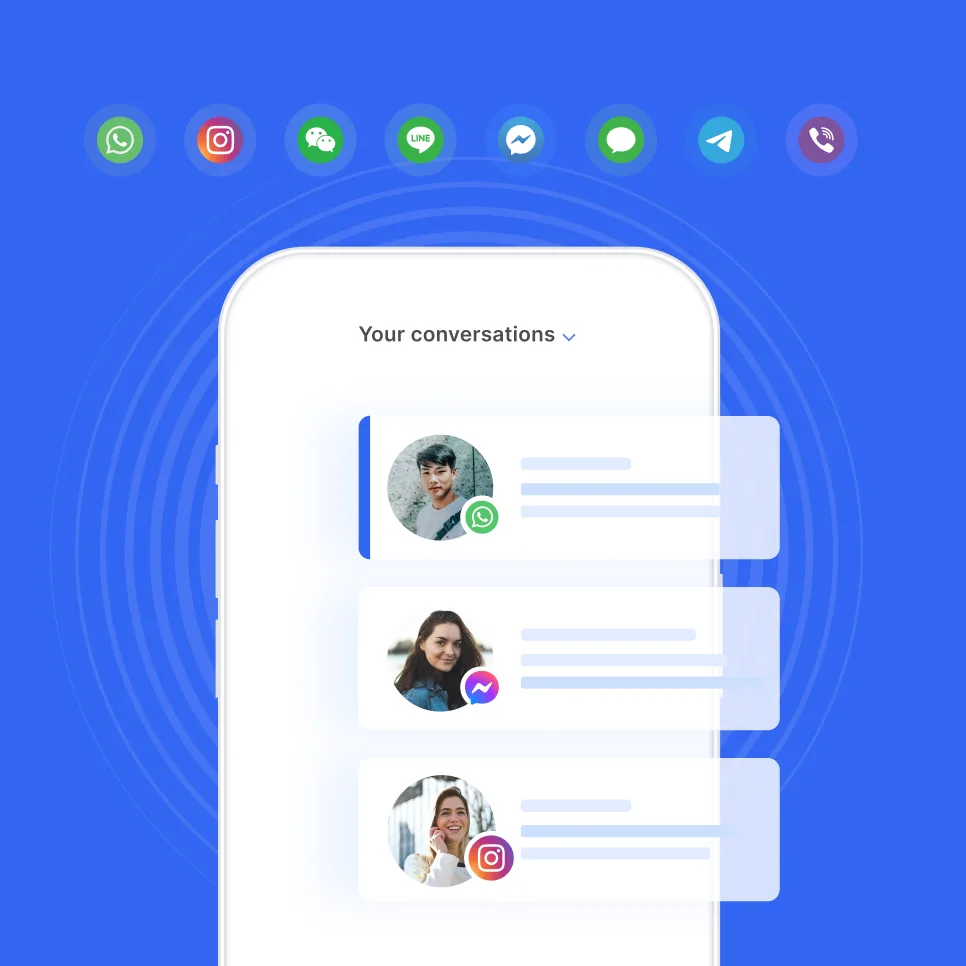
If the visitor leaves before the conversation completes, automated retargeting workflows pick up the conversation via WhatsApp or SMS—using the contact details already captured. The conversation continues exactly where it left off, on the channel the customer actually uses. See all the messaging channels SleekFlow supports.
Businesses converting the most website visitors aren't choosing between live chat and chatbots—they're using AI to do both. Let SleekFlow's AI Growth Widget handle the full journey, from first contact to follow-up.


