SMS Automation for Business: A Complete Guide to Automated SMS Marketing


TL; DR: Quick Summary
- SMS automation sends scheduled or trigger-based texts (sign-ups, purchases, cart abandonment, reminders) to match 98% open rates and fast reads.
- It includes both automated marketing flows (promos, nurturing, conversions) and automated replies (confirmations, keyword support).
- Core setup: define triggers/schedules, build templates with dynamic fields, segment audiences, sync CRM/data, and run workflows with follow-ups.
- High-impact use cases: appointment reminders, subscription/billing alerts, abandoned cart recovery, and B2B onboarding/lead nurturing.
- Measure ROI using revenue per action vs messaging cost; strong returns come from reminders and high-intent commerce flows.
- Best practices: keep texts short, test timing/CTAs, respect opt-in/opt-out compliance, and use AI chatbots for 24/7 qualification and support.
With SMS open rates reaching up to 98% and nearly 90% of messages read within three minutes, SMS remains one of the most reliable channels for real-time customer communication.
In an environment where consumers expect immediate, personalized responses, whether they’re confirming an appointment, tracking an order, or requesting support, businesses face growing pressure to communicate faster at scale. Handling this manually not only drains operational resources but also increases the risk of inconsistent or delayed responses.
This is why a growing number of organizations are adopting automated SMS messages. Through SMS marketing automation, brands can deliver timely updates, reminders, confirmations, and promotional campaigns without manual intervention. From automated SMS replies and event-triggered notifications to monthly billing workflows, automation improves engagement, reduces labor overhead, and strengthens overall customer experience.
This guide draws on industry research, practical use cases, and verified performance data to explain how automated SM marketing services help businesses communicate smarter, faster, and more consistently while saving hours of repetitive work every week.
What Is SMS Automation?
SMS automation is the process of sending scheduled or trigger-based automated SMS messages without manual effort. These triggers can include new sign-ups, purchases, cart abandonment, appointment reminders, or support queries. When a customer performs an action or when a specific time arrives, the system automatically sends the right message.
There’s a key difference between automated SMS marketing and automated SMS replies/responses. Marketing automation focuses on promotions, nurturing, and conversions, while automated replies handle instant responses such as confirmations or keyword-based support messages. Both help businesses communicate faster and more efficiently.
How SMS Automation Works
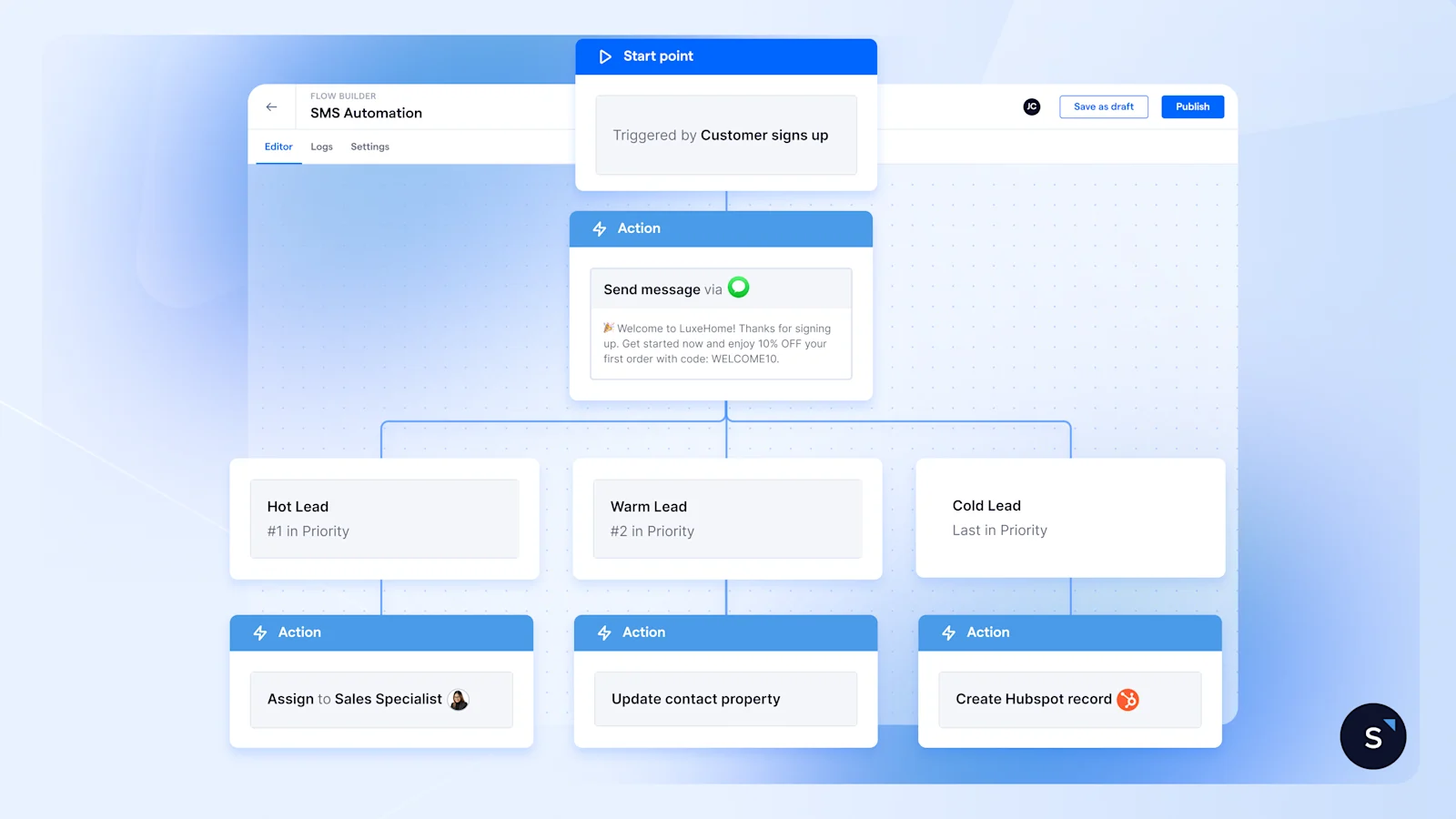
SMS automation uses data, rules, and workflows to send the right automated SMS messages at the right time. It typically follows a simple but powerful structure:
1. Set Triggers or Schedules
Automation begins with defining when messages should be sent, such as sign-ups, purchases, abandoned carts, monthly billing cycles, or support requests. These actions activate your automated SMS sender.
2. Create Message Templates
Businesses prepare templates for reminders, promotions, confirmations, or automated SMS replies. Dynamic fields (name, date, order ID) personalize each message.
3. Segment Your Audience
Using sms marketing automation strategies, companies group customers by behavior, demographics, or past purchases to improve relevance and engagement.
4. Connect Your CRM or Data Source
Integrating your CRM ensures real-time data sync so the automated SMS software always sends accurate, timely messages.
5. Deliver Through Automated Workflows
Once activated, workflows send messages instantly, track delivery, and trigger follow-up actions.
Simple Example
Customer signs up → Automated welcome SMS
Invoice generated → Automated SMS reminder sent monthly
Customer texts a keyword → System sends an automated SMS response
This end-to-end automation helps businesses communicate efficiently while reducing manual work.
Business Use Cases: Automated SMS That Save Time & Increase Conversions
SMS automation helps businesses across industries streamline communication, reduce manual workload, and improve customer engagement. Here are the most impactful use cases:
1. Appointment Reminders
Industries: healthcare, salons, automotive, financial services
Why it works: Reduces no-shows and improves operational efficiency.
Example:
A dental clinic sends automated SMS reminders 24 hours before appointments.
“Your appointment with Dr. Smith is tomorrow at 3 PM.”
Case Study: Zocdoc improves patient attendance through automated reminders.
2. Subscription & Monthly Billing Alerts
Industries: Software, insurance, gyms, utilities
Why it works: Ensures timely payments using how to automate an SMS sending every month workflows.
Example:
A software company sends:
“Your subscription renews on the 1st. Manage billing here.”
Case Study: Chargebee automates subscription reminders.
3. E-commerce Promotions & Abandoned Cart Recovery
Industries: retail, fashion, consumer electronics
Why it works: Recovers lost revenue and boosts conversions using automated SMS marketing flows.
Example:
“You left something in your cart! Complete your purchase for 10% off.”
Case Study: Shopify merchants increase conversions with SMS flows (https://www.shopify.com/success-stories)
4. B2B Lead Nurturing & Onboarding
Industries: Software, enterprise services, consulting
Why it works: Automates touchpoints across long B2B cycles.
Example:
Lead submits form → instant SMS
Demo scheduled → reminder SMS sent 1 hour before
Explore SleekFlow’s Automation Case Studies
How to Automate SMS Messages
Automating SMS is straightforward when you use the right automated SMS software. Here’s a practical framework any business can follow.
Step-by-Step: Time-Based Automations (Monthly SMS)
Ideal for: billing reminders, monthly subscription alerts, renewal notifications.
1. Choose a Monthly Schedule
In your automation tool, set:
Frequency: Monthly
Time: e.g., 10 AM on the 1st
2. Connect CRM or Customer Data
Sync billing status from platforms like Shopify, Stripe, or HubSpot.
3. Create a Personalized Template
Include name, invoice link, or due date.
Example:
“Hi {{name}}, your monthly invoice is ready. Pay securely here: {{link}}.”
4. Add Conditional Logic
Skip paid invoices
Send follow-up SMS after 48 hours if unpaid
5. Test & Activate
Preview the automated SMS to ensure correct personalization.
Step-by-Step: Event-Based Automations (Trigger-Based SMS)
Ideal for: sign-ups, cart abandonment, customer support, order updates.
1. Select an Event Trigger
Examples:
Lead added
Form submitted
Cart abandoned
Delivery status changed
2. Build Your Automation Flow
Use your automated SMS sender to set actions:
Send SMS
Assign to agent
Trigger email
Add tags
3. Personalize Message Templates
Use merge tags to add context.
Example: Welcome SMS After Sign-Up
Trigger: "New Customer Created"
Automation sends:
“Welcome {{name}}! We're excited to have you. Reply YES for offers.”
Example: Support Workflow Using Automated SMS Response
Trigger: "Customer texts HELP"
Automation sends:
“Thanks for reaching out! A support agent will contact you shortly.”
SMS ROI Calculator by Industry (Healthcare, E-commerce, B2B)
Use this quick calculator-style framework to translate your automated SMS workflows into revenue impact. Plug in your own numbers for average revenue per action, monthly SMS volume, and total messaging cost, then apply a simple ROI formula: (Revenue – Cost) ÷ Cost.
Industry benchmarks show SMS campaigns can generate anywhere from roughly $21–41 up to $71+ in revenue for every $1 spent, especially in ecommerce and high-intent reminders, while B2B teams often target more modest but still strong ROI for longer sales cycles.
SMS automation case studies across different Industries
Domino’s Pizza - Automated SMS for High-Conversion Promotions
Domino’s used automated SMS coupons to drive fast student purchases and dramatically reduce acquisition costs.
Timeline
Phase 1: Built an SMS subscriber list through local campus promotions
Phase 2: Sent automated coupon blasts to opted-in customers
Phase 3: Measured ordering activity and cost per conversion
Challenge
Domino’s needed a fast, low-cost marketing channel to reach students who ignored emails and app notifications.
Solution
They implemented automated SMS marketing to deliver instant coupon codes directly to students’ phones, ensuring visibility and quick action.
Results
125 orders generated from a single SMS campaign
Cost per acquisition: $0.15, significantly lower than social ads
Faster engagement compared to email (SMS open rates ~98%)
Improved repeat orders through ongoing automated SMS promos
Slack - Automated SMS for Security & Incident Alerts
Slack uses automated SMS to ensure users receive critical system and security alerts instantly, even when offline.
Timeline
Phase 1: Implemented SMS-based notifications for 2FA and emergency alerts
Phase 2: Expanded SMS triggers for service incidents and admin-level status changes
Phase 3: Rolled out global SMS routing to ensure delivery at scale
Challenge
Slack needed a failsafe communication channel to reach admins and users during authentication events or downtime, especially when app notifications fail.
Solution
Slack deployed automated SMS senders as a backup channel for:
Two-factor authentication (OTP)
Security alerts
Critical system incidents
Admin notifications
Results
Dramatically faster user verification during login
Reliable incident visibility, even when mobile data is off
Reduced support tickets related to login failures
Consistently high SMS delivery rates across geographies
Amazon - Automated SMS for Delivery, OTPs & Order Status
Amazon uses automated SMS workflows to keep customers informed at every point of the delivery lifecycle.
Timeline
Phase 1: Adopted SMS for OTP verification and login security
Phase 2: Introduced automated shipping and delivery notifications
Phase 3: Integrated SMS workflows with logistics partners for real-time updates
Challenge
Amazon needed a scalable and real-time communication system to manage millions of deliveries and verification requests daily.
Solution
Amazon built multi-trigger automated SMS workflows, including:
OTP & account verification
Shipment dispatched notifications
Out-for-delivery alerts
Delivery confirmation messages
Driver–customer communication (where enabled)
Results
Faster customer logins with instant OTP delivery
Higher delivery success rates due to real-time alerts
Improved customer satisfaction through transparent order tracking
Reduced WISMO (“Where Is My Order?”) support calls
Set up SMS Automations with SleekFlow
2025 Trend: AI Chatbots + SMS Integration
2025 research shows that conversational AI and chatbots are becoming a core part of SMS strategies, with a growing share of businesses already using AI inside their text campaigns and prioritizing chatbot-driven messaging as a key growth lever.
Rather than one-way broadcast texts, brands are moving toward two-way SMS flows where an AI chatbot can answer questions, collect data, and seamlessly hand off complex issues to human agents.
Lead qualification: AI asks 2–3 questions over SMS (budget, timeline, use case), scores the lead, and pushes hot prospects into your CRM with tags for sales follow-up.
24/7 support triage: AI handles FAQs like order status, basic troubleshooting, or password resets via SMS, then escalates to an agent with full conversation context when needed
Proactive retention campaigns: AI watches for risk signals (no recent logins, low usage, expiring subscriptions) and triggers personalized SMS check-ins, tutorials, or save offers.
Example – AI Chatbot + SMS for B2B Onboarding:
Imagine a mid-market SaaS team connecting an AI chatbot to their SMS automation so every new trial receives a welcome text, guided setup steps, and a short Q&A sequence. The bot answers common onboarding questions, gathers firmographic details (team size, role, primary use case), and automatically routes high-intent prospects to sales with a demo-booking link. Human reps spend less time on repetitive queries and more time on qualified opportunities, while customers get instant, always-on support through a channel they already check dozens of times a day.
SMS Marketing Automation Strategies & Best Practices
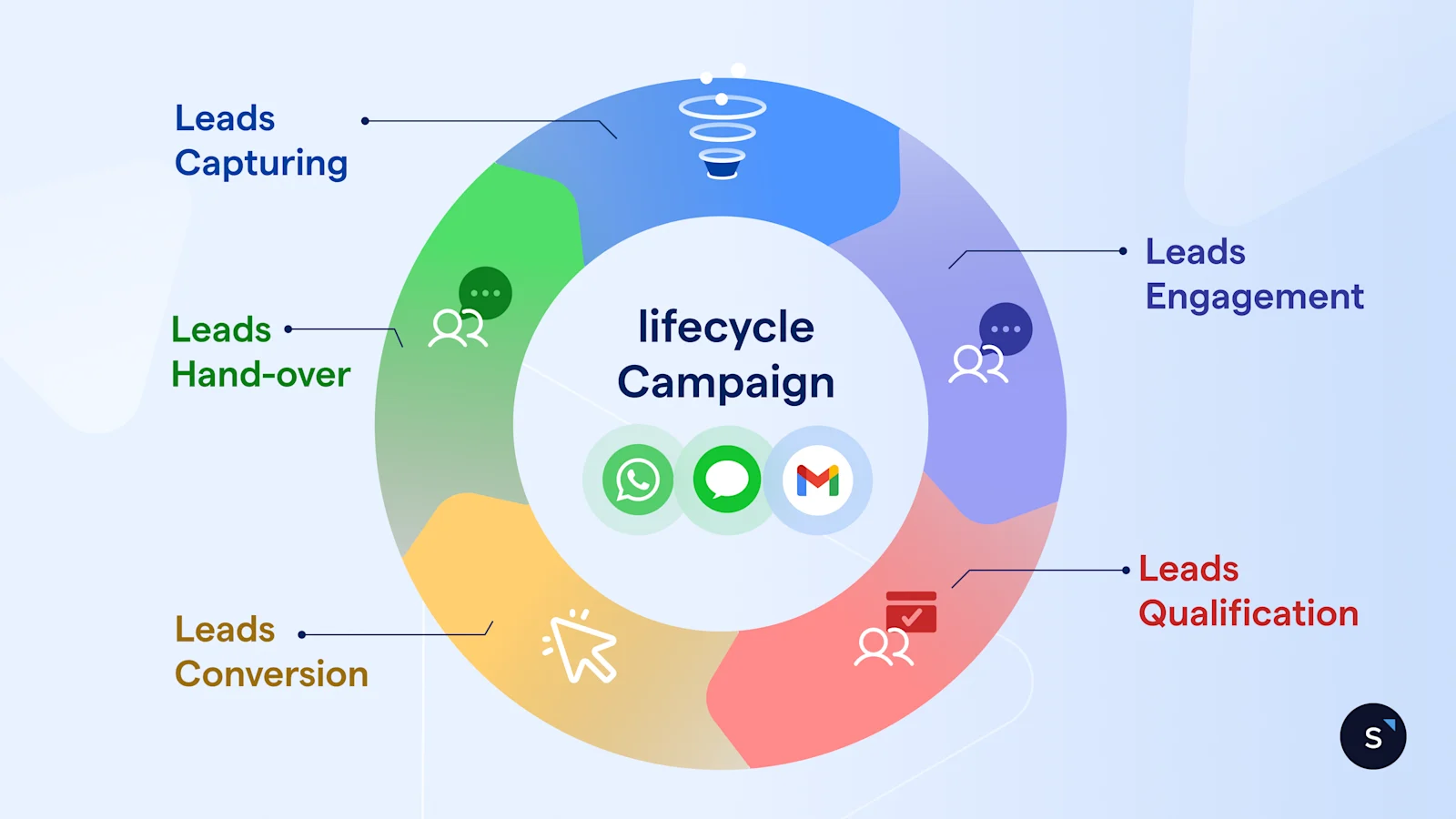
SMS marketing automation helps businesses deliver timely, personalized communication at scale. Here are proven strategies to maximize engagement:
Key Strategies
Segment your audience to send personalized automated SMS messages based on behavior, demographics, or purchase history.
Build multi-step automated drip flows that guide customers from awareness to conversion.
Use omnichannel nurturing by combining SMS + WhatsApp + Email within one journey.
Run A/B tests for message templates, timing, and calls-to-action.
Leverage AI for automated SMS replies and smart routing for faster support.
Create lifecycle workflows - welcome, onboarding, abandoned cart, reorder, and re-engagement campaigns.
Best Practices
Keep automated SMS short, clear, and actionable.
Send at the right frequency and timing to avoid fatigue.Provide clear opt-out options in every automated SMS.
Use dynamic fields such as names and order details.
Test your automated SMS responses before launching.Follow all compliance rules (opt-in, opt-out, data privacy).
SMS Marketing Compliance: Key Rules You Must Follow
To run automated SMS marketing legally and responsibly, businesses must follow core compliance standards. Obtain clear opt-in consent before sending messages and always include an easy opt-out option like “Reply STOP.” Follow local regulations such as TCPA in the U.S. (FCC TCPA Guidelines) and GDPR in the EU (EU GDPR Info). Avoid purchased lists, respect quiet hours, and maintain consent records.
SleekFlow: The Best Platform for Automated SMS Services
SleekFlow stands out as the most comprehensive solution for automated SMS marketing, automated SMS replies, and omnichannel customer engagement.
Why SleekFlow?
Omnichannel automation: Build flows using SMS, WhatsApp, Facebook, Instagram, and more using the Flow Builder.
AI-native smart routing and replies: Automate FAQs, support queries, and lead qualification.
Advanced Flow Builder with conditional logic, triggers, and segmentation.
CRM and eCommerce integrations (Salesforce, HubSpot, Shopify, WooCommerce, Magento).
A unified inbox that centralizes SMS + WhatsApp + other channels for team collaboration.
AgentFlow automation for sales & support teams: Automate task assignment, follow-ups, and internal workflows so agents never miss leads or customer messages. AgentFlow, our AI agent, ensures the right conversations reach the right team member at the right time for faster resolutions and improved productivity.
Enterprise-grade security, compliance, and scalability for SMBs to large enterprises.
Conclusion
Automated SMS empowers businesses to send timely, relevant, and personalized messages, without manual effort. From reminders to marketing flows, automated SMS boosts engagement, conversions, and customer satisfaction.
With powerful automation, omnichannel capabilities, AI responses, and CRM integrations, SleekFlow is the best platform for automated SMS services for businesses of all sizes.


