WhatsApp in the U.S.: Stats, Usage Trends, and Business Opportunities


TL; DR: Quick Summary
- WhatsApp has 3B+ global users and ~98M in the U.S., with steady growth among Gen Z, Millennials, and multicultural communities.
- U.S. adoption trails SMS/iMessage but is rising as businesses embrace messaging-first engagement.
- SMBs use WhatsApp for support, marketing, automation, and AI-powered chatbots to scale conversations.
- AI features improve response times, lead qualification, and customer satisfaction without extra headcount.
- Early adoption offers a less saturated, high-engagement channel for U.S. businesses.
- Platforms like SleekFlow centralize chats, automate workflows, and provide analytics for scalable growth.
WhatsApp is one of the world’s most widely used messaging platforms, with more than 3 billion active users globally, making it a dominant force in personal and business communication alike. From everyday conversations to customer engagement, WhatsApp has become deeply embedded in how people connect across borders, cultures, and devices.
While WhatsApp dominates messaging globally, its position in the United States is more nuanced. Despite strong competition from SMS and iMessage, WhatsApp adoption in the US is growing steadily, particularly among younger users, multicultural communities, and businesses seeking more direct customer engagement.
This article examines WhatsApp usage in the US, including adoption trends, user behavior, and real-world business applications. We’ll explore how SMBs are using WhatsApp for customer support, marketing, and automation, and help you evaluate whether the platform makes sense for your U.S. communication strategy.
What is WhatsApp and why does it matter for businesses?
WhatsApp is a free, cross-platform messaging application owned by Meta that allows users to send text messages, voice notes, images, videos, documents, and make voice or video calls over the internet. Known for its end-to-end encryption, WhatsApp prioritizes privacy and reliability, two key reasons behind its massive global adoption.
Today, WhatsApp is more than just a personal messaging app. With the introduction of WhatsApp Business Messaging, the platform has evolved into a widely used channel for brands that want faster, more conversational interactions with customers.
Key WhatsApp Features That Drive Global Popularity
WhatsApp’s widespread usage is driven by a simple, familiar interface combined with powerful features:
One-to-one and group messaging with instant delivery
Voice and video calling with global reach
Media and document sharing for rich conversations
End-to-end encryption for secure communication
WhatsApp Business profiles with verified business details
Automation tools such as quick replies and message templates
AI-assisted features such as automated responses and chat routing (availability depends on region and provider)
These capabilities make WhatsApp a practical foundation for business communication, especially as U.S. businesses explore messaging-first customer engagement.
Importance of WhatsApp in a Customer-Centric Business World
Customer expectations have shifted dramatically. Modern consumers expect businesses to be:
Available in real time
Responsive across channels
Helpful, personal, and easy to reach
WhatsApp supports this shift by enabling direct, conversational engagement. Compared with email or traditional SMS, WhatsApp allows businesses to respond faster, share rich content, and keep conversations in a single thread, which can improve the overall customer experience.
For U.S. businesses exploring new engagement channels, WhatsApp usage in the US represents an opportunity to move beyond crowded inboxes offer a more conversational alternative to phone-based support..
How Businesses Use WhatsApp Today
Businesses across industries are already using WhatsApp to streamline communication and improve customer experience:
1. WhatsApp Customer Support
Share order updates, receipts, and support documents
Reduce call center volume with real-time chat support
2. WhatsApp Marketing
Send opt-in promotions and product announcements
Run targeted WhatsApp campaigns with typically higher open rates than email
Re-engage customers through personalized messaging
3. Direct and Secure Communication
Enable two-way conversations instead of one-way notifications
Build trust using verified business accounts
Maintain conversation history for better service continuity
For small and medium businesses in particular, WhatsApp offers a relatively low-cost, scalable way to build stronger customer relationships without complex infrastructure or high marketing costs.
WhatsApp Adoption and Usage in the U.S.
For businesses assessing messaging channels, having a realistic view of WhatsApp’s position in the U.S. market is essential.
WhatsApp User Base in the U.S.: Key Numbers
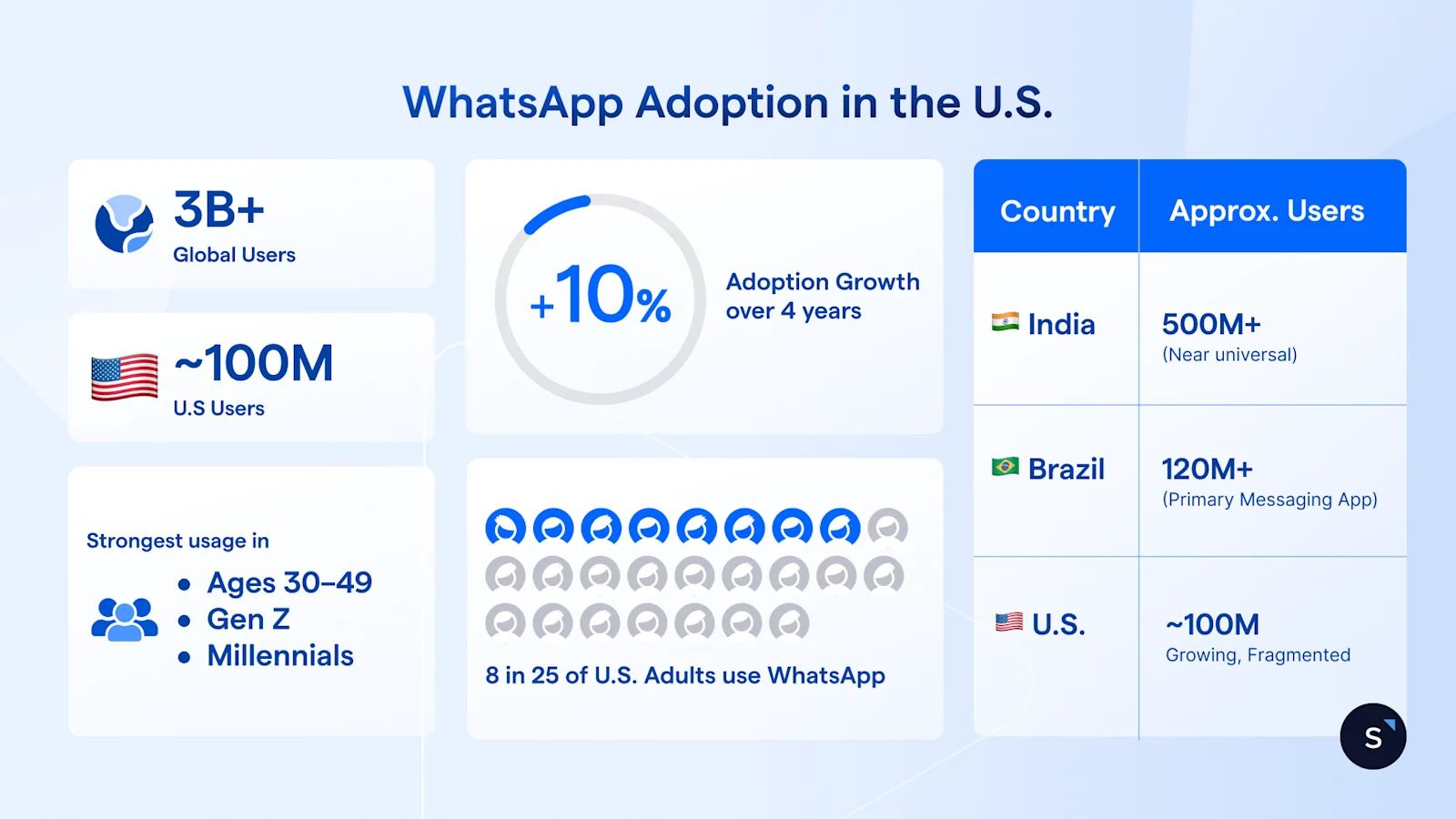
~98 million people in the United States use WhatsApp, placing it among the top countries by user count, despite lower penetration than in other major markets.
About one-third of U.S. adults report using WhatsApp, rising from ~23% in 2021 to roughly 32% in 2025, based on Pew Research Center surveys and reporting.
Usage remains highest among adults aged 30-49 and certain demographic groups such as urban residents and multicultural communities.
Growth Trends: Is WhatsApp Gaining Ground in the U.S.?
Several indicators point to consistent WhatsApp growth in the U.S.:
Adoption has increased by nearly 10 percentage points over the past four years.
Growth is strongest among Gen Z and Millennials, signaling continued relevance.
WhatsApp is increasingly used not just for international messaging, but also for local conversations and select types of business communication.
Compared to other messaging apps, WhatsApp still trails iMessage and SMS in total reach, but it is gaining traction as a privacy-first, app-based alternative, especially for conversational customer interactions and commerce..
U.S. vs Global WhatsApp Adoption
WhatsApp’s position in the U.S. looks very different when compared with countries where it dominates everyday communication:
In markets like India and Brazil, WhatsApp functions as the default communication channel for both consumers and businesses. In contrast, WhatsApp usage in the U.S. exists alongside strong native alternatives - shaping a more competitive environment.
Barriers to Broader U.S. Adoption
Despite its growth, several factors limit WhatsApp’s market share in the U.S.:
iMessage dominance among iPhone users reduces the need for third-party apps
SMS and carrier messaging remain deeply ingrained
Competition from Facebook Messenger, Snapchat, and Telegram
Perception of WhatsApp as mainly an international messaging tool
However, these barriers are gradually weakening as businesses adopt WhatsApp for customer support, marketing, and direct engagement.
The Role of WhatsApp AI Features in Business Growth
As WhatsApp adoption in the US grows, businesses are increasingly turning to WhatsApp AI features to manage larger conversation volumes while maintaining a personal experience. These AI capabilities help SMBs manage higher message volumes, respond faster, and deliver more relevant customer experiences, without expanding support teams.
Key AI WhatsApp Features Businesses Use Today
While WhatsApp itself provides the infrastructure, AI capabilities are typically enabled through the WhatsApp Business Platform and solution providers. The most impactful features include:
Automated responses and quick replies allow businesses to instantly answer common customer questions such as order status, pricing details, and business hours, ensuring faster first response times.
AI chatbots handle first-line customer support by resolving routine queries on their own and escalating conversations to human agents only when needed.
Customer segmentation and intent detection help route conversations intelligently based on factors like customer intent, preferred language, or past behavior, creating more relevant interactions.
Conversation handover automation ensures a smooth transition from bot-led conversations to live agents, maintaining context and improving the overall customer experience.
These WhatsApp AI features allow businesses to stay responsive 24/7, a growing expectation among U.S. customers.
How AI Enhances Engagement and Customer Support
For SMBs, AI on WhatsApp is about amplifying efficiency and consistency.
Key benefits include:
Faster first response times
Reduced support workload
Higher customer satisfaction through instant replies
Better lead qualification for sales teams
In a market where WhatsApp customer support is still emerging, AI gives early adopters a competitive edge by delivering enterprise-level experiences at SMB scale.
Real-World SMB Use Cases
Example 1: Local Retail & E-commerce
A U.S.-based online retailer uses AI chatbots on WhatsApp to:
Answer product availability questions
Share order tracking updates automatically
Route high-intent customers to live sales reps
Result: Faster response times and higher conversion from conversational inquiries.
Example 2: Service-Based SMBs (Healthcare, Education, Consulting)
Small service providers use WhatsApp automation to:
Confirm appointments
Send reminders
Handle rescheduling requests
Result: Reduced no-shows and less manual coordination.
WhatsApp’s Market Growth and Its Future in the U.S.
WhatsApp’s future in the U.S. is less about raw user numbers, and more about how the platform is evolving and how businesses are beginning to use it. As messaging becomes a preferred customer touchpoint, WhatsApp is steadily positioning itself as a serious business communication channel in the U.S.
What’s Driving WhatsApp’s Future Growth in the U.S.
Several structural shifts are working in WhatsApp’s favor:
Messaging-first communication is becoming normalized for customer service and sales interactions.
Business adoption is increasing, particularly among SMBs looking for faster, more personal customer engagement.
WhatsApp’s strong presence among younger and multicultural audiences aligns with long-term digital-first buying behavior..
Rather than competing head-on with iMessage or SMS, WhatsApp is carving out a role as a trusted, two-way business messaging platform.
Platform Evolution: From Messaging App to Business Tool
WhatsApp is expanding beyond basic messaging by supporting a wider range of business functions, including:
Automation and AI workflows for handling high message volumes
Structured message templates for notifications and updates
Rich media experiences such as product catalogs and interactive messages
Deeper integrations with CRM, support, and marketing systems
This evolution enables businesses to use WhatsApp not only for support, but also for lead qualification, customer retention, and post-purchase engagement.
Why This Matters for Businesses in the U.S.
For businesses, WhatsApp’s growth trajectory creates a window of opportunity:
The channel is generally less saturated than email and paid social
Customers are often more likely to open and respond to messages
Automation allows businesses to scale conversations without increasing headcount
As WhatsApp usage in the US continues to mature, SMBs that adopt early can establish stronger customer relationships before competition intensifies.
Forward-Looking Insight
WhatsApp’s long-term success in the U.S. will likely come from:
Continued investment in business and AI features
Increased normalization of messaging for customer service
Broader awareness of WhatsApp as a legitimate domestic business channel
For businesses, the question is shifting from “Is WhatsApp popular in the U.S.?” to “Does WhatsApp fit our customers’ communication preferences??”
How SleekFlow Supports WhatsApp Usage for SMBs
For SMBs looking to get more value from WhatsApp, SleekFlow transforms a basic messaging channel into a centralized customer engagement engine. Rather than juggling multiple tools and notifications, businesses can streamline communication, automate workflows, and gain real-time insights - all while keeping WhatsApp at the core of their customer interactions.
Centralize WhatsApp and Other Channels in One Inbox
SleekFlow consolidates all customer conversations - including WhatsApp chats, Facebook Messenger, Instagram DMs, SMS, and more - into a single AI omnichannel inbox. This means support, sales, and marketing teams don’t need to switch apps or lose context when handling customer messages. SleekFlow’s shared inbox lets teams collaborate efficiently and respond faster with visibility into past interactions.
Automate WhatsApp Conversations Without Losing Context
One of SleekFlow’s standout capabilities is its no-code automation builder and AI chatbot platform. SMBs can:
Build AI WhatsApp chatbots that respond to FAQs 24/7
Qualify leads, collect contact info, and route conversations based on intent
Automate repetitive tasks, such as greeting new customers or follow-ups
These features make customer engagement more consistent and scalable, even during peak times.
For example, businesses that implemented SleekFlow AI chatbots have faster response times and improved lead handling, with some seeing increases in qualified demo bookings and engagement from click-to-chat WhatsApp ads.
Turn WhatsApp Conversations Into Actionable Insights
Beyond messaging, SleekFlow offers analytics dashboards and a Social CRM to help SMBs better understand their customers and measure performance. With these tools, businesses can:
Track message volumes, response times, and engagement trends
Build customer segments based on behavior and conversation history
View comprehensive customer profiles that include interactions across channels.
This helps SMBs use WhatsApp conversations to inform marketing, sales, and support decisions rather than treating them as isolated chats.
ETS Global Improved Student Engagement with SleekFlow’s WhatsApp Automation
ETS Global, an international educational assessment organization, faced growing challenges engaging prospective students particularly Gen Z audiences as traditional email campaigns delivered declining results. As inquiry volumes increased, slow response times and limited two-way interaction made it difficult to engage high-intent students during critical decision moments.
To address this, ETS Global adopted SleekFlow’s WhatsApp automation and AI chatbot solutions. By shifting campaign communication from email to WhatsApp, the team enabled real-time, conversational engagement. Automated workflows and AI responses handled FAQs efficiently, while built-in analytics helped track performance and optimize outreach.
The results were immediate and measurable:
63% increase in engagement compared to email campaigns
Higher reply rates and more two-way conversations with prospective students
Improved operational efficiency through reduced manual workload
Faster, more consistent responses at scale using AI automation
Nafsi Health Increased Conversions with SleekFlow’s WhatsApp Automation
Nafsi Health, the UAE’s first fully licensed online mental health platform, needed a more effective way to engage prospective patients, where trust, empathy, and timely communication play a critical role in conversion. As inquiry volumes grew, Nafsi faced the challenge of managing high-touch, sensitive conversations at scale. App-first engagement approaches failed to resonate, and maintaining a human, supportive tone while improving response speed became increasingly difficult.
To solve this, Nafsi Health adopted SleekFlow’s WhatsApp automation and conversational AI solutions. By shifting communication to WhatsApp, the team enabled real-time, personalized conversations. Automated workflows handled lead qualification and daily engagement, while backend integrations enriched conversations with contextual data. Importantly, automation was carefully balanced with human handover to preserve empathy and trust.
The impact was clear:
Higher conversion rates through timely, personalized WhatsApp conversations
Faster response times without compromising care quality
Stronger patient relationships built on consistent, supportive communication
Scalable operations achieved without losing the human touch
Best Practices for Using WhatsApp for Businesses in the U.S.
To succeed with WhatsApp business messaging in the U.S., SMBs need more than just access to the platform. The real value comes from how WhatsApp is used - thoughtfully, consistently, and with customer needs in mind.
Use WhatsApp as a Real-Time Customer Support Channel
Fast response times are one of WhatsApp’s biggest advantages. Businesses that treat WhatsApp as a live support channel often report better customer satisfaction and stronger trust.
Best practices:
Set clear response-time expectations using auto-replies
Use automation for FAQs, but escalate complex queries to humans
Maintain conversation history for continuity across support teams
Run Opt-In, Value-Driven WhatsApp Marketing
Effective messaging-based customer support in the U.S. is permission-based and relevance-driven.
Best practices:
Use opt-in forms or click-to-chat ads to build your audience
Share timely updates, not excessive promotions
Personalize messages based on customer behavior and intent
Balance Automation with a Human Touch
Automation improves scale, but trust is built through human interaction.
How to strike the right balance:
Use AI chatbots for first responses and routing
Hand over high-intent or sensitive conversations to live agents
Train teams to respond conversationally, not transactionally
Create Engaging, Conversational Content
WhatsApp content should feel like a conversation, not a campaign.
Tips for better engagement:
Keep messages short and clear
Use rich media (images, PDFs, voice notes) when helpful
Ask questions to encourage two-way interaction
This approach strengthens relationship management and keeps customers engaged over time.
Measure, Optimize, and Iterate
To scale WhatsApp effectively, SMBs should treat it as a measurable channel.
Track key metrics like:
First response time
Resolution time
Engagement and reply rates
Conversion from conversations
Platforms like SleekFlow provide real-time analytics that help businesses refine both WhatsApp customer support and marketing performance.
Conclusion: WhatsApp’s Growing Role for Businesses in the U.S.
WhatsApp is no longer just a global messaging app - it’s becoming an increasingly important business communication channel in the U.S. As WhatsApp adoption in the US continues to rise, SMBs have a unique opportunity to connect with customers through faster, more personal, and more conversational experiences.
From customer support and marketing to relationship management and automation, WhatsApp offers flexibility that complements traditional channels. When combined with platforms like SleekFlow, businesses can turn WhatsApp into a more organized and scalable engagement channel.
For SMB owners, the message is clear: The earlier you adopt WhatsApp strategically, the greater your competitive advantage. Exploring WhatsApp with the right tools today can lead to stronger relationships, higher engagement, and sustainable business growth tomorrow.


