Introducing CX Intelligence: what your customer conversations already know that your dashboards don't


TL; DR: Quick Summary
- SleekFlow CX Intelligence reads every customer conversation and turns it into topics, satisfaction scores, and plain-language answers.
- Dashboards count what happened, so a CSAT drop shows up as a number with no reason attached.
- IDC estimates around 80% of the world's data is unstructured, and customer conversations sit in that unread share.
- Scoring every conversation on a 0 to 5 scale counts the customers who never answer a survey.
- Marketing, CX, and sales leaders get the reasons behind their metrics from conversations they were already having.
Your dashboard says customer satisfaction slipped from 4.4 to 4.1 last month. Tickets are up 12%. You can see exactly what happened, and you have no idea why.
The why isn't missing. It's sitting in thousands of conversations your customers had with your team, in their own words, across WhatsApp, Instagram, live chat, email, and calls. Your dashboard never read a single one of them.
SleekFlow CX Intelligence closes that gap. It reads every customer conversation, classifies what people are talking about, scores how each one went, and lets you ask questions of the whole pile in plain language. Dashboards are good at counting and blind to language, and language is where customers tell you what they think.
Why don't dashboards tell you why?
Dashboards count structured events, like tickets, scores, and response times, and the reason behind those events lives in unstructured language they can't read. A BI tool can tell you complaints rose 20%. It can't read the complaints. That's a data-shape problem, not a reporting problem.
IDC projects that 80% of worldwide data is unstructured, and customer conversations are exactly that: free text and speech, not neat rows and columns. Traditional analytics was built for the structured 20%.
Three common workarounds, three blind spots
Most teams try to work around it with three methods, and each one has a blind spot.
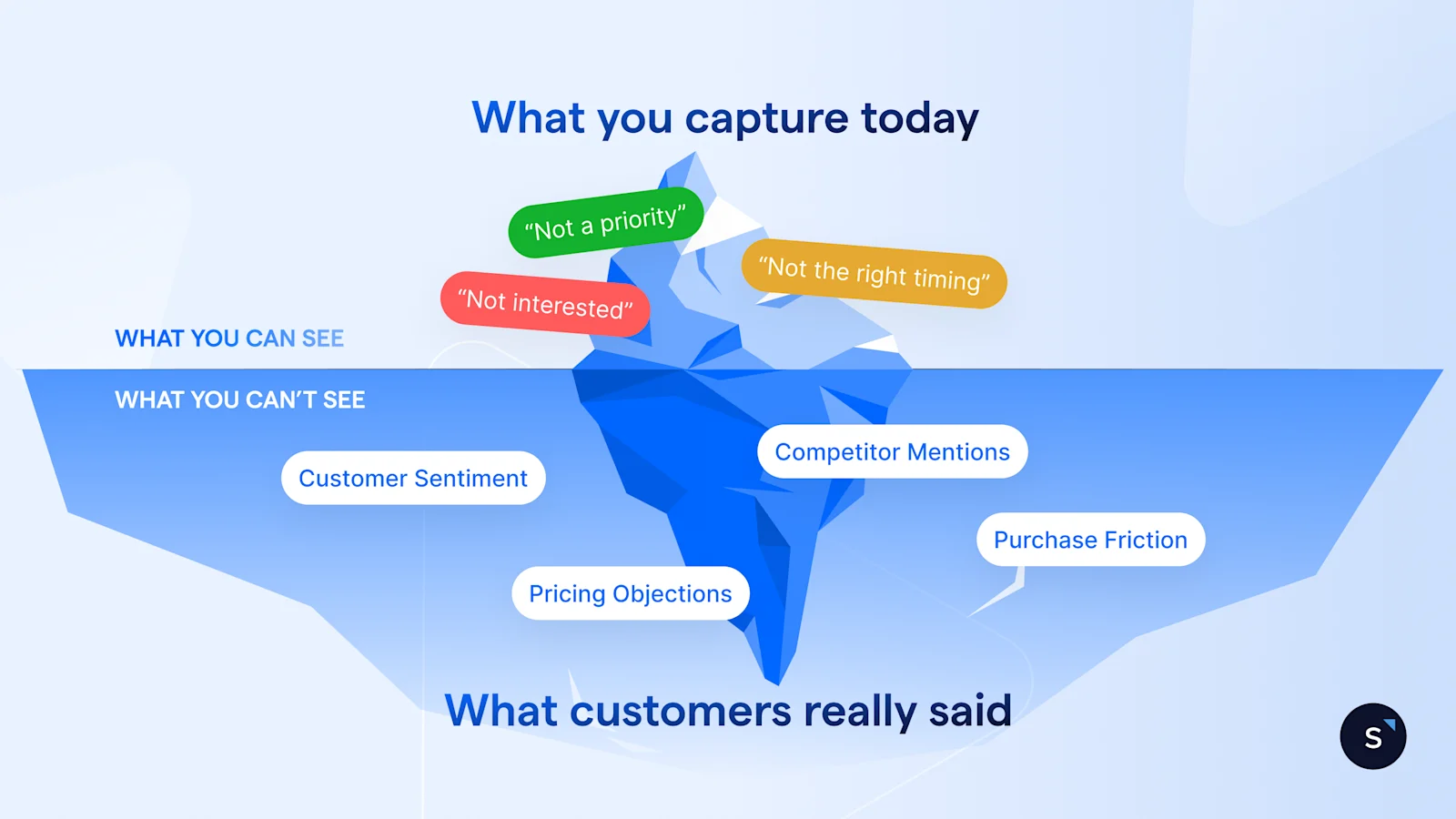
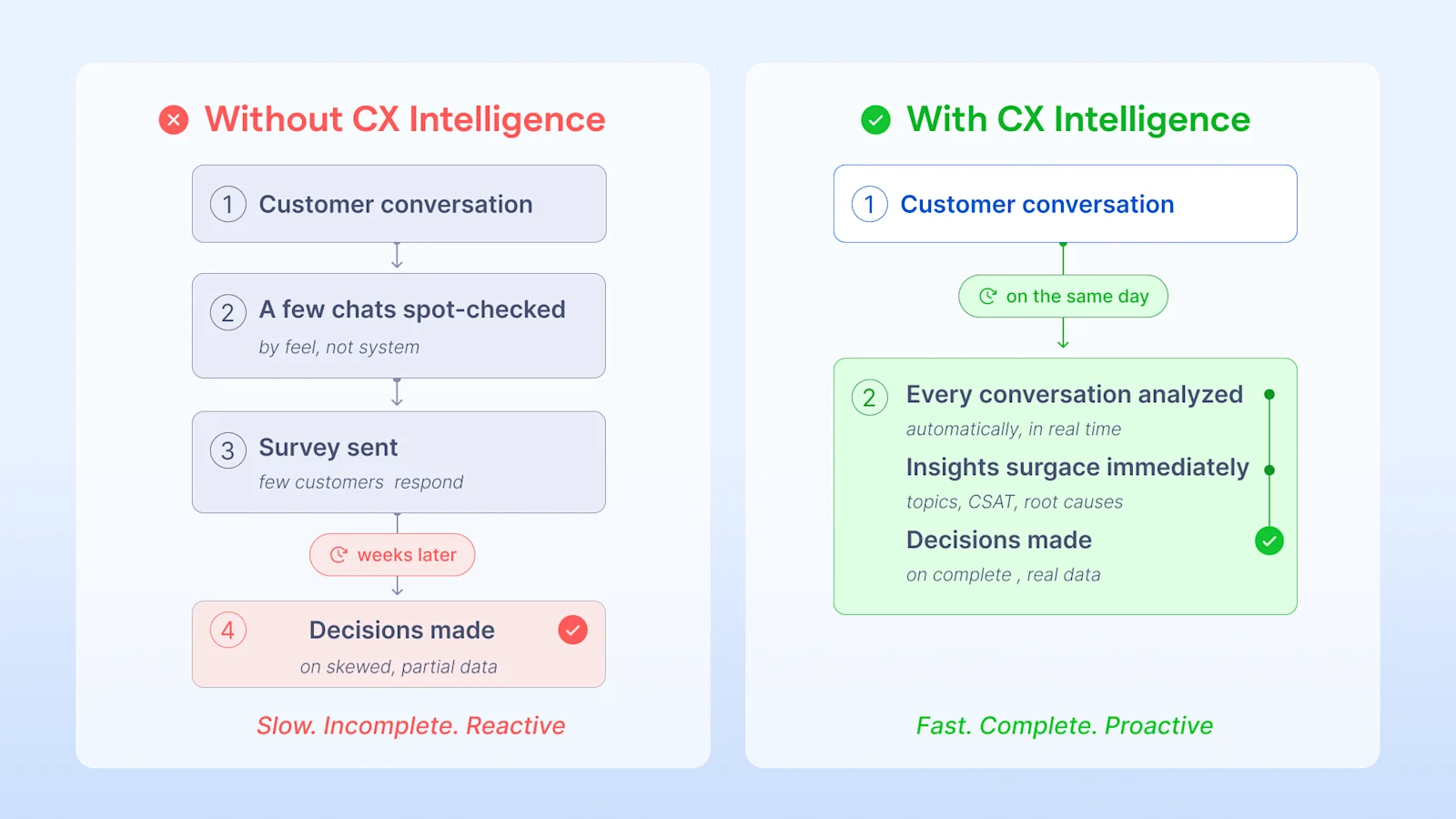
Each method feels analytical. None of them reads the conversation. You end up making decisions on a slice of reality, and the slice is skewed toward the customers who shouted loudest or bothered to click "Submit".
"Dashboards and BI tools count things really well, and they're completely blind to what a customer actually meant. The signal is in the language, and language is messy, so it got ignored for years because it was hard to process at scale. What changed is that you can now read every conversation, not a sample, and classify it consistently. When you do that, the answer to 'why did CSAT drop' stops being a guessing game in a meeting and starts being something you can point to in the actual chats."
Leo Choi, Director of Engineering at SleekFlow
What is CX Intelligence?
CX Intelligence is a conversation analytics product in SleekFlow that reads every customer conversation in your workspace and turns it into topics, satisfaction scores, and plain-language answers. Instead of counting outcomes, it reads what customers said, so you can see the reasons behind your metrics and act on them.
To use CX Intelligence, you tell SleekFlow about your business once, and it starts reading.
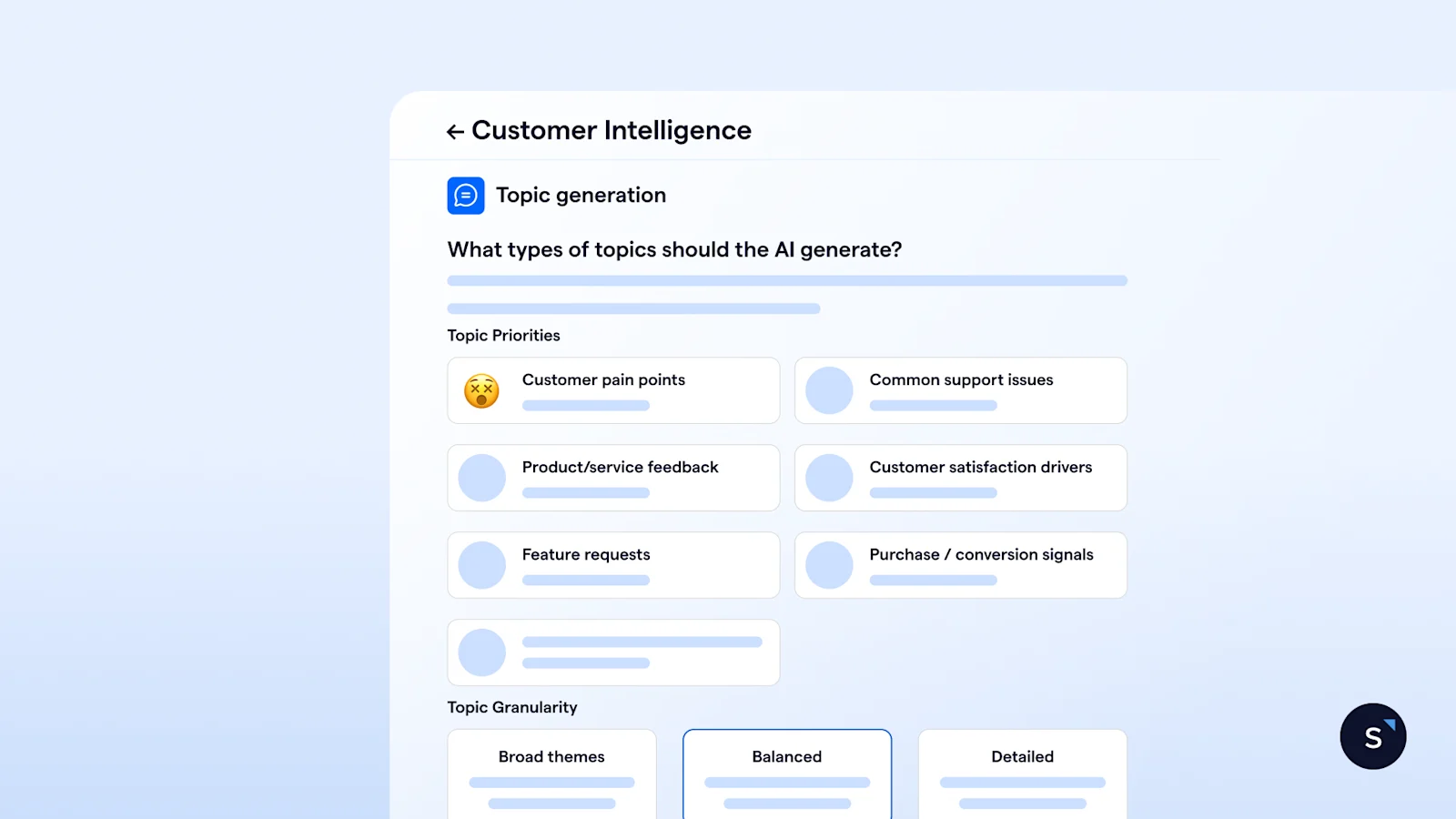
Four sections do the work.
Topics: what customers are actually contacting you about
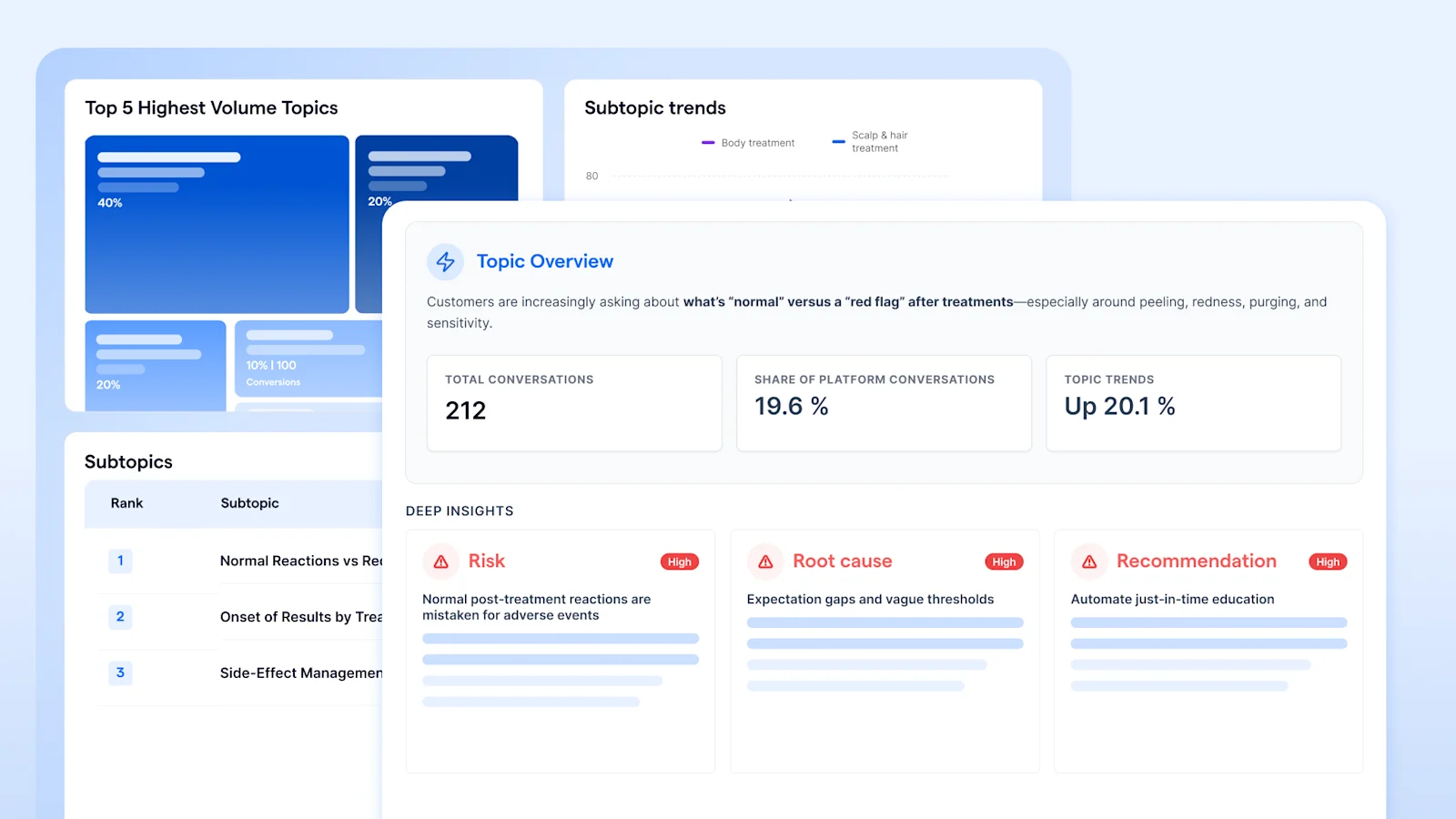
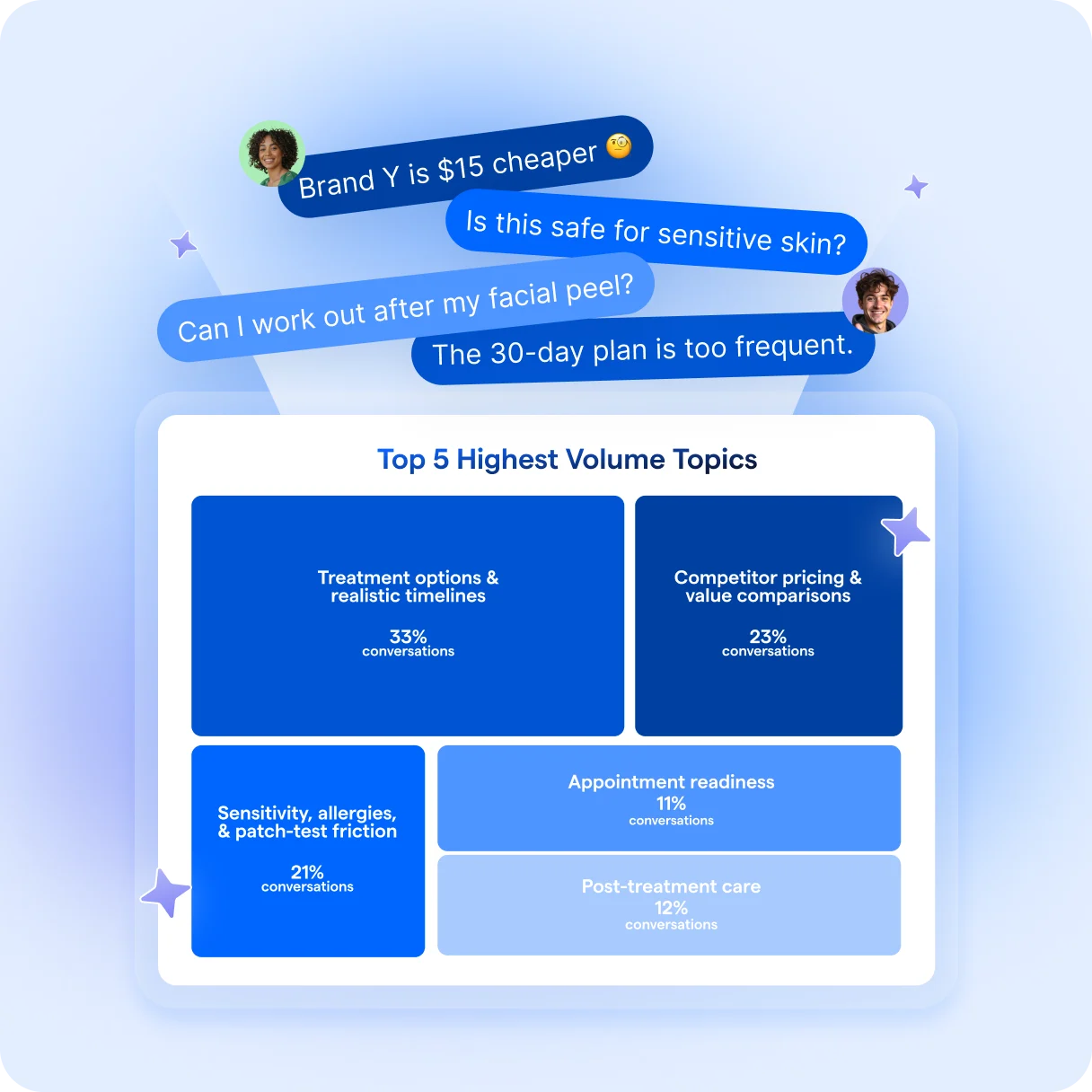
Topics classify every conversation into themes and subtopics automatically, with no manual tagging. You can see which issues come up most, drill from a broad theme like delivery into the subtopics under it, and watch topics rise and fall over time.
Every topic opens into the conversations behind it, so a spike in "refund delays" is a list of real chats you can read, not a bar on a chart.
CSAT: how every conversation went, not just the surveyed ones
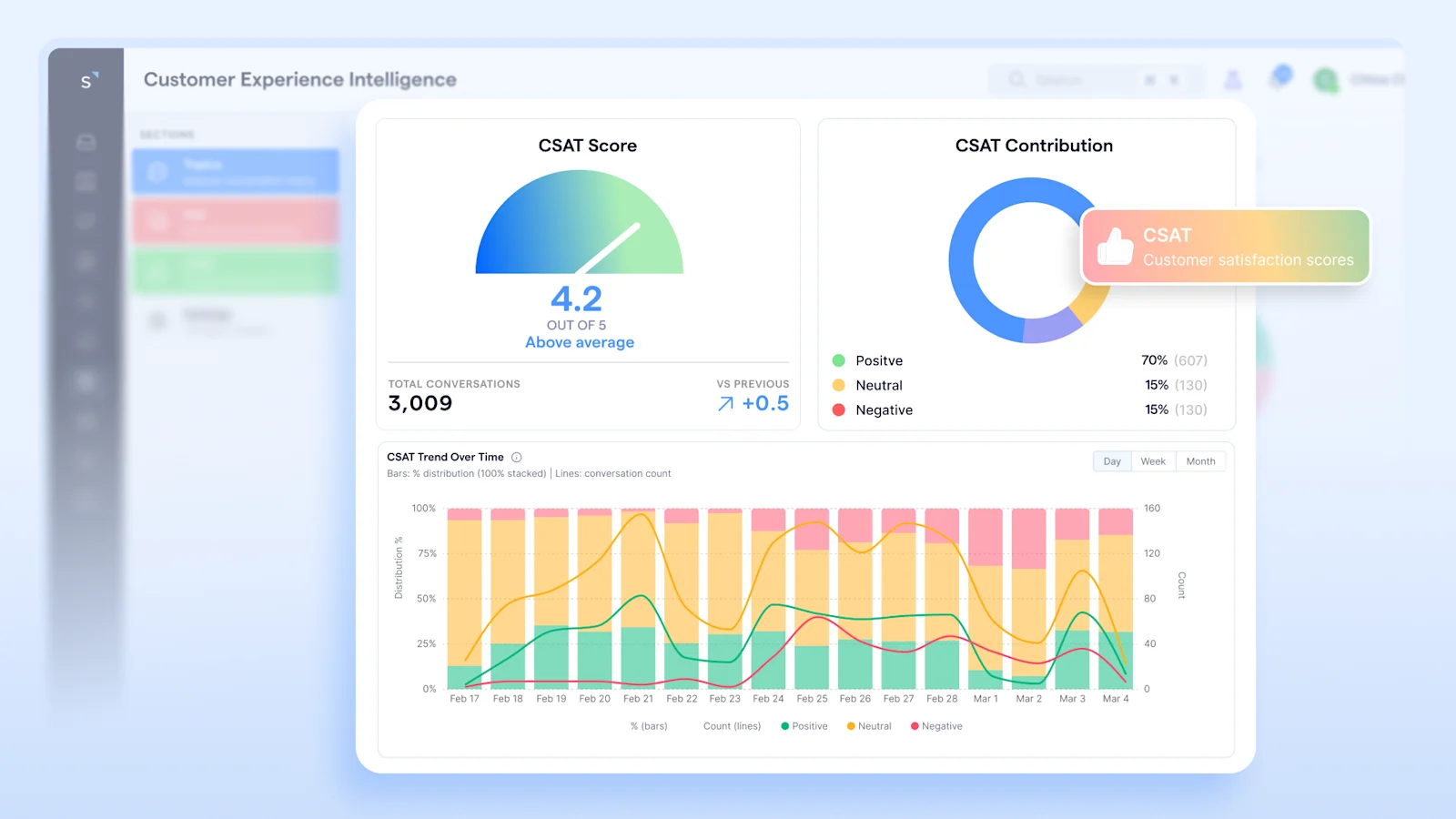
CSAT scores every conversation on a 0 to 5 scale, read from the conversation itself: its tone, whether the issue got resolved, and how it ended. Satisfaction is estimated across all of your conversations rather than the few customers who answer a survey.
Low-scoring conversations are surfaced with the reasons behind them, so a team lead can review what went wrong and coach on it. SleekFlow is clear that these AI scores are meant to support review and analysis, and may not replace a formal survey program if your team relies on one.
Ask: plain-language questions across every conversation
Ask lets anyone type a question like "what are the top customer issues this week?" or "why did CSAT drop last month?" and get back a summary, a chart, and suggested follow-up questions. No query language and no waiting on an analyst.
It's built for the follow-up. A broad question narrows into a specific one, and each answer traces back to the conversations it was drawn from.
Settings: teaching it your business
Settings is where you give CX Intelligence your business context: what you sell, who your customers are, and what you care about. That context shapes how it classifies topics and scores satisfaction, so the insights are relevant to your business rather than generic. You can also turn CSAT scoring on or off here.
CX Intelligence vs BI dashboards: what each one sees
A BI dashboard and CX Intelligence answer different questions. The dashboard is built to count structured events; CX Intelligence is built to read unstructured conversations. Most teams need both, but only one of them tells you why the numbers moved.
Use case 1: market research without the research agency
Sales and marketing leaders need to know what customers think about the brand, the products, and the competition, and they need it continuously, not in a quarterly report. Customer conversations already contain all of that, and Topics makes it readable at scale.
The difference from a focus group is who's talking. In a focus group, people tell you what they think you want to hear. In a support chat at 11pm, a customer who's hesitating on price says so, in their own words. You get the kind of product and competitive intelligence that used to need a research budget, from conversations you were already having.
Use case 2: CSAT and service quality without the survey
Post-chat surveys have two problems: most customers ignore them, and the ones who answer are rarely representative. You end up optimizing for a skewed minority while most experiences go unmeasured. CX Intelligence scores every conversation, so the quiet, dissatisfied customer who would never fill in a survey still counts.
For CX leaders, this changes the rhythm of the job. Today, most teams find out about a service problem after customers have already left. With every conversation scored as it happens, a dip in one team or one agent shows up in days, and the conversations behind it are one click away.
How is this different from asking ChatGPT to read my chats?
A general chatbot can summarize a handful of conversations you paste in. CX Intelligence reads thousands consistently, learns your business, and traces every finding back to the source conversation. The difference is scale, consistency, and auditability, not raw language ability.
Paste 10 transcripts into a general assistant, and you'll get a decent summary. Run it across every conversation, week after week, and the gaps show. There's no guarantee it scores the next 10,000 chats by the same criteria, no consistent classification you can trust over time, and no way to click a theme and open the exact conversations behind it.
CX Intelligence classifies every conversation against topics that matter to your business, applies the same scoring criteria every time, and keeps a trail from any insight back to the conversations it came from.
What marketing, CX, and sales leaders can do with it
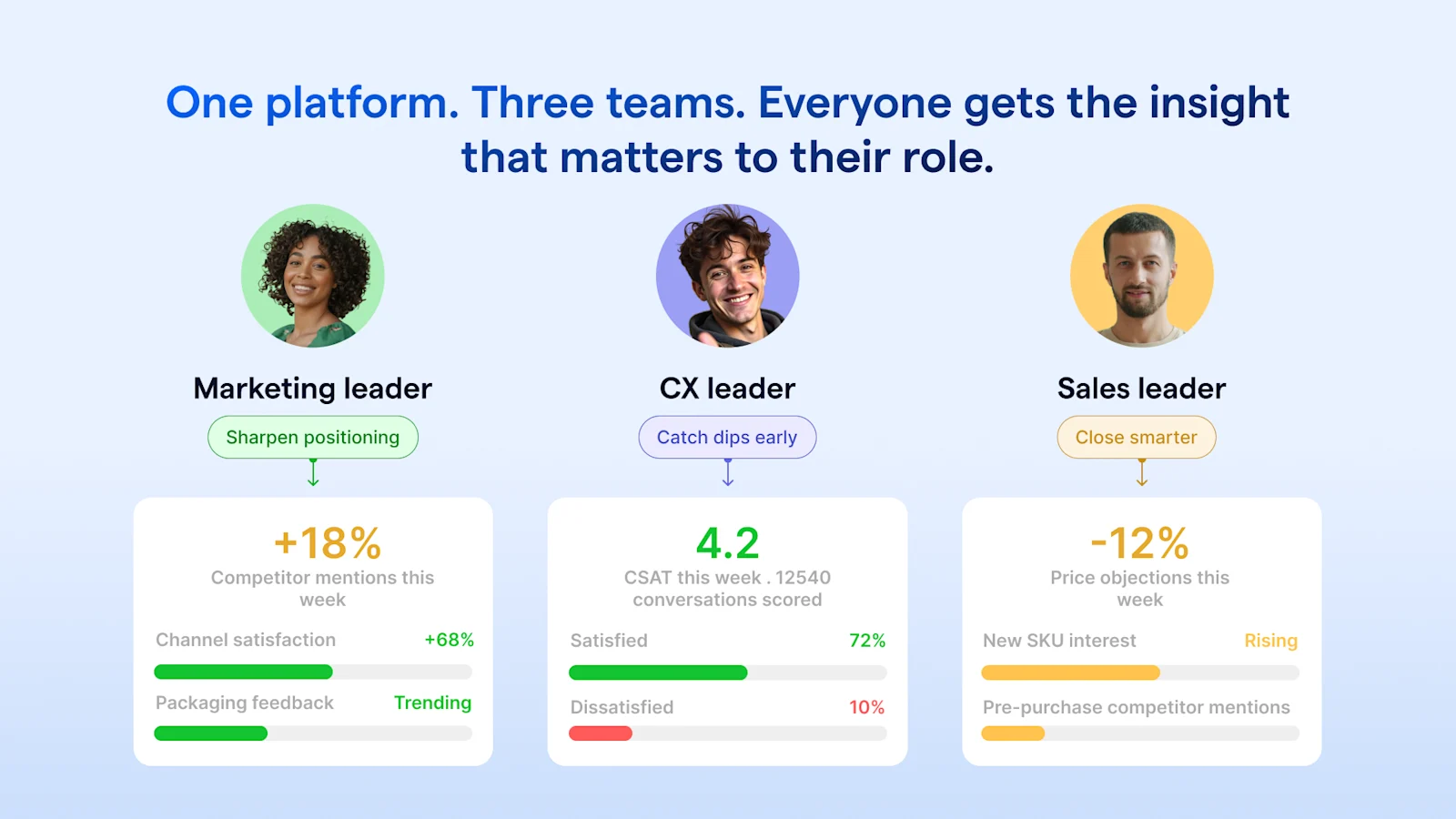
Every leader who touches customer conversations gets a different answer out of the same product. Marketing gets the language customers use, CX gets a satisfaction score for every conversation, and sales gets the objections and competitor mentions as they happen.
Marketing leaders can sharpen positioning using the words customers actually use, and spot trends in conversations before they show up in sales data.
CX leaders can see how every customer felt after every conversation, catch service dips early, and coach from specific conversations rather than general feedback.
Sales leaders can tell whether a price objection is real or a reflex, see which products delight and which confuse, and read what customers say about the competition in their own words.
See what you've been missing
Every week you don't have CX Intelligence, thousands of customer signals go unread.
Frequently Asked Questions
What is CX Intelligence, in plain terms?
How is CX Intelligence different from a BI tool like Tableau or Power BI?
Is conversation scoring more accurate than CSAT surveys?
Which channels does CX Intelligence cover?
Can I just use ChatGPT to analyze customer chats?
Recommended for you


