Offline Lead Capture in Retail: How QR Codes Turn Foot Traffic into CRM-Ready Leads


TL; DR: Quick Summary
- Most store visitors don’t buy, and without contact details you lose the chance to follow up and convert later.
- Traditional capture (paper/iPads) creates friction, low-quality data, and disconnected offline-to-online attribution.
- Modern offline lead capture uses QR codes to collect zero-party data quickly on shoppers’ own phones.
- Best flow: scan → WhatsApp (or chat) opens with prefilled message → customer taps Send → you capture a verified number and start a conversation.
- High-impact use cases: checkout receipts/loyalty sign-ups, pop-ups and trade shows, promos and giveaways with campaign tagging.
- Success depends on smart placement, clear value-driven CTAs, minimal steps, instant confirmation, and explicit consent; SleekFlow can automate follow-ups and sync CRM-ready lead data.
It’s a familiar retail reality: your store has steady foot traffic, customers browse, ask questions, and show genuine interest. Some buy, but many don’t. Once they walk out that door, it’s easy to lose touch - no contact details, no context, and no second chance to re-engage.
This gap quietly costs retailers real revenue. In many retail environments, only ~20–40% of visitors buy, so a majority leave without a transaction. At the same time, businesses that follow up with prospects immediately can see conversion rates increase, showing how much opportunity is lost when follow-ups don’t happen quickly.
The challenge isn’t a lack of visitors; it’s a lack of continuity. Without a strategy for offline lead capture, valuable in-store interactions end the moment a customer leaves the premises. Modern retail lead capture solves this by turning in-store conversations into contact details retailers can actually use.
Lead capture QR codes make this easy without interrupting the shopping experienc. Familiar, mobile-first, and frictionless, these tools allow customers to share details at moments of peak intent, whether at a product demo, a promotional display, or the checkout counter. As offline lead capture solutions become a retail standard, this approach bridges the gap between physical browsing and digital follow-up, turning every scan into a lead that’s ready for follow-up.
Why Traditional Retail Lead Capture No Longer Works
Traditional retail lead capture methods were built for a slower, less connected retail environment. Today, they struggle to keep up with rising customer expectations, limited store resources, and the urgent need for clean, usable data, making modern offline lead capture solutions essential for long-term growth. In an era where shoppers value both speed and privacy, even small amounts of friction can stop people from signing up.
Paper Forms, iPads, and “Sign-Up Fatigue”
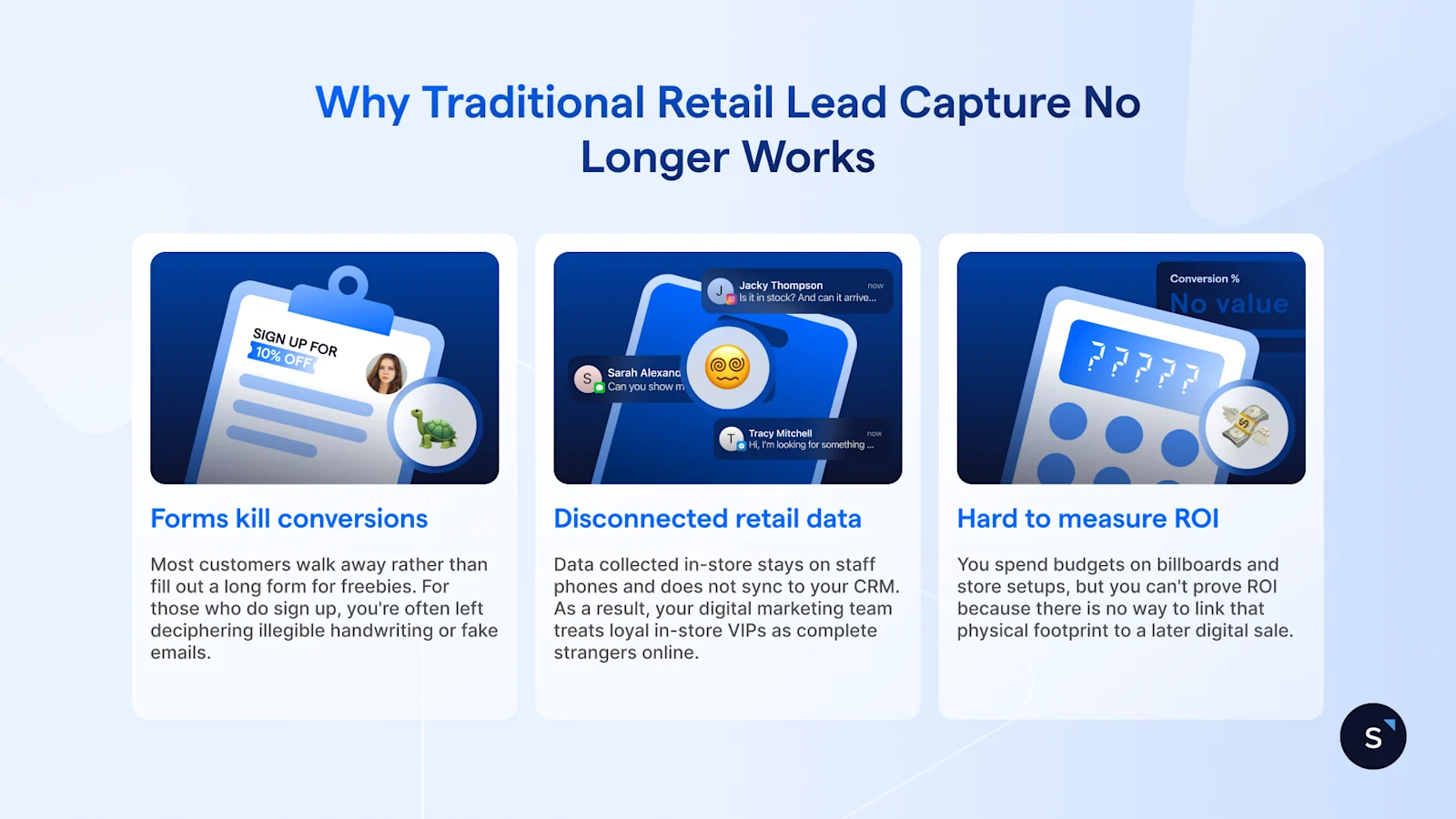
For years, retail lead capture meant asking customers to fill out a paper form at the counter or tap through a sign-up screen on an iPad. In theory, it collected contact details; in reality, it added extra steps at exactly the wrong moment, when customers were ready to move on.
Furthermore, shared tablets now face "digital friction" and hygiene concerns, leading many shoppers to bypass them entirely. Manual forms slow customers down and feel outdated. When shoppers are forced to rush through fields, the result is predictable: incomplete entries, illegible handwriting, and fake email addresses. By contrast, lead capture QR codes let customers use their own phones, making the process feel personal, secure, and instantaneous.
The Data Gap Between Store Visits and Digital Marketing
Traditional lead capture methods also create a deeper problem: disconnected data. When offline interactions are not captured or captured poorly, they never make it into CRM systems, marketing platforms, or attribution reports. This makes it hard to know which store visits or conversations later turned into sales.
Without reliable offline lead capture solutions, personalization breaks down. Email campaigns, retargeting ads, and WhatsApp follow-ups are forced to rely only on online behavior, while high-intent offline interactions go unrecognized. For SMBs running tight marketing budgets, this often results in wasted ad spend and underperforming campaigns, not because demand is low, but because signals are missing.
This isn’t just a technology gap; it’s a measurement and growth problem. When physical locations can’t be tied to digital outcomes, retailers struggle to prove ROI from stores, pop-ups, or trade shows. Over time, this lack of visibility makes it harder to justify investment in offline channels, even though they remain some of the strongest drivers of customer intent.
What Is Offline Lead Capture in Modern Retail?
At its core, offline lead capture is the process of collecting customer details during in-store or in-person interactions and instantly converting them into usable digital leads. Instead of relying on manual entry, modern offline lead capture solutions are designed for zero-party data collection: info that customers willingly and intentionally share. It turns the interaction into a simple trade: customers share details, and get something useful in return.
In a modern retail setting, retail lead capture happens through simple actions such as a scan, tap, or chat. When a customer scans a lead capture QR code, they aren't just filling out a form; they are opening a direct, verified communication channel.
Among these options, QR code lead capture has emerged as the most frictionless and scalable method for offline environments. Customers already know how to use them, they work on any smartphone, and they require no app downloads, making them ideal for high-traffic stores and temporary pop-ups.
How QR Codes Turn Foot Traffic into Actionable Leads
Lead capture QR codes transform casual in-store interest into measurable engagement by making retail lead capture quick, familiar, and fully in the customer’s control . This turns a momentary physical presence into a permanent digital relationship.
Why QR Codes Work Better Than Forms
QR codes align better with how customers already behave in-store. Shoppers are already "phygital" using their phones to compare prices or check reviews while standing in your aisle. Scanning a code feels natural, not disruptive. Speed is the second major advantage; a QR code lead capture takes seconds, compared to the minutes required for manual typing. Crucially, it provides a sense of privacy; customers enter their data on their own screen, away from prying eyes or staff pressure.
From Scan to Conversation: The Lead Capture QR Code Flow
To truly maximize ROI, the flow must move beyond a static landing page. A high-conversion flow looks like this:
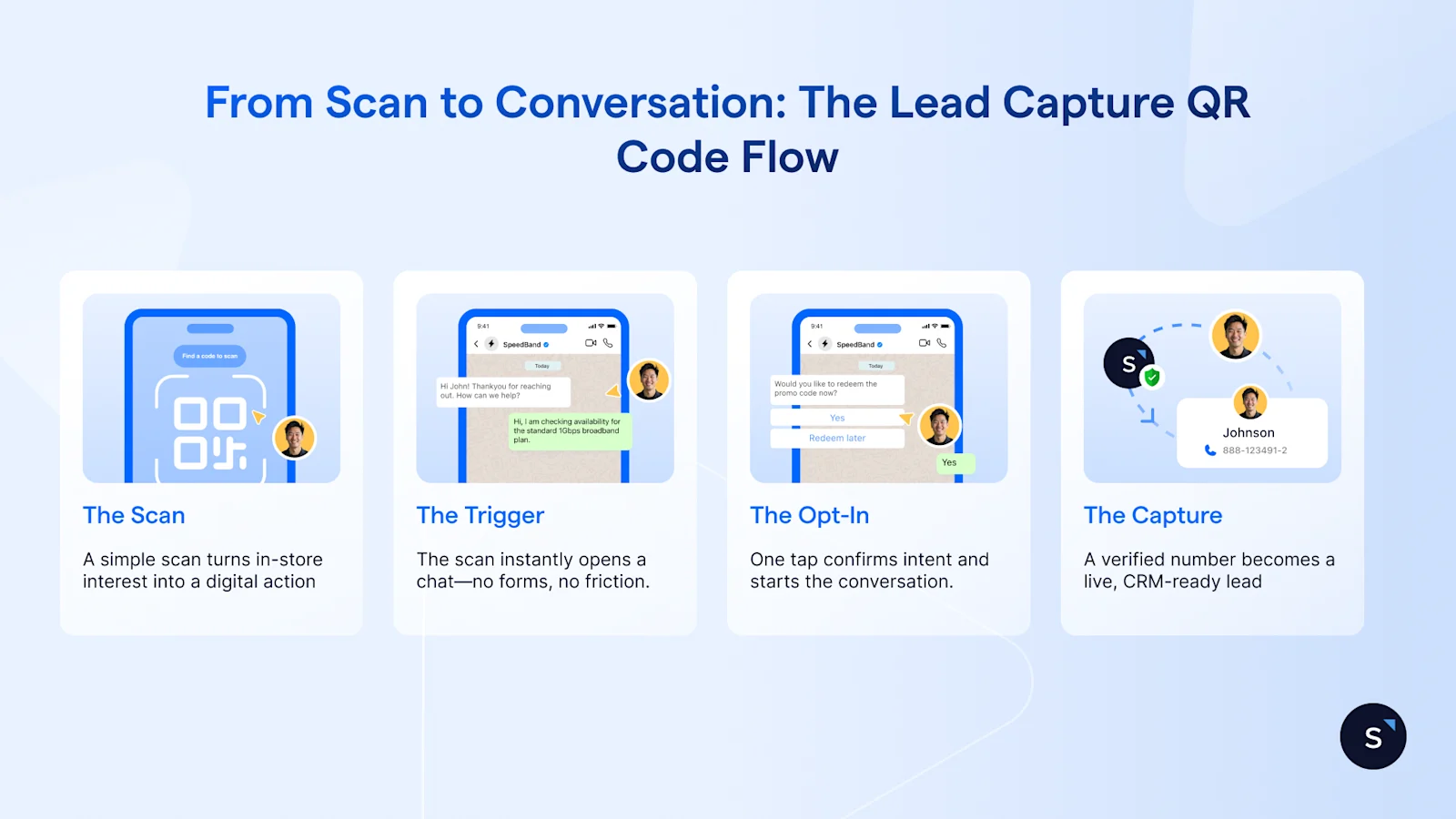
The Scan: Customer scans a lead capture QR code at a point of interest.
The Trigger: A messaging app (like WhatsApp) opens instantly with a pre-filled message.
The Opt-in: The customer taps “Send” to request a discount or info.
The Capture: The business captures a verified phone number and starts a real-time conversation.
This approach produces higher-quality leads than email-only capture. Messaging-based interactions confirm identity, enable immediate follow-up, and keep the conversation in a channel customers actively use. Instead of collecting static data, retailers open a direct line of communication, transforming casual foot traffic into actionable, CRM-ready leads.
Real-World Retail Use Cases for Offline Lead Capture
Modern offline lead capture works best when it’s embedded naturally into everyday retail moments. QR-based workflows allow retailers to collect high-intent leads without interrupting the customer journey, whether in permanent stores, temporary setups, or campaign-driven activations.
In-Store Purchases & Checkout Counters
The checkout counter is the highest-intent moment in retail. Strategically placed offline lead capture solutions turn one-time buyers into loyal brand advocates by digitizing the post-purchase experience.
Digital Receipts: Offer a "Scan-to-WhatsApp" or "Scan-to-Email" receipt to reduce paper waste and capture a verified contact.
Loyalty Sign-ups: Eliminate the "clipboard bottleneck" during peak hours by letting customers join via their own devices.
Post-Purchase Care: Provide automated care instructions or warranty registration delivered instantly via chat, ensuring the customer leaves with value.
Pop-Ups, Trade Shows, and Events
Temporary setups face high traffic and limited time. To truly optimize lead capture trade show QR code scans, businesses must move beyond manual badge scanning or business card bowls.
Using mobile-first retail lead capture ensures that even in crowded environments with spotty Wi-Fi, no prospect is lost. This allows your team to focus on the conversation while the technology handles the data.
Promotions, Giveaways, and Seasonal Campaigns
Whether it’s a festive contest or an in-store giveaway, QR code lead capture allows customers to opt-in while the excitement is top-of-mind. These interactions allow retailers to:
Tag leads by specific promotion or season for better segmentation.
Re-engage customers through digital channels long after the physical event ends.
Track which specific campaign or store location generated the highest ROI.
What Makes a QR-Based Offline Lead Capture Strategy Effective?
A QR code alone doesn’t guarantee results; it is a doorway, not a destination. The most successful offline lead capture solutions combine smart placement with a clear "Value Exchange." For SMBs, these execution details are what turn a casual browser into a CRM-ready lead.
Placement: Target the "Natural Pause"
Where a QR code appears is often more vital than the design itself. The most effective placements align with moments when shoppers are already stationary or reflecting.
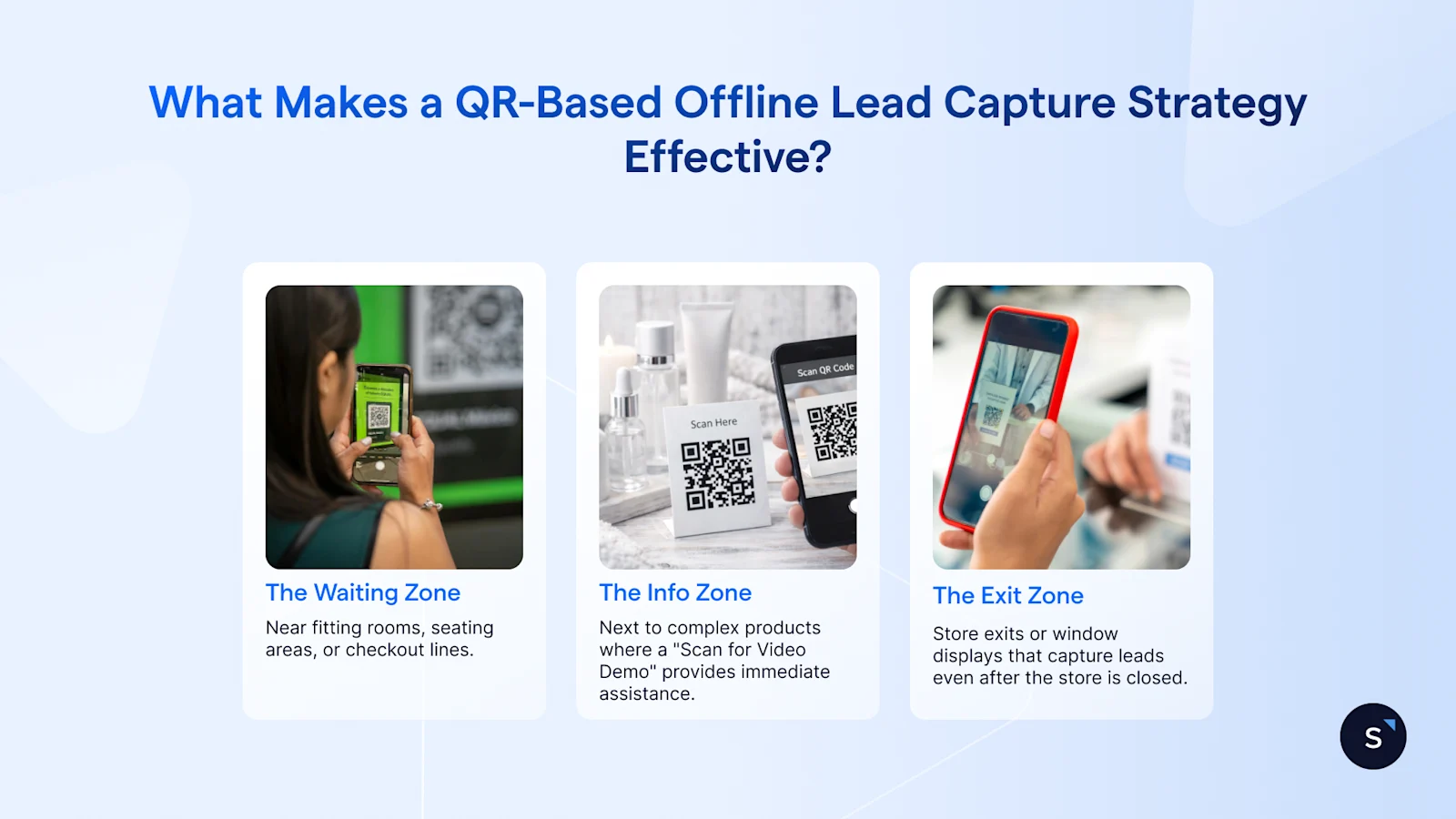
The Waiting Zone: Near fitting rooms, seating areas, or checkout lines.
The Info Zone: Next to complex products where a "Scan for Video Demo" provides immediate assistance.
The Exit Zone: Store exits or window displays that capture leads even after the store is closed.
Use Action-Oriented CTAs
Generic prompts like “Scan here” suffer from "scan-blindness." Your call-to-action (CTA) must be specific and benefit-driven.
Passive: "Scan to join our list."
Active: "Scan to unlock your 10% discount code."
Expert: "Scan for your digital care guide & instant warranty."
Avoid Common Execution Pitfalls
Many retail lead capture efforts fail because the process following the scan is too complex. To maintain high conversion rates:
Minimize Taps: If a scan leads to a 10-field form, customers will drop off. Aim for a one-tap opt-in.
Instant Confirmation: Use an automated "Thank You" message to provide immediate peace of mind and record the interaction.
Mobile Optimization: Ensure the destination page or chat flow is lightweight and loads instantly on all mobile devices.
Trust, Transparency, and Consent
In modern retail, data privacy is a significant trust signal. Always make it clear that scanning constitutes an opt-in for specific communications. Using messaging-based offline lead capture (like WhatsApp or SMS) is inherently transparent, as the customer initiates the conversation, resulting in a more ethical and higher-quality lead source.
How SleekFlow Supports Offline Lead Capture for Retail SMBs
Retail SMBs usually don’t struggle with foot traffic; they struggle with turning in-store interest into follow-ups they can act on. This is where businesses use platforms like SleekFlow to capture offline leads and connect those interactions to digital systems without adding complexity for staff or customers.
How Retailers Commonly Implement Solutions Like SleekFlow
1. Scan-to-Chat QR Codes (Instead of Forms)
QR codes placed at checkout counters, displays, or booths
Customers scan and land directly in a messaging app
No forms, no typing, no staff involvement
2. Verified, High-Quality Lead Capture
Phone numbers are captured through messaging apps
Fewer fake or incomplete contacts
Clear opt-in and consent are built into the interaction
3. Automated, Immediate Follow-Ups
Welcome messages are sent instantly after the scan
Follow-ups triggered based on campaign or store location
No manual chasing by store teams
4. CRM-Ready Data from Day One
Leads automatically tagged by source (store, event, promotion)
Conversations synced into CRM systems
Offline interactions become measurable and attributable
Why This Works Well for Retail SMBs
Minimal setup and fast deployment
No additional training required for store staff
Scales across multiple locations and events
Improves retail lead capture without disrupting the in-store experience
Used this way, offline lead capture becomes a repeatable system, not a one-time campaign, helping SMBs turn everyday foot traffic into structured, CRM-ready leads.
Case Studies & Real-World Examples
Rather than focusing on tools, retail SMBs often evaluate offline lead capture initiatives based on outcomes: did engagement improve? Did follow-ups get faster? Could offline efforts finally be measured? The examples below reflect how businesses typically implement these solutions and the results they’ve seen.
QR Codes at Checkout to Capture Retail Engagement
Retail Brand Increasing Sign-Ups at Checkout
A mid-sized retail brand struggled to grow its loyalty program as staff-led sign-ups at checkout were inconsistent and often disrupted peak service flow. Customers were interested, but the process felt intrusive and time-consuming.
What changed:
Scan-to-chat QR codes implemented using SleekFlow at checkout counters
Clear call-to-action: “Scan to get your digital receipt & offers”
Outcomes observed:
Higher opt-in rates from high-intent, paying customers
Cleaner, consented contact data compared to paper or tablet forms
Faster post-purchase follow-ups via messaging channels
By using SleekFlow to power QR-based interactions, the retailer replaced manual sign-ups with a frictionless opt-in flow, capturing customer intent at checkout and extending engagement beyond the in-store transaction.
Event Booth Capturing Phone Numbers Instead of Emails
At trade shows and pop-ups, brands often find that email-only lead capture results in poor-quality data and low post-event engagement. One retail team addressed this by using SleekFlow to enable QR-based, conversational lead capture at their booth, inspired by omni-channel (OMO) chat commerce workflows.
What changed:
Prominent scan-to-chat QR codes deployed using SleekFlow at the event booth
Messaging-first capture (e.g., WhatsApp or other chat apps) instead of manual keyboard entry or email forms
Outcomes observed:
More verified phone numbers and fewer fake or incomplete contacts
Higher post-event engagement compared with email-only outreach
Faster connection to leads while interest was still high
By using SleekFlow to power QR-based messaging interactions, the brand was able to optimize lead capture trade show QR code scans and turn brief booth interactions into real, two-way conversations that continued well after the event ended.
Multi-Store Retailer Tracking Lead Sources by Location
A retail chain had no reliable way to attribute in-store engagements to specific locations or campaigns. Offline interactions were driving traffic, but performance data was fragmented.
What changed:
Unique QR codes deployed per store
Automatic tagging and segmentation by location
Outcomes observed:
Clear visibility into which stores generated the most leads
Better allocation of marketing resources by region
Stronger alignment between store teams and marketing
Beyond capturing contact info, brands can track which QR codes (and thus which locations or campaigns) drive scans important for multi-store attribution.
Across these scenarios, businesses typically rely on solutions like SleekFlow to make offline lead capture repeatable and measurable. Scan-to-chat QR codes capture verified phone numbers with consent, automatically tag leads by store or event, and trigger immediate follow-ups. By syncing these interactions into CRM systems, retailers gain visibility into which physical touchpoints drive real engagement, without disrupting the in-store experience.
Getting Started - A Practical First Step for Retail SMBs
Offline foot traffic has always been valuable, but it only creates impact when it’s captured, followed up, and measured. Modern offline lead capture closes this gap by turning everyday moments, at checkout counters, pop-ups, or events into CRM-ready opportunities.
For retail SMBs, the key is to start small. One QR code at one high-intent location, such as a checkout counter or demo area, is often enough to prove value. From there, it becomes easier to scale across stores, campaigns, or events without adding complexity for staff or customers.
Many businesses begin by exploring a scan-to-chat approach using platforms like SleekFlow, where QR scans open a direct messaging conversation, capture verified contact details, and trigger timely follow-ups. Used this way, offline lead capture becomes a practical, low-risk step toward better engagement and attribution.
Frequently Asked Questions
How long does it take to set up an offline lead capture QR code?
Is QR-based offline lead capture compliant with SMS and data privacy regulations?
What kind of incentives work best for encouraging QR code scans in-store?
Can offline lead capture work for businesses with multiple store locations?
What happens if store staff forget to promote the QR code?
How does QR-based lead capture compare to collecting email addresses in-store?
Is offline lead capture only useful for sales, or can it support customer service too?
Recommended for you


