Why Replying in Under 60 Seconds Makes or Breaks Your Ad ROI


TL; DR: Quick Summary
- Speed to lead (time to first response) directly impacts conversions, CAC, and ad ROI.
- Responding within 60 seconds can boost conversions up to 391%, while most businesses average ~42 hours.
- Fast follow-ups reduce wasted ad spend, increase qualification rates, and shorten sales cycles.
- Buyer psychology favors instant gratification—delays introduce doubt and lost intent.
- Automation and AI enable 24/7 instant replies, smart routing, and quick qualification at scale.
- Using SMS, AI agents, and unified inboxes helps teams consistently hit under-60-second responses.
- Platforms like SleekFlow show real gains: faster replies, higher conversions, and better lead quality.
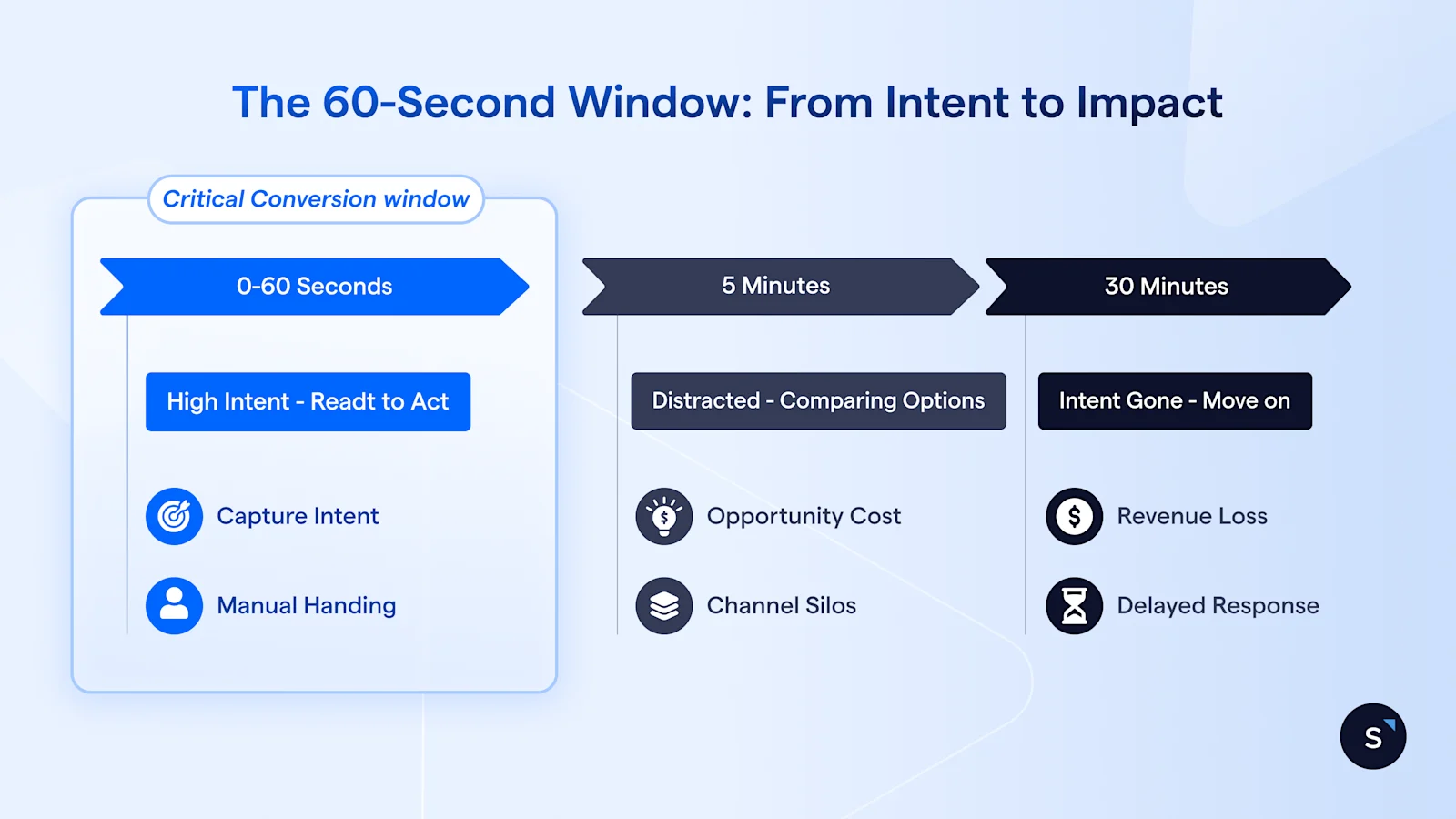
In today’s hyper-competitive digital marketplace, response speed plays a decisive role in lead conversion, especially for ad-driven businesses. The moment a prospect clicks an ad or submits a form, their interest and intent are at their peak. That window, however, is brief. If engagement doesn’t happen quickly, attention fades and opportunities are often lost.
This makes rapid lead follow-up mission-critical. Time to first response refers to how quickly a business reaches out after a prospect signals interest. For teams investing heavily in paid acquisition, that clock starts ticking the second a lead converts. Delays of even a few minutes can significantly reduce the likelihood of turning that interest into revenue.
Across performance-focused industries, slow follow-ups are consistently linked to lower conversion rates, increased customer acquisition costs, and lost opportunities to faster-moving competitors. Multiple studies on inbound lead response timing reinforce the same insight: engaging prospects early, while intent is still high, is one of the most effective ways to protect and improve ad ROI.
Several market studies show why first-response speed matters:
Responding to leads within the first minute can increase conversions by up to 391%.
Leads contacted within 60 seconds are more likely to convert than those contacted later.
78% of buyers choose the first company to respond to their inquiry, underscoring the competitive edge of rapid follow-up.
Yet, the average lead response time across industries sits at around 42 hours, meaning most businesses are missing out on prime conversion opportunities.
These numbers make it clear: that speed to lead isn’t just a metric, it’s a cornerstone of effective ad ROI. With rising ad costs, shorter attention spans, and buyers exploring multiple options simultaneously, delays of even a few minutes can mean the difference between a sale and a lost opportunity.
What Is Speed to Lead?
Speed to lead is the time it takes for a business to contact a potential customer after they submit their information through a form, chat, or inquiry. In simple terms, it measures how fast you respond when someone raises their hand and says, “I’m interested.”
This metric originated in sales and performance marketing, where teams noticed a clear pattern: leads contacted quickly were far more likely to convert than those contacted later. As digital advertising and online lead generation scaled, delays between submission and follow-up became a major revenue leak.
Speed to lead exists to track and reduce that gap between lead submission and first contact, ensuring businesses engage prospects while interest is still high.
The Data: How Lead Response Time Impacts Conversions
Evidence from lead response time statistics and lead response time studies consistently shows that how quickly you contact a lead after submission dramatically affects conversion outcomes and this underpins the widely cited 60-second rule.
Response Timing and Lead Qualification
Leads contacted within 1 minute can see conversion rates increase by up to 391% compared with slower follow-ups, underscoring the power of rapid engagement.
Responding to a lead in the first 5 minutes makes a prospect 21 times more likely to be qualified than if contacted after 30 minutes.
After just 5–10 minutes, the probability of qualifying a lead plummets, and the drop accelerates further beyond 30 minutes.
Probability of Qualification Drops Over Time
Response times beyond 30 minutes or more see a sharp decrease in qualification odds, often decreasing by more than 80% compared with immediate follow-up.
Contacts made within an hour remain significantly stronger up to 7 times more likely to qualify a lead than responses delayed further.
Impact on CAC and ROAS
While specific CAC (Customer Acquisition Cost) and ROAS (Return on Ad Spend) benchmarks vary by industry, faster response times tend to lower cost per acquisition and improve return on ad spend because early engagement captures intent and reduces lead leakage to competitors.
Quick follow-ups also mean higher qualification and conversion rates, which increase revenue without proportional increases in marketing spend, improving overall efficiency.
Time to first response statistics overwhelmingly support that the sooner you engage a lead, the higher the chances of qualification and conversion, dramatically shaping how effective your CAC and ROAS will be.
Why Fast Lead Follow-Up Boosts Ad ROI
In performance marketing, fast lead follow-up is directly tied to ROI. You’re paying premium rates on platforms like Google, Meta, and TikTok to capture intent, if your team doesn’t respond fast, that spend is partially wasted.
A faster lead follow up improves ROI in three critical ways:
First, it reduces wasted ad spend. When inbound leads aren’t contacted quickly, their intent fades or shifts elsewhere. Every delayed response increases the chance that the lead never converts, meaning you paid for a click, but lost the opportunity.
Second, it improves conversion rates. Shorter inbound lead response time means you’re engaging prospects while motivation is high. Faster responses consistently outperform slower ones because users are still thinking about the problem your ad promised to solve.
Third, it shortens sales cycles. When you respond to leads immediately, conversations start earlier, objections surface faster, and deals move through the funnel with less friction lowering CAC and improving overall efficiency.
This matters even more today because:
Hot leads go cold fast, sometimes in minutes
Competitors respond faster, especially in high-intent categories
Users multitask and forget, switching apps, tabs, or even vendors
In performance-driven environments, fast inbound lead response time isn’t just operational efficiency it’s a competitive advantage that directly boosts ad ROI.
The Human Psychology Behind the 60-Second Window
The 60-second window exists because of how buyers think and behave, not because of arbitrary benchmarks. When a user submits a form, their intent is at its peak, they’re actively looking for answers, pricing, or validation. A fast response satisfies instant gratification, reinforcing the feeling that they made the right choice.
Delay introduces doubt. As minutes pass, intent fades, distractions take over, and urgency drops. In a mobile-first world, leads are often multitasking, scrolling social feeds, switching apps, or comparing multiple vendors at once. If a response doesn’t arrive quickly, attention shifts elsewhere.
Fast replies align with modern expectations of immediacy. Slow responses feel outdated, impersonal, and disconnected from how users experience digital products today.
The Hidden Cost of Slow Lead Follow-Up
Slow follow-up doesn’t just reduce conversions, it creates compounding opportunity costs that often go unnoticed.
When teams respond late, marketing has to spend more on ads to generate the same number of meetings. Lead-to-meeting rates drop, pipelines thin out, and sales teams work harder for fewer results. Meanwhile, high-intent leads don’t disappear, they simply move to competitors who respond faster.
There’s also a brand impact. A delayed response signals disorganization and low customer focus, weakening trust before a conversation even begins. Over time, this erodes user experience, damages perception, and quietly increases acquisition costs across channels.
Barriers That Keep Teams From Responding Fast
Most teams don’t respond slowly by choice, it’s usually an operational issue.
Common barriers include:
Disconnected systems where leads sit across forms, CRMs, and inboxes
Manual lead assignment that depends on human availability
Lack of automation for routing and first responses
Team availability gaps across time zones or working hours
Delayed notifications that cause leads to go unnoticed
These challenges affect SMBs, mid-market, and enterprise teams alike, just at different scales. Without streamlined workflows and automation, even well-funded teams struggle to consistently respond within the critical first minute.
How Automation Solves the Speed-to-Lead Problem
Automation removes the biggest bottleneck in lead follow-up: human delay. A well-designed inbound response speed automation layer ensures every inbound inquiry is acknowledged instantly, regardless of time zone, workload, or team availability.
AI agents act as the first point of contact, responding the moment a lead submits a form. They confirm interest, ask qualifying questions, and capture intent while it’s still high. Automated SMS plays a critical role here, messages are delivered and read faster than emails, making them ideal for immediate engagement.
Behind the scenes, smart routing assigns leads to the right sales rep based on rules like geography, product interest, or deal size. At the same time, instant lead notifications alert teams in real time, ensuring no opportunity sits unattended in a queue.
This creates a hybrid model:
A 24/7 automated lead follow up system handles immediate responses and basic qualification
Human teams step in for complex conversations, negotiations, and relationship building
The result is a seamless process that answers a core question for modern sales teams: how to respond to a sales lead instantly without overwhelming people. Automation doesn’t replace humans, it makes fast, consistent lead engagement possible at scale.
How SleekFlow Helps You Respond in Under 60 Seconds
SleekFlow is designed to eliminate delays between lead submission and first response by unifying automation, messaging, and CRM workflows into one system. Below is how the end-to-end process works in practice:
1. Capture Leads Instantly From Your Ads
Businesses publish lead ads on platforms like Facebook and Instagram, where prospects submit their contact information including phone numbers, directly through the ad. This captures intent at the moment interest is highest.
2. Automatic Sync to SleekFlow
As soon as a form is submitted, lead details sync instantly to the SleekFlow CRM. There’s no manual data handling, no spreadsheet uploads, and no dependency on internal handoffs, ensuring zero delay at the data layer.
3. Trigger Instant SMS Outreach
SleekFlow automatically sends a personalized SMS reply in under one second, acknowledging the inquiry and opening the conversation immediately.
Example message:
“Thanks for reaching out! How can we help you today?”
This instant response reassures prospects, sets expectations, and keeps engagement alive while intent is still high.
4. Assign Leads to the Right Team or AI Agent
The lead appears in SleekFlow’s omnichannel inbox, where intelligent routing rules assign it to the right resource:
Human sales or support agents for high-value conversations
SleekFlow AI agents for instant qualification and common questions
This ensures every lead is handled quickly and appropriately, without manual intervention.
5. Add Leads Into Marketing or Nurturing Campaigns
If a lead doesn’t respond immediately, SleekFlow can automatically enroll them into SMS follow-up or nurturing campaigns sending reminders, helpful information, or next steps to keep the conversation moving forward.
Case Study: SleekFlow in Action - BateriHub
Company: BateriHub (automotive services provider across Malaysia)
Use Case: Sales, marketing, customer support
Products Used: SleekFlow Inbox & Automation
Problem:
Lead response times were inconsistent and often slow (around ~17 minutes), especially during busy periods.
Customer messages were scattered across different channels, making it hard to track who contacted from where.
Communication was fragmented, leading to delayed replies and missed opportunities.
Solution by SleekFlow:
Omnichannel Inbox: All inbound enquiries, from website, social, and messaging channels, were centralized for faster visibility and response.
24/7 AI Smart Reply: SleekFlow’s AI Smart Reply instantly engaged customers around the clock, even outside business hours, gathering key details like location and service needs before a human agent stepped in.
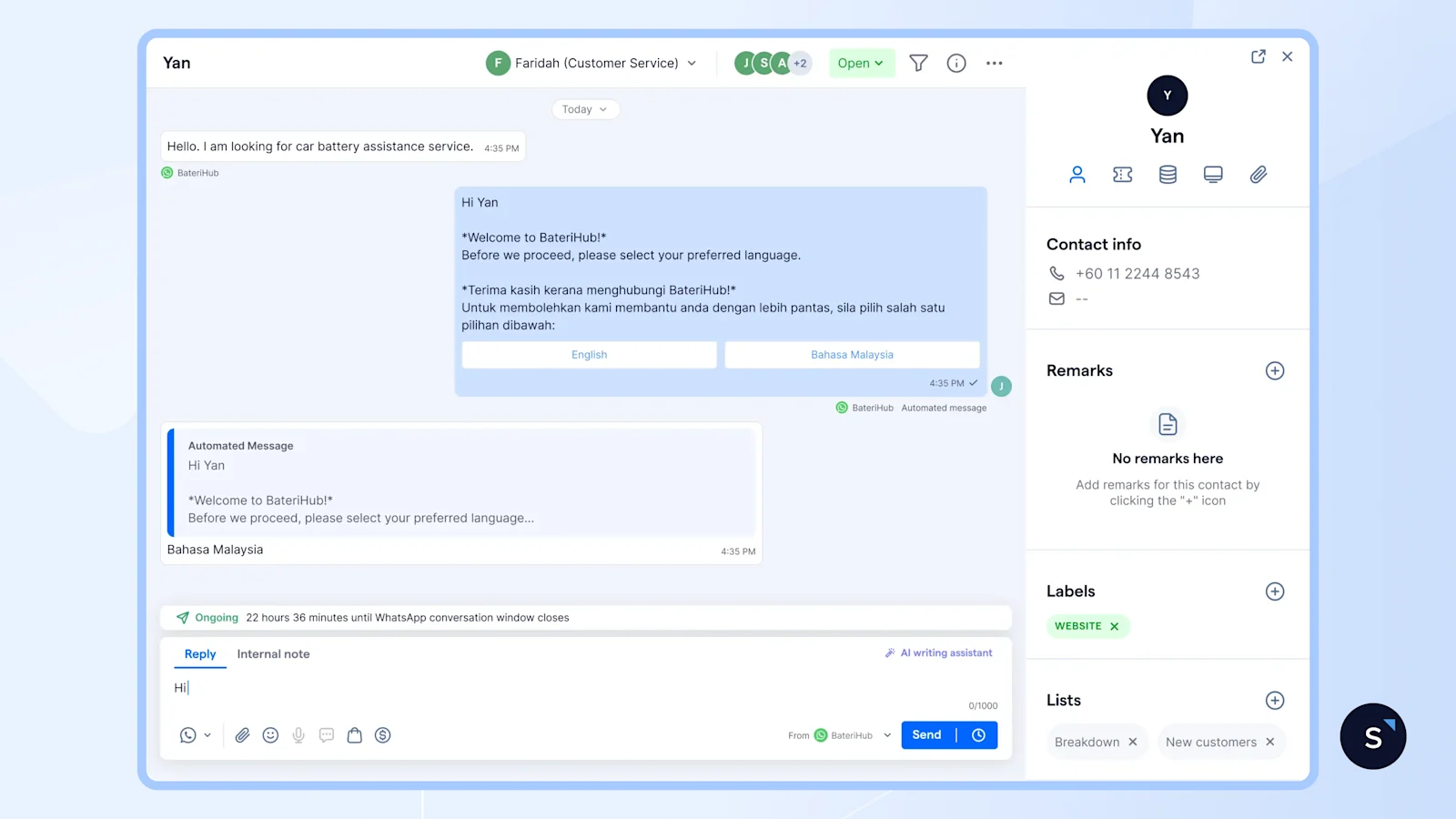
Automated Qualification: AI processed technical battery-match queries using an uploaded product knowledge base, delivering quick, accurate replies that freed staff to focus on higher-impact interactions.
Improved Metrics:
~17× faster response speed (from many minutes down to near-instant replies)
<1% spam leads as automation filtered and tagged low-intent enquiries
+22% conversions in 3 months thanks to higher engagement and faster follow-up workflows
With SleekFlow’s AI automation, BateriHub demonstrates how reducing lead response time and centralizing communications using SleekFlow’s automation and AI delivers measurable improvements in engagement, lead quality, and overall conversion, mirroring the ideal workflow outlined above.
This workflow allowed the business to scale lead volume without increasing headcount, while consistently meeting the critical speed-to-lead window.
Examples of Lightning-Fast Lead Replies
Here are practical examples where speed to lead automation and rapid follow-up have made a real difference in business outcomes:
1. Instant Form Submission Response (Automated Acknowledgment + Follow-Up)
When leads fill out a contact form, automated systems can reply instantly with personalized messages, capturing interest before attention fades.
As per Nexum Automations case study, A D2C brand implemented a multi-channel automated system that responded to 100% of new leads in under 20 seconds, cutting their lead response time drastically and boosting conversions by 34% while simultaneously reducing customer acquisition costs by 28%.
2. Demo Reminder via SMS (Boost Attendance & Engagement)
Automated SMS reminders confirm bookings immediately, add calendar links, and reduce no-shows by engaging leads where they’re most responsive on mobile.
Einstein Moving Company integrated SMS follow-ups through Leadferno - capturing 675+ leads and trimming first reply times to under 10 minutes, significantly improving their conversion and booking rates.
3. Retargeted Pricing Page Viewer (Behavior-Triggered Follow-Up)
When visitors abandon your pricing page without converting, AI systems can trigger personalized follow-ups that re-engage them and create opportunities to close the sale.
As per SuperAGI case studies, Companies using AI lead automation (SMS, email, WhatsApp) have seen rapid improvements in conversion metrics by reconnecting with these high-intent visitors within minutes. Some brands report up to 300% increases in qualified opportunities after implementing speed-to-lead automation that triggers relevant follow-ups based on behavior.
4. After-Hours Inquiry Handling (24/7 Response with AI)
Leads that arrive outside business hours often go cold before teams can respond. Automated responders or AI agents ensure that initial engagement happens instantly, even when human agents aren’t online.
Case study by Make suggests that In the renewable energy space, a company called HomeBiogas, reduced lead response times from ~24 hours to under 3 minutes using automated workflows that instantly deliver distributor info or next steps to leads, even outside business hours.
Best Practices to Achieve Under-60-Second Responses
To consistently hit the critical under-60-second response benchmark, follow these actionable steps:
Use SMS as the first-touch channel - texts are read faster than email and drive higher open rates.
Set up automated rules and AI replies - templates and AI ensure instant, relevant engagement without waiting for humans.
Create a smart lead routing system - ensure leads go to the right agent based on skill, priority, or product interest.
Monitor response time KPIs in reporting tools - track actual inbound lead response time to identify bottlenecks and improve.
Conclusion: The 60-Second Rule Is the New Standard
Fast communication isn’t just a best practice, it’s an expectation. Data shows that leads contacted quickly are far more likely to convert, and companies that respond first often win the business. By using automation, SMS, and AI to handle the initial touchpoints, businesses can stay ahead of the competition while delivering the kind of responsiveness modern buyers demand.

