How AI Chatbots Reduce Cart Abandonment in E-commerce


TL; DR: Quick Summary
- Cart abandonment is a major revenue leak: ~70% of carts are abandoned, often due to friction or unanswered questions, not lack of intent.
- Top causes include surprise fees, slow support, complex checkout, trust issues, and mobile distractions.
- Traditional recovery (email + blanket discounts) is often late, unprofitable, and not personalized to the real objection.
- AI chatbots prevent abandonment by answering product/shipping/payment questions instantly and nudging users during checkout hesitation.
- Best use cases: exit-intent prompts, checkout help, payment/delivery clarification, stock checks, and two-way follow-ups after abandonment.
- SleekFlow enables omnichannel cart recovery with AI agents, automated WhatsApp/SMS reminders, CRM sync, and unified inboxes to recover more revenue.
Introduction: Why Cart Abandonment Is One of E-commerce’s Biggest Revenue Leaks
Every e-commerce business faces it but few fully solve it. Cart abandonment happens when shoppers add products to their cart but leave without completing the purchase. The result? Lost sales that slowly chip away at your marketing budget and growth.
Industry data consistently shows that over 70% of online shopping carts are abandoned, making it a problem most online stores deal with every day. According to Baymard Institute, the global average cart abandonment rate is 70.19%, meaning only 3 out of 10 shoppers actually complete checkout. For growing e-commerce brands, this can add up to a huge amount of missed revenue over time.
Research and real-world benchmarks consistently indicate that most abandoned carts are not because shoppers don’t want to buy, but because something gets in the way at checkout, such as unanswered questions, delivery or payment uncertainty, or momentary hesitation without immediate support. As shopping journeys become faster, mobile-first, and omnichannel, real-time help has become essential for getting shoppers to finish checkout. This is why modern cart abandonment solutions are increasingly centered on AI chatbots for e-commerce, which step in at the right moment, answer questions quickly, and prevent people from leaving.
What Is Cart Abandonment?
In simple terms, cart abandonment occurs when a shopper adds one or more items to their online cart but leaves the website without completing the purchase. The products remain in the abandonment cart, which means a lost sale and an incomplete purchase.
While abandonment is common across all e-commerce categories, it rarely happens without reason. Most shoppers intend to buy, but something in the experiencemakes shoppers pause, feel unsure, or get distracted.
The Most Common Reasons Shoppers Abandon Carts
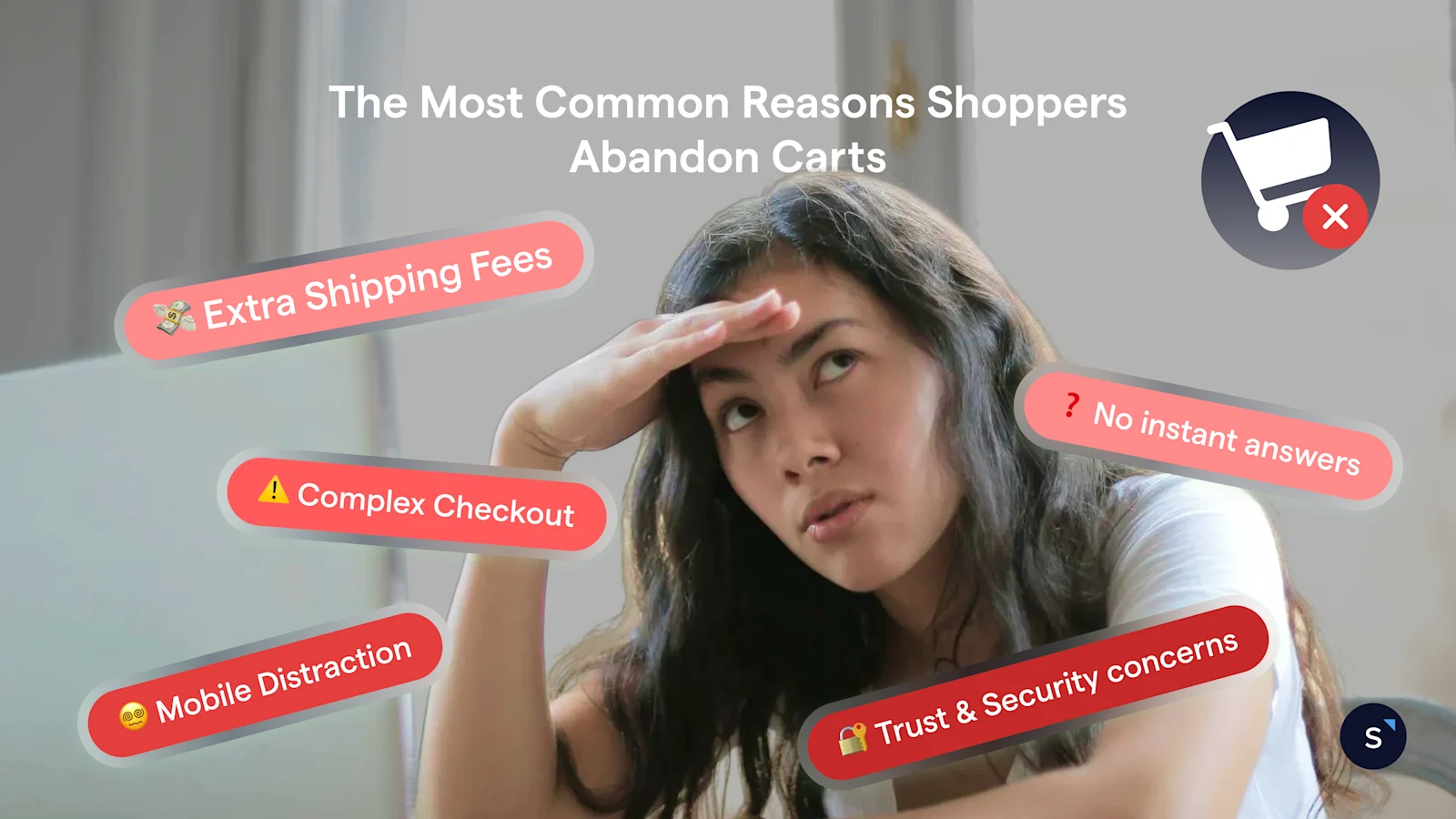
Below are the primary factors that drive abandonment across e-commerce sites, supported by industry research:
1. Unexpected Shipping Costs or Extra Fees
Hidden costs remain the #1 reason for cart abandonment. When shipping, taxes, or service fees appear late in checkout, shoppers often feel surprised or misled.
Baymard Institute reports that 39% of shoppers abandon carts due to extra costs being too high
Lack of upfront pricing transparency creates immediate drop-offs
2. Lack of Instant Answers at Critical Moments
Shoppers frequently have last-minute questions such as:
“Will this arrive before the weekend?”
“Is this returnable?”
“Does this size fit true to measurement?”
When there’s no instant support available, hesitation turns into exit. Traditional support channels like email or ticket forms are too slow to prevent abandonment in real time.
This is why many brands are looking for better ways to recover carts that provide immediate, conversational assistance.
3. Check out Friction and Complexity
Long forms, forced account creation, or too many checkout steps increase cognitive load and frustration.
Common friction points include:
Mandatory sign-ups
Multiple redirects
Poorly optimized mobile checkout flows
According to Baymard, 18% of users abandon carts because checkout is too long or complicated.
4. Trust and Security Concerns
If shoppers don’t feel confident about payment security or brand credibility, they hesitate at checkout.
Typical trust blockers:
Missing security badges
Limited payment options
Unclear return or refund policies
Even small trust gaps can cause users to abandon their carts.
5. Distractions - Especially on Mobile
Mobile shopping introduces a unique challenge. Users are more likely to:
Switch apps
Get interrupted by notifications
Lose focus mid-checkout
With over 60% of e-commerce traffic coming from mobile devices, distractions play a major role in abandonment behavior.
Why Traditional Cart Recovery Methods Fall Short
For years, e-commerce brands have relied on familiar cart abandonment solutions like reminder emails, retargeting ads, and discount-driven campaigns. While these methods still have value, they often fail to address the real reason shoppers abandon carts, unresolved hesitation at the moment of checkout.
Here’s why traditional recovery tactics struggle to consistently reduce cart abandonment:
1. Email-Only Reminders Arrive Too Late
Abandoned cart emails usually come too late. They reach shoppers hours or even days, after the cart is left behind.
Common issues with email-only recovery:
The shopper has already bought from a competitor
The original intent or urgency has faded
Emails get buried in crowded inboxes
By the time the message is opened, the buying moment has often passed.
2. Discount-Only Recovery Hurts Profit
Discounts are often used as a default recovery tactic, but they come with drawbacks:
They train customers to wait for price drops
They reduce profitability
They don’t address the actual reason for abandonment
Many shoppers don’t leave because of price, they leave because they need reassurance, clarity, or quick answers.
3. One-Size-Fits-All Messaging Lacks Relevance
Traditional recovery campaigns usually send the same message to every shopper, regardless of intent or behavior.
Examples of poor relevance:
Offering a discount when the issue is delivery timing
Sending a reminder when the shopper simply had a question
Ignoring context like device type or browsing history
Without personalization, recovery efforts feel impersonal and ineffective.
What Is an AI Chatbot for e-commerce?
An AI chatbot for e-commerce is an intelligent, conversational tool that talks with shoppers in real time, answering questions, resolving objections, and guiding users through the buying journey without human intervention.
Unlike traditional rule-based chatbots (which follow predefined scripts and fixed decision trees), AI chatbots use machine learning and natural language understanding (NLU) to interpret user intent, context, and behavior. This allows them to respond dynamically, even when shoppers phrase questions differently or ask multiple things at once.
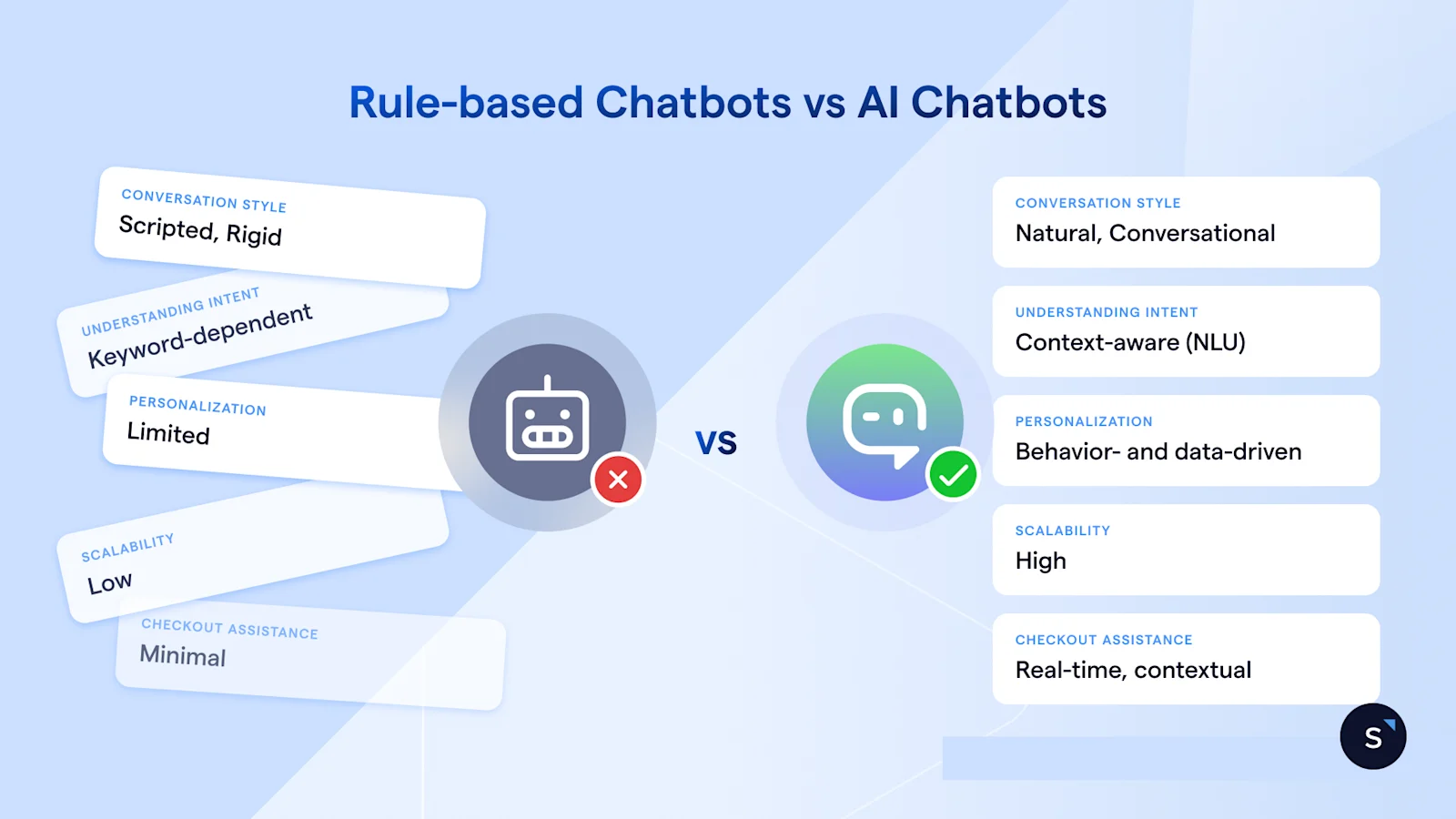
Core Capabilities of AI Chatbots in e-commerce
Modern AI chatbots are designed to support sales, not just customer service. Key capabilities include:
Natural language understanding (NLU) to interpret shopper intent accurately
Real-time responses to eliminate waiting and hesitation
Automation of FAQs, order queries, and checkout support
Context awareness, using browsing behavior and cart data
Seamless handoff to human agents when needed
These capabilities make AI chatbots especially effective as cart abandonment solutions, because they engage shoppers before they leave rather than after.
How AI Chatbots Reduce Abandoned Checkout in Real Time
The biggest advantage of AI chatbots isn’t automation - it’s timing. They engage shoppers at the exact moment hesitation occurs, preventing carts from being abandoned in the first place.
Here’s how AI chatbots actively work to cart recovery during critical checkout moments:
1. Answering Last-Minute Product or Shipping Questions
Shoppers often abandon carts due to unanswered checkout questions. AI chatbots instantly provide answers from:
Product catalogs
Shipping rules
Return policies
This removes uncertainty at the final decision point.
2. Addressing Objections Instantly
AI chatbots respond within seconds - before hesitation turns into exit. They help by:
Reassuring users about payment security
Explaining refund policies
Clarifying pricing or taxes
Salesforce reports that 69% of consumers prefer chatbots for quick brand communication.
3. Offering Contextual Help During Checkout
AI chatbots proactively assist based on shopper behavior. Common triggers include:
Inactivity on the payment page
Checkout hesitation prompts
Alternative payment suggestions
This keeps shoppers moving forward instead of dropping off. McKinsey reports that personalized, real-time engagement can increase conversion rates by up to 40% in digital commerce.
4. Keeping Shoppers Engaged on Mobile
On mobile, distractions frequently interrupt checkout. AI chatbots help by:
Prompting users to resume checkout
Answering questions without page exits
Maintaining cart context
With over 60% of e-commerce traffic on mobile, these nudges significantly reduce drop-offs.
Key e-commerce Chatbot Use Cases for Cart Recovery
AI chatbots are most effective when deployed at high-intent moments, right before a shopper abandons their cart or during checkout hesitation. Below are the most practical e-commerce chatbot use cases that directly support cart abandonment solutions and help brands consistently reduce abandoned checkouts without relying on aggressive discounts.
1. Follow-Up Conversations After Cart Abandonment
After a cart is abandoned, AI chatbots can continue the conversation instead of relying on one-way reminders.
How it helps:
Re-engages shoppers while intent is still fresh
Resolves last-minute questions in real time
Reduces reliance on discount-based recovery
SleekFlow highlights that abandoned cart reminders perform best when they enable two-way conversations. Shoppers who re-engage can instantly ask questions about delivery, pricing, or returns, helping nearly half of engaged users complete their purchase.
2. Exit-Intent Chat Prompts
Exit-intent chatbots activate when a shopper shows signs of leaving, such as moving the cursor toward the close button or becoming inactive on the checkout page.
How it helps:
Re-engages shoppers before they exit
Offers help instead of discounts
Keeps the conversation lightweight and non-intrusive
ASOS uses on-site conversational prompts and live chat triggers during checkout to answer delivery, returns, and sizing questions reducing friction at exit points.
3. Checkout Page Assistance
During checkout, even small points of confusion can cause users to drop off. An AI chatbot for e-commerce can stay persistently available to guide users through each step.
Common chatbot assistance includes:
Explaining form fields
Helping with promo code issues
Recommending guest checkout
Shopify Plus merchants commonly use chat widgets during checkout to assist with promo codes, guest checkout, and payment issues, significantly reducing checkout friction.
4. Payment or Delivery Clarification
Uncertainty around payment methods or delivery timelines is a major reason carts are abandoned.
AI chatbots instantly clarify:
Available payment options (UPI, cards, wallets, BNPL)
Estimated delivery dates by location
Shipping fees and return policies
Flipkart uses AI chat assistants to clarify payment options (UPI, wallets, BNPL) and delivery ETAs - especially important for mobile shoppers.
5. Stock Availability Confirmation
Nothing frustrates shoppers more than discovering an item is out of stock at checkout. AI chatbots proactively confirm inventory availability in real time.
What chatbots can do:
Confirm size or color availability
Suggest similar in-stock alternatives
Notify users when items are restocked
IKEA uses digital assistants and on-site messaging to confirm product availability by location, offer in-stock alternatives, and guide shoppers toward items that can be delivered sooner.
AI Chatbots Beyond the Website: Cart Recovery Across Channels
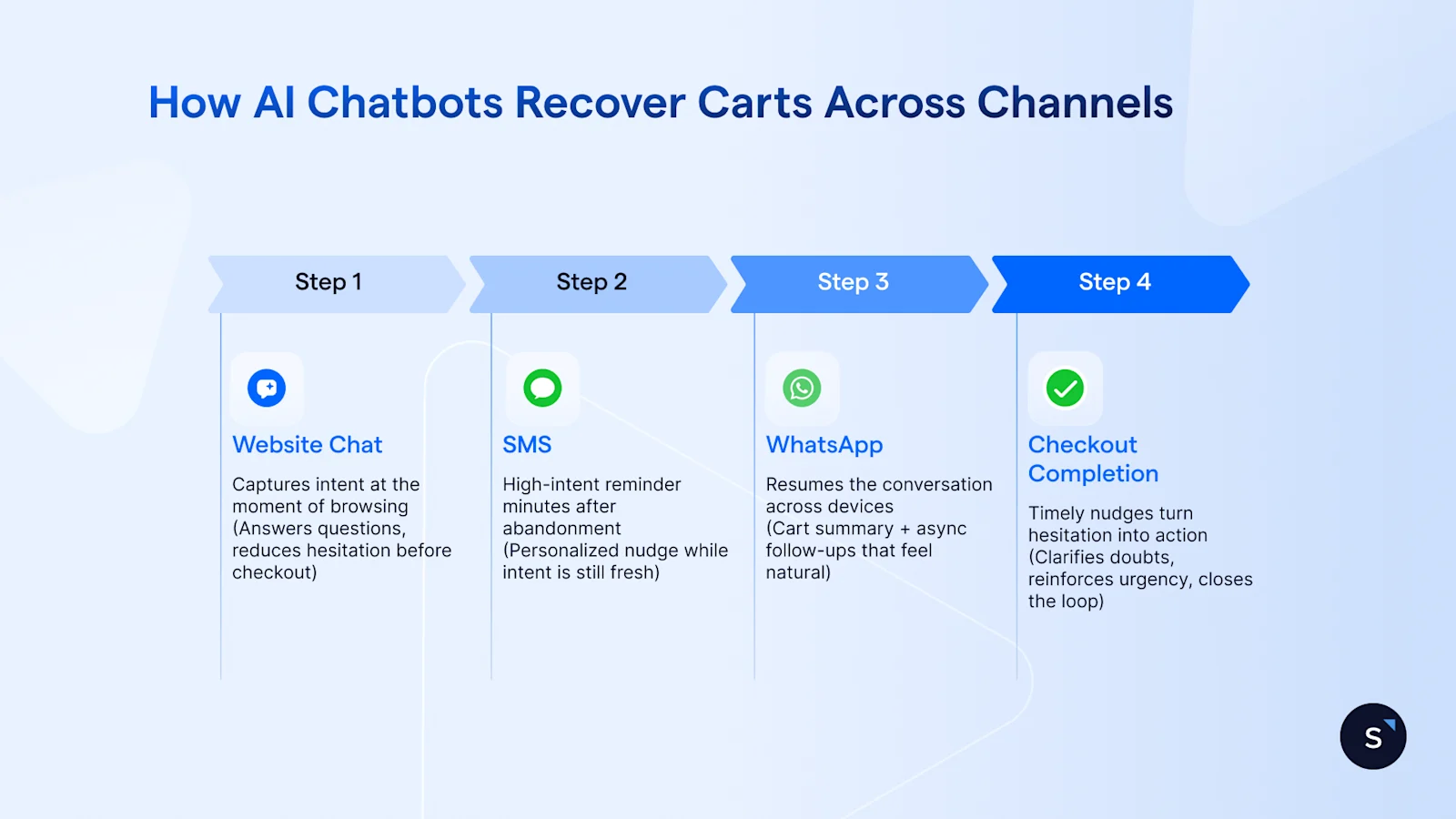
Cart abandonment doesn’t always happen because the on-site experience fails - often, shoppers simply leave the website and continue their day. This is where AI chatbots extend their value beyond website chat and enable true omnichannel cart recovery, supporting AI for e-commerce sales across multiple touchpoints.
Modern AI chatbots maintain conversation context across channels, ensuring shoppers can resume their journey without starting over.
How SleekFlow Enables AI Cart Abandonment Solutions
Modern cart recovery requires more than a single chatbot or channel, it needs a connected workflow that brings conversations, context, and automation together. This is where SleekFlow fits naturally into an e-commerce stack, enabling scalable, AI cart abandonment solutions without disrupting existing operations.
Rather than acting as a standalone chat widget, SleekFlow functions as a central engagement layer across channels helping brands respond faster, stay contextual, and ultimately reduce checkout friction.
Centralized Omnichannel Inbox
SleekFlow brings customer conversations from website chat, WhatsApp, SMS, and social messaging into a single inbox.
Why this matters for cart recovery:
Teams avoid switching between tools
Conversations stay continuous even if shoppers change channels
The same abandonment cart context is preserved across touchpoints
This omnichannel continuity is critical for delivering consistent, real-time assistance.
AI Agents Handling Cart-Related Questions
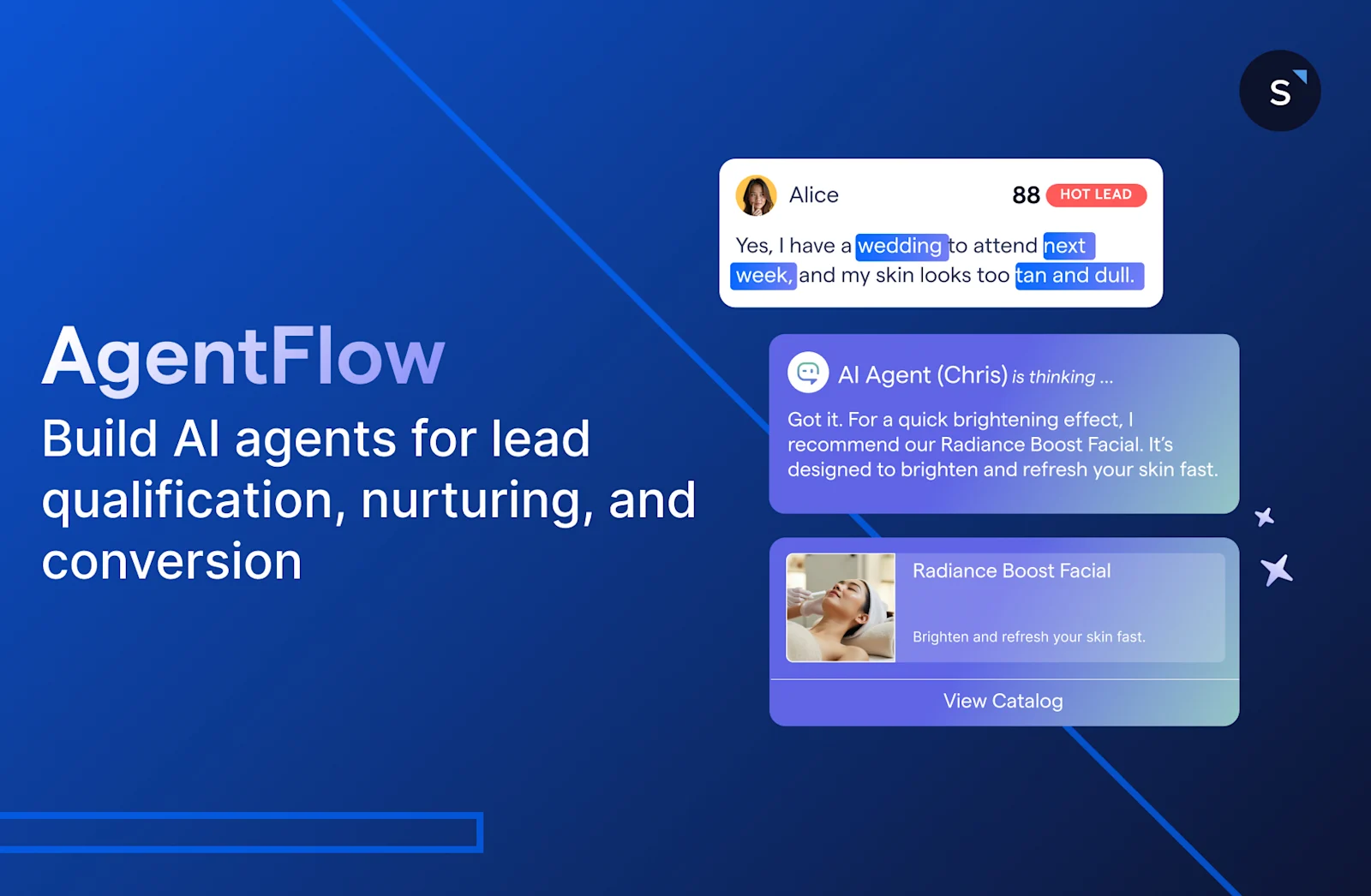
SleekFlow’s AI agents can automatically handle common cart and checkout queries, such as:
Shipping timelines
Payment options
Return and refund policies
Product availability
By responding instantly, AI agents remove hesitation at the checkout stage, where most abandonment occurs.
This directly supports an AI chatbot for e-commerce use cases focused on conversion, not just support.
Automated Cart Abandonment Follow-Ups
When a cart is abandoned, SleekFlow enables automated follow-ups through channels like SMS or WhatsApp, triggered based on shopper behavior.
Key benefits include:
Timely nudges sent minutes after abandonment
Personalized messages using cart data
Two-way conversations instead of static reminders
Unlike email-only recovery, these follow-ups feel immediate and conversational.
CRM Syncing for Better Shopper Context
SleekFlow integrates with CRM and e-commerce platforms to sync shopper data, including:
Purchase history
Previous conversations
Preferences and behavior
This context allows AI chatbots to personalize responses, making recovery messages more relevant and effective.
Personalization is a proven driver of AI for e-commerce sales, improving both conversion rates and average order value.
Example Scenarios: AI Chatbots in Action
Below are realistic, high-impact scenarios showing how AI chatbots work within an omnichannel workflow to reduce checkout friction.
Scenario 1: Checkout Hesitation
A shopper pauses on the checkout page.
AI chatbot detects inactivity
Shopper asks about delivery timeline
Chatbot instantly confirms estimated delivery
Shopper completes purchase.
Scenario 2: Cart Abandoned → SMS Recovery
A shopper leaves without checking out.
AI triggers a personalized SMS reminder
Message includes product name and quick help prompt
Shopper replies with a payment question
Chatbot answers → checkout resumed.
Scenario 3: Returning Customer Experience
A repeat customer revisits the site.
Chatbot recognizes previous purchase
Recommends a compatible product
Applies context-aware suggestions
Faster decision, higher conversion.
Scenario 4: Cross-Channel Continuity
A shopper abandons a cart on the desktop.
AI follows up on WhatsApp
Conversation resumes with full cart context
Shopper completes purchase on mobile
No friction, no repetition.
Best Practices for Using AI Chatbots to Reduce checkout friction
Use this practical checklist to ensure your AI chatbot for ecommerce actively supports cart abandonment solutions and helps reduce cart abandonment at critical moments.
Trigger Chatbots at High-Intent Moments
Deploy chatbots when shoppers hesitate, such as inactivity on checkout, exit intent on cart pages, or repeated navigation between payment and shipping. Timing matters more than volume.
Keep Messages Short and Helpful
Use clear, conversational prompts that resolve one issue at a time. Avoid long explanations or sales-heavy language during checkout.
Combine AI with Human Handover
Let AI handle common cart questions instantly, but enable seamless escalation to human agents for complex concerns, without losing context.
Avoid Overly Aggressive Discounts
Don’t default to coupons. First, use chatbots to clarify delivery, returns, or payment options. Reserve discounts only when hesitation is price-related.
Metrics to Track When Using AI Chatbots for Cart Recovery
Tracking the right KPIs helps measure how effectively your AI chatbot for ecommerce supports cart abandonment solutions and drives AI for ecommerce sales.
Cart Abandonment Rate
Measures how many carts are left without checkout. A declining rate indicates chatbots are resolving hesitation before shoppers exit.Cart Abandonment Rate (%) = ((Carts Created – Completed Purchases/Carts Created)*100)
Conversion Rate
Tracks completed purchases after chatbot deployment. Improvements show reduced checkout friction and better real-time assistance.Conversion Rate (%) = ((Completed Purchases/ Total Sessions or visitors)*100)
Assisted Conversions
Counts orders where shoppers interacted with a chatbot before purchasing, highlighting the chatbot’s influence even when it doesn’t close the sale directly.Assisted Conversions (%) = ((Orders with Chatbot Interaction/Total Completed Orders)×100)
Response Time
Measures how quickly the chatbot replies during checkout. Faster responses correlate strongly with lower abandonment and higher buyer confidence.Average Response Time = Total Time to First Response/Number of Chatbot Conversations (Measured in seconds)
Revenue Recovered
Tracks sales completed after chatbot engagement or follow-ups, directly linking chatbot activity to recovered revenue.Revenue Recovered = Revenue from Chatbot-Assisted Orders
The Future of AI Shopping Assistants in E-commerce
AI shopping assistants are rapidly evolving from reactive support tools into proactive revenue drivers. As customer expectations for speed, relevance, and personalization continue to rise, AI chatbots for e-commerce will play a central role in shaping how brands prevent and recover cart abandonment.
Here are the key trends shaping the future:
More Personalized, Context-Aware AI
Future AI chatbots will rely even more on behavioral data, purchase history, and real-time intent signals to tailor conversations. Instead of generic prompts, shoppers will receive assistance that feels uniquely relevant to their journey, helping brands further reduce checkout friction without incentives.
More Natural Conversational Experiences
Advances in natural language understanding will make chatbot interactions feel less transactional and more human-like. Shoppers will be able to ask complex, multi-part questions and receive accurate, contextual responses, reducing hesitation during checkout.
Deeper CRM and Commerce Integrations
AI shopping assistants will increasingly sync with CRMs, inventory systems, and order management tools. This deeper integration enables:
Better understanding of returning customers
Faster resolution of cart-related questions
Smarter follow-ups tied to the abandonment cart context
Predictive Cart Recovery Strategies
Instead of reacting after abandonment, AI will predict when a shopper is about to leave and intervene earlier. These predictive strategies represent the next phase of AI for e-commerce sales, shifting recovery from reactive to preventative.
Conclusion: Turning Abandoned Carts Into Conversions With AI
Cart abandonment remains one of the biggest revenue leaks in e-commerce, but it’s also one of the most solvable.
As this guide has shown, AI chatbots for e-commerce help brands:
Address hesitation in real time
Provide instant, contextual support
Engage shoppers across channels
Reduce dependency on discounts
Scale customer assistance without increasing costs
Rather than chasing abandoned carts after the fact, AI chatbots focus on preventing abandonment at the moment it happens, while still enabling intelligent follow-ups when needed. The result is a better customer experience and more sustainable growth.
As conversational commerce continues to mature, brands that explore AI-driven cart abandonment solutions will be better positioned to convert intent into revenue, without sacrificing trust or margins.
For e-commerce teams looking to improve conversions and customer experience at scale, AI conversational commerce is no longer optional, it’s becoming the standard.


