AI and Automation in Recruitment: How Recruiters Can Use WhatsApp and SMS to Streamline Hiring


TL; DR: Quick Summary
- The biggest hiring bottleneck is coordination, not sourcing. Manual screening, follow-ups, and scheduling slow hiring and cause candidate drop-offs.
- AI automation with WhatsApp and SMS streamlines early hiring stages, enabling instant responses, automated screening, interview scheduling, and reminders.
- Messaging improves candidate engagement, leading to faster responses, higher applicant-to-interview conversion, and fewer interview no-shows.
- Messaging improves candidate engagement, leading to faster responses, higher applicant-to-interview conversion, and fewer interview no-shows.
- Structured workflows and tools like SleekFlow centralize conversations, reporting, and compliance, helping teams scale recruitment while maintaining control and a better candidate experience.
While recruiting, the real bottleneck in hiring isn’t sourcing, it’s coordination. Between application and interview, recruiters juggle screening, follow-ups, scheduling, and reminders. Done manually, this slows everything down and leads to candidate drop-offs.
AI and messaging channels like WhatsApp and SMS remove that friction. Screening questions, follow-ups, and interview scheduling can run automatically, while recruiters focus on evaluating candidates. Using the WhatsApp Business API and centralized workflows, teams can manage conversations at scale without losing control.
The outcome is straightforward: faster responses, fewer drop-offs, and a smoother candidate experience.
The recruiter business case: speed, consistency, and candidate experience
Recruiting leaders are not looking for more tools. They want better outcomes. So what does “better” actually look like?
1. Faster first response time
Candidates expect quick acknowledgment. With AI recruitment automation, applications trigger instant WhatsApp or SMS replies, cutting response time from days to minutes.
2. Higher applicant-to-interview conversion
When screening and scheduling happen immediately through chat, fewer candidates drop off. AI tools automate top-of-funnel recruiting tasks, helping qualified applicants reach interviews faster.
3. Lower no-show rate
Automated confirmations and reminders via WhatsApp for recruitment reduce missed interviews and last-minute confusion.
4. Less manual follow-up work
Recruiters no longer chase availability or confirmations. AI tools for recruiters automated follow-ups handle reminders consistently.
5. Better visibility and reporting
Structured workflows make tracking easier. Leaders see response time, screening outcomes, and conversion rates in one system.
To standardize these processes, teams use workflow automation tools to create structured screening, routing, and follow-up journeys.
Before vs After: Manual vs Automated Workflow
The recruiter focuses on evaluating strong candidates instead of coordinating calendars.
How to Use WhatsApp for Recruitment (Complete Playbook)
Recruiters often ask how to use WhatsApp professionally without losing control of communication. The key is structure. WhatsApp should function as part of your hiring process, not as a personal messaging tool.
Below is a practical, step-by-step guide based on how recruiting teams typically implement it.
1. Set Up a Professional Business Account
For occasional hiring, the basic WhatsApp Business app may be enough. However, once multiple recruiters are involved or message volume increases, a more structured setup is necessary.
A professional configuration should allow:
Multi-user access under one official number
Integration with your ATS or CRM
Message templates for confirmations and updates
Centralized reporting
Logged conversation history
The WhatsApp Business API is designed for this type of setup. It also requires message templates to be approved before outbound use, which helps maintain compliance and reduces the risk of spam.
Most teams implement this through an official integration partner to avoid using personal phone numbers and to ensure proper configuration.
2. Define Clear Entry Points
Candidates should know exactly how to start the conversation.
Common entry points include:
Click-to-chat links in job ads
QR codes at hiring events
A WhatsApp button on your careers page
Links in social media job posts
Make it clear that the number is an official company account. This builds trust and reduces hesitation.
3. Create a Simple Application Flow
Keep early-stage communication short and focused. Long conversations increase drop-off.
A typical mini-flow includes:
Role selection
Preferred location
2–4 eligibility questions (e.g., work authorization, availability, certifications)
The goal is not to replace recruiter judgment. It is to gather structured information before human review.
Avoid asking for sensitive or unnecessary personal data at this stage.
4. Automate Repetitive but Administrative Steps
Certain tasks are repetitive and benefit from structured messaging.
Application confirmation
Send an immediate acknowledgment after submission. This reassures candidates that their application was received.
Screening questions
Ask short eligibility questions to determine whether the candidate meets basic requirements.
Interview scheduling
Share a booking link that syncs with recruiter calendars to avoid back-and-forth messages.
Status updates
Inform candidates whether they are progressing or not. Even a brief update reduces uncertainty and improves candidate experience.
Recruiters should still review candidates and make decisions. Messaging simply handles coordination.
5. Set Expectations Early
Clear communication prevents repeated follow-ups.
Let candidates know:
How long review typically takes
What the next step will be
How interviews are conducted
Example:
“Our team reviews applications within 24 hours. Shortlisted candidates will receive an interview scheduling link here.”
Setting timelines improves trust and reduces unnecessary inbound messages.
6. Keep Messages Professional and Concise
Messaging platforms are informal by nature, but recruitment communication should remain professional.
Best practices:
Use short paragraphs
Avoid sending full job descriptions in chat
Communicate during business hours
Identify the company clearly
Provide an opt-out option where required
Clarity and tone matter more than speed.
7. Use Groups Carefully
WhatsApp groups can work in limited situations, such as:
Campus hiring updates
Event reminders
Seasonal hiring announcementsGeneral talent community broadcasts
However, groups should never be used for:
Sharing resumes
Discussing interview feedback
Posting personal candidate details
Handling offer or rejection decisions
For most recruitment workflows, one-to-one messaging is safer and more compliant.
Always collect consent before adding anyone to a group and clearly define the purpose of the group.
8. Monitor and Review the Process
Using WhatsApp for recruitment should not mean losing visibility.
Ensure you can:
Track response times
Monitor conversation history
Assign conversations to specific recruiters
Maintain access controls
Regularly review workflows to ensure screening questions remain relevant and unbiased.
Example Message Templates
Application confirmation
“Hi [Name], thank you for applying for the [Role] position. We’ve received your application. Please answer the following questions so we can continue the review process.”
Next steps message
“Hi [Name], thank you for completing the screening questions. Our team will review your responses within 24 hours. If shortlisted, you will receive an interview scheduling link here.”
WhatsApp Business API considerations for recruiters
If you plan to use WhatsApp for recruitment seriously, the WhatsApp Business API version matters. The regular app works for one person. Recruiting teams need shared access, structure, and tracking.
Multi-user access: Multiple recruiters can manage candidate conversations under one official number.
Shared inbox and routing: Chats can be assigned to the right recruiter based on role, location, or hiring stage.
Automation support: You can run screening flows, send reminders, and trigger interview scheduling through structured workflows. This connects directly with AI recruiting automation tools.
Auditability and reporting: All conversations are logged. This helps with compliance, internal reviews, and performance tracking.
To set up API-based WhatsApp properly, recruitment teams typically work through an official integration partner that connects WhatsApp with automation and shared inbox capabilities.
Operational realities recruiters should know
1. Template messages for outbound communication: If you message candidates outside a 24-hour response window, WhatsApp requires approved templates. These are pre-reviewed message formats for confirmations, reminders, and updates.
2. Opt-in and consent management: Candidates must agree to receive WhatsApp messages. Add clear opt-in checkboxes in job forms or ask for consent during the first interaction.
3. Consistent branding and identity: An official business profile displays your company name and logo. This builds trust when a recruiter is asking for WhatsApp number details.
When you might not need the API yet
If you are a very small team hiring occasionally with low message volume, the basic WhatsApp Business app may be enough.
You outgrow it when:
Multiple recruiters need access
Volume increases
You need automation
Tracking and reporting become necessary
At that stage, API-based setup supports long-term AI recruitment automation. For cost planning, you can estimate usage using a tool. Using the API is not about complexity. It is about control, compliance, and scale.
SMS Recruiting Automation: When and Why It Works
While WhatsApp for recruitment works well globally, SMS remains highly effective in the recruitment market. Many frontline and hourly workers prefer standard text messaging. No app download is required, and nearly every mobile phone supports SMS. For recruiters, the decision is not WhatsApp or SMS. It is choosing the right channel for the role and location.
Where SMS Automation Works Best
SMS is particularly effective in high-volume hiring sectors such as:
Retail
Logistics and warehousing
Healthcare support roles
Hospitality
Seasonal workforce campaigns
In these environments, quick screening and fast scheduling matter more than long conversations.
Seasonal Hiring Example
Imagine a recruitment automation with AI, a seasonal hiring campaign for a retail brand preparing for peak season.
Step 1: Bulk SMS outreach
Past applicants receive: “We are hiring seasonal staff in [Location]. Reply YES to apply.”
Step 2: Automated screening
Candidates who reply receive 3 to 4 short qualification questions. This supports AI tools that automate top-of-funnel recruiting tasks without manual review.
Step 3: Interview scheduling
Qualified candidates receive a booking link.
Step 4: Automated reminders
SMS reminders reduce interview no-shows.
This type of campaign can move hundreds of candidates through screening in days instead of weeks.
Response Rate Advantage
Text-based recruiting consistently shows:
Faster first responses compared to email
Higher completion of screening questions
Lower interview no-show rates when reminders are automated
For high-volume hiring, this makes SMS a practical channel within AI recruiting automation tools.
Setting Up SMS at Scale
To manage bulk messages, routing, and tracking, recruiters should use an integrated platform rather than personal devices. Teams implementing SMS recruiting automation connect through platforms that support shared inbox access, automation, and reporting.
Where AI automation fits in the recruitment funnel (and where it shouldn’t)
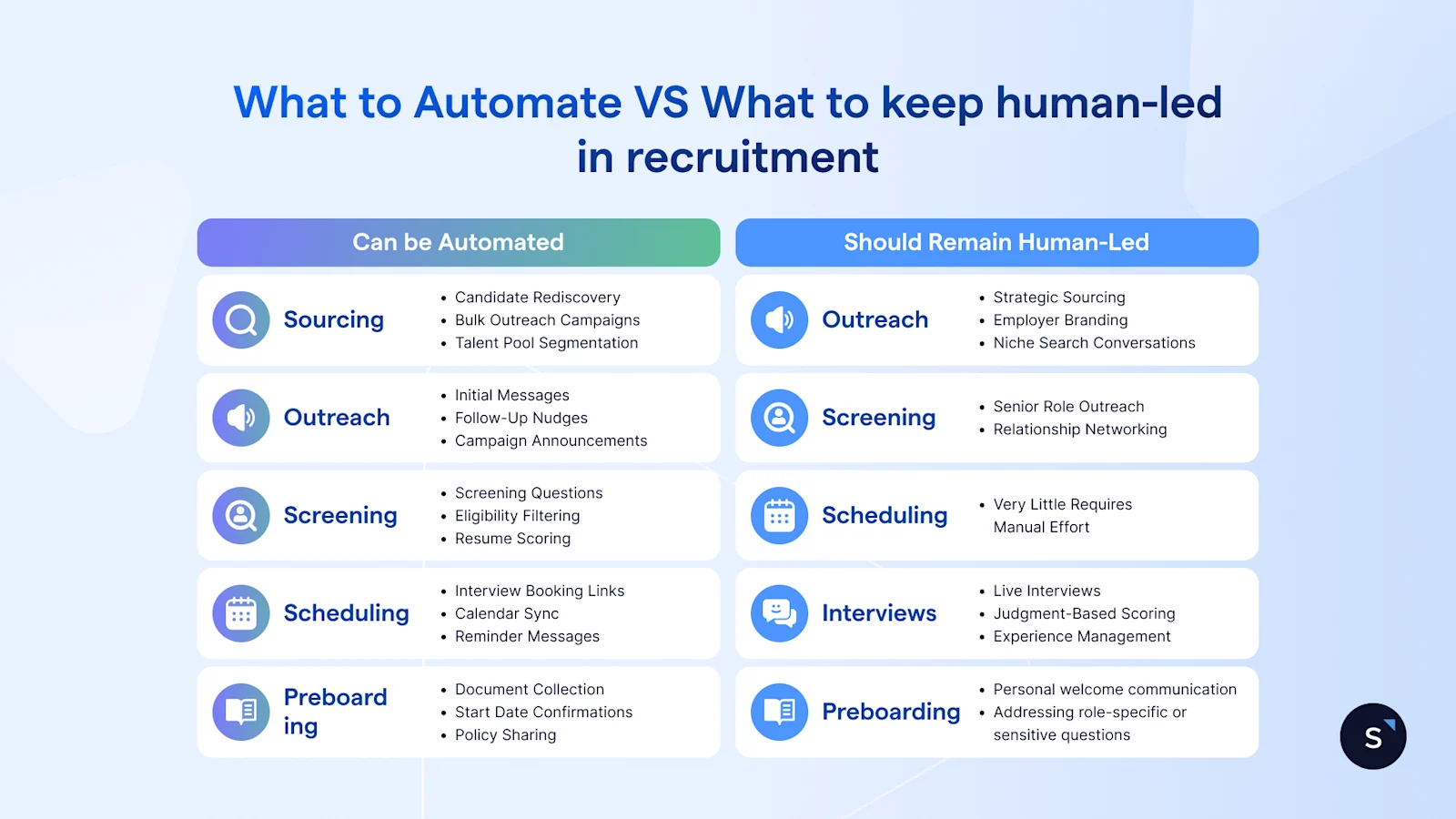
The goal of AI and automation in recruitment is not to replace recruiters. It is to remove repetitive work and improve speed. A simple rule applies: automation supports decisions; it does not replace accountability.
Here is how AI recruitment automation fits across the hiring funnel.
1. Sourcing
Can be automated
Candidate rediscovery from past databases
Bulk outreach campaigns via WhatsApp or SMS
Talent pool segmentation
Should remain human-led
Strategic sourcing decisions
Employer branding strategy
Niche or executive search conversations
Automation helps surface candidates. Recruiters decide who to engage deeply.
2. Outreach
Can be automated
Initial outreach messages
Follow-up nudges
Campaign-based hiring announcements
Using structured AI recruiting outreach automation, recruiters can contact large pools quickly.
Should remain human-led
Personalized conversations for senior roles
Relationship-based networking
3. Screening
Can be automated
Structured screening questions
Eligibility filtering
Basic resume scoring
FAQ responses
This is where AI tools automate top-of-funnel recruiting tasks bring the biggest efficiency gain.
Should remain human-led
Behavioral assessment
Culture fit evaluation
Complex qualification reviews
Automation filters. Recruiters interpret.
4. Scheduling
Can be automated
Interview booking links
Calendar synchronization
Confirmation and reminder messages
Rescheduling flows
This supports AI recruitment software automated text chat interview scheduling calendar invite processes and reduces no-shows.
Very little in scheduling requires manual effort once workflows are set.
5. Interviews
Can be automated
Interview reminders
Structured note capture
Post-interview feedback forms
Should remain human-led
Live interviews
Judgment-based scoring
Candidate experience management
AI can organize feedback. It should not replace human evaluation.
6. Offer stage
Can be automated
Offer letter document sharing
Deadline reminders
Onboarding checklist updates
Should remain human-led
Compensation discussions
Negotiation conversations
Final approval decisions
Sensitive discussions require empathy and accountability.
7. Preboarding
Can be automated
Document collection reminders
Start date confirmations
Policy sharing
FAQ responses
Should remain human-led
Personal welcome communication
Addressing role-specific or sensitive questions
Automation keeps communication consistent before day one.
Quick Reference: Do and Don’t Automate
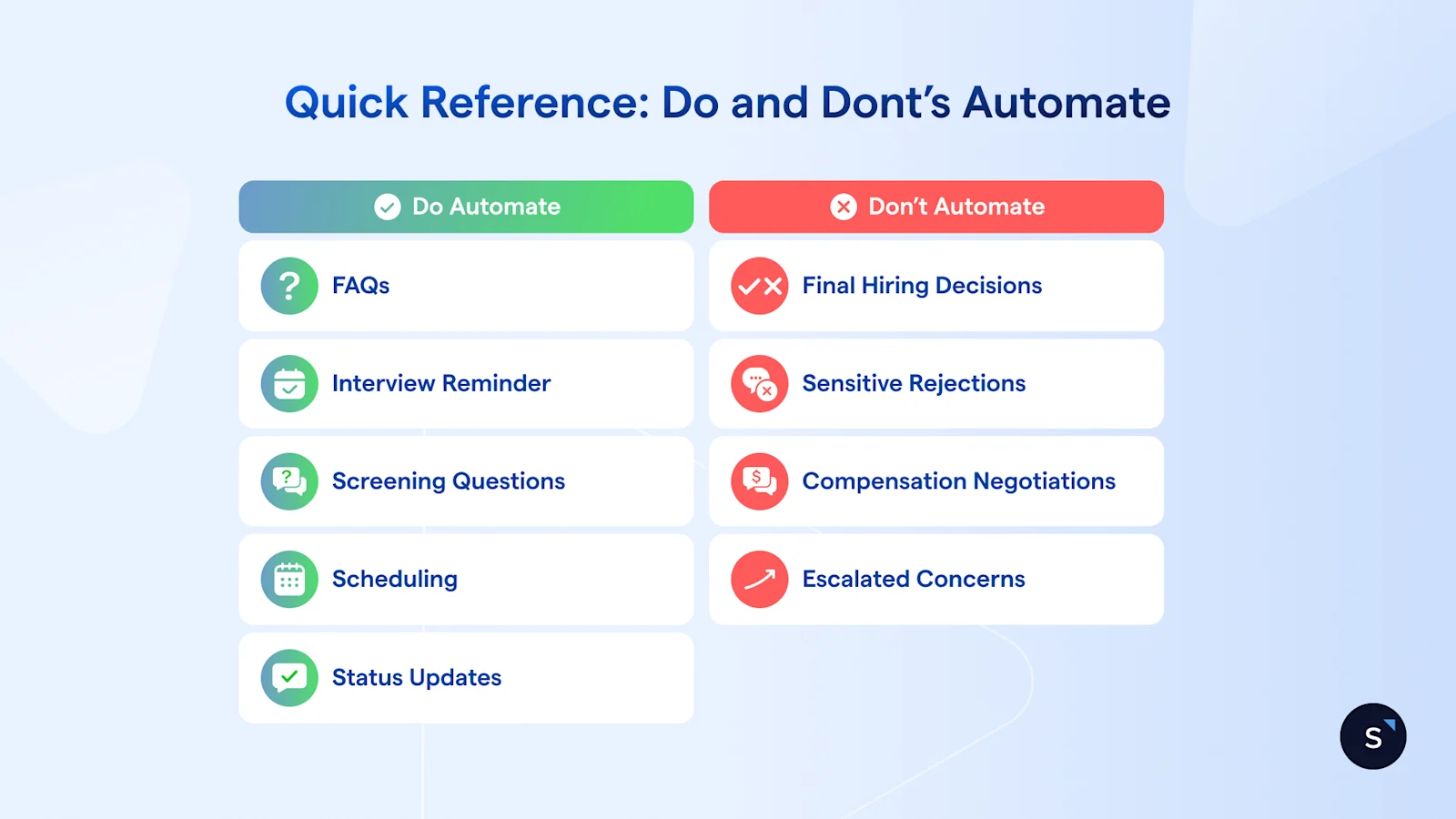
Do automate:
FAQs
Interview reminders
Structured screening questions
Scheduling
Status updates
Don’t automate:
Final hiring decisions
Sensitive rejection messages without human review
Compensation negotiation
Escalated candidate concerns
When used correctly, recruitment automation with AI reduces delays, improves response time, and standardizes early-stage hiring. But accountability stays with the recruiter. Automation handles structure. Humans handle judgment.
How SleekFlow operationalizes AI recruiting automation across WhatsApp and SMS
Recruiting challenges are rarely about strategy, they’re about volume, coordination, and visibility.
Here’s how structured AI automation across WhatsApp and SMS helps solve common hiring pain points:
Prevents candidate drop-off. Automated confirmations, structured screening questions, and instant chat follow-ups keep applicants engaged and informed from the moment they apply.
Eliminates interview scheduling back-and-forth. Candidates can self-book interview slots via chat with calendar integration and automated reminders, reducing no-shows and saving recruiter time.
Centralizes recruiter collaboration. A shared inbox with multi-user access and intelligent routing ensures clear ownership, no duplicate replies, and full team visibility.
Standardizes screening and communication. Predefined workflows and AI-driven screening sequences create consistent candidate experiences across roles and locations. AgentFlow enables AI-driven intent detection, candidate classification, and smart workflow triggers to ensure the right actions happen automatically at the right time.Provides real-time reporting and oversight. Centralized analytics track response times, workflow performance, and conversion rates so leaders can identify bottlenecks quickly.
Ensures governance and data security. Role-based permissions, consent management, access controls, and secure message logging keep recruitment automation compliant and controlled with data security.
In practice, SleekFlow connects WhatsApp and SMS into structured workflows that reduce manual coordination, improve response speed, and maintain consistent communication, while recruiters stay in control of final hiring decisions.
SleekFlow case studies and real-world examples
Recruiting leaders want measurable outcomes, not theory. Below are two real customer examples and what they mean in a hiring context.
1. Nan Fung Property Management: Modernizing recruiting with WhatsApp automation
Nan Fung Property Management used WhatsApp automation to streamline recruiting across more than 80 properties.
Reported results include:
Around 70% applicant engagement
Initial contact made within approximately 24 hours
What this means for recruiters
Faster outreach reduces drop-offs, especially for frontline roles where candidates apply to multiple employers at once. Messaging also drives higher screening completion since candidates are more likely to respond on WhatsApp than email.
For teams hiring across multiple locations, automation keeps communication consistent and standardized, helping you scale without adding more manual work.
2. Tutor Circle: Handling 1,000 daily inquiries with automation
Tutor Circle manages up to 1,000 inquiries per day using centralized messaging and automation.
Reported outcomes:
60% efficiency improvement
75% faster response time
Although this case focuses on customer inquiries, the operational impact translates directly to high-volume recruiting.
What this means for recruiting teams
When applications come in at scale, centralized messaging keeps conversations from getting lost, automated routing sends candidates to the right recruiter, and standardized replies cut repetitive work.
If response time drops from 48 hours to under 12, interview conversions naturally improve and drop-offs decrease.
The takeaway is simple: faster responses increase engagement, automation reduces workload, and recruiters get to spend more time evaluating candidates, not chasing follow-ups.
Risks, Compliance, and Ethical Considerations in AI Recruitment
AI can speed up hiring and improve consistency, but it also comes with responsibility. Efficiency must be balanced with compliance, fairness, and transparency. (This is not legal advice; always align with your internal HR policies and local regulations.)
Obtain clear candidate consent. Use opt-in checkboxes, explain that updates will be sent via WhatsApp or SMS, and provide an easy opt-out option in every message. Consent rules vary by country, especially for SMS.
Practice data minimization. Collect only what’s necessary for screening (e.g., experience, work authorization, location). Avoid gathering unrelated sensitive information early in the process.
Restrict access to recruitment data. Use role-based permissions, limit visibility of confidential notes, maintain message logs, and ensure clear ownership of candidate conversations.
Keep humans accountable. AI should assist with screening and coordination, not make final hiring decisions. Review criteria regularly for bias and avoid fully automated rejections without oversight.
Secure your messaging infrastructure. Understand encryption standards, account verification processes, data storage policies, and audit logging for platforms like WhatsApp Business and SMS.
Responsible automation protects both candidates and the organization, building trust while maintaining compliance and fairness.
AI + Messaging = Faster, More Human Recruitment
Recruiting doesn’t slow down because teams aren’t working hard. It slows down because too much time is spent coordinating interviews, sending follow-ups, and chasing responses.
AI recruitment automation combined with WhatsApp and SMS helps remove that friction. Screening, scheduling, and reminders run automatically. Candidates respond faster to messages than email, which improves interview conversion and reduces drop-offs.
The goal isn’t to replace recruiters, it’s to free them up. When automation handles coordination, recruiters can focus on evaluating the right candidates. If you’re rethinking your hiring process, structured messaging and AI workflows can make it faster, smoother, and more predictable.


