AI chatbots for lead generation: templates, qualification questions and routing logic


TL; DR: Quick Summary
- Most “lead gen chatbots” fail after the greeting: leads wait, reps lack context, and details get logged as messy free-text instead of structured fields.
- The best AI chatbots don’t just follow buttons, they interpret intent from natural language and still qualify leads even when conversations go off-script.
- A high-converting setup comes down to 4 building blocks: entry points, qualification questions, routing/handoff, and CRM sync.
- Keep qualification short to prevent drop-offs: 1 - 2 messages to confirm intent, 2 - 4 questions to qualify, then capture details and route (buttons/quick replies + max one free-text step).
- Use proven flow templates (demo, quote, product quiz, location routing) and back it with real outcomes (e.g., qualified lead volume, efficiency gains, response/read rates) to show the playbook works in practice.
A lead generation chatbot is only as good as what happens after "Hi". The problem for most teams isn't getting leads to start a conversation. It's what happens next. The lead sends a message, gets an automated greeting, and waits. The agent who picks it up has no context, asks the same questions all over again, and logs a free-text note instead of a structured field. By the time a follow-up happens, the intent is already gone.
The best AI chatbots for lead generation don't just greet visitors. They capture intent, collect the right fields, qualify quickly, route to the right team, and sync clean data into your CRM before a human has to step in. This blog covers the templates, qualification questions, and routing logic to build one that actually converts across channels.
What is an AI chatbot for lead generation?
An AI chatbot for lead generation is an automated conversation flow that turns inbound chats into sales-ready leads. Unlike a support bot, this chatbot’s job is pipeline creation and speed-to-lead, not ticket deflection. The core jobs: capture contact details, qualify intent, route to the right human, and log outcomes to your CRM.
The type of chatbot you use shapes how well it handles real conversations:
Why does an AI chatbot qualify leads faster than a contact form?
A form submission kicks off a slow relay: CRM entry, assignment, a "we'll get back to you" email, and then the lead goes cold. A chatbot collapses that relay into a single session.
Research published in Harvard Business Review found that companies contacting inbound leads within the first hour were nearly 7x more likely to qualify them than those who waited even slightly longer. Companies that waited 24 hours or more were 60x less likely. Intent decays fast. A chatbot that responds instantly and routes within the same session catches that intent before it goes elsewhere.
What are the building blocks of an AI chatbot for lead generation?
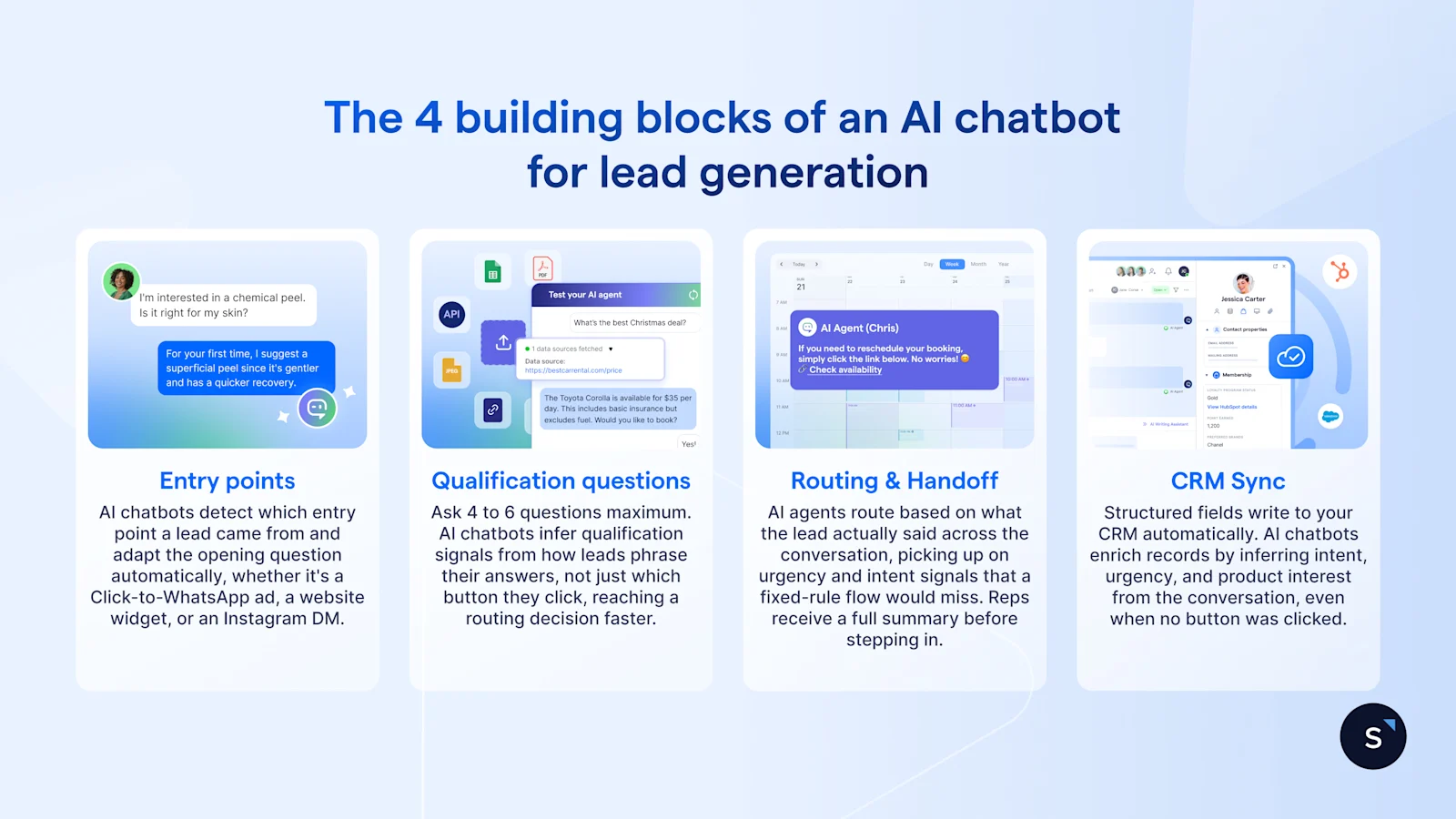
A well-built AI chatbot for lead generation has 4 components: entry points that match how people find you, qualification questions that get the right information without losing the lead, routing logic that connects the right leads to the right people quickly, and CRM sync that writes clean structured data from the start.
1. Entry points
Pick entry points that match how people actually discover you:
Click-to-WhatsApp or Click-to-Messenger ads
Instagram story link and DM keyword
QR codes in-store, on packaging, or at events
Email signature and “message us” CTA
Store the entry source (UTM or ad ID) as a field from the first message. You'll need it to understand which channels actually produce qualified leads, not just volume. AI chatbots go further by recognising which entry point a lead came from and adapting the opening question accordingly, without any manual setup per campaign.
2. Qualification questions
High-performing chatbots ask a few questions upfront, then progressively collect details once value is clear.
A simple rule:
First 1 - 2 messages: confirm intent and offer value
Next 2 - 4 messages: qualify (fit and urgency)
Then: capture details and route
Use question types that are easy to answer on mobile:
Buttons or quick replies
Short multiple-choice
One free-text question maximum before routing
Unlike a fixed flow, an AI chatbot reads how a lead phrases their answers to infer qualification signals, which means reaching a routing decision with fewer questions.
3. Routing and human handoff
Routing is where many “lead gen bots” fail. Great routing is:
Fast: no dead ends
Specific: routes by intent, language, country and region, product line, SLA tier
Context-rich: hands off with a summary so reps don’t ask the same questions again
AI agents take this further. Rather than routing based on which button a lead clicked, they route based on what the lead actually said across the whole conversation. They pick up on signals like urgency, hesitation, or high intent that a fixed-rule flow would miss. That means a lead who never clicked "Book a demo" but spent three messages asking detailed pricing questions can still be flagged as hot and routed accordingly.
Seeing the handoff in action makes this clearer than any diagram. This short video shows what happens when a lead has been chatting with the AI for 10 minutes and a human needs to take over, and why the summary the AI writes before stepping back is what stops the deal from going cold.
4. CRM sync and clean data capture
A lead gen chatbot should write structured fields to your CRM so sales teams can act immediately.
Minimum viable lead fields:
Name
Channel (WhatsApp, Instagram, web chat)
Intent (demo, quote, support, other)
Product interest
Country and language
Urgency and timeline
Email or phone number (depending on channel and consent)
Beyond storing explicit answers, AI chatbots infer intent, urgency, and product interest from the conversation itself, so CRM fields get populated even when a lead never clicks a button.
Lead generation chatbot templates
These templates follow the same structure: confirm intent early, qualify in 2 to 4 questions, capture contact details, and route. Adapt the quick replies and language for your market. In multilingual regions, add a language selection step before anything else.
Template 1: "Book a demo"
Goal: Turn pricing and demo inquiries into qualified meetings.
Flow:
Fields captured: role, company size, timeline, email, country, preferred follow-up channel.
Routing logic:
100+ users → enterprise sales queue, priority SLA
SMB → SMB sales queue
"Just researching" → nurture flow with resource link and optional follow-up consent
Template 2: “Get a quote” chatbot
Goal: Convert quote requests into booked calls.
Flow:
Routing logic:
Urgent and high budget → fastest queue + immediate human takeover
Low budget and “not sure” → automated guidance + schedule link
Template 3: “Product finder quiz” chatbot
Goal: Guide to the right product, then capture for follow-up.
Flow:
Routing logic:
"Talk to someone" → route to sales agents by category and language
"Ask a question" → route to product experts with quiz results attached
Template 4: “Branch or country routing” chatbot
Goal: Reduce misrouted leads and speed up local follow-up.
Flow:
Routing logic:
HK + CN + Demo → HK Sales CN queue
UK + EN + Partnership → Partnerships queue
What qualification questions should a lead generation chatbot ask?
Pick 4 to 6 questions from the bank below based on your sales motion. Fit questions establish whether the lead is a realistic customer. Urgency and authority questions tell you how to prioritize the handoff.
Fit questions
“Which industry are you in?”
“Which use case best fits?”
“Do you need WhatsApp, Instagram, web chat, or all channels?”
Value questions
“What outcome matters most?”
“What’s your current monthly inbound volume?”
Urgency questions
“When do you want to start?”
“Are you evaluating other tools?”
Authority questions
“Are you the decision maker?”
“Who else is involved?”
Practical routing questions
“Which country/time zone should we follow up in?”
“Preferred follow-up channel?”
How SleekFlow empowers AI chatbots for lead generation
SleekFlow is an AI suite for revenue-driving conversations across various channels, such as WhatsApp, Instagram, Messenger, web chat, and more. Its Flow Builder handles qualification logic, routing rules, and CRM sync without code, so the chatbot flows in this playbook can be built and adjusted by a sales or marketing team, not just a developer. Its AgentFlow product goes further, deploying AI agents that handle first contact, qualify leads, and route conversations to the right person 24/7. Here's what that looks like when it runs in practice.
1. Jubin Cantik replaces manual lead intake with SleekFlow's automated WhatsApp qualification
Jubin Cantik's sales team was managing WhatsApp, Instagram, and Facebook inquiries in three separate places. Agents had no unified view of incoming leads, attribution was entirely manual, and every new inquiry started with the same repetitive discovery questions.
With SleekFlow, Jubin Cantik ran Click-to-WhatsApp ads on Facebook and Instagram and used Flow Builder to automate the entire intake process. When a prospect tapped the ad, an automated greeting fired immediately, the contact was tagged with the campaign source, and the conversation was routed to the right sales agent before a human had to touch it. Leads who hadn't purchased were automatically flagged for follow-up.
As a result:
2,000+ qualified leads captured in just over a month
32% increase in team efficiency from eliminating manual handovers
Since implementing SleekFlow, our response time to customer inquiries has improved, and it has become easier for the sales team to assist with inquiries if the person in charge is on leave.

Hidayah Hisham
Head of Sales, Marketing and Supply Chain
2. HKBN re-engages inactive customers through SleekFlow's automated WhatsApp campaigns
HKBN's telesales operation was struggling. Customers had stopped answering calls from unknown numbers due to the rise in phone scams, and conversion rates were falling with no clear alternative channel.
With SleekFlow, HKBN set up separate verified WhatsApp accounts for Home Broadband, Mobile Service, and Promotions, so customers immediately recognised which part of the business was contacting them. Flow Builder automated outreach campaigns, routed engaged customers to agents for the close, and gave the team campaign-level analytics to measure what was working.
As a result:
95% message read rate
50% response rate
35% contract renewal success rate among re-engaged customers
SleekFlow stands out as a premier WhatsApp Business API provider in Hong Kong, offering comprehensive marketing and customer service solutions. Within a month, they enabled us to seamlessly integrate WhatsApp into our operations, fostering direct interaction with our customers.

Kenneth She
Chief Transformation Officer, Hong Kong Broadband Network
Most lead generation chatbots fail at the handoff, not the greeting. The qualification questions are easy. The part that actually drives the pipeline is getting the right lead to the right person fast, with enough context to skip the repetitive questions. If that's the problem you're solving, book a demo with SleekFlow to see how it handles end-to- end.
Want to outcompete your peers with SleekFlow's help?
Book your personalised demo with SleekFlow today and unlock the potential of seamless communication


