How to use ChatGPT with automation to boost work productivity


ChatGPT is becoming an invaluable tool for businesses aiming at incorporating AI technology and improving the overall productivity of the workplace. With its advanced abilities to create human-like responses, write codes, offer summaries or elaborations, and more, ChatGPT can be utilised by businesses to save time by automating mundane tasks and focusing on more important projects.
Curious about how ChatGPT for business can be used with automation? Read on.
What is ChatGPT?
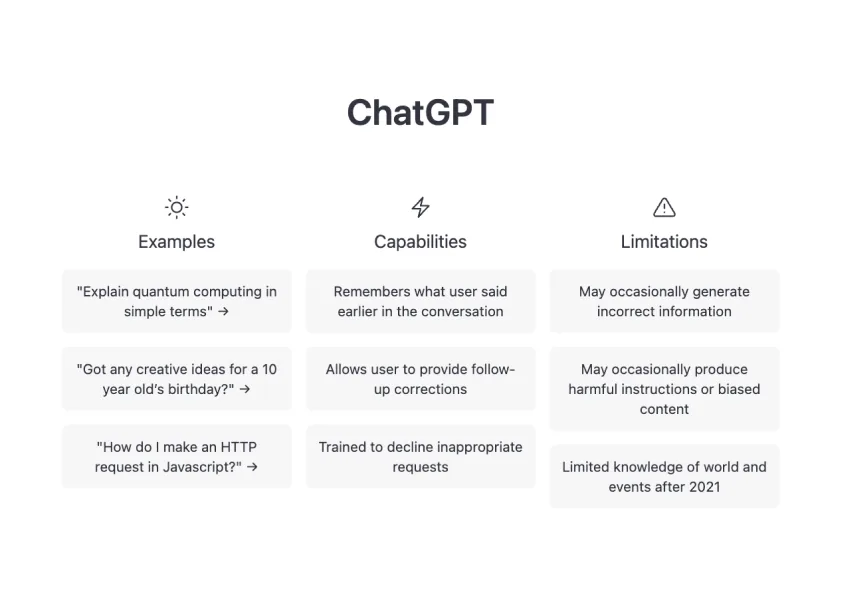
ChatGPT is an artificial intelligence (AI) tool that enables businesses to generate conversations with customers more quickly and efficiently. It is a natural language processing (NLP) tool that uses OpenAI's GPT-3 technology to generate text based on user input. With its smart capabilities and features that help businesses save time, resources, and money, ChatGPT achieved 100 million active users in just two months after being launched in November 2022.
How ChatGPT works
ChatGPT works by analyzing the input text and generating a response based on its understanding of the language. It is a language model trained on a large dataset of text from the internet using a technique called unsupervised learning, where the model learns to predict the next word in a sequence of text.
When given a prompt or question, ChatGPT generates a response by using its learned knowledge to predict the most likely continuation of the text. The response is generated by considering the input text along with the vast knowledge it has learned during its training. This is why it can be customized to fit specific business needs, such as responding to customer inquiries or providing product recommendations.
ChatGPT to ease the use of automation and increase business efficiency
Automation is no doubt a great helper for most businesses these days, especially when it comes to attending to an overwhelming volume of customer inquiries and providing the best responses to them. However, one of the common issues when it comes to setting up automation rules is the limitation of keyword triggers. For instance, using a wrong keyword or one that is too general for your automation can lead to messages being sent to the wrong customers and inappropriate conditions.
1. ChatGPT for conversational or AI chatbots

AI chatbots use Natural Language Processing (NLP) technology to understand and analyze human language and then generate an appropriate response. Unlike rule-based chatbots that are more commonly used by most businesses, an AI chatbot like ChatGPT breaks down the sentences or information received and interprets the context for better user interactions.
By using ChatGPT with automation, businesses can rely on chatbots with inquiries that are a little more complex based on its ability to:
Attend to various questions at once
Interpret customers’ intent even when there are typos
Understand and responds in multiple languages
2. ChatGPT for conversation labeling
With ChatGPT incorporated into customer engagement, it can be first used to interpret customer intention whenever inquiries come in. Once the query is identified as a specific category, the correct label can be automatically assigned to the active conversation.
Example of ChatGPT use cases: categorizing purchase requests, customer support, billing queries, and customer complaints
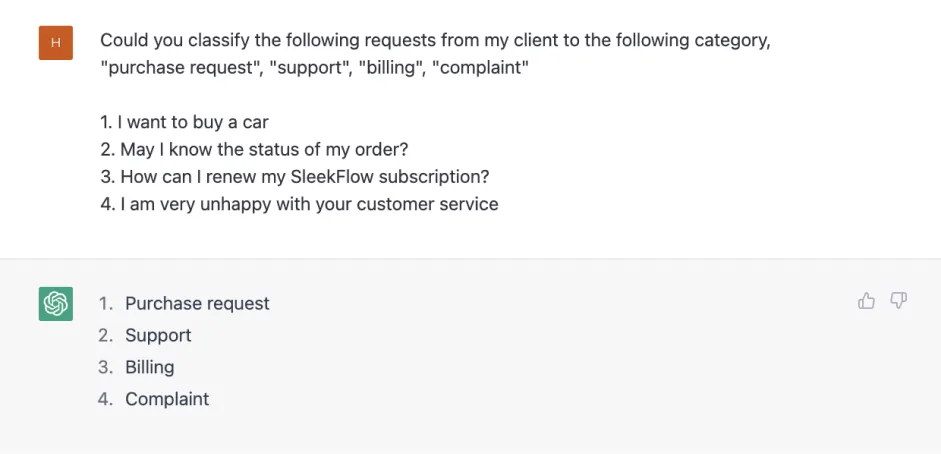
Purchase request: if a customer drops a message about a product that they’re interested in, the automated settings can combine the purchase requests into a list. Sales agents can quickly attend to this list of customer conversations.
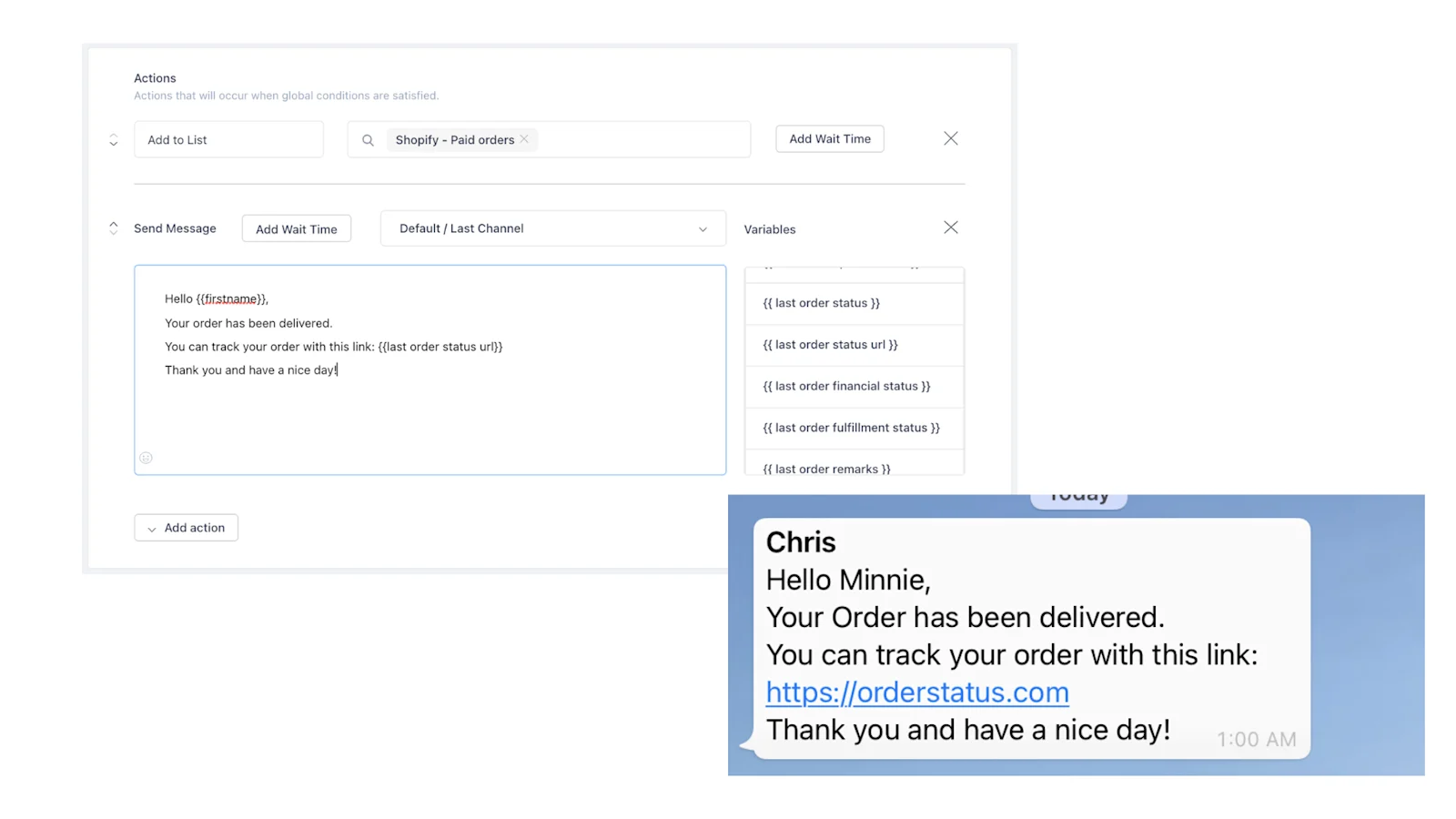
Support: most of the time, online customers will message a business to check for orders or shipping statuses. By grouping these conversations together using ChatGPT automation, you can send out order updates to customers all at once. Or even better, you can integrate messaging channels with your e-commerce store, such as Shopify, to see the progress of each customer’s order and their purchase history right next to the chatbox.
Billing: before customers change their minds about renewing subscriptions or memberships, assign your team members automatically so that they can act fast and provide billing support to your customers.
Complaint: angry or disappointed customers can cause detrimental damage to your brand reputation. Once ChatGPT automation identifies the customer’s intention to make a complaint, you can have these conversations labeled as a priority.
3. ChatGPT to improve chatbot-to-human handoff
When a customer requests to talk to a human agent or if the issues become too complicated for a chatbot to handle, your customer support team will need to take over the conversation. With the help of ChatGPT, a brief summary of the situation can be provided. Your customers will not need to repeat themselves, and your agents will be able to get a hold of what the customer needs without going through large chunks of messages.
64% of customer service agents managed to spend more time resolving difficult tasks with the help of AI chatbots. - Salesforce
How to start using ChatGPT for automation on SleekFlow
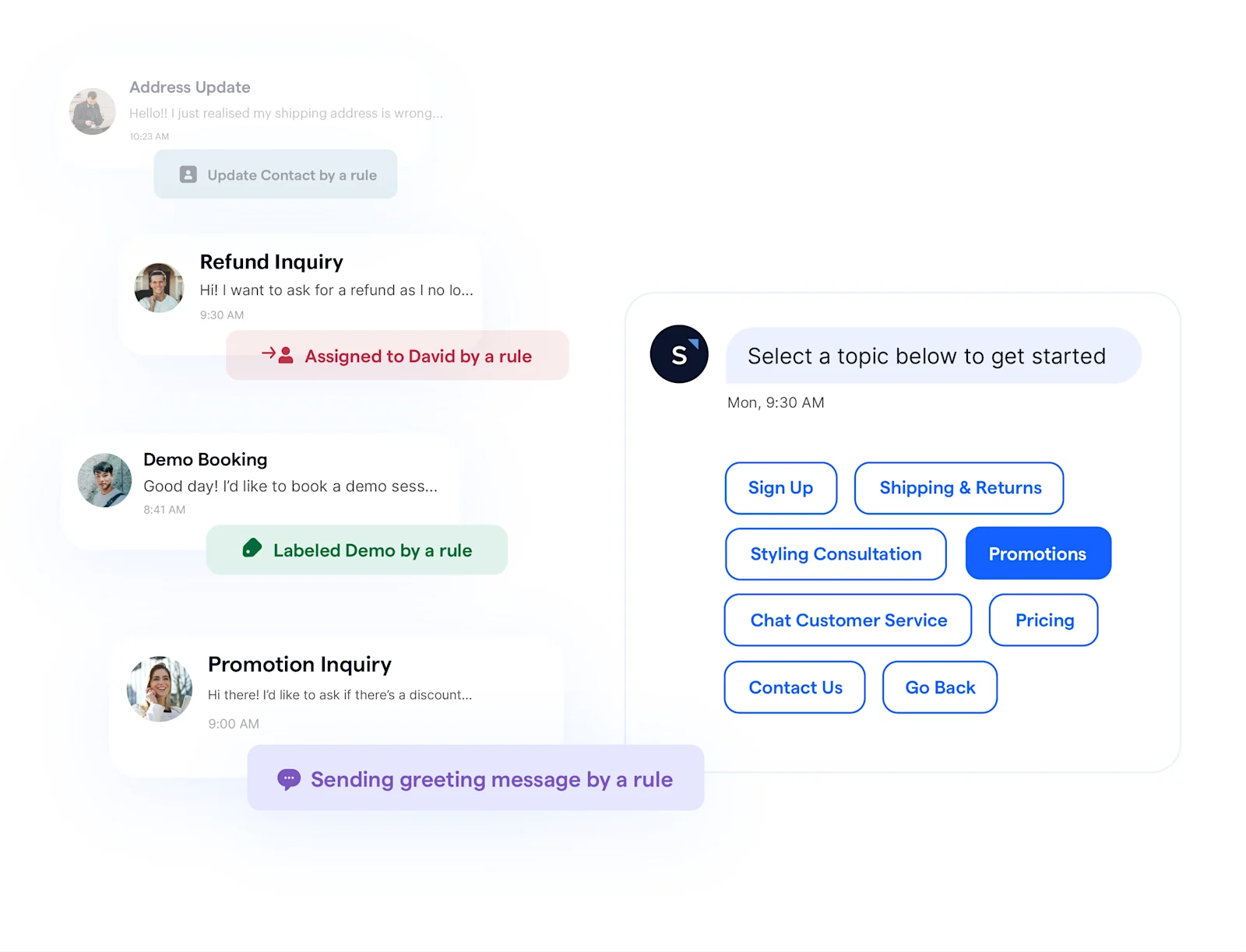
ChatGPT for business is an effective tool for managing automated conversations with customers using its AI capabilities to define customer intent. Since ChatGPT automation is great for helping companies quickly label incoming conversations, it can save plenty of time and money while improving customer satisfaction.
On SleekFlow, an omnichannel messaging platform with advanced automation available for setup, the ChatGPT integration make it even easier for businesses to automate sales, marketing, and customer support.
On SleekFlow’s intuitive interface, you can also:
Set automated replies for inquiries and automatically assign conversations to agents
Schedule and send personalized broadcast messages to customers at the right time
Install a free, no-code omnichannel live chat widget to attend to customers on their preferred messaging channels
We always go the extra mile for our customers and having the ability to personalize communications is super important. I’d recommend SleekFlow to other businesses, as it has given us the full picture across our retail channels. It eases the workflow, improves customer experience, and we’ve seen a good return.

Kate Kikano
FOUNDER OF TKD LINGERIE
No matter if you’re in the retail, or e-commerce industry, SleekFlow has tailored solutions for your business. Find out more about what you can do on SleekFlow to sell better and scale quicker from our success stories.
See SleekFlow AI in action
Discover how you can adopt Agentic AI for your business messaging with just a small amount of data and setup time.
Further reading:


