Customer feedback analysis: a practical guide for B2C brands


Your customers are talking. The question is whether you're listening.
A study by Harvard Business Review Analytic Services found that improving customer experiences (85%) and customer retention and loyalty (58%) are where real-time customer analytics are delivering the greatest business value today. Yet only 16% of brands consider themselves very effective at delivering real-time interactions across channels, meaning most are sitting on valuable feedback they're not fully acting on.
This guide walks you through everything you need to get started: what customer and market feedback actually means, what to collect, how to analyze it at scale, and the best customer feedback tools to begin with.
What is customer feedback analysis?
Customer feedback analysis is the process of collecting, organizing, and interpreting what customers say about your brand across every channel to identify patterns, uncover pain points, and make smarter business decisions.
It turns raw, unstructured input like reviews, survey responses, and chat conversations into clear signals your team can actually act on. Done well, customer feedback analysis tells you not just what customers are saying, but why and what to do about it.
What is customer feedback and market feedback?.
Customer feedback comes directly from people who have bought and used your product or service. It reflects real experiences: what worked, what didn't, and what they wish were different. This is your most grounded source of truth because it's based on actual interactions rather than assumptions.
Market feedback, on the other hand, is broader. It captures signals from your entire target market, including:
prospects who browsed but didn't buy
churned users,
people who've never heard of you but fit your ideal customer profile.
Think survey responses, social listening, competitor reviews, or search behavior. It tells you what the market wants, not just what your existing customers experience.
Both matter. Customer feedback helps you improve what you already offer. Market feedback reveals gaps you haven't addressed yet, and opportunities your competitors might be missing, too.
Types of customer feedback you should collect and why it matters
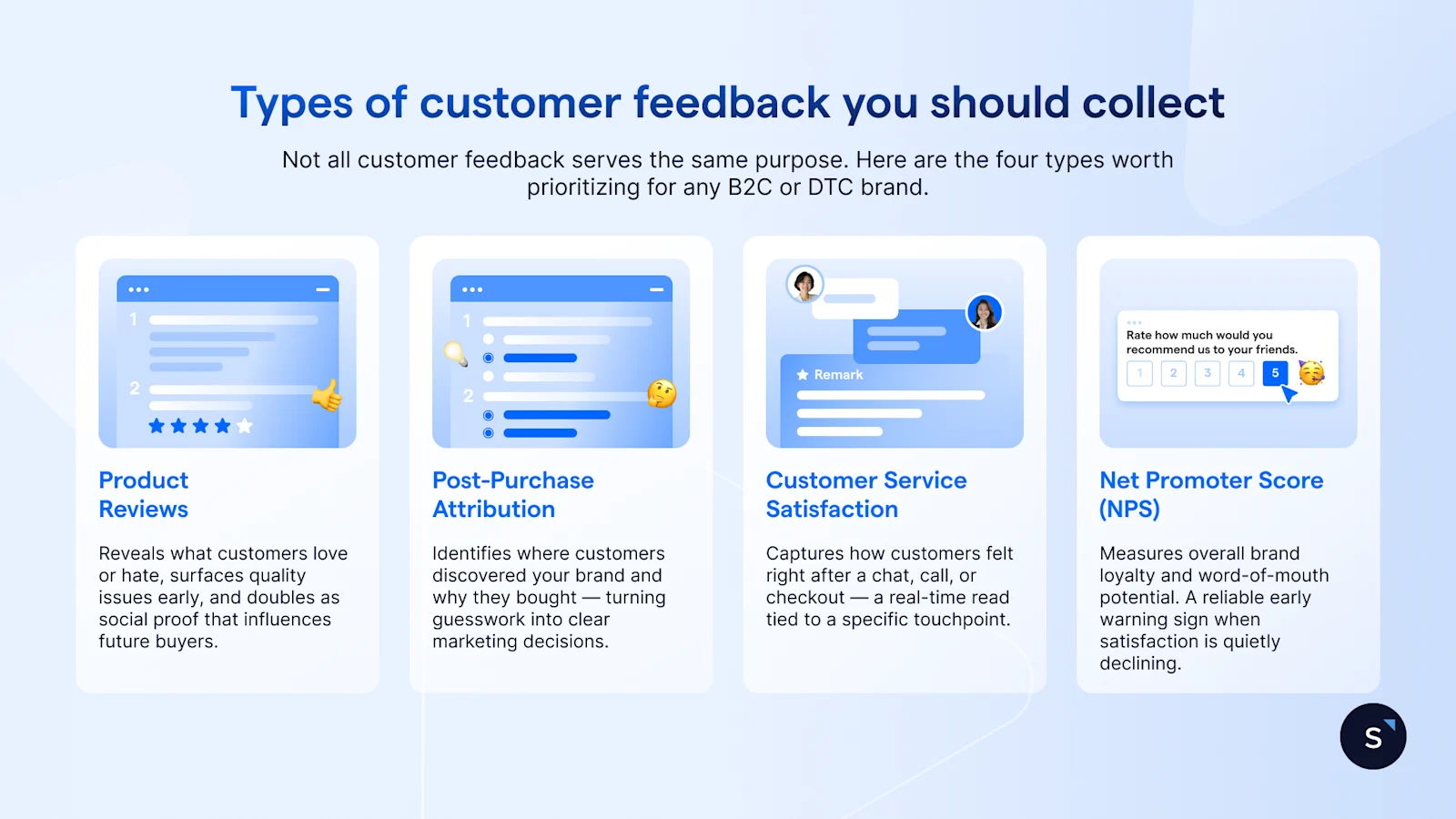
Not all customer feedback serves the same purpose. Here are the four types worth prioritizing.
Product reviews
Product reviews are your most direct signal on what's working and what isn't. They reveal what customers love or hate about specific products, surface quality issues early before they escalate into complaints, and double as social proof that influences whether the next shopper buys. A spike in negative reviews about sizing, for example, is a returns problem waiting to happen.
The stakes are high. Northwestern University found that the purchase likelihood for a product with five reviews is 270% greater than for a product with no reviews at all.
Post-purchase attribution
Post-purchase attribution tells you two things: where customers discovered your brand, and why they decided to buy. This is especially valuable for DTC brands trying to figure out which channels actually drive conversions, not just traffic. Without it, marketing spend decisions are mostly guesswork.
Customer service satisfaction (CSAT)
CSAT captures how customers felt right after an interaction, whether that's a chat conversation, a phone call, or an in-store checkout. It's a real-time read on your support quality, and because it's tied to a specific touchpoint, it's much easier to act on than general brand sentiment.
According to Microsoft's Global State of Customer Service report, 89% of consumers want to provide feedback to the brands they interact with. The demand to be heard is already there, you just need a system to capture it.
Net Promoter Score (NPS)
NPS takes a step back from individual interactions and asks the bigger question: would your customers recommend you to someone else? It's a reliable indicator of overall brand loyalty and word-of-mouth potential. When tracked over time, a useful early warning sign if satisfaction is quietly declining.
Types of market feedback you should collect and why it matters
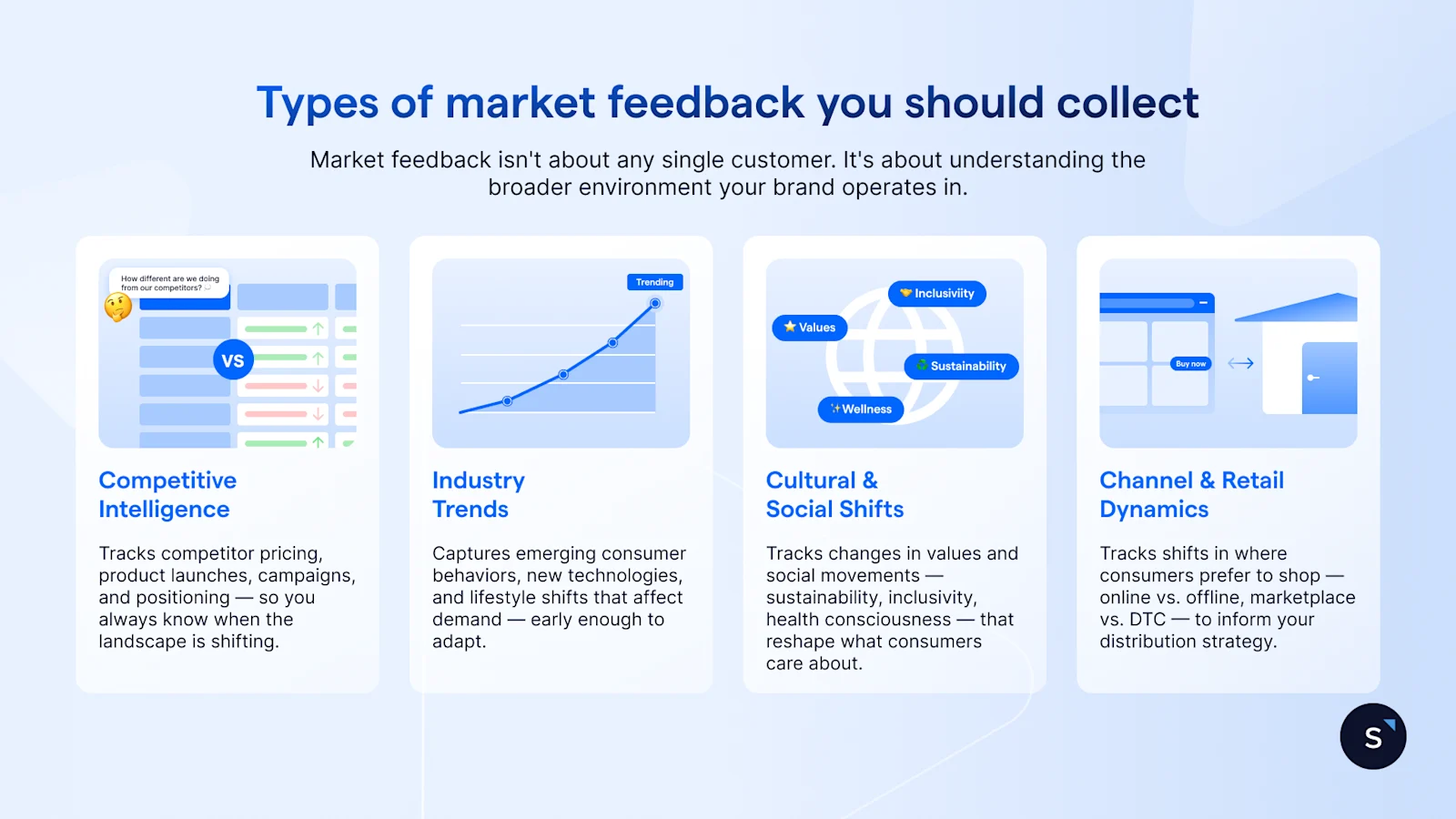
Market feedback isn't about any single customer. It's about understanding the broader environment in which your brand operates.
Competitive intelligence
Competitive intelligence covers what your competitors are doing, e.g., their pricing changes, new product launches, campaigns, and how they're positioning themselves. You don't need to copy them, but you do need to know when the landscape is shifting around you. A competitor dropping prices or launching in a new category affects your customers' expectations, whether or not you respond.
Industry trends
Industry trends capture emerging consumer behaviors, new technologies, or lifestyle shifts that affect demand. Think of the rise of "buy now, pay later" in retail, or the growing preference for personalized shopping experiences. These trends rarely appear overnight; tracking them early gives you time to adapt before they become mainstream.
Cultural and social shifts
Cultural and social shifts go deeper than trends. Changes in values, demographics, or social movements can fundamentally reshape what consumers care about. Sustainability, inclusivity, and health consciousness aren't passing fads, they're purchase criteria for many shoppers. Brands that miss these shifts don't just lose relevance; they lose trust.
Channel and retail dynamics
Channel and retail dynamics track where consumers prefer to shop, e.g., online vs. offline, marketplaces vs. DTC, social commerce vs. branded storefronts. Distribution preferences shift faster than most brands expect. Understanding where your market is moving helps you meet customers where they are, not where they used to be.
Customer feedback analysis methods: how to collect and analyze at scale
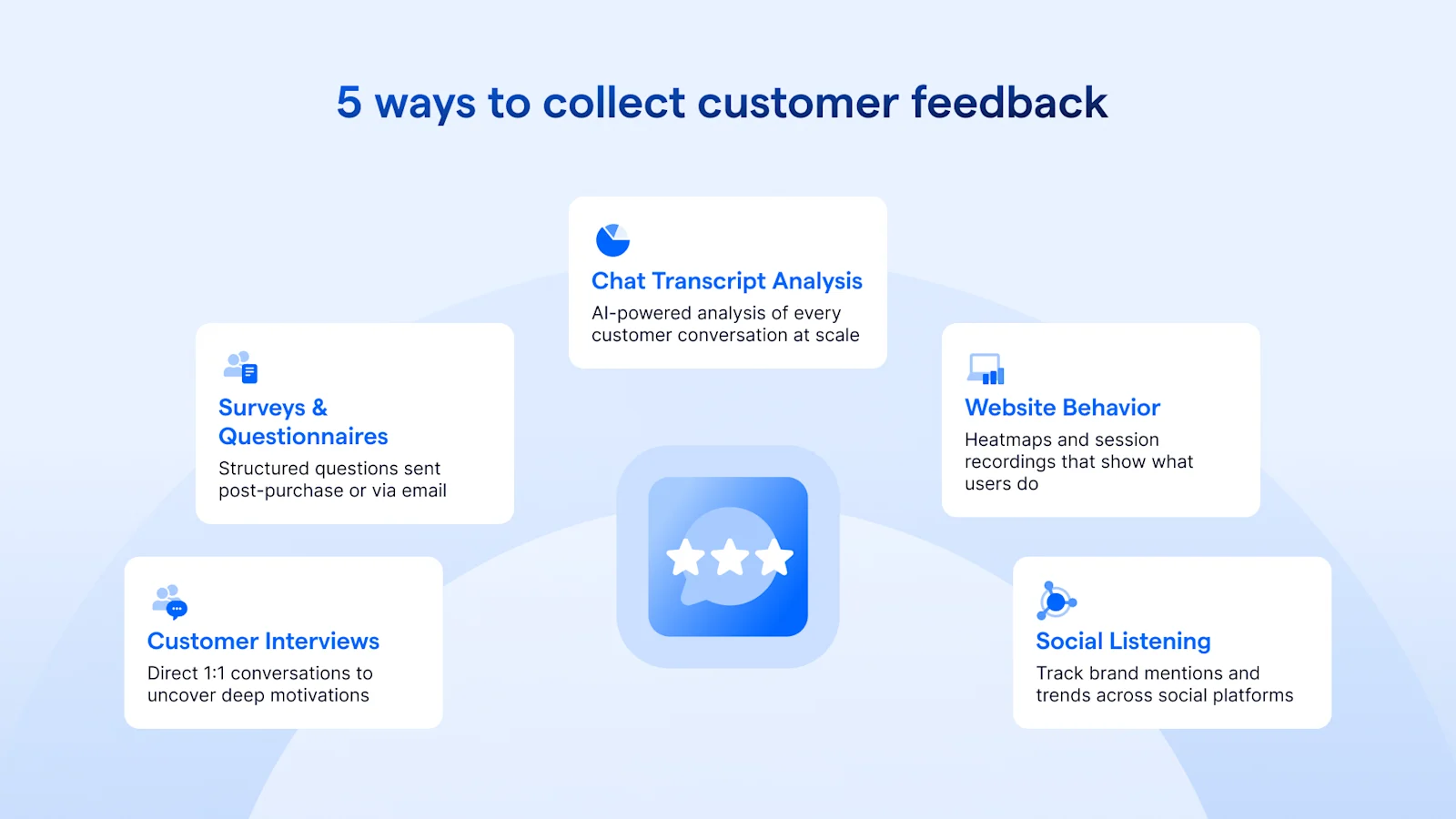
Customer interviews and focus groups
The oldest method — and still one of the most revealing. Interviews and focus groups give you direct, unfiltered access to how customers think and feel about your brand.
Pros:
Rich, qualitative insights you can't get from a customer feedback survey
Let you probe deeper when an unexpected answer comes up
Great for understanding the "why" behind behaviors
Cons:
Time-consuming to recruit, run, and analyze
Hard to scale, you can realistically only speak to a small sample
Responses can be influenced by social desirability (people say what sounds good, not what's true)
Best used when you're exploring a new product direction or trying to understand a specific customer segment in depth.
Surveys and questionnaires
A customer feedback surve is the most common feedback method for a reason. They're structured, scalable, and easy to deploy. Post-purchase email surveys sent after a transaction are particularly effective for B2C brands because the experience is still fresh.
Pros:
Easy to send at scale across your entire customer base
Quantifiable results are easy to track over time
Can be automated and triggered by specific actions (purchase, support ticket closed, etc.)
Cons:
Response rates are typically low, 5%–30% is considered acceptable
Closed-ended questions can miss nuance
Survey fatigue is real; over-surveying customers backfires
Website behavior analysis
For e-commerce brands, how customers behave on your site is feedback in itself. Heatmaps, session recordings, exit-intent data, and funnel drop-off reports all tell you where friction exists without asking a single question.
Pros:
Captures what customers actually do, not just what they say
Always-on — no active collection effort needed
Pinpoints specific pages or steps causing drop-off
Cons:
Tells you where the problem is, but rarely why
Requires additional tools and some technical setup
Privacy regulations (GDPR, PDPA) limit what you can track
Social listening and monitoring
Social listening means tracking mentions of your brand, competitors, and relevant keywords across social media platforms, forums, and review sites, even when customers don't tag you directly.
Pros:
Captures unsolicited, unfiltered opinions
Early warning system for emerging issues or viral moments
Useful for competitive intelligence and trend spotting
Cons:
High volume of noise to filter through
Sentiment analysis tools aren't always accurate, especially with sarcasm or slang
Harder to tie insights back to specific customer segments
Customer service and live chat transcript analysis
Every support conversation your team has is a data point. Analyzing chat transcripts and call logs at scale reveals recurring complaints, product confusion, and unmet needs, often before they appear elsewhere.
Pros:
Feedback is unprompted and highly specific
Reflects real pain points, not curated survey responses
Chat transcripts are already being generated, no extra collection effort needed
Cons:
Raw transcripts are messy and unstructured
Manual review doesn't scale; you need AI or tagging tools to process volume
Insights may be skewed toward customers who had a problem, not satisfied ones
How to do customer feedback analysis: a step-by-step process
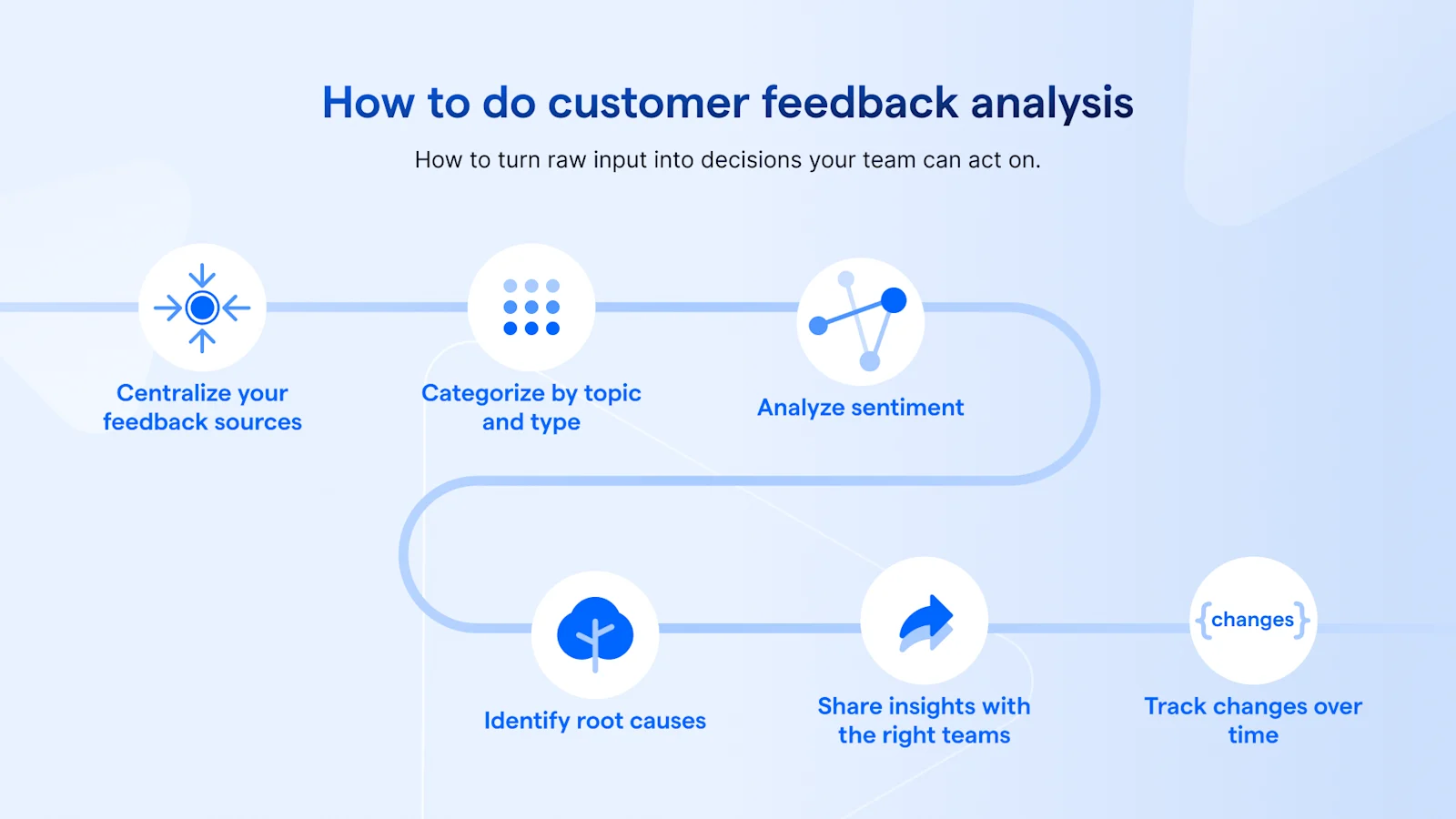
Step 1: Centralize your feedback sources
Before you can analyze anything, you need everything in one place. Pull together feedback from your review platforms, survey tools, support chat logs, and social channels. Scattered data leads to incomplete analysis — patterns emerge only when you look at the full picture.
Step 2: Categorize by topic and type
Group feedback into themes such as product quality, shipping, customer service, pricing, and so on. This can be done manually with tags or automatically using AI tools. The goal is to move from individual comments to patterns — not "one customer complained about sizing" but "sizing complaints have increased 40% this month."
Step 3: Analyze sentiment
Once feedback is categorized, layer in sentiment. Is the tone positive, negative, or neutral? Sentiment analysis helps you prioritize. A high volume of neutral feedback on a topic is very different from a high volume of negative feedback on the same topic. Most modern feedback tools handle this automatically.
Step 4: Identify root causes
Don't stop at the symptom. If CSAT scores drop after a specific product launch, dig into the transcripts and reviews to understand why. The most valuable output of customer feedback analysis isn't a report but a root cause you can actually fix.
Step 5: Share insights with the right teams
Feedback about product quality belongs with your product team. Feedback about checkout friction belongs with your e-commerce team. Feedback about response times belongs with support. Analysis only creates value when it reaches the people who can act on it.
Step 6: Track changes over time
Run your analysis consistently, weekly, monthly, or quarterly, depending on your volume. The real signal isn't a single snapshot; it's the trend. Are complaints about a specific issue increasing or decreasing after you made a change? That's how you close the loop.
Best customer feedback tools for B2C brands
The right customer feedback tools depend on where your feedback lives. Here are four worth starting with.
SurveyMonkey — Best for post-purchase email surveys
SurveyMonkey is the go-to platform for building and sending customer feedback surveys at scale. It's easy to set up, integrates with most e-commerce and email platforms, and lets you build structured feedback collection without any technical heavy lifting.
Use cases:
Trigger post-purchase satisfaction surveys automatically after a transaction
Send NPS surveys to customers after a set number of days post-purchase to measure loyalty over time
Collect onboarding feedback from first-time buyers to understand their early experience
Test product concepts or new campaign messaging before a full launch
SurveyMonkey’s free plan caps responses at 25 per survey, which won't cut it once your order volume grows. You'll likely need a paid plan to get meaningful sample sizes at scale.
Hotjar — Best for website behavior analysis
Hotjar shows you how visitors actually behave on your site, where they click, where they scroll, and where they leave. For e-commerce brands, it turns anonymous traffic into actionable insight without needing a data analyst to interpret it.
Use cases:
Identify why a product page has high traffic but low add-to-cart rates
Spot friction in your checkout flow by watching real session recordings
Test how customers navigate a new homepage layout or menu structure
Trigger exit-intent surveys when someone leaves without completing a purchase to understand why
Worth knowing: Hotjar is most valuable when you already have consistent traffic. If you're still in the early growth stage, you won't have enough sessions to spot meaningful patterns.
Hootsuite — Best for social listening and monitoring
Hootsuite brings social media scheduling, analytics, and social listening into a single dashboard. For B2C brands, its listening capability is what makes it useful for feedback analysis. Hootsuite lets you monitor brand mentions, discover sentiment behind specific topics, and track trends across platforms, all without jumping between tools.
Use cases:
Monitor how the market reacts to a competitor's new product launch or pricing change in real time
Track brand sentiment as a campaign rolls out and catch negative reactions early
Spot emerging trends in your category before they peak using AI topic summaries
Identify early signs of a brand crisis through automated mention alerts
Worth knowing: Hootsuite’s paid plans start at $199/month. That said, they offer a 30-day free trial, which is enough to run a focused listening sprint or evaluate whether it fits your stack before committing.
SleekFlow — Best for chat transcript analysis and WhatsApp surveys
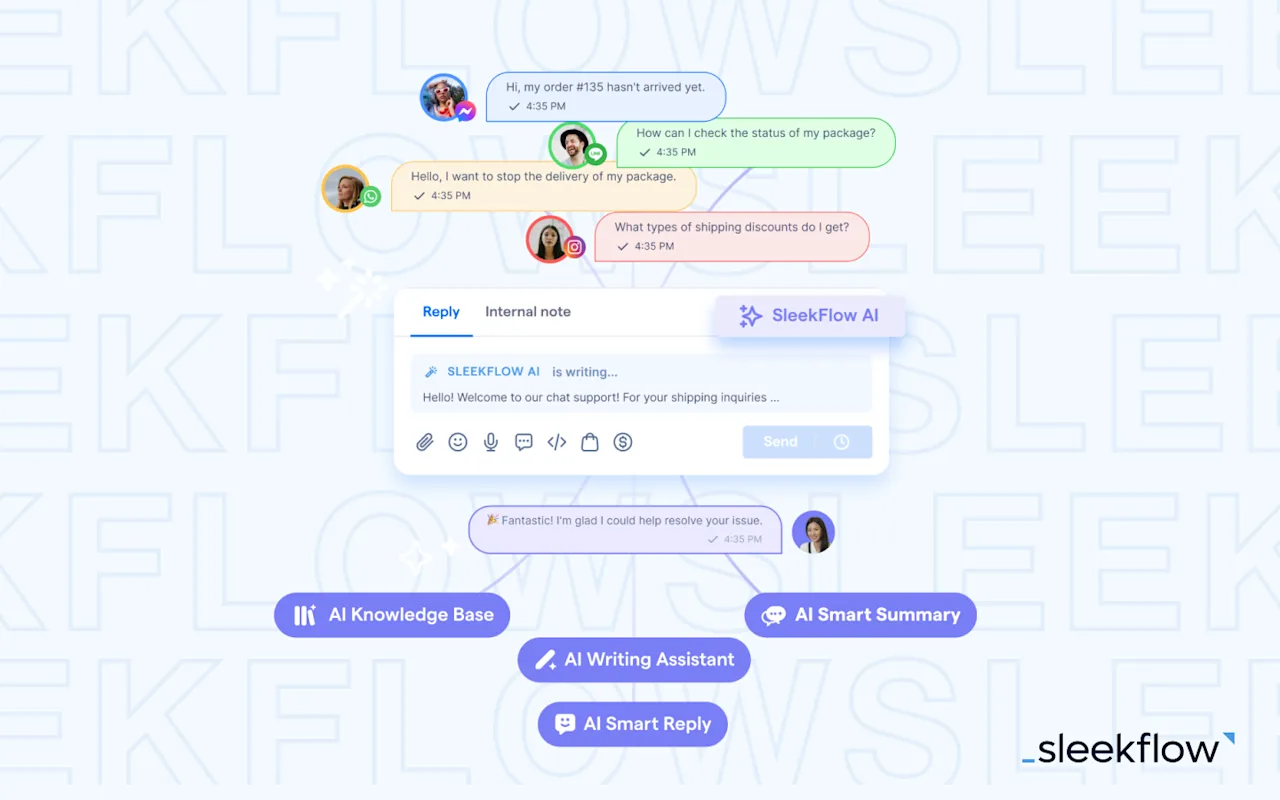
SleekFlow centralizes customer conversations across WhatsApp, Instagram, Facebook Messenger, and live chat into a single inbox, making it one of the most practical tools for B2C brands that use messaging to interact with customers.
Where it goes beyond a typical chat tool is Customer Experience Intelligence. It is an AI functionality that automatically analyzes every conversation to surface topic trends, sentiment, and growth opportunities your team would never catch by manually scrolling through transcripts or tagging chats by hand. Specifically, it:
Discover hot topics automatically: Detect recurring themes across all your conversations, track their volume over time, and flag what's trending before it becomes a problem
Goes deep on each topic: Break down agent performance, customer sentiment, and root causes tied to specific issues, so you know not just what customers are talking about, but why
Let you trace insights back to the source: Click into any topic to see every relevant conversation, then open individual chats to read exactly what customers said in their own words.
SleekFlow also natively supports WhatsApp Flows, interactive forms, and surveys sent directly inside WhatsApp conversations. This means you can trigger post-purchase NPS surveys, collect product feedback, or run CSAT checks without ever asking customers to leave the chat. For brands whose customers are already active on WhatsApp, response rates are significantly higher than those of email surveys.
Worth knowing: SleekFlow is most impactful for brands that already use chat as a primary customer touchpoint. If most of your customer interactions happen via email or phone, you'll get less out of the transcript analysis.
Want to see how SleekFlow can enhance your sales process?
Book a demo today and experience the power of AI-driven conversational intelligence firsthand.


