AI powered CRM: definition, benefits and trends for Singapore businesses


TL; DR: Quick Summary
An AI-powered CRM helps Singapore businesses do more than store customer data. It uses AI to prioritise leads, automate follow-ups, suggest replies, route enquiries, and surface insights in real time.
The main benefits are faster response times, less manual admin, better lead qualification, more consistent service, and smarter decision-making.
AI-powered CRMs are most valuable for teams dealing with high chat volume, repetitive enquiries, disconnected tools, or unclear sales priorities.
The best AI CRM is not just the one with flashy AI features, but the one with strong customer context, grounded responses, workflow automation, and proper governance.
The bigger trend is that CRMs are shifting from passive databases to active systems that help teams decide what to do next.
Singapore businesses are moving quickly on AI, but adoption alone is not the goal. The real question is whether your systems can turn customer data into faster replies, smarter follow-ups, and better decisions. That matters even more in a market where digital and social usage is high: there are 5.16 million active social media user identities in Singapore, which is equivalent to 88.2% of the population. On the business front IMDA says SME AI adoption in Singapore rose from 4.2% in 2023 to 14.5% in 2024, while non-SME adoption reached 62.5%.
For many teams, that is where an AI-powered CRM becomes valuable. It helps you manage customer conversations, predict intent, automate repetitive work, and keep service quality consistent across channels such as WhatsApp, Instagram, and live chat.
What is an AI CRM?
An AI CRM is a customer relationship management system that uses artificial intelligence to automate tasks, generate insights, and personalise customer interactions in real time. Unlike a standard CRM that mainly stores and organises records, a CRM with AI helps teams decide what to do next, whether that means scoring a lead, drafting a reply, routing a conversation, or forecasting revenue.
For Singapore businesses with messaging-heavy funnels, this also overlaps with conversational CRM. SleekFlow’s WhatsApp CRM connects chat activity with customer context and built-in AI, instead of treating conversations as a separate tool.
How to know if you need CRM with AI for your business
You probably need an AI-powered CRM if any of these sound familiar:


Your team is handling too many repetitive conversations
If staff spend hours answering the same questions, copying data into spreadsheets, or manually tagging leads, AI can reduce that admin load and keep response quality stable.
Your leads arrive in chat, but your CRM is built for email
Many Singapore businesses now generate demand through WhatsApp, social DMs, web chat, and click-to-chat ads. If your current CRM does not capture those journeys well, you lose context and speed. WhatsApp Flows is one example of how conversational journeys can move beyond basic chat into structured lead capture.
Your sales team does not know which lead to prioritise
AI lead scoring, intent detection, and conversation summaries help teams focus on the opportunities most likely to convert, while AI continues to nurture prospects who aren’t ready.
Your service quality depends too much on individual agents
A good AI CRM software layer can suggest responses, surface knowledge, and route issues to the right person faster, which is especially useful for onboarding new staff and managing after-hours demand.
Key features you need

Not every platform that includes AI qualifies as a strong AI powered CRM. The most valuable tools combine automation, context, and governance in ways that improve day-to-day operations rather than simply adding AI as a surface feature.
Unified customer data
AI is only effective when it works from a complete and reliable customer context. A strong AI powered CRM should bring together conversation history, contact details, purchase records, support interactions, and lead status in one place. Without that foundation, AI recommendations are more likely to be inconsistent or incomplete.
Grounded AI responses
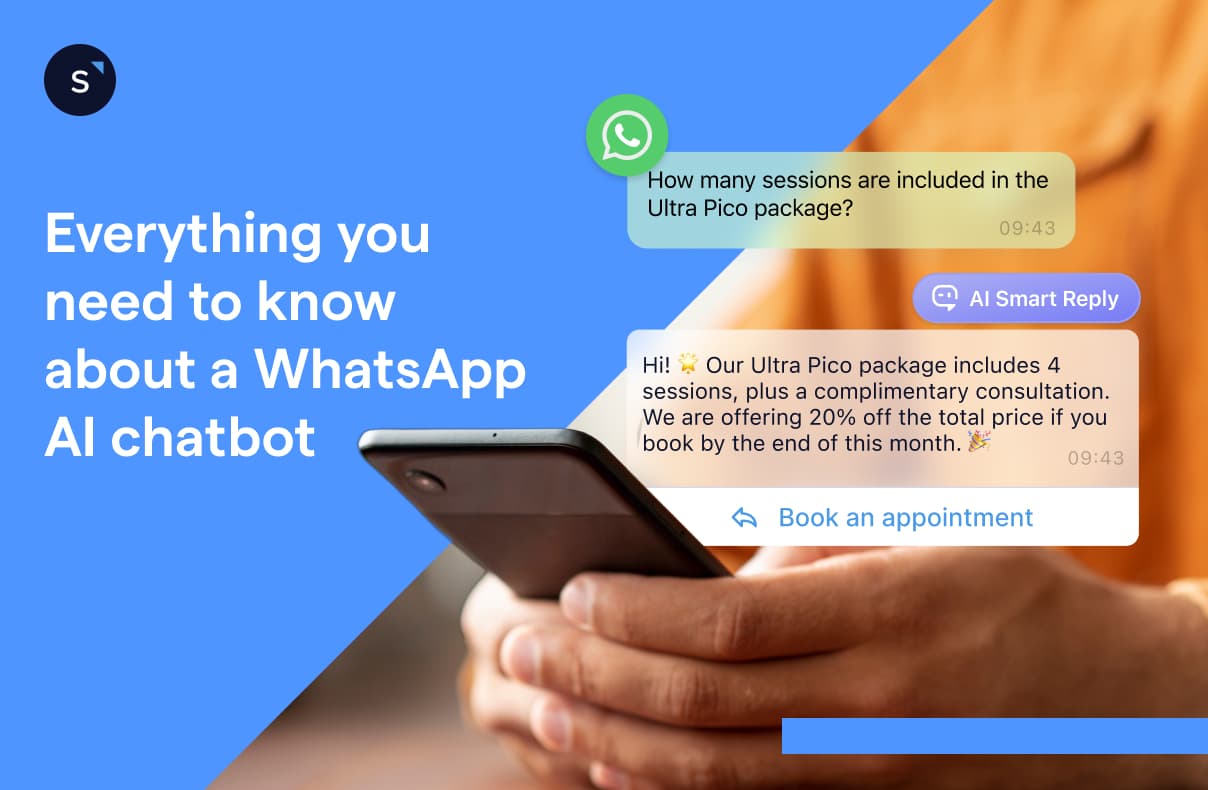
The best systems do more than generate text. They draw on approved knowledge sources so responses reflect current product information, policies, and internal guidance. That matters especially for teams handling customer enquiries at scale, where consistency and accuracy are more important than speed alone. Features such as AI Smart Reply show how this can work in practice when AI is grounded in business-specific information.
Smart routing and lead qualification
A useful CRM with AI should help teams understand what each conversation needs next. This includes identifying intent, urgency, customer stage, or enquiry type, then routing leads or tickets to the right person or workflow. In many cases, this has more impact on performance than generative features alone.
Workflow automation
Automation remains one of the most practical benefits of an AI powered CRM. The platform should be able to trigger follow-ups, reminders, record updates, task creation, and alerts with minimal manual work. It is also important to connect these workflows to performance tracking, so teams can measure whether automation is actually improving conversion, response times, or service quality. Tools such as analytics dashboards can support that visibility.
Security, permissions, and auditability
For businesses in Singapore, governance should be built into the system from the start. Look for role-based access, approval controls, audit trails, and clear handling of customer consent. Teams also need to consider local compliance requirements, including Singapore’s PDPA and Do Not Call rules, particularly when AI is used in outbound communication or customer data processing.
5 best AI powered CRM software for your business
There is no single best AI powered CRM for every company. The right choice depends on how your team sells, which channels drive the most conversations, and whether you need a traditional sales CRM, a service-led platform, or a more messaging-first setup.
type: embedded-entry-inline id: 7Ictk84fCbAJVWNNW4Jn1C
1. SleekFlow
SleekFlow is the strongest fit for businesses that manage sales, support, and customer engagement across messaging channels. Its platform brings together WhatsApp, Instagram, SMS, live chat, AI agents, CRM automations, and shared conversation history in one workspace, which makes it particularly useful for teams that run on chat rather than email-first sales processes.
SleekFlow is the most relevant choice for companies that want a more conversational approach to CRM, especially when lead qualification, follow-up, and support occur within messaging apps. For teams prioritising omnichannel messaging and AI-assisted engagement, it is the most differentiated option on this list.
2. HubSpot
HubSpot is one of the most accessible mainstream options for businesses that want an AI powered CRM without the complexity of a heavy enterprise rollout. HubSpot positions its Smart CRM as a unified system for customer data, teams, and tools, with Breeze AI features designed to support more personalised experiences and streamline day-to-day work across sales, marketing, and service.
It is often a strong choice for SMEs and mid-market teams that value ease of use, strong marketing alignment, and relatively fast adoption. The main trade-off is that while HubSpot is broad and user-friendly, businesses with more specialised messaging or operational requirements may still need additional layers or integrations.
3. Salesforce
Salesforce remains one of the strongest choices for large organisations that need a deeply configurable CRM with mature AI capabilities. Salesforce positions itself as an AI CRM built around data, apps, and agents, with Einstein and Agentforce supporting predictive insights, generated content, automation, and cross-functional workflows across sales, service, and marketing.
It is best suited to enterprises with complex processes, larger teams, and the resources to manage implementation well. Compared with lighter platforms, Salesforce offers more depth, but that usually comes with more setup, admin overhead, and cost.
4. Zoho CRM
Zoho CRM is a practical option for businesses that want a more traditional CRM with built-in AI but without enterprise-level complexity. Zoho’s AI layer, Zia, is designed to support automation, predictions, summaries, content generation, and custom AI use cases inside the CRM, while the wider Zoho ecosystem makes it attractive for companies that want multiple business tools under one umbrella.
It is generally a good fit for cost-conscious teams that still want strong functionality and room to scale. Its strength is breadth and value, though businesses with highly advanced enterprise requirements may still find Salesforce more robust.
5. Pipedrive
Pipedrive is a strong choice for sales-led businesses that want a simpler CRM with practical AI features. The platform highlights AI tools for deal management, workflow support, automation, and performance improvement, all within a sales pipeline structure that is easier to navigate than many enterprise CRMs. It also emphasises a large integration ecosystem and a relatively low-friction rollout.
Pipedrive is best for teams that want to improve sales execution without adopting a heavier all-in-one platform. It is less suited to businesses that need deep service, marketing, or omnichannel messaging capabilities in the same system.
AI trends in the CRM market
The CRM market is shifting from systems of record to systems of action. AI is no longer being added as a standalone feature. It is being built into how teams qualify leads, answer questions, prioritise accounts, and decide what to do next.
AI copilots are becoming a baseline feature
AI copilots are becoming a core part of modern CRM platforms. Rather than sitting outside the workflow, they now help teams summarise records, draft replies, surface customer context, and recommend next steps as work happens. This makes CRM systems more useful in day-to-day execution, not just reporting.
AI agents are moving from support to revenue workflows
AI in CRM is no longer limited to handling service queries. It is increasingly being used in lead qualification, follow-up, forecasting, pipeline support, and post-sales engagement. That shift matters because businesses now expect AI to contribute to growth, not just efficiency.
Messaging-first CRM is becoming more valuable
As more customer interactions happen on chat and social channels, CRM platforms are being pushed to support messaging-led journeys more effectively. Omnichannel conversation history, real-time routing, and structured lead capture are becoming more important, especially for businesses that rely on fast, personalised engagement. For brands with chat-led customer journeys, this is where a more conversational setup such as WhatsApp CRM or omnichannel customer engagement becomes more relevant than a purely email-first system.
Governance is becoming a buying criterion
As AI becomes more embedded in customer-facing workflows, buyers are paying closer attention to data quality, permissions, auditability, and response accuracy. Strong AI features are no longer enough on their own. Businesses also want to know that the platform can support compliance, internal controls, and reliable outputs at scale with clear data protection requirements such as Singapore’s PDPA.
Choose an AI CRM that improves decisions, not just efficiency
A good buying decision starts with one question: where is customer momentum being lost today? If leads go cold because follow-up is too slow, if service quality drops when volume spikes, or if teams work across disconnected tools, the right AI powered CRM should solve those gaps directly.
For businesses that manage customer relationships across WhatsApp, social messaging, and live chat, a more conversational CRM approach can be more effective than relying on a traditional, email-first system. SleekFlow can also complement broader CRM platforms such as HubSpot and Salesforce, allowing businesses to strengthen messaging-led engagement without losing the value of their existing sales and customer data infrastructure. The real value of AI is not simply automating tasks. It is giving teams the context and speed to turn more conversations into revenue, retention, and better customer experiences.

Want to see how SleekFlow can enhance your sales process?
Book a demo today and experience the power of AI-driven conversational intelligence firsthand.
Frequently Asked Questions
Share Article