Create AI WhatsApp Chatbot for Business


TL; DR: Quick Summary
- WhatsApp’s 98% open rate makes it a powerful channel for scalable, real-time customer engagement through chatbots.
- To build one without coding, apply for WhatsApp Business API via an official provider, then use a no-code platform like SleekFlow to design flows, automate replies, and integrate CRM.
- Plan FAQ flows, enable human handover, test before launch, and continuously optimize using analytics and conversion tracking.
- Chatbots provide 24/7 support, personalized messaging, marketing automation, multilingual communication, and can handle up to 79% of routine queries.
- Real cases show strong results: higher conversions, improved efficiency, faster response times, and better-qualified leads through automated workflows.
Providing exceptional customer service is essential for any brand looking to grow. WhatsApp has a 98% open rate, making it one of the most effective platforms for customer communication. To capitalize on this, businesses are turning to WhatsApp chatbots to:
Handle conversations at scale
Respond faster
Improve customer satisfaction
In this guide, you’ll learn how to build a WhatsApp chatbot and why you should start looking to create one.
How to set up a WhatsApp chatbot for your business without coding?
Setting up a WhatsApp chatbot for your business is straightforward and requires no coding. Here’s how you can build a WhatsApp bot for your business that will automatically respond to WhatsApp messages from your customers.
Step 1: Apply for WhatsApp Business API through a WhatsApp Business Solution Provider
To create a WhatsApp chatbot, you will need access to the WhatsApp Business API. Choose an official WhatsApp Business Solution Provider, such as SleekFlow, to help you with your application.
With an official WhatsApp Business API provider like SleekFlow, you get access to essential features like:
Verified badge eligibility: Subject to Meta’s review, a verified badge can help customers recognise your business as an official presence.
Official business name display: Your company name appears even if the contact hasn't saved your number.
Reliable performance: Get uninterrupted access and more advanced chatbot functionalities.
To apply for WhatsApp API, you’ll need to provide:
Your company name
Website URL
Contact details of a company representative
The verification process can take up to four weeks, depending on Meta's review timeline. During this period, your business information will be validated to ensure compliance with WhatsApp's policies. For the complete process, read this step-by-step guide on how to apply for WhatsApp Business API.
Step 2: Set up your chatbot on a no-code platform
Building an auto-reply WhatsApp chatbot from scratch can be overwhelming, especially for inexperienced users. It's best to use a no-code platform like SleekFlow to simplify the process and avoid unnecessary roadblocks.
With SleekFlow, you can:
Automate marketing drip campaigns, conversation routing, and data collection using a visual flow builder.
Customize quick replies, call-to-actions, and opt-in buttons directly within WhatsApp chat threads.
Streamline customer interactions by automating responses while allowing human intervention when needed.
Even without programming skills, you can create a structured and seamless chatbot experience for your customers. While automation is the ultimate goal, with SleekFlow’s AI agent you can:
Auto-qualify leads based on budget/timeline
Route conversations to the right team
Collect data while answering questions
Track conversion rates in real-time
How Pest Killer boosted conversions with SleekFlow's WhatsApp chatbots
Pest Killer, an environmental services provider in Hong Kong, was struggling with operational inefficiencies as it expanded.
The company relied on manual data entry causing slow response times. There was also a disconnect between office staff and field technicians, which further delayed services.
They used the SleekFlow's WhatsApp API to create chatbots for 24/7 instant responses. They also integrated a unified inbox gave field staff direct access to customer information.
Conversion rates increased by 16% by eliminating response delays.
Overall operational efficiency improved by 23%.
Service delivery time was reduced by 22%.
Step 3: Visualize & plan the dialogues in your flows
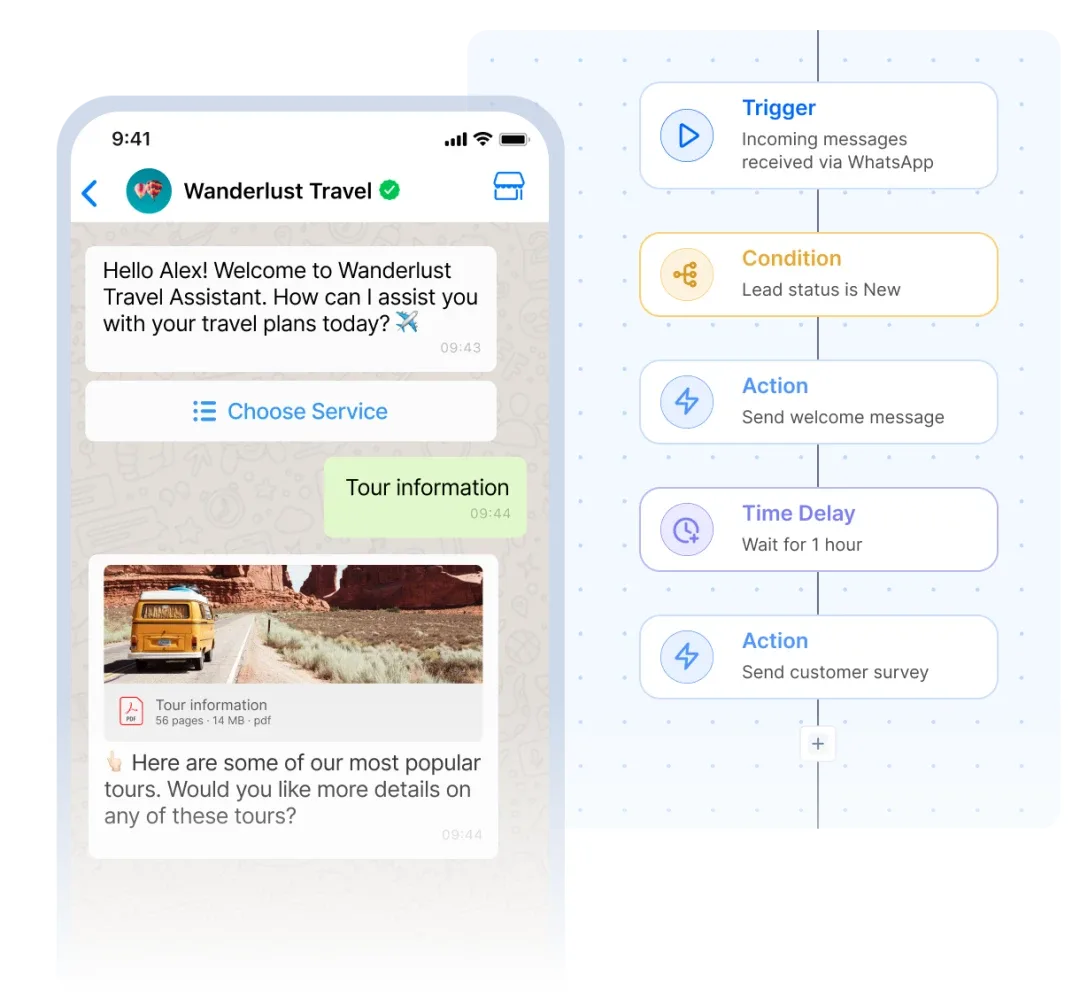
With SleekFlow, building a WhatsApp chatbot is as simple as setting a few automation rules. The chatbot will provide quick, consistent replies—but first, you need to decide what kind of conversation flow you want to create for your chatbot.
Here’s how:
Plan responses to frequently asked questions (FAQs). These responses should be brief and straight to the point to keep interactions efficient.
Prepare a smooth handover message for situations where a human agent needs to take over the conversation.
SleekFlow also offers ready-made templates to help you get started quickly:
Go to Automation.
Select Apply a Template.
Configure the triggers and actions.
Once set, your chatbot is ready to engage with customers effortlessly.
Step 4: Test & deploy your WhatsApp chatbot
Never roll out a new feature without testing it first.
Run your chatbot through multiple test scenarios to check its responses.
Ensure it follows the planned flows and integrates well with other systems.
Carefully review its performance, as any overlooked issue could impact the customer experience.
Once you’re confident that everything works as expected, deploy your WhatsApp chatbot. With SleekFlow, your chatbot will be up and running in no time, helping you deliver faster, more reliable customer support.
Step 5: Monitor and optimize your chatbot based on data
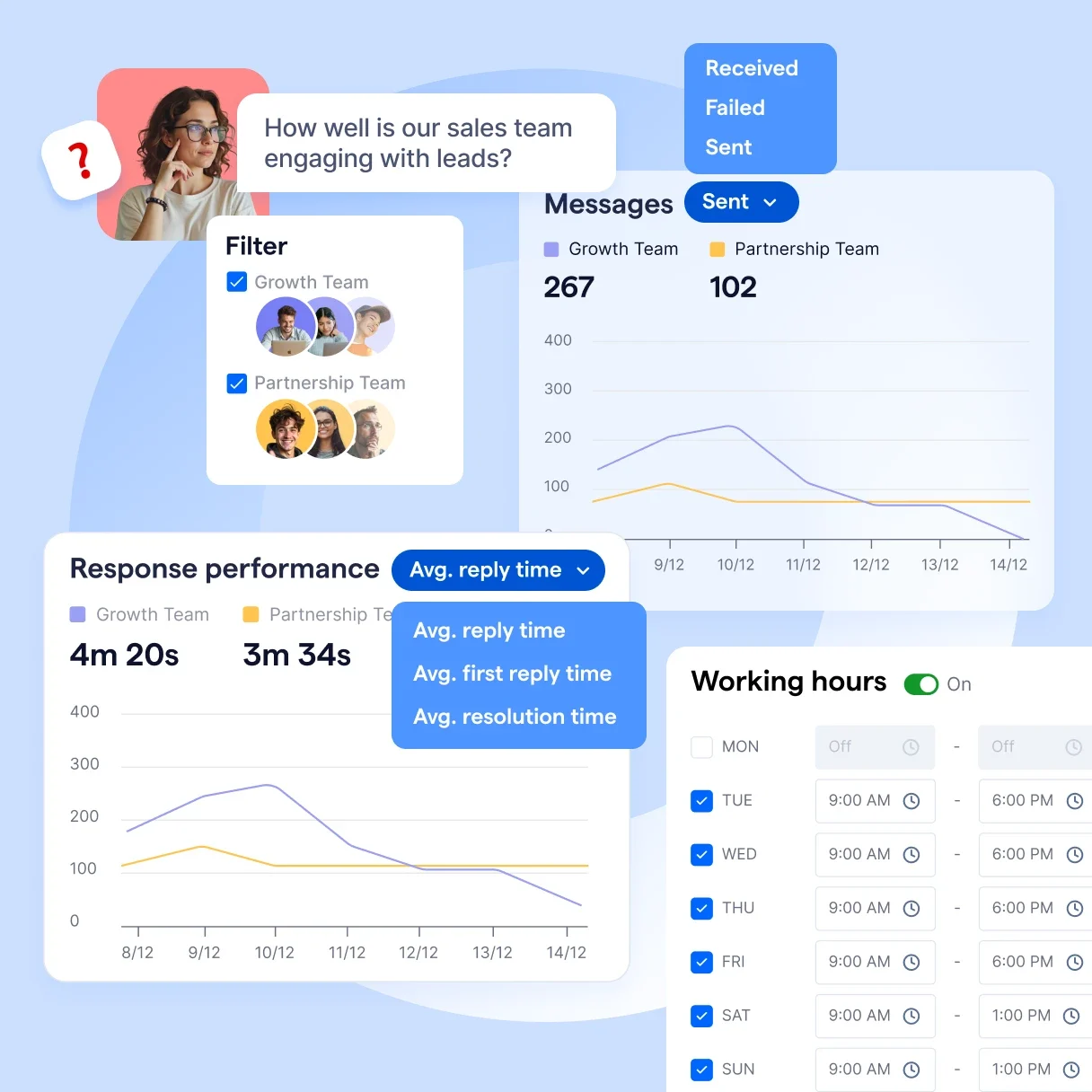
You need to monitor your WhatsApp bot’s performance and make data-driven improvements. With SleekFlow’s built-in analytics features, you can effortlessly track, analyze, and optimize your chatbot's performance.
When you use SleekFlow to build your WhatsApp chatbot, you can access detailed insights from every chat and campaign. The analytics dashboard helps you track how conversations contribute to conversions, monitor agent performance, and customize metrics that align with your goals.
Here’s how SleekFlow’s analytics features can help you optimize your WhatsApp chatbot:
Track actions like website visits or booking confirmations and automatically log how customers progress through their journey in chats.
Filter conversions by period and audience segments, such as location and lead source, to refine your campaign targeting and achieve better results.
Visualize drop-off and conversion rates, identify bottlenecks, and highlight high-performing touchpoints to optimize your chat conversion funnel.
Additionally, SleekFlow allows you to track which campaigns contribute most to your contact base growth. You can attribute new leads to their source, analyze the factors driving inquiries, and double down on what works best.
Want to outcompete your peers with SleekFlow's help?
Book your personalised demo with SleekFlow today and unlock the potential of seamless communication
Why are WhatsApp chatbots a must for businesses?
88% of users have engaged in at least one conversation with a chatbot, and 80-90% of users describe their experience as engaging. People have grown familiar with chatbots and trust them to handle their queries. Also, chatbots can answer up to 79% of routine questions, freeing up your team to focus on more complex tasks.
Here’s why every business should start using WhatsApp chatbots:
1. Better customer service – 24/7 availability
Chatbots are commonly used in customer support, with 37% of businesses relying on them. If you don’t adopt this technology soon, your competitors will leave you behind.
A WhatsApp chatbot can simplify your customer support process by:
Automatically handling simple and repetitive tasks.
Working around the clock to provide instant responses at any time.
Transferring more complicated questions smoothly to a human agent.
Here’s why every business should start using WhatsApp chatbots:
2. Personalized customer experiences
Personalization is no longer a luxury; it’s expected. 71% of consumers want companies to deliver personalized interactions, and WhatsApp chatbots can do exactly that.
With WhatsApp chatbots, you can:
Address customers by name during conversations.
Tailor messages based on past interactions, such as order history or frequently asked questions.
Send personalized offers and recommendations based on customer behavior.
Segment users by location, purchase behavior, or engagement to deliver relevant promotions and updates.
This level of personalization helps build stronger relationships and enhances customer satisfaction.
3. Improved marketing campaigns
To convert prospects effectively, you need to respond quickly—and that’s where WhatsApp chatbots excel.
WhatsApp chatbots can:
Send instant replies to inquiries, ensuring you don’t miss potential leads.
Automate follow-up messages for promotions, product launches, or abandoned carts.
Engage customers throughout the conversion funnel, optimizing each touchpoint for better results.
Broadcasting to Targeted Segments – Businesses can send bulk messages while ensuring they’re personalized and relevant to different customer groups.
With chatbots handling initial interactions, your team can focus on nurturing high-intent leads and closing deals.
4. Multi-language support
WhatsApp chatbots are designed to communicate with customers in multiple languages, making them ideal for businesses with a global reach. They help strengthen connections across different markets by:
Automatic detection: They can detect and respond in a customer’s preferred language.
Natural interactions: This ensures conversations feel personalized and localized.
Eliminating barriers: By removing language hurdles, businesses can effectively engage and strengthen connections across different markets.
Take a look at how successful businesses use WhatsApp chatbots to improve customer engagement.
Best practices for an effective WhatsApp chatbot
Source: Pexels
Creating a WhatsApp chatbot is just the beginning. To ensure it provides real value to your customers and supports your business goals, follow these best practices:
1. Clearly define use cases
Start by identifying the primary purpose of your chatbot.
Will it handle customer support?
Is it for lead generation?
Will it drive sales?
Or is it simply there to answer FAQs?
This will help you build better conversation flows and ensure users get the answers they need without confusion.
2. Personalize conversations
Personalization makes conversations more engaging and strengthens connections. When possible:
Use customers' names.
Reference past interactions.
A simple message like, “Hi Sarah, your order has been shipped!” adds a personal touch that customers appreciate.
3. Provide clear instructions
WhatsApp is a quick, casual communication channel, so clarity is key. Let users know exactly what they can do with the chatbot. For instance:
"Type '1' for Order Status"
"Type '2' for Product Info"
"Type '3' to Speak to a Human"
4. Enable handoff to a human agent
Chatbots are great for routine tasks, but some situations require human support. Make sure your chatbot can hand over the conversation to a live agent when needed. This ensures customers don't get stuck when dealing with more complex questions.
5. Offer quick replies & buttons
Make navigation as intuitive as possible by using interactive buttons. Instead of asking users to type everything, provide quick reply options like:
"Check Order Status"
"View Product Catalog"
"Speak to Support"
6. Offer easy opt-out
Respect your customers' preferences by making it easy to opt-out. Allow users to unsubscribe by sending simple keywords like:
"Stop"
"Unsubscribe"
This builds trust and ensures compliance with messaging regulations.
Why is SleekFlow the smart choice for your WhatsApp chatbot?
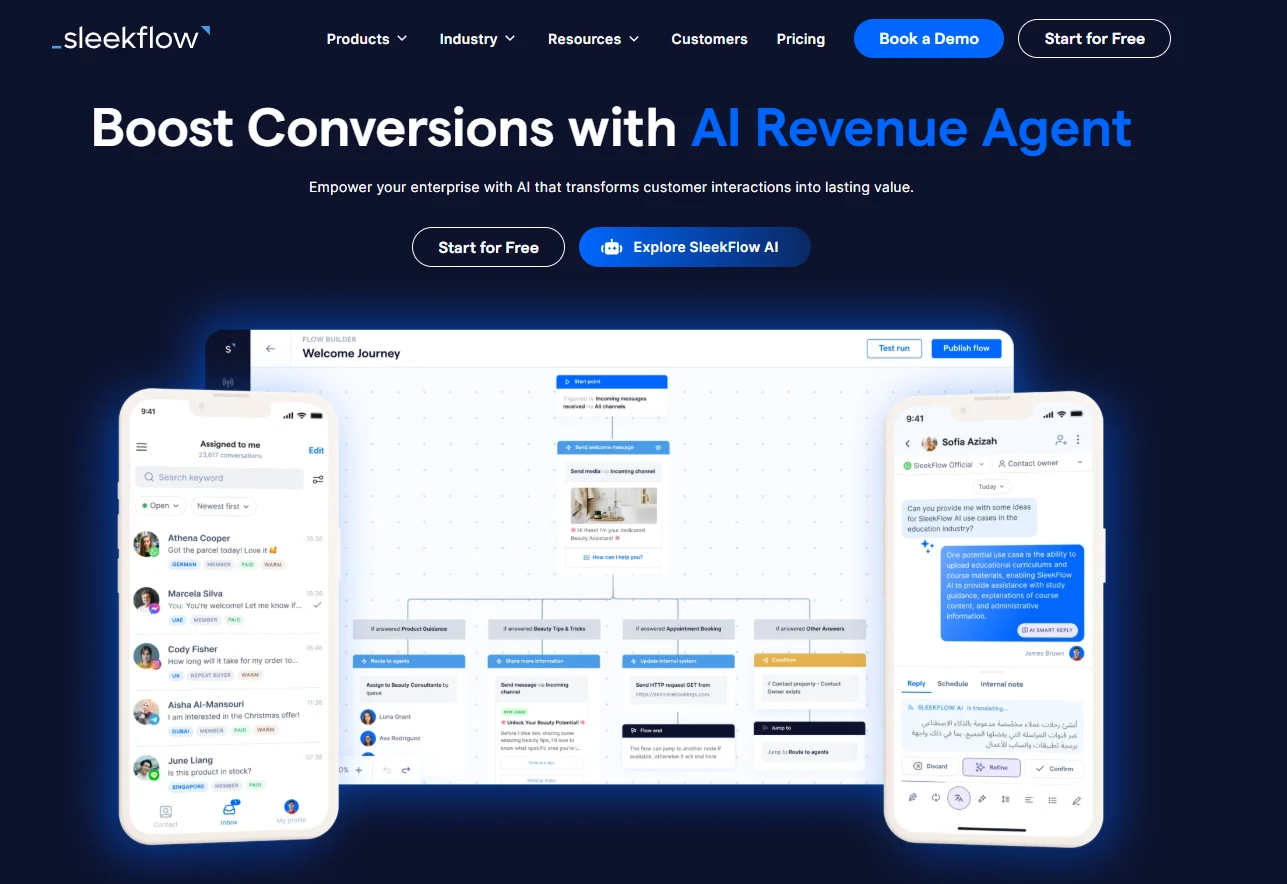
Building a WhatsApp chatbot is no longer a complex, time-consuming task. With the right tools, you can automate conversations, improve customer interactions, and personalize experiences effortlessly. SleekFlow makes this process simple with its intuitive, no-code steps.
By choosing SleekFlow, you get more than just a chatbot—you get a reliable, scalable, and easy-to-use platform that helps you:
Stay connected with your customers 24/7
Utilize automated responses
Create personalized interactions
Access actionable analytics
Qualify leads, recommend products, schedule meetings, or update your CRM with AI agents
SleekFlow equips your business with the tools needed to thrive in today’s messaging-first world.
YouTuber Mingjai (700K subscribers) built an engaging, gamified chatbot with SleekFlow
Mingjai, a Hong Kong YouTuber with over 700,000 subscribers, launched a premium storytelling course, "How to Achieve Billions of Views on YouTube".
Traditional communication methods like email and static video failed to maintain engagement. High traffic created logistical challenges, making lead qualification inefficient.
The team created a gamified WhatsApp chatbot via SleekFlow to guide prospects through a workflow, filtering high-intent users. Data collected was used for automated drip campaigns.
57% of users completed the full game sequence.
70% inquiry rate, creating a highly qualified lead pool.
200 early bird seats sold out in 48 hours.
Quote: Storytelling is more about what the audience takes away than what we say. Our gamified WhatsApp chatbot ensures potential customers carry the course experience home.

MingJai
Hong Kong renowned Youtuber
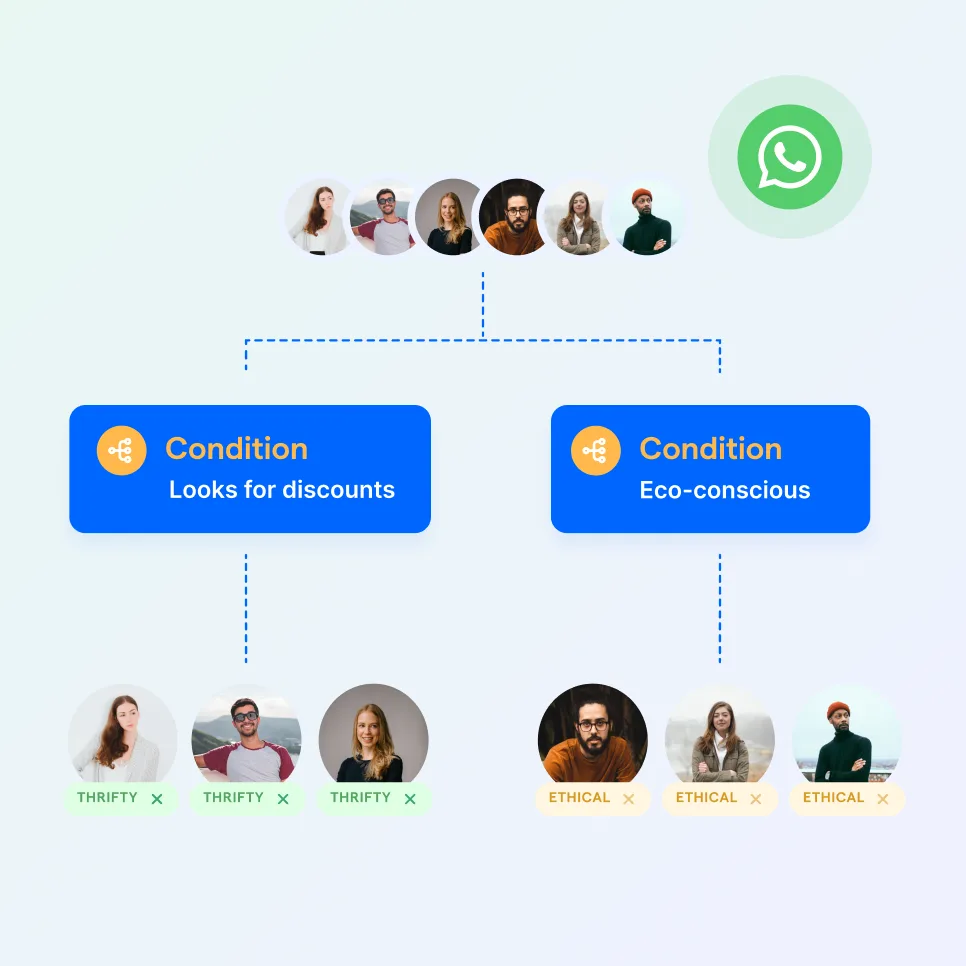
Automate your business growth with Flow Builder
Streamline sales, marketing, support, and operation workflows in the era of hyper-personalization.


