How much does an AI agent cost?


If you’re evaluating an AI agent, the better question is not, “What is the cheapest plan?” It is, “What will my actual monthly cost look like once the solution is live?”
That is where many businesses get caught out. The software subscription is only one part of the picture. The total cost usually depends on your platform plan, how many contacts actively engage with your business, how advanced your AI workflows need to be, and what systems that the agents need to connect to.
This guide breaks down the real cost drivers, explains whaxt buyers often miss, and shows how to estimate a budget that makes sense for sales, support, and customer engagement teams.
What makes up the total cost of a WhatsApp AI agent?
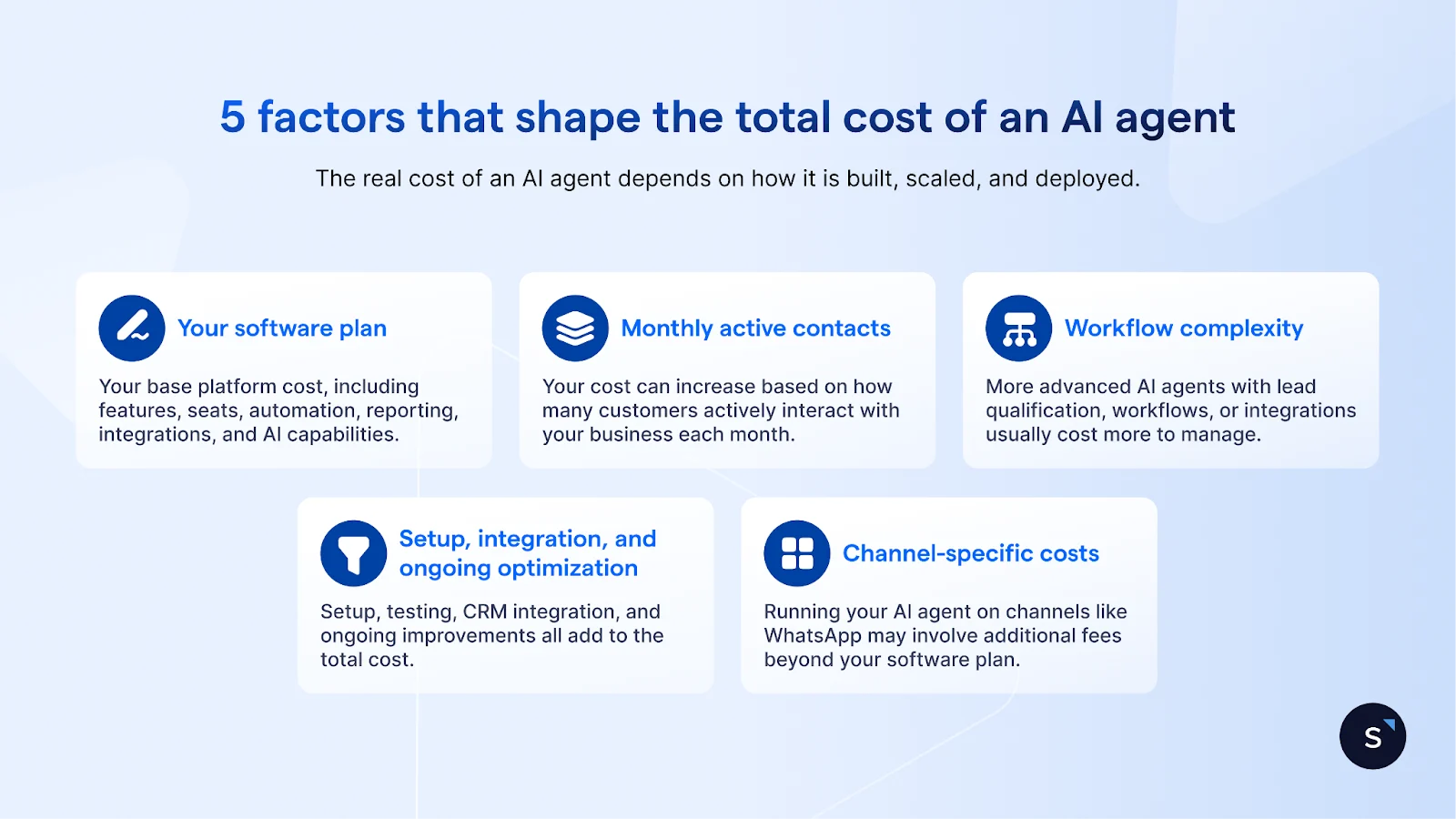
In most cases, your monthly cost comes from 5 areas.
1. Your software plan
Your platform subscription is the foundation of the cost. It usually determines what you get in terms of seats, automation, reporting, integrations, governance, and AI capabilities.
SleekFlow offers a 7-day free Pro plan trial, Premium plan for scaling businesses, and a Custom option for more advanced enterprise needs. Plans also vary in included features and support levels.
2. Monthly active contacts
A WhatsApp AI agent is not only about how many people are stored in your CRM. What matters more is how many contacts are actively engaging with your business during the month.
SleekFlow’s pricing model uses monthly active contacts (MACs). Public plan thresholds currently start at 500 on Pro, and 1,000 on Premium, with add-ons available on paid plans. That makes MAC volume an important cost factor for growing teams with rising enquiry volumes.
3. Workflow complexity
This is often the biggest driver of cost, and also the one buyers underestimate the most.
A basic AI agent that answers FAQs is usually easier and cheaper to launch than one that qualifies leads, triggers workflows, checks order status, updates a CRM, recommends products, or supports service teams across multiple markets.
The more your AI agent needs to do, the more important it becomes to think about implementation work, testing, handover logic, fallback handling, and ongoing tuning. Buyers often focus on plan price, but the bigger cost difference usually comes from the complexity of the workflow behind the agent.
4. Setup, integration, and ongoing optimization
A basic AI agent that answers FAQs is usually easier and cheaper to launch than one that qualifies leads, triggers workflows, checks order status, or updates a CRM.
The more your AI agent needs to do, the more important it becomes to think about implementation work, testing, handover logic, and ongoing tuning. Buyers often focus on plan price, but the bigger cost difference usually comes from the complexity of the workflow behind the agent.
5. Channel-specific costs
This is the part many buyers overlook.
Some AI agents run mainly on website chat or in a shared team inbox. Others are deployed across messaging channels such as WhatsApp, Instagram, Facebook Messenger, or SMS. In those cases, your AI software plan may not be the only bill you need to consider.
For example, on the WhatsApp Business Platform, Meta moved to per-message pricing on July 1, 2025. Businesses are charged per delivered template message, while utility templates sent within the 24-hour customer service window are free. On SleekFlow, paid plans may also require a separate WhatsApp hosted number fee.
In practice, this means channel fees should be treated as an operating cost layered on top of your AI platform cost, not confused with the AI agent price itself.
What kind of AI agent do you actually need?
Not every WhatsApp AI agent should cost the same, because not every agent solves the same problem.
A useful way to think about it is in three levels.
1. FAQ and support agent
This is the simplest starting point. It is designed to answer common questions, share business information, and reduce repetitive work for support teams.
This model is often the fastest to launch because it usually depends on a smaller knowledge base and fewer integrations.
2. Lead qualification agent
This type of AI agent goes beyond answering questions. It helps capture lead details, understand intent, ask follow-up questions, route leads to the right team, and shorten the time between enquiry and response.
For many sales teams, this is where the business case becomes stronger, because speed-to-lead and qualification quality have a direct impact on revenue operations.
3. Integrated AI agent
This is the most advanced layer. It can connect to external systems, trigger actions, check order or booking information, update customer records, and support more complex workflows.
This model usually creates the most value, but it also requires the most planning. The cost is not only about the AI itself. It is about whether the AI can take meaningful action inside your actual business workflow.
Example cost scenarios for growing teams
Instead of asking for one “average price,” it is more practical to estimate cost by use case.
Scenario 1: Small business automating FAQs
A smaller team may use an AI agent to answer common questions, qualify simple enquiries, and reduce after-hours support load.
The main cost drivers here are the software plan and the number of monthly active contacts. WhatsApp charges may stay relatively manageable if the business is not sending large volumes of outbound templates.
Scenario 2: Sales team qualifying inbound leads
A growth-stage business may use the AI agent to capture lead details, identify high-intent prospects, and route them to sales.
In this case, the agent needs stronger routing logic, better handover design, and possibly CRM integration. The cost is still manageable, but the workflow starts to matter more than just the plan price.
Scenario 3: Multi-team operation handling support and campaigns
A larger team may want one setup that handles support, sales, follow-up reminders, promotions, and customer updates.
This is where total cost becomes more sensitive to message volume, automation logic, analytics needs, and governance requirements. If your outbound template usage is high, message fees can become a more meaningful part of the budget.
How to choose the right AI agent plan
The right plan is not always the cheapest one. It depends on how many customer conversations you manage each month, how advanced your workflows need to be, and whether your AI agent needs to do more than answer simple questions.
Use the table below to assess what kind of setup fits your business best.
The easiest way to choose a plan is to start with your real use case. If you mainly want to automate common questions, a simpler setup may be enough. If you need lead qualification, handover logic, analytics, or integrations with tools like your CRM or ecommerce platform, you will likely need a more advanced plan.
Choose the right AI agent setup with SleekFlow
With AgentFlow, SleekFlow helps businesses move beyond basic chatbot automation and build AI agents for real customer journeys on WhatsApp. Teams can use AgentFlow to qualify leads, recommend products, schedule meetings, update CRM records, and hand off conversations to human agents when needed - all within SleekFlow’s broader messaging and automation platform.
For businesses comparing options, this makes it easier to choose a setup that fits both current needs and future growth.
How businesses are using AgentFlow in real customer journeys
These examples show how businesses use AgentFlow to automate key conversations, reduce manual work, and improve efficiency across customer journeys.
1. Elétron Seguros uses AgentFlow to automate support at scale
Elétron Seguros used AgentFlow to automate high-volume support while keeping human agents focused on more complex cases. AI handled the first layer of support, resolved repetitive enquiries, and passed conversations to human agents when needed.
This gave Elétron a way to scale support without losing service quality or adding unnecessary workload to the team. After around three months of running AI across the full flow, the business reported:
80% of conversations resolved by AI
A significant reduction in repetitive messages
More time for the human team to focus on high-value interactions
No need for new hires to sustain growth
2. Checkmob uses AgentFlow to automate lead qualification and demo bookings
Checkmob faced delays in early-stage sales conversations, with manual lead qualification taking up too much of the sales team’s time. With AgentFlow, Checkmob automated first contact, used AI to qualify incoming leads, and scheduled demos before handing high-intent conversations to sales.
This helped the team respond faster, reduce repetitive back-and-forth, and focus more on qualified opportunities instead of manual screening. As a result:
Response time decreased by 70%
Demo bookings increased by 20%
Sales teams saved 30% of their time by reducing manual back-and-forth
Security and compliance with SleekFlow
SleekFlow prioritizes data security to ensure that customer information is handled with the utmost care and compliance.
SOC 2 Type II and ISO 27001 Certification:SleekFlow adheres to industry-standard data protection practices, ensuring that all customer data is secure.
GDPR-Aligned Practices:The platform follows strict GDPR guidelines, ensuring that customer privacy is respected and data is only used for the purposes for which it was provided.
Enterprise-Level Security Features:With features like role-based access control (RBAC), data masking, and IP whitelisting, SleekFlow ensures that only authorized personnel can access sensitive data, maintaining privacy and compliance.
Plan your AI agent rollout with more confidence
If you’re exploring what an AI agent setup could look like for your business, SleekFlow can help you turn that plan into a practical rollout. From lead qualification and support automation to secure, scalable workflows, SleekFlow gives teams a clearer way to launch AI agents that fit both current needs and future growth.
Want to outcompete your peers with SleekFlow's help?
Book your personalised demo with SleekFlow today and unlock the potential of seamless communication


