SMS for e-commerce: The Complete Guide to Boosting Sales & Engagement


TL; DR: Quick Summary
- SMS is a top-performing e-commerce channel with up to 98% open rates, driving faster clicks and conversions than email.
- E-commerce SMS covers promotional and transactional messages like cart recovery, order updates, shipping alerts, and exclusive offers.
- Integrations with Shopify, WooCommerce, and Magento enable real-time, automated SMS based on customer behavior.
- High-impact use cases include abandoned cart reminders, flash sales, restock alerts, loyalty updates, and COD verification.
- Best strategies focus on clear opt-in, smart segmentation, automation, personalization, and performance tracking.
- SleekFlow powers e-commerce SMS with AI automation, omnichannel inboxes, CRM sync, compliance controls, and ROI analytics.
With open rates soaring as high as 98%, SMS has rapidly become one of e-commerce’s highest-impact marketing channels. It delivers exceptional visibility and engagement, far surpassing the typical 20–30% open rate of email. Additionally, Omnisend data shows that SMS consistently drives higher click-through rates, helping brands generate faster conversions and improve customer response times.
From recovering abandoned carts to sending order updates, promotions, and personalized offers, SMS lets online stores connect with customers at every step of their buying journey, boosting engagement, trust, and long-term retention.
What Is e-commerce SMS Marketing?
E-commerce SMS marketing refers to sending promotional, transactional, and personalized text messages to online shoppers. This includes updates like order confirmations, shipping alerts, abandoned cart reminders, and exclusive SMS-only offers.
SMS marketing integrations are available for all major e-commerce platforms, including Shopify, WooCommerce, and Magento, enabling automated triggers based on customer behavior.
Shopify SMS marketing is especially effective because it plugs directly into your storefront data, customers, orders, and abandoned checkouts, so you can trigger real-time texts without manual work.
Common Shopify SMS marketing flows include welcome messages, cart recovery, shipping updates, and post-purchase upsells powered by customer tags and purchase history. For stores running WooCommerce SMS marketing, the same automation principles apply: connect customer events (checkout started, order placed, item restocked) to SMS triggers so shoppers get timely nudges that feel personal and relevant.
Why SMS Works So Well for e-commerce
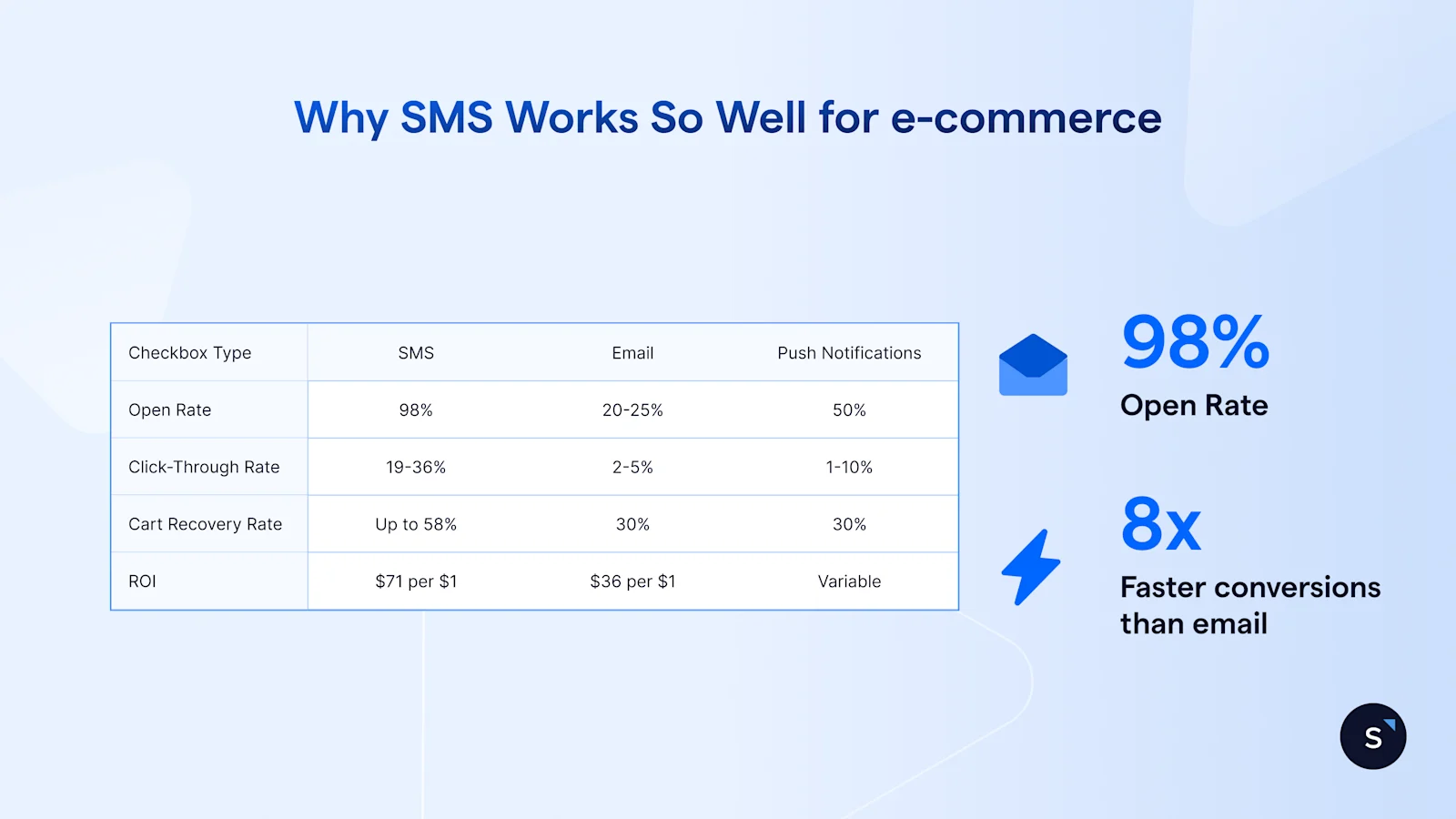
Here’s why SMS has become a top-performing channel for online stores:
1. High open and response rates
With nearly universal visibility, SMS is ideal for flash sales, reminders, and time-sensitive alerts.
2. Instant delivery and real-time communication
Messages arrive within seconds, making SMS perfect for order updates, restock alerts, and customer notifications.
3. High personalization potential
When paired with platforms like Shopify and WooCommerce, brands can tailor messages based on customer behavior, past orders, and browsing patterns.
4. Cost-effective re-engagement
SMS is affordable, low-friction, and consistently outperforms email and retargeting ads, especially for cart recovery and reactivation campaigns.
The numbers reinforce why SMS is considered “cost-effective,” especially when you look at SMS marketing ROI ecommerce benchmarks. Ecommerce and retail companies generate $71 for every dollar spent on SMS marketing, showing how quickly one well-timed cart reminder or limited-time offer can pay for itself.
Broader industry benchmarks also report that SMS marketing generates an average ROI of $73 for every $1 spent, which makes SMS one of the highest-return channels for direct-response campaigns. In practice, this ROI comes from high visibility, fast clicks, and automated flows (welcome, cart recovery, post-purchase) that keep working even when your team is offline.
E-Commerce SMS Marketing Use Cases With Relevant Links
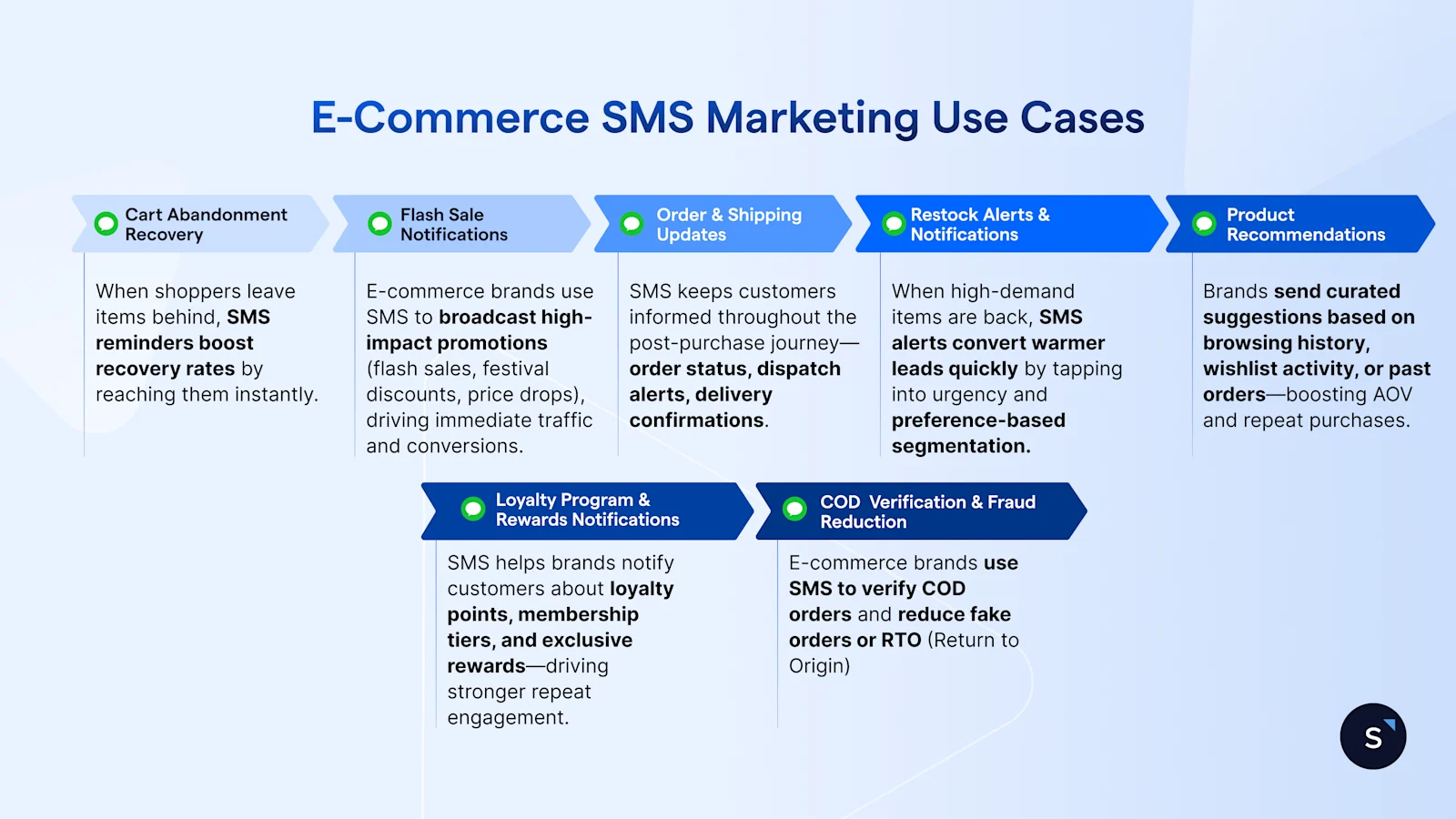
1. Cart Abandonment Recovery
When shoppers leave items behind, SMS reminders boost recovery rates by reaching them instantly, far faster than email (Abandoned Cart Recovery Insights)
2. Flash Sale & Limited-Time Discount Notifications
E-commerce brands use SMS to broadcast high-impact promotions (flash sales, festival discounts, price drops), driving immediate traffic and conversions.
3. Order Confirmation & Shipping Updates
SMS keeps customers informed throughout the post-purchase journey - order status, dispatch alerts, delivery confirmations. This reduces customer support burden and improves satisfaction (Shipping Communication)
4. Restock Alerts & Back-in-Stock Notifications
When high-demand items are back, SMS alerts convert warmer leads quickly by tapping into urgency and preference-based segmentation.
5. Personalized Product Recommendations
Brands send curated suggestions based on browsing history, wishlist activity, or past orders - boosting AOV and repeat purchases.(SleekFlow Segmentation & Personalization Tools)
6. Loyalty Program & Rewards Notifications
SMS helps brands notify customers about loyalty points, membership tiers, and exclusive rewards - driving stronger repeat engagement.
7. COD (Cash on Delivery) Verification & Fraud Reduction
E-commerce brands use SMS to verify COD orders and reduce fake orders or RTO (Return to Origin) losses. Eg. Shiprocket
How to build a high-converting SMS marketing strategy for e-commerce
1. Get clear opt-in
Collect SMS consent at checkout, via pop-ups, or through sign-up forms. Offer clear value - exclusive deals, alerts, and faster updates.
2. Segment your audience
Group customers based on purchase history, engagement, and browsing behavior for more relevant campaigns.
3. Automate high-impact triggers
Set up automated workflows such as:
Cart recovery reminders
Order confirmation texts
Shipping updates
Post-purchase follow-ups
4. Personalize content and schedule smartly
Use customer names, preferences, or previous orders. Send messages during reasonable hours to maximize engagement.
5. Track and optimize performance
Monitor open rates, click-through rates, conversions, and unsubscribe rates. Use A/B testing to refine messaging and timing.
Best Practices for e-commerce SMS Campaigns
Effective e-commerce SMS campaigns balance clarity, timing, personalization, and compliance to maximize engagement and conversions. By following proven best practices, brands can deliver high-impact messages that feel relevant, respectful, and truly customer-centric.
Keep messages under 160 characters
Short, scannable texts deliver better results. Industry case studies show that keeping SMS concise improves open rates and ensures messages don’t split into multiple parts, helping e-commerce brands maintain a smooth customer experience.Include brand name + a clear CTA
Always identify your brand and guide the shopper toward one action, Shop Now, View Cart, Claim Offer. Brands like Nordstrom and Wayfair consistently see higher CTRs when every SMS contains a single, compelling CTA.Use personalization where possible
Personalized recommendations based on browsing or past purchases boost conversion rates significantly. Many e-commerce brands reported up to a 20–30% lift when using segmented SMS flows, especially for cart recovery and restock alerts.Send at optimal times
Timing directly impacts revenue. Case studies show that messages sent mid-morning (10–11 AM) or early evening (5–7 PM) get higher engagement, while late-night SMS increases opt-outs.Always include an opt-out option
This builds trust, reduces complaint rates, and helps maintain strong deliverability - critical for scaling e-commerce SMS campaigns without triggering carrier filters.Follow compliance laws (TCPA, GDPR, and local regulations)
Ensuring proper consent and transparent communication safeguards your campaigns. Brands adhering to compliance enjoy more stable long-term ROI and better customer retention.
Real-World e-commerce SMS case studies
Thread Wallets - Accessories & Lifestyle Brand
Thread Wallets struggled with high browse and cart abandonment rates. To improve conversions, they adopted behavior-based SMS automation using segmentation, browse-abandon and cart-abandon workflows, plus send-time optimization. This shift to personalized, timely messaging helped the brand increase SMS revenue by 30.7% YoY and boost conversion rates by 40% on targeted campaigns. The case shows how lifestyle brands can turn SMS into a high-impact, revenue-driving channel with automation and personalization.
Davines - Premium Beauty & Haircare Brand
Davines faced declining salon-based sales and needed to shift focus to online retail. By implementing automated post-purchase SMS flows - including shipping notifications, delivery updates, and proactive order-status alerts, along with personalized messaging tied to customer preferences, they reduced post-order friction. As a result, customer inquiries dropped significantly, and eCommerce conversions and repeat orders rose markedly. This demonstrates how clear, timely SMS communication boosts trust and drives online sales for premium brands.
Compliance and Opt-in Rules for e-commerce SMS
Staying compliant is essential for building trust and ensuring your e-commerce SMS marketing is both effective and legally sound. Regulations such as TCPA (US), GDPR (EU), and other regional data-privacy laws govern how brands can collect customer numbers, send promotional texts, and manage personal data.
To maintain full compliance:
Obtain explicit opt-in before sending promotional SMS
Customers must knowingly agree to receive marketing SMS. This can be done through a checkout checkbox, a sign-up form, or a keyword-based opt-in (e.g., “Text JOIN for updates”). Pre-checked boxes or vague consent wording should be avoided.
Provide a clear and easy opt-out method
Every message must include a simple way to unsubscribe, such as “Reply STOP to opt out.” This keeps your SMS list healthy and protects your brand from penalties.
Store customer data securely
All phone numbers, consent logs, and message history should be stored using secure systems that follow data-protection standards. Platforms like SleekFlow help you maintain a record of opt-ins, consent timestamps, and user preferences for audit readiness.
Avoid messaging during restricted hours
Certain regions limit how late or early you can send promotional SMS. Respecting quiet hours not only ensures compliance but also improves customer experience.
Distinguish between transactional and promotional content
Transactional messages (order confirmations, delivery updates, OTPs) typically do not require marketing consent. Promotional messages, on the other hand, discounts, offers, sales alerts, require explicit opt-in. Keeping these categories separate ensures accurate compliance tracking.
How to measure SMS marketing ROI and key performance metrics for e-commerces
Tracking your SMS KPIs helps you understand campaign performance, refine your strategy, and improve e-commerce conversions. Monitoring these metrics regularly ensures your SMS channel remains profitable and relevant to your audience.
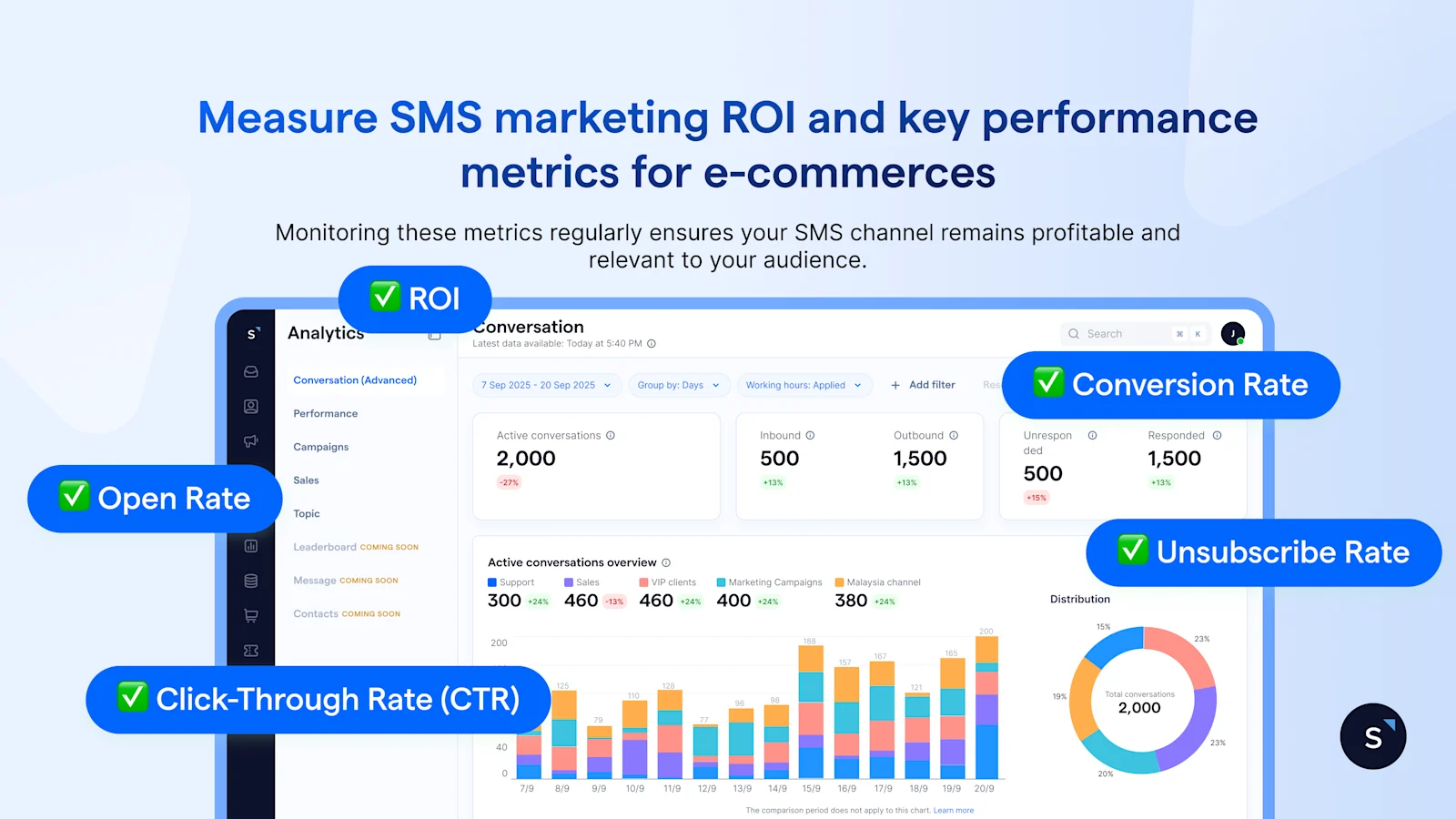
Open Rate – visibility and engagement
SMS open rates are typically high, making this metric a strong indicator of how effectively your brand captures attention. A low open rate may signal timing or sender ID issues.
Click-Through Rate (CTR) – link interaction
CTR measures how many recipients clicked your product link, sale page, or checkout reminder. It helps you evaluate the strength of your offer and the clarity of your CTA.
Conversion Rate – completed actions
This highlights how many users went on to purchase, redeem a promo, or take the intended action. A strong conversion rate reflects message relevance and audience alignment.
ROI – revenue generated vs. campaign cost
ROI proves the financial value of your SMS strategy. By comparing the cost of sending messages with the revenue generated, brands can assess the true efficiency of SMS as a marketing channel.
Unsubscribe Rate – content relevance & frequency
A rising opt-out rate suggests your messages may be too frequent, poorly targeted, or misaligned with customer expectations. Monitoring this helps maintain list quality.
Platforms like SleekFlow offer built-in analytics dashboards that make it easy to monitor performance, compare transactional SMS vs promotional SMS, and optimize every campaign for better results.
How SleekFlow Powers eCommerce SMS Automation
SleekFlow transforms SMS marketing for e-commerce into a fully automated, AI-driven, and compliant growth engine. It helps online stores engage customers, recover lost sales, and manage communications across multiple channels - all from one platform.
AI Conversations
SleekFlow’s AI agents can handle customer interactions 24/7, qualify leads, answer common queries, and seamlessly hand off conversations to human agents with full context. This ensures timely, relevant, and personalized responses for both promotional and transactional SMS campaigns.
Native Shopify Integration
Sync your customer data, order history, and abandoned carts directly from Shopify. This enables automated SMS triggers such as abandoned cart reminders, order confirmation SMS, shipping updates, and post-purchase retention campaigns - all personalized for each shopper.
Unified Inbox for Multi-Channel Management
Manage SMS alongside WhatsApp, Instagram, and email in a single inbox. This centralized system ensures no conversation is missed and allows teams to coordinate responses efficiently, improving customer experience while streamlining workflow.
Compliance Built-In
SleekFlow automatically handles TCPA compliance with features like opt-out management, audit logs, and differentiation between transactional SMS vs promotional SMS. Brands can confidently run campaigns knowing every message meets regulatory requirements.
Analytics Dashboard
Track the performance of your e-commerce SMS campaigns in real-time. SleekFlow’s dashboards provide metrics on delivery rates, open rates, click-through rates, conversions, and ROI, helping you optimize campaigns and prove SMS ROI quickly.
Conclusion
SMS is now an essential channel for e-commerce brands looking to boost conversions, improve customer experience, and build long-term loyalty. When combined with email and chat automation, SMS creates a powerful omnichannel strategy that drives consistent, measurable growth.
With platforms like SleekFlow, integrating automated SMS workflows into Shopify or WooCommerce becomes simple - turning every message into an opportunity for engagement and revenue.
Frequently Asked Questions
What is e-commerce SMS marketing?
How do you use SMS to recover abandoned carts?
How often should e-commerce brands send SMS?
Is SMS marketing effective for small e-commerce stores?
How do e-commerce brands ensure SMS compliance?
Recommended for you


