AI Agent examples in businesses: What they actually achieve


TL; DR: Quick Summary
- AI agents differ from chatbots by understanding intent, holding context, and acting inside real business systems, not just answering from a script.
- The businesses with results worth citing started with one high-volume, repetitive question type, not a rare edge case.
- Agents that write into a real system, booking a slot or updating a record, tend to outperform ones that only answer questions.
- Every deployment with numbers worth repeating defined its human handoff from day one, not after launch.
- Connecting an agent to Salesforce, HubSpot, or Zoho takes four steps: authenticate, set guardrails, train the knowledge base, then launch.
Every vendor page shows the same headline numbers: faster responses, happier customers, leaner teams, more revenue. What most skip is which examples are a genuine AI agent doing the work, and which are a well-built chatbot wearing an AI label. That distinction decides whether the results below are repeatable for your business, or a one-off story.
An AI agent is software that understands what a customer means even when phrasing shifts, holds context across a conversation, and takes action inside a business's own systems: booking a slot, updating a record, confirming an order, without a person typing the command.
This piece covers three AI agent examples from Singapore and Malaysia, one case that looks like an AI agent but is actually smart automation, and the pattern behind the deployments that produced real numbers.
AI agent or chatbot: what actually separates them
The two terms get used interchangeably in vendor marketing, but a chatbot matches a message to a script and a real AI agent understands intent, holds context, and takes action inside your systems, which is why the gap changes what results you can expect from each.
A traditional chatbot follows a decision tree: it matches a message to a keyword or menu option and returns a pre-written answer. The moment a question falls outside the script, it loops back to a menu or hands off to a person.
An AI agent understands what a customer means even when the phrasing shifts, holds context across the conversation, and, critically, can act: look up an order, update a record, confirm a booking, without a person typing the command.
AI agent examples that serve customers
These three are genuine agent deployments, each built on SleekFlow's AgentFlow, and each one understands intent, holds context, and takes action inside a real business system.
Example 1: NNIO, cutting a 14-person operation down to 3
NNIO, a Singapore electronics brand launched in 2024 specializing in air and cooling products and home appliances, grew into over 90% of the country's major retail chains and every major e-commerce platform within two years. Growth outpaced support fast: four teams (marketing, e-commerce, retail promoters, phone) ran independently with no shared view of a conversation, so a customer messaging on Instagram and calling about the same order could get two different answers, or none. On campaign nights, up to 50 inquiries arrived past midnight.
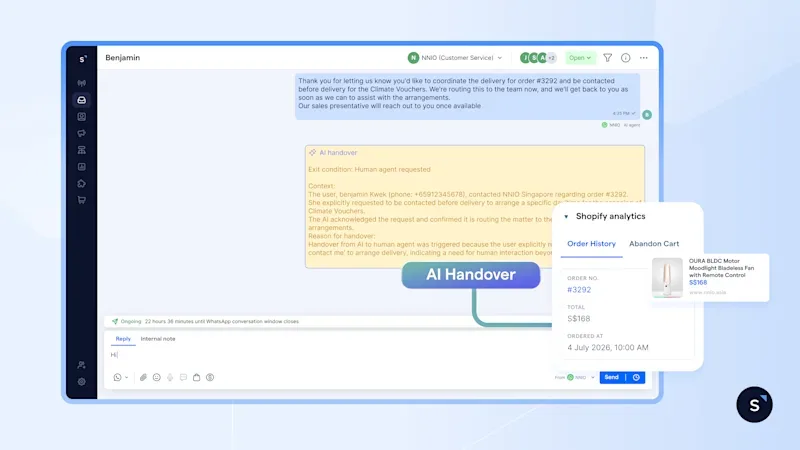
NNIO brought WhatsApp, Instagram, Facebook, and live chat into one shared inbox, then deployed an AI agent through AgentFlow to answer after-hours questions, work through product specifications trained on the brand's own website, and detect when a customer switches to Chinese mid-conversation. A WhatsApp flow now also registers offline retail purchases for warranty, turning walk-in customers into contacts the brand can follow up with.
Results
The team shrank from more than 14 people across 4 groups to 3 (two customer service agents and one e-commerce team member); average response time is down 40%; the AI agent resolves 20 to 30% of inquiries with no human involved; completed checkouts are up 20%; overall conversion rate is up 5%; and retention has grown by roughly 260%.
Example 2: SACES, an AI agent that holds its own in a sales conversation
SACES, a family-run Singapore aircon installation and servicing business with 30 years in the trade, was fielding growing pricing and availability questions across WhatsApp, Facebook, and Instagram with no unified view. Earlier-stage inquiries often waited while admin staff focused on customers close to booking, and exhibition visitors who missed face time at the booth had no way to register interest at all.
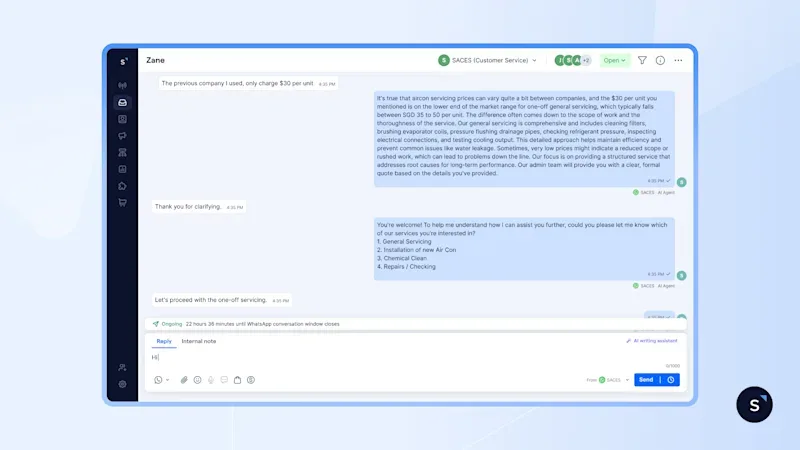
SACES trained an AI agent on its FAQ library, manufacturer brochures, and service rate sheets, so it can generate accurate, dynamic pricing by service type and unit count, and share image links via Google Drive for parts customers don't have the vocabulary to describe. It knows its limits too: discount requests, disputes, and complex installation scopes route straight to a person. In one case, a customer pushed back on price by citing a cheaper competitor quote; the agent explained what the service included, and the customer booked.
Results
60% of incoming inquiries are now handled by the AI agent; 75% of the leads it qualifies go on to convert; top-of-funnel response time improved from multiple days to within 24 hours; and a WhatsApp QR code flow at roadshows lifted event-driven conversions by 15%.
Example 3: Taylor's University, 4x more inquiries that end in enrollment
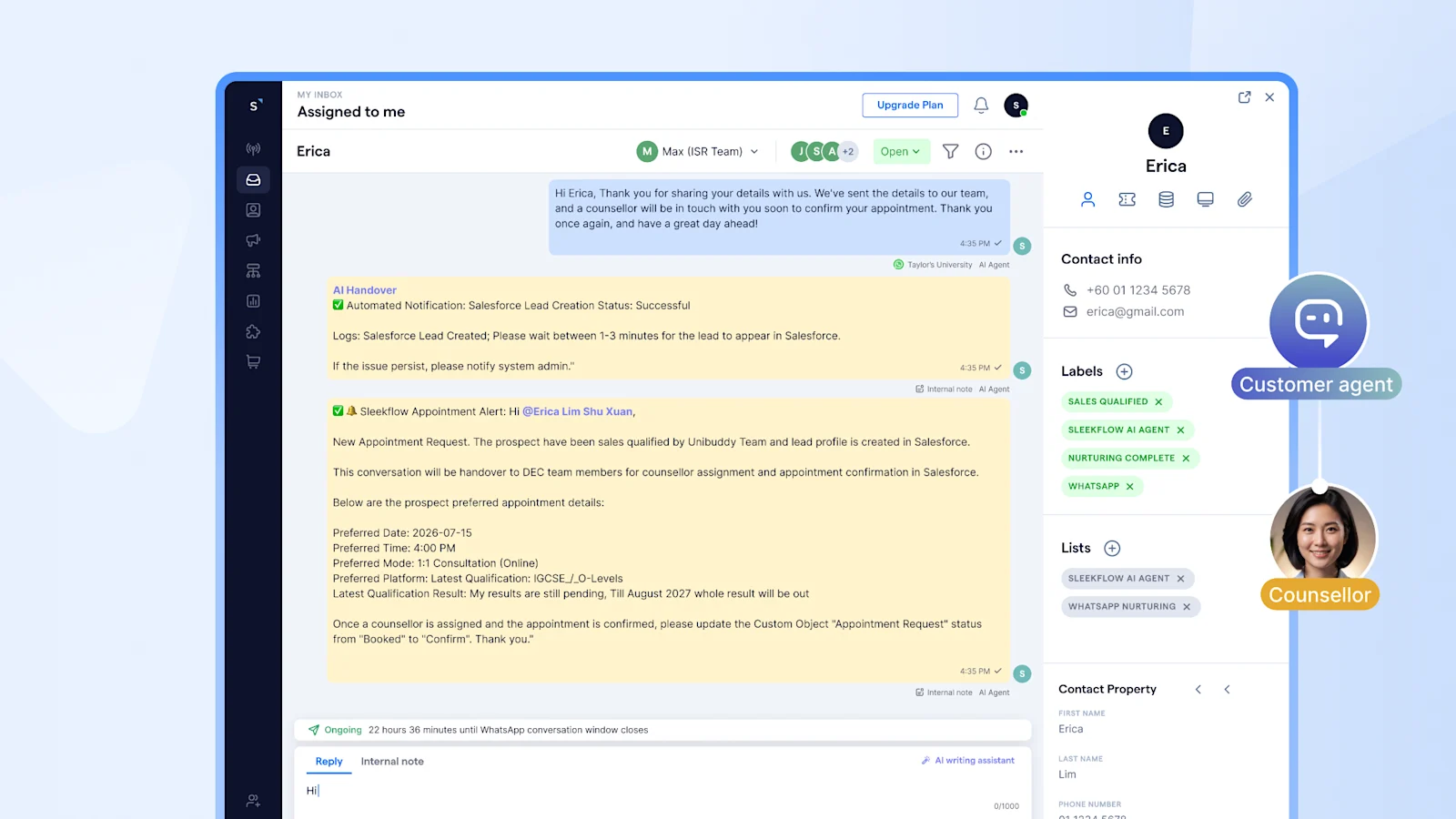
Taylor's University in Malaysia runs three recruitment cycles a year, with inquiries exceeding 10,000 conversations during Open Days and intake campaigns. Channels ran separately, so a student moving from Instagram to WhatsApp forced the counselor picking up the thread to start cold. Records inside Salesforce, the university's system of record, were only as complete as what staff had time to enter by hand, with no visibility into response times or reply rates.
Taylor's connected every channel into one inbox, automated lead creation directly into Salesforce, and deployed an AI agent through AgentFlow to pre-qualify inquiries about programs, entry requirements, fees, and campus information around the clock. The agent reads intent rather than keywords; in one case, it separated a partnership inquiry buried inside a student's message and routed it correctly instead of treating it as routine admissions traffic.
Results
Average first response time dropped from 1 hour 20 minutes to 17 minutes; reply rate rose from 71.5% to 79.3%; the team managed over 60,000 contacts and close to 36,000 conversations in 2025 without adding headcount; and conversational inquiries convert to enrollment at 11%, 4x the 2.7% rate from the university's broader online leads.
What these AI agent examples have in common
Three patterns show up across these AI agent examples that produced a measurable result:
High-volume, repetitive questions. Each business started with a use case where the same question came up constantly: pricing, product fit, program requirements. AI agents earn their keep on volume, not rare, complex cases.
Action inside a real system, not just an answer. SACES scores and prioritizes leads automatically; Taylor's pushes inquiries straight into student records; NNIO turns a warranty registration into a contact it can market to later. An agent that only reads information back doesn't deliver the same return.
Human escalation built in from day one. None of the three replaced their support, sales, or admissions teams. Each defined, in advance, what the agent handles and what it hands to a person, with full context on handoff.
Build an AI agent that works across every stage of the customer lifecycle, with AgentFlow
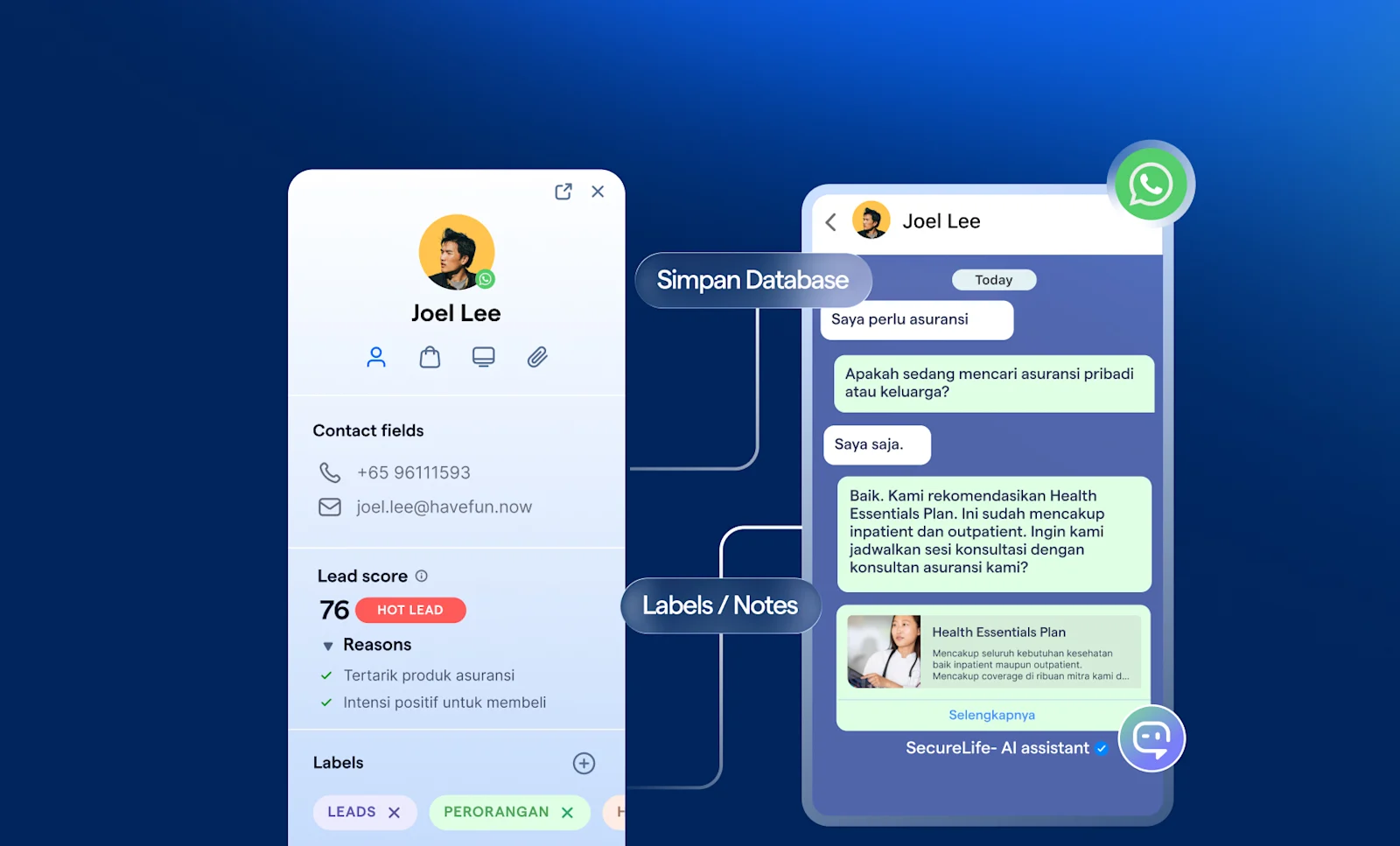
The examples above span retail, home services, and higher education, but the same approach extends across the full customer lifecycle: qualifying a lead, resolving a support question, and following up on a stalled inquiry can sit inside one connected agent rather than three separate tools. AgentFlow works that way, on WhatsApp and every other channel your customers already use, with the knowledge base, guardrails, and escalation rules configured by your team, not left to guesswork.
Claim your digital edge today
Book your personalised demo with SleekFlow today to view our available pre-approved PSG packages. Limited slots.


