ERP vs CRM vs SCM: what each system does and why CRM is the one your customers actually feel


TL; DR: Quick Summary
- ERP runs internal operations: finance, HR, procurement, and the numbers that keep the business solvent.
- CRM runs customer-facing sales, marketing, and support, the only one of the three a customer can actually feel.
- SCM runs the physical movement of goods, from supplier through to delivery.
- Integrated, the three cover a complete order lifecycle, but none of them capture buying intent at the moment it first appears in a conversation.
- That gap, not a missing integration, is what AI agents like AgentFlow are built to close.
A customer messages your business on WhatsApp asking if a product is in stock. Somewhere behind that one message sits a stack of software: something is tracking the inventory, something is meant to log the enquiry, something will eventually process the invoice and arrange delivery. Most businesses call this stack "our systems" and leave it at that, until the systems stop talking to each other and someone has to explain why the customer got three different answers from three different people.
What is ERP vs CRM vs SCM?
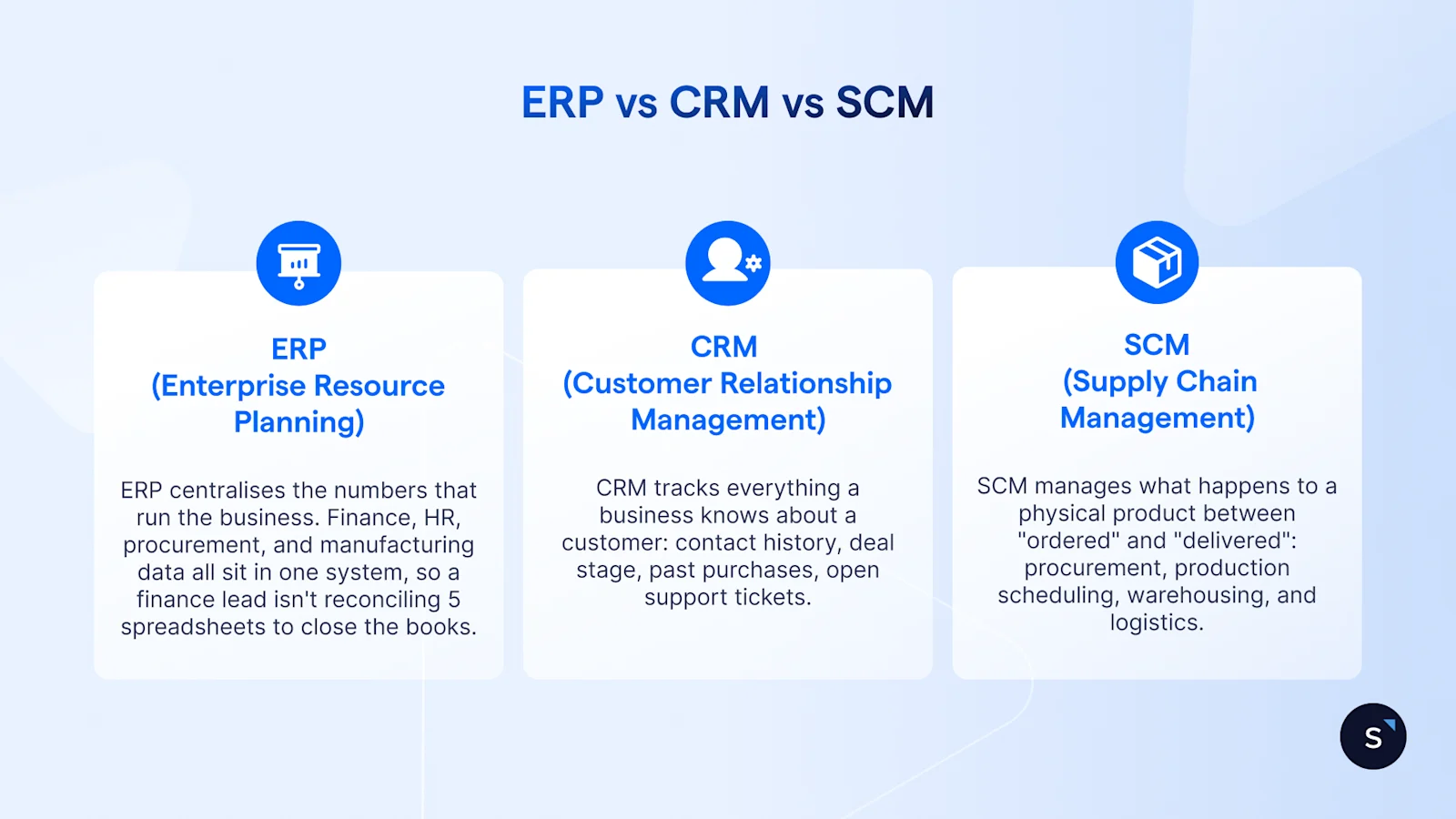
ERP, CRM, and SCM are the three software categories that run a business's finances, customer relationships, and physical supply chain, and CRM is the only one of the three a customer ever directly experiences.
Enterprise Resource Planning (ERP), Customer Relationship Management (CRM), and Supply Chain Management (SCM) get treated as interchangeable "business software." They aren't. Each was built to manage a different part of the business, for a different team, with different stakes when it fails.
Time to value follows the same split: CRM is usually live in weeks to a few months, while ERP and SCM rollouts typically run 6 to 18 months given how many departments they touch.
ERP: the operational backbone
ERP centralises the numbers that run the business. Finance, HR, procurement, and manufacturing data all sit in one system, so a finance lead isn't reconciling 5 spreadsheets to close the books. The global ERP software market was valued at roughly US$77.1 billion in 2025, a scale that reflects how few mid-sized and larger businesses still run finance and operations without one.
CRM: the customer-facing layer
CRM tracks everything a business knows about a customer: contact history, deal stage, past purchases, open support tickets. It's the system your sales and support teams live inside every day, and it's the one customers indirectly interact with every time an agent already knows their order history instead of asking them to repeat it. Gartner reports the global CRM software market grew 13.4% to $128 billion in 2024, making it the fastest-growing of the three categories.
SCM: the physical fulfilment engine
SCM manages what happens to a physical product between "ordered" and "delivered": procurement, production scheduling, warehousing, and logistics. Grand View Research puts the global SCM market at US$23.3 billion in 2023, on track to reach US$48.59 billion by 2030. Customers rarely see this system directly, but they feel its failures immediately, in the form of a late delivery or an out-of-stock item that was never updated.
How do ERP, CRM, and SCM work together?
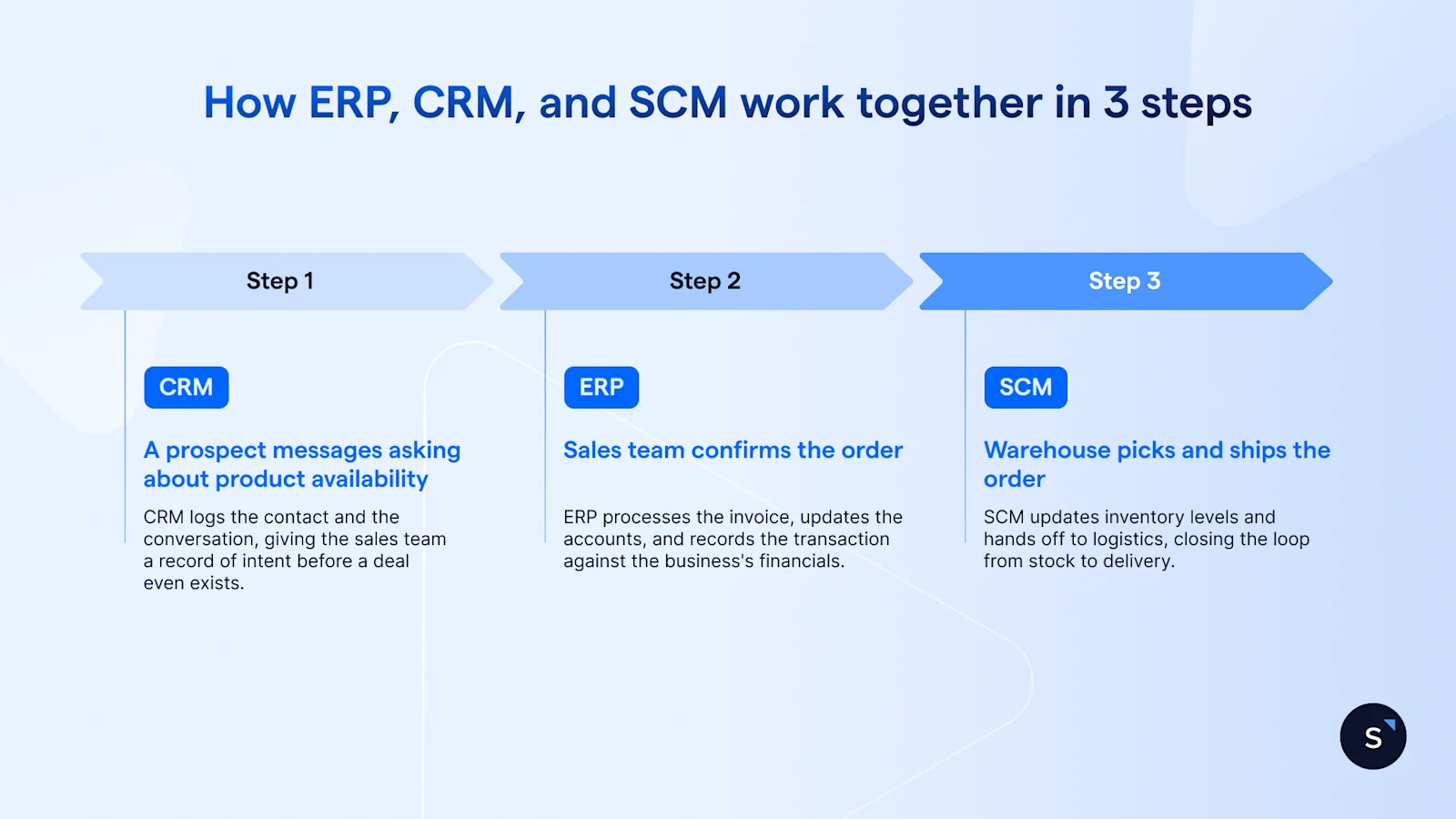
A single customer order usually moves through all three systems in sequence: CRM logs the intent, ERP processes the transaction, and SCM fulfils it, and each handoff is a transfer between systems that were never built to be the same system.
A prospect messages asking about product availability. CRM logs the contact and the conversation, giving the sales team a record of intent before a deal even exists.
The sales team confirms the order. ERP processes the invoice, updates the accounts, and records the transaction against the business's financials.
The warehouse picks and ships the order. SCM updates inventory levels and hands off to logistics, closing the loop from stock to delivery.
When the three are integrated well, a support agent can see that an order shipped without leaving the CRM. When they're not, the customer becomes the integration layer, repeating their order number to three different teams.
Which system should you implement first?
There's no universal order here. What to build first depends on where the operational pain actually sits: CRM for revenue and relationship problems, SCM plus ERP for inventory-heavy product businesses, and an integration audit for anyone whose systems already exist but don't talk to each other.
A useful gut check: if the pain is "we don't know why deals stall or customers churn," that's a CRM problem. If it's "we don't know what we actually have in stock," that's SCM. If it's "we can't close the books without three people and a week," that's ERP.
The customer intelligence gap ERP, CRM, and SCM don't fill
All three systems record what happened after a customer signal, not the signal itself, so the WhatsApp question, the early churn warning, and the pre-purchase back-and-forth never reach a system in real time.
The WhatsApp message where a prospect asked about stock before buying. The conversation thread where a churn risk first showed up, 3 messages before the customer went quiet. The pre-purchase exchange where buying intent actually formed. None of that reaches a CRM record, an ERP demand forecast, or an SCM reorder trigger in real time, because none of these systems were built to read a live conversation. They were built to store what a human decided to type into a form afterward.
This gap matters more than it used to, because conversation has become the default channel customers use before they buy. Across 22 global markets, Meta's Kantar-commissioned research found that 73.3% of consumers prefer messaging a business over other contact methods, and a comparable share said they're more likely to purchase from a brand that offers it.
AI closes this gap by operating at the conversational layer itself, rather than after it. An AI agent can read the conversation as it happens, qualify intent from what the customer is actually asking, and surface real demand before the order exists, upstream of where CRM, ERP, and SCM currently pick up the story.
How AgentFlow turns conversations into pipeline intelligence
AgentFlow sits inside the conversation itself, across WhatsApp, Instagram, and live chat, qualifying leads from what customers say rather than from a form they fill in later.
It feeds that intent back into your existing sales and support workflow, connecting to the CRM, ERP, or SCM system you already run rather than replacing any of them.
That's the specific gap it closes: the signal all three systems currently miss, captured and handed off before the moment passes.
Frequently Asked Questions
What is the difference between ERP, CRM, and SCM?
Is CRM part of ERP, or are they separate systems?
Which should a business implement first: ERP, CRM, or SCM?
How does integrating ERP, CRM, and SCM improve customer experience?
What does a modern CRM need to capture that a traditional CRM tool misses?

Want to outcompete your peers with SleekFlow's help?
Book your personalised demo with SleekFlow today and unlock the potential of seamless communication

