How to increase business revenue: proven strategies to grow sales, conversion, and retention


TL; DR: Quick Summary
- Increasing business revenue starts with fixing funnel leaks, such as slow replies, missed enquiries, abandoned carts, weak follow-up, and low repeat purchases.
- Businesses can grow revenue by improving five key levers: qualified demand, conversion rate, average order value, purchase frequency, and customer retention.
- AI and automation help teams respond instantly, qualify leads, route enquiries, recover abandoned carts, and personalise follow-ups across channels like WhatsApp, Instagram, and live chat.
- For Singapore businesses, conversational commerce is especially important because customers increasingly discover, ask, compare, and buy through mobile-first messaging channels.
- Cellini uses SleekFlow to generate over S$10,000 in one campaign, showing how conversation-led engagement can directly support sales growth.
For most businesses, the best way to increase business revenue is not to chase every new growth tactic at once. It is to understand which revenue lever is underperforming, then fix the leaks already sitting inside the sales funnel.
In Singapore, this matters even more. DataReportal reported that Singapore has 5.61 million internet users and 10.5 million cellular mobile connections, making digital and mobile-first customer engagement a core revenue channel rather than a side activity.
Revenue usually grows when one or more of these five levers improve:
More qualified demand
Higher conversion rate
Bigger average order value
Stronger purchase frequency
Better retention
The fastest way to increase revenue is often to convert more of the demand you already have before spending heavily on new acquisition.
What actually increases business revenue?
Xero defines revenue as the total income a business earns from selling products or services before expenses, and explains that businesses can grow revenue by selling more, attracting more customers, or charging higher prices.
A simple revenue formula makes this practical:
Revenue = traffic or leads × conversion rate × average order value × purchase frequency × retention
This formula shows why “more leads” is not always the answer. A business with strong traffic but poor follow-up has a conversion problem. A business with many first-time buyers but few repeat purchases has a retention problem. A business with healthy sales but low basket size has a monetisation problem.
Where is your business losing revenue right now?
Before adding new tools or campaigns, identify the leak.
This is the key principle: business revenue growth comes from removing friction, not just adding campaigns.
Best strategies to increase your business revenue
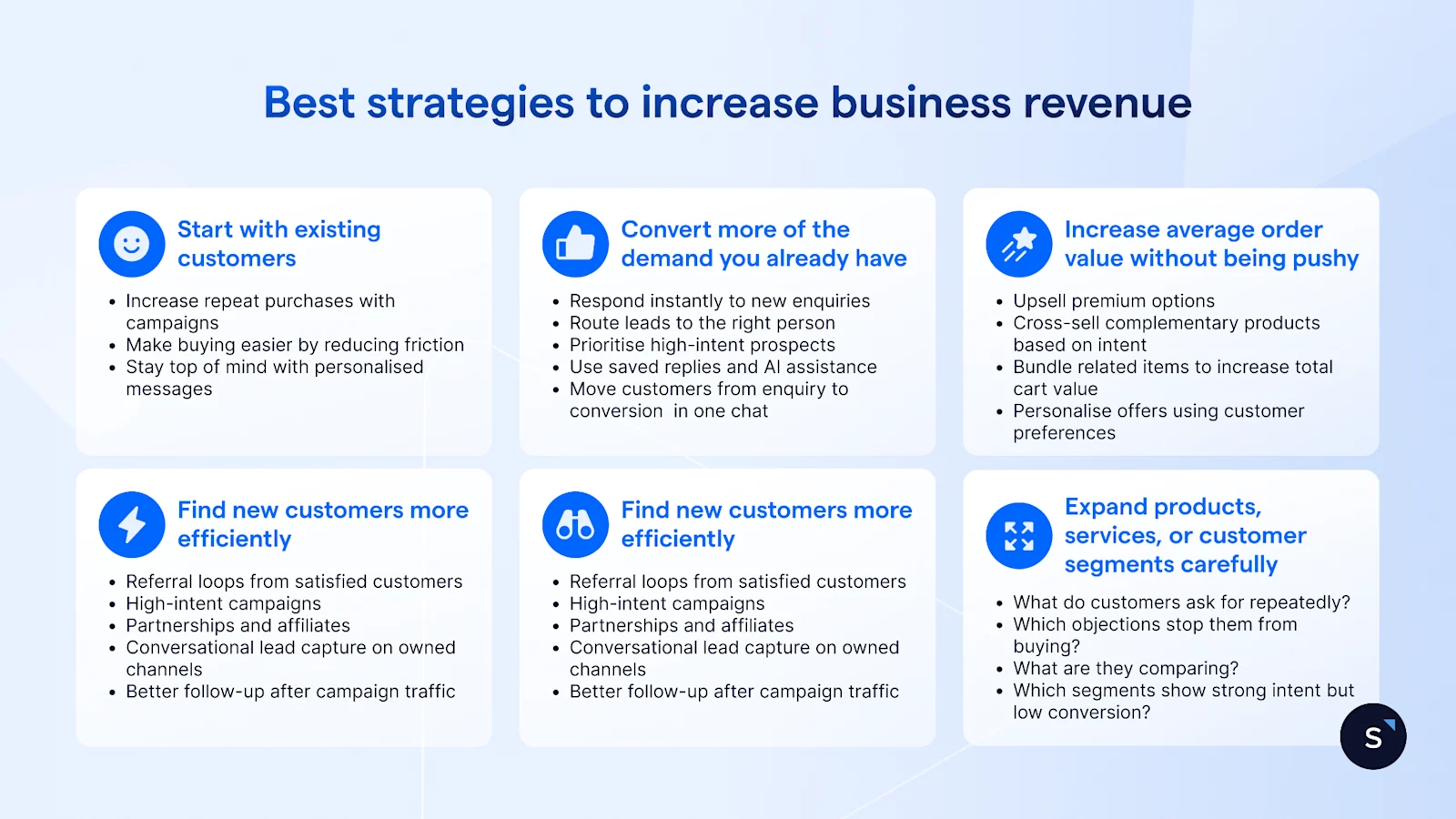
Start with your existing customers before chasing new ones
Existing customers already understand your brand, offer, and buying process. That makes them the most practical starting point for revenue growth.
Focus on three moves:
Increase repeat purchases with timely reminders, replenishment campaigns, service renewals, or post-purchase offers.
Make buying easier by reducing unnecessary forms, redirects, and manual payment steps.
Stay top of mind with personalised messages based on customer behaviour, interests, and purchase history.
Xero also recommends encouraging more purchases from existing customers as one of the main ways to increase revenue.
Convert more of the demand you already have
If leads are coming in but sales are not increasing, the problem is usually response speed, routing, or conversation quality.
Harvard Business Review’s classic study found that many companies were not responding to online sales leads fast enough, and the underlying research showed that companies contacting leads within an hour were nearly seven times more likely to qualify them than those that waited longer.
To improve conversion:
Respond instantly to new enquiries
Route leads to the right team or location
Prioritise high-intent prospects
Use saved replies and AI assistance for consistency
Move customers from enquiry to payment or booking inside the same conversation
For many businesses, revenue is not lost because demand is absent. It is lost because conversations are missed, slow, scattered, or never followed up.
Increase average order value without feeling pushy
Average order value grows when customers see a more useful option, not when they feel pressured.
Practical ways to increase AOV include:
Upsell premium options by clearly explaining the extra value.
Cross-sell complementary products based on intent or purchase history.
Bundle related items to increase total cart value while protecting margin.
Personalise offers using customer preferences, past purchases, and conversation context.
Xero highlights upselling to premium products and bundling as ways to increase sale value, while warning that discounting can damage profitability if used carelessly.
Recover lost revenue hiding in abandoned journeys
Abandoned carts, unanswered chats, missed calls, incomplete forms, and dormant leads are all revenue leaks.
Baymard Institute’s 2026 benchmark places the average documented online cart abandonment rate at 70.22%, based on 50 studies.
That means ecommerce teams should treat recovery as a revenue channel. Use reminders, WhatsApp follow-ups, live chat assistance, payment links, and product recommendations to bring customers back before intent disappears.
[Image guideline: Add a before-and-after visual showing “abandoned cart” becoming “WhatsApp reminder → product help → payment link → purchase”. Alt text: “Recovering abandoned carts with conversational follow-up”.]
Find new customers more efficiently
Once your funnel is converting well, expand demand.
The strongest acquisition channels often include:
Referral loops from satisfied customers
High-intent search and social campaigns
Partnerships and affiliates
Conversational lead capture on owned channels
Better follow-up after campaign traffic
For Singapore businesses, owned messaging channels such as WhatsApp, Instagram, live chat, and Messenger are especially valuable because they create direct conversations instead of anonymous traffic.
Expand products, services, or customer segments carefully
Expansion works best when your core offer already converts. Xero recommends testing new products or services in a small way before committing to large investments.
Use customer conversations to spot demand gaps:
What do customers ask for repeatedly?
Which objections stop them from buying?
Which related products or services are they comparing?
Which segments show strong intent but low conversion?
Start small, measure conversion, then scale.
How AI and automation can increase business revenue
Capture and qualify leads automatically
AI agents and automation can collect names, preferences, budgets, locations, urgency, and product interests before a salesperson joins the conversation.
SleekFlow’s Flow Builder supports automated journeys, routing, and customer data capture, while AI agents can be configured for lead scoring, handoff, and team-specific use cases.
Respond instantly across channels
Customers may message from WhatsApp, Instagram, Facebook Messenger, live chat, or SMS. A unified inbox helps teams respond without switching apps.
SleekFlow’s omnichannel inbox lets businesses respond across multiple channels while keeping customer context in one place.
Route sales and support conversations intelligently
Smart routing sends enquiries to the right team based on product type, urgency, location, language, or customer value.
SleekFlow supports conversation assignment, team collaboration, internal notes, role-based controls, CRM context, and AI-assisted replies for sales and support teams.
Recover abandoned carts and dormant customers
Automation can trigger abandoned cart reminders, reactivation messages, replenishment prompts, and post-purchase follow-ups.
SleekFlow’s ecommerce integrations support Shopify sync, WhatsApp Catalogue, custom catalogues, payment links, and abandoned cart follow-up workflows.
Personalise upsell and retention campaigns
AI can recommend products, generate personalised replies, segment audiences, and tailor follow-ups based on customer intent.
SleekFlow supports broadcasts, contact lists, labels, customer properties, and personalised campaign messaging for targeted re-engagement.
Turn conversation data into revenue insights
Conversation analytics reveal where revenue is leaking: slow response times, poor handoff, weak campaigns, low reply rates, or missed conversion events.
SleekFlow’s analytics track conversation volume, response time, resolution time, broadcast performance, conversion events, and conversion rate.
Revenue growth strategies by business type
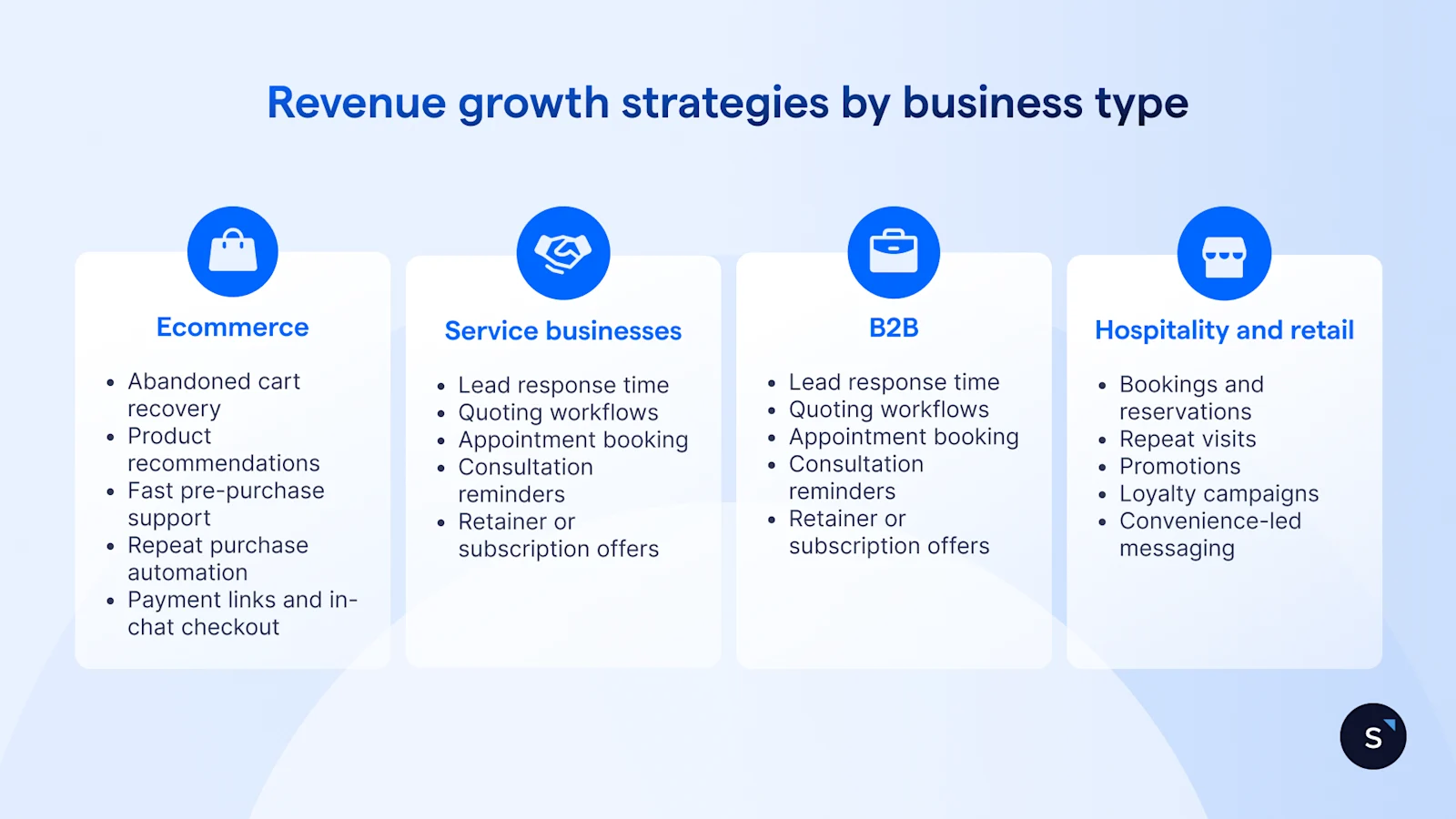
Ecommerce
Focus on:
Abandoned cart recovery
Product recommendations
Fast pre-purchase support
Repeat purchase automation
Payment links and in-chat checkout
Businesses can track sales generated through in-chat payment links and identify top-performing agents and teams across revenue stages.
Service businesses
Focus on:
Lead response time
Quoting workflows
Appointment booking
Consultation reminders
Retainer or subscription offers
For service-led businesses, every slow reply can become a lost booking.
B2B
Focus on:
Lead qualification
Sales cycle speed
Account expansion
Dormant lead reactivation
CRM updates and sales handoff
The goal is not just more leads. It is better-qualified opportunities moving faster through the pipeline.
Hospitality and retail
Focus on:
Bookings and reservations
Repeat visits
Promotions
Loyalty campaigns
Convenience-led messaging
Retail and hospitality brands can use conversational channels to send timely offers, answer questions, confirm bookings, and recover missed intent.
How SleekFlow can help increase business revenue
SleekFlow helps businesses turn conversations into measurable revenue by connecting AI, omnichannel messaging, automation, commerce, CRM, and analytics in one platform.
With SleekFlow AgentFlow, businesses can use AI agents to accelerate lead generation, sales, and retention across multiple channels.
With SleekFlow’s omnichannel inbox, teams can manage WhatsApp, Instagram, Messenger, live chat, SMS, and other channels in one place. SleekFlow also unifies leads from websites, WhatsApp, Facebook Messenger, Instagram, TikTok, SMS, and more, while its AI agent works 24/7 to engage leads, create profiles, and recommend products.
Real life example: Cellini used SleekFlow to turn conversations into S$10K revenue
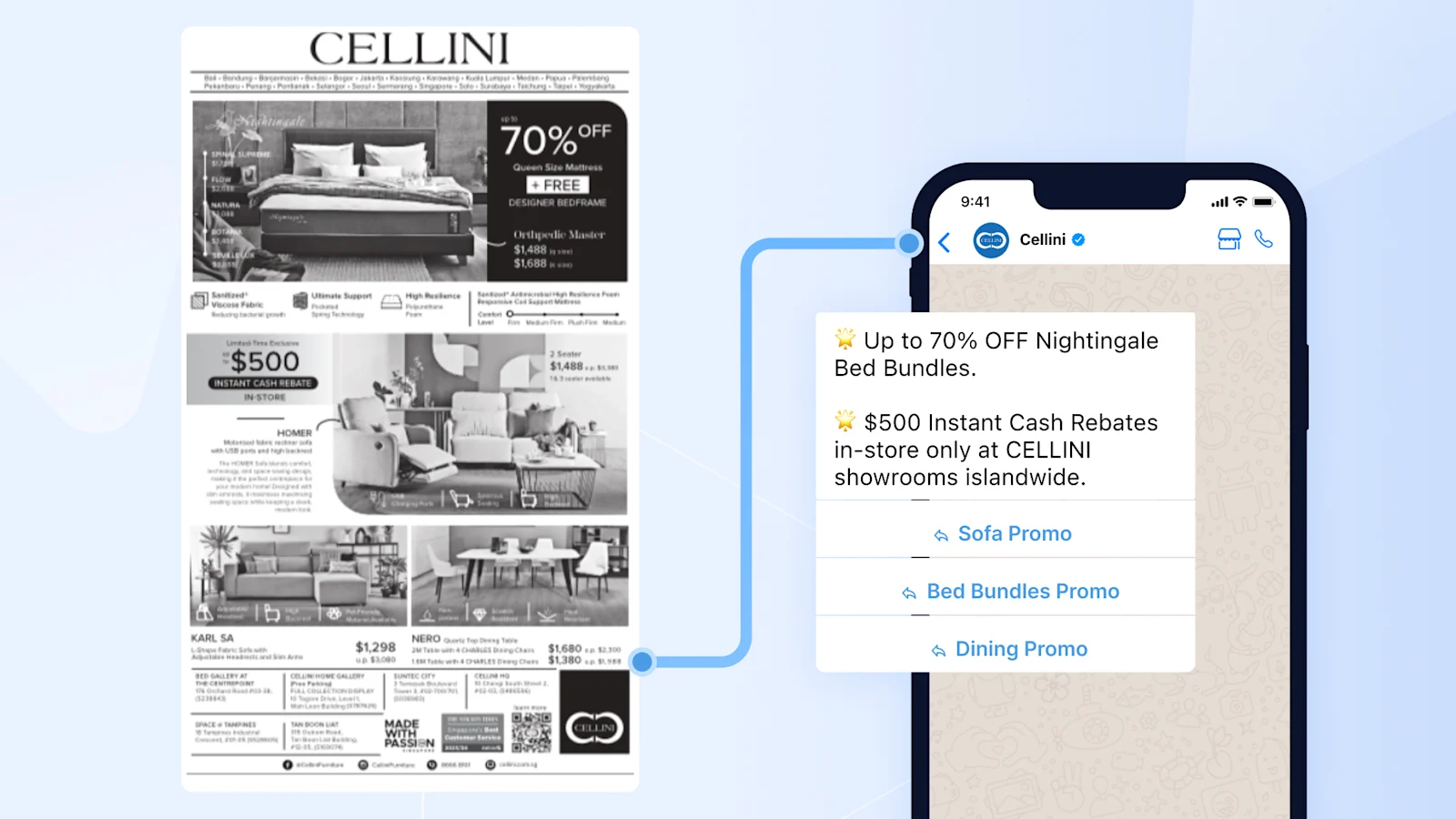
Cellini Singapore used SleekFlow to manage customer enquiries across WhatsApp, Facebook, and website chat in one unified inbox. With automated replies, smart routing, CRM-integrated customer context, WhatsApp QR code campaigns, and Click-to-WhatsApp ads, the furniture retailer reduced manual work while improving lead capture and follow-up. In six months, Cellini handled nearly 7,000 customer queries automatically, while one Click-to-WhatsApp campaign generated almost 500 WhatsApp leads in March 2025 and over S$10,000 in revenue from a single showroom. Bowtie used CRM-triggered WhatsApp follow-ups and web-to-WhatsApp campaigns to improve health questionnaire response rate by 23%, with 50% of promo-code recipients from the campaign becoming customers.
For Singapore businesses, SleekFlow is especially practical because revenue growth increasingly happens in conversations: enquiries, recommendations, bookings, support, payments, renewals, and reactivation.


