How to use WhatsApp Business for restaurants: bookings, campaigns & more


TL; DR: Quick Summary
- Customers now discover, ask, and book restaurants through chat apps like WhatsApp, Instagram, and TikTok, making instant messaging essential for modern restaurant operations.
- WhatsApp Business offers powerful tools for reservations, promotions, ordering, and customer support, with significantly higher open rates than email.
- Restaurants can automate bookings, FAQs, reminders, and feedback with AI agents and chatbots, reducing staff workload while improving guest experience.
- Restaurants can automate bookings, FAQs, reminders, and feedback with AI agents and chatbots, reducing staff workload while improving guest experience.
- Omnichannel strategies unify WhatsApp, social media, and SMS into one system, enabling faster responses, centralized campaigns, and personalized guest interactions.
- Real-world examples show strong results, including higher response rates, improved efficiency, and increased customer engagement.
Customers now discover, ask, book and review restaurants via chat and social apps. They explore new restaurant options on Instagram and TikTok, message via WhatsApp or Instagram DM, and expect instant answers.
For restaurants that still rely on single-channel marketing like SMS, email blasts, or walk-in counters, there might be many challenges:
Missed bookings
Disorganized promotions
Inconsistent guest experiences across different locations
With an omnichannel for restaurants strategy, you can turn every chat into a potential restaurant reservation, and every reservation into a loyal guest. Discover why you should use WhatsApp Business for restaurants, how AI agents can be integrated, and strong case studies that show measurable results.
Why use WhatsApp Business for restaurants
WhatsApp, one of the largest messaging platforms globally, is a great channel for quick and personal real-time conversations. Its 98% open rates, compared to emails with only 20%, makes it an incredible booster for your restaurant communication strategy.
WhatsApp Business API also has useful features that can make it a good tool for your restaurant reservation booking system:
Verified business profiles
Customized message templates
Quick replies and scaled automation
Integrations with property management systems (PMS), booking engine or CRM
For multi-branch operations, having a centralised WhatsApp Business account in your omnichannel restaurant communication strategy is highly beneficial. Routing of inquiries will be centralized, booking confirmations can be consistent, and promotional broadcasts will generate a higher ROI.
WhatsApp Business App vs. API: Which is right for your restaurant?
For restaurants, both options have their own advantages. The choice between the App and the API depends on a restaurant's service complexity and volume of covers.
WhatsApp Business App: Ideal for small businesses like family diners or single-location cafes, this free tool offers a simple interface similar to personal WhatsApp but includes basic business features like profiles.
WhatsApp Business API: Designed for larger operations such as restaurant chains or high-volume venues, the API requires integration with a third-party inbox like SleekFlow. It enables automation, CRM integration, and large-scale communication, making it a powerful tool for enterprise-level needs.
Use cases of WhatsApp Business for restaurants
Now that you know the benefits of using WhatsApp Business for your restaurant, let's review a few key use cases before diving into specific scenarios.
Here are some common restaurant workflows where WhatsApp becomes an integral part of a restaurant communication strategy:
WhatsApp for reservations: Streamline table bookings with quick replies and confirmations
Imagine a guest who sees your Instagram story about tonight’s chef’s special. They tap the “Message” CTA and land in WhatsApp. From there:
A short, automated flow asks for the date, time, party size, and preferred branch.
The table is reserved instantly.
An automated confirmation message is sent via WhatsApp, along with a reminder two hours before the booking.
Here's how reservation automation works step-by-step:
Entry points (Instagram DM / Google / QR / Click-to-WhatsApp ad) → WhatsApp Flow (collect date/time/party size) → Branch routing → Confirm reservation → Send reminder → Capture feedback → CRM tagging → Broadcast segment
The guest feels served and your team’s workload is reduced with fewer phone calls.
[Restaurant Name] - Reservation Confirmed!
Hi [Guest Name], great news! Your table for [Restaurant Name] tonight is all set. Here are your reservation details:
Date:
Time:
No. of Guests:
Branch Location:
We can't wait to see you! 👉 Need to change or cancel? Please reply "Manage" to this message. We'll send a friendly reminder 2 hours before your booking. See you soon!
In the case where reservations are cancelled, they can simply reach out to your restaurant on WhatsApp, where the AI agent for your restaurant can trigger an automated system for cancellation.
The freed-up table immediately becomes available.
The system automatically notifies the next guest on your waitlist.
This process helps reduce last-minute no-shows, minimizing potential revenue loss.
WhatsApp marketing for restaurants: Promotions, menus, and loyalty offers
Using a strategy focusing on WhatsApp marketing for restaurants, you can segment customers by past visits and send them a unique promo code via broadcast. The dynamic fields of WhatsApp broadcast feature will enable you to:
Customize messages with customer names.
Recommend items based on their past orders.
Attach one-tap message buttons like "Reserve" or "View Menu".
With message templates, you won’t have to spend time editing the messages one by one for conversions to improve and campaign ROI to grow.
Hi [Customer Name],
We’ve missed you at [Restaurant Name]! 🧡As one of our favorite guests, we want to thank you for your continued support with this special offer. 🤭
Enjoy 15% OFF your entire bill on your next visit using promo code [VIP2025]: valid for the next two weeks! Secure your spot now!
Button 1: Reserve Table
Button 2: View Menu
Read more about the best WhatsApp marketing software options to choose from for your restaurant.
WhatsApp chatbot for restaurants: Automate FAQs, confirmations and feedback
Restaurants always receive the same basic questions over and over: “Do you have vegan options?”, “Can I see the menu?”. A well-built AI and WhatsApp chatbot for restaurants can handle all of these FAQs automatically, 24/7. When the issue gets complicated, for example, customized needs for a private event request, these AI agents for restaurants can be routed seamlessly to a human agent.
After a reservation, you can set up automated settings to:
Trigger a mini feedback survey.
Capture data.
Tag guests with labels like “VIP-repeat” and “allergy-sensitive”.
That intelligence then fuels your next promotion or loyalty campaign.
Not sure how to train your AI? Learn to customize AI responses for your restaurants.
WhatsApp ordering for restaurants: Menu, order, pay, and upsell
Your restaurant customers can:
Browse your menu in-chat via a WhatsApp catalog.
Add items to their cart.
Choose pickup or delivery.
Personalized suggestions can be sent to encourage add-on purchases, and special coupons can be sent to recover abandoned carts. WhatsApp ordering for restaurants can also be synced to your POS and kitchen like any online order, but the experience stays where the guest started, all in chat.
WhatsApp Regulations for Restaurants
As with any messaging platform, it is important to adhere to the regulations set by WhatsApp in order to ensure a positive and compliant experience for your customers. These guidelines are put in place to protect both businesses and customers, and failing to follow them can result in account suspension or termination.
Menu and Catalog Restrictions
The WhatsApp Business Messaging Policy defines what you can sell in your WhatsApp Catalog. While most food items are allowed, several common restaurant offerings are prohibited:
Alcohol: You cannot list wine, beer, or spirits for direct sale in the commerce catalog, even if you have a liquor license.
Health and Supplements: Be cautious with "health-focused" items like detox juices or protein shakes. Products with specific health claims or classified as supplements may be rejected.
Animal Products: The sale of live animals or any products from endangered species is strictly forbidden.
Pricing Transparency: All prices must be clear. Hidden fees or misleading food descriptions violate the policy.
Rules for Customer Interaction
The WhatsApp Business Terms of Service govern how restaurants interact with customers. The most important rule is consent.
Mandatory Opt-In: You must get explicit consent before messaging customers. A customer's phone number for a reservation does not count as consent for marketing messages.
Anti-Spam Policy: WhatsApp has a zero-tolerance policy for spam. Automated messages are limited to a 24-hour window after a user's last message. Excessive messaging can lead to a permanent ban.
Operational Responsibility: Your restaurant is liable for its use of the platform, including compliance with privacy laws like GDPR or CCPA.
Message Templates: Restaurants must use pre-approved templates for communications like order confirmations and delivery updates. This ensures clarity and prevents platform misuse.
Pricing Variability by Country and Conversation Category
As of July 1, 2025, the WhatsApp Business Platform has shifted from a conversation-based pricing model to a per-message system. Costs now vary based on message category and the recipient's country.
Here’s a breakdown of the new pricing structure:
Why use omnichannel for restaurants and bookings
Omnichannel platforms bring every message into one flow. From SMS to social chats, your teams can manage customer conversations efficiently instead of facing dozens of silos across platforms. A great omnichannel restaurant communication strategy can bring many benefits:
Faster response, fewer lost reservations
A wider and more diverse customer reach across different locations and age group
Unified guest profile with order history and preferences for personalized service and higher spend per customer
Centralized campaigns with consistent promotions can generate better engagement and conversion
Better staff efficiency and less burn out, leading to greater customer experience
Integrating social media and AI agents for restaurants: A seamless omnichannel customer experience
Are your teams still checking WhatsApp, Facebook, Instagram DM, Telegram, SMS, and other communication channels separately? A single unified, omnichannel system will enable you to:
Collect messages from Facebook, Instagram, WhatsApp, and more into one inbox
Enrich customer profiles with order history and past booking info
Automate routine replies with AI agents for restaurants, escalating to humans for complex requests
Personalize follow-ups using the same chat history (e.g., “We noticed you love spicy foods! Here’s what you might like…”)
When you combine omnichannel strategy with AI agents trained on your menu, tone, and policies, you get instant answers and consistent guest experiences.
AI agents for restaurants: Beyond automation
Incorporating AI agents in your WhatsApp chatbot for restaurants can help:
Understand customers and parse intent (book a table vs. ask allergen question)
Update CRM fields (mark guest VIP, note preference)
Trigger actions through integrations (create booking in reservation system)
Propose pre-order suggestions based on past orders
Successful AI agents for restaurants are trained according to your restaurant needs and goals, including policies like cancellations and deposit rules, and other common FAQs like branch-specific hours, table capacity, and more.
For instance, an AI agent can suggest a dessert combo during booking or ask about dietary restrictions. The advanced automation can then complete the customer profile and drive more revenue in the long run.
Restaurant case study examples: Strategies and real results of omnichannel for restaurants
Omnichannel restaurant communication strategies that include WhatsApp often yield consistent outcomes.
Automated confirmations can ensure that guests are more likely to show up.
Personalized chat campaigns can bring higher broadcast ROI.
Case study #1: A Singapore confinement meal provider doubles efficiency and cuts response delays with omnichannel messaging
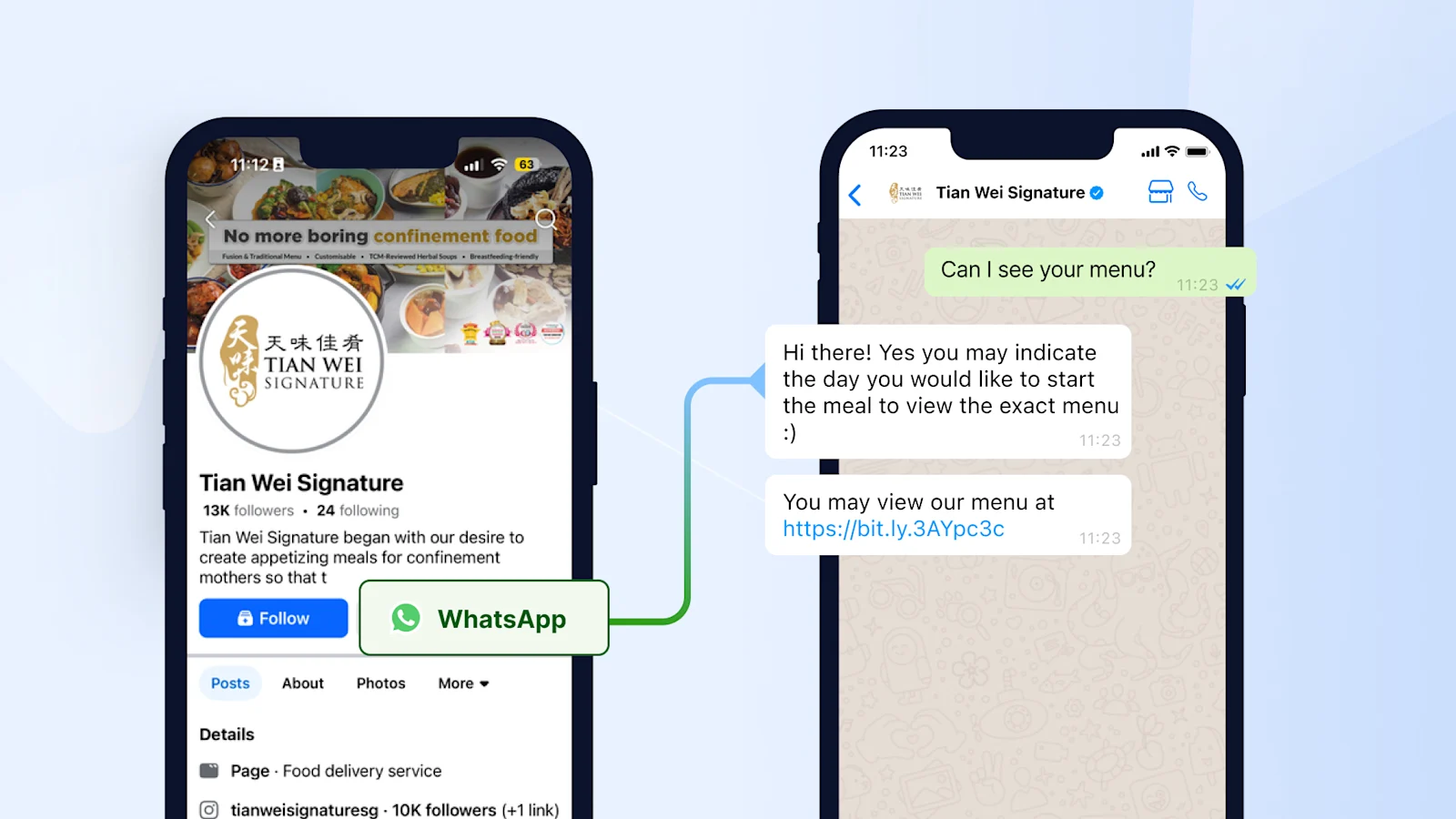
Tian Wei Signature, a professional confinement meal caterer delivering over 100 varieties of traditional and fusion dishes to postpartum mothers across Singapore, managed customer communications through a mix of phone calls, emails, and WhatsApp, with no central system tying them together.
With a structured omnichannel communication strategy, they've since consolidated all touchpoints into a single platform, allowing their team to focus on what actually matters: supporting new mothers through a critical recovery period.
Deployed an AI chatbot responding to "menu," "booking," and similar queries, freeing agents to handle complex, high-sensitivity conversations
Moved from the free WhatsApp Business App to the WhatsApp Business API: eliminated the 256-contact broadcast cap and removed the risk of account bans
Used segmented WhatsApp broadcast campaigns with personalised messaging: raised response rates without manual copy-pasting per customer
Centralised Facebook, Instagram, and WhatsApp into a shared inbox: enabled multiple team members to collaborate and hand off conversations without losing context
Results: 2× improvement in team efficiency, 20% increase in customer satisfaction, and a 40% improvement in response rate. WhatsApp open rates came in 4× higher than email for the same promotional campaigns.
"SleekFlow is centralised and hassle-free. It helps consolidate messages from various channels into a single platform, enabling multiple users to collaborate efficiently." — Ho Yi, Deputy Manager, Tian Wei Signature
Case study #2: F&B enterprise boosts loyalty flow across 40 outlets using WhatsApp for restaurants
LUBUDS Group, with over 1000 staff and nearly 40 outlets across Hong Kong and Macao, used WhatsApp QRs and prefilled messages to capture walk-in customers and build marketing opt-ins. By linking hundreds of channels into one platform and deploying WhatsApp chatbots for restaurants, their WhatsApp marketing solution for restaurants has yielded desirable outcomes.
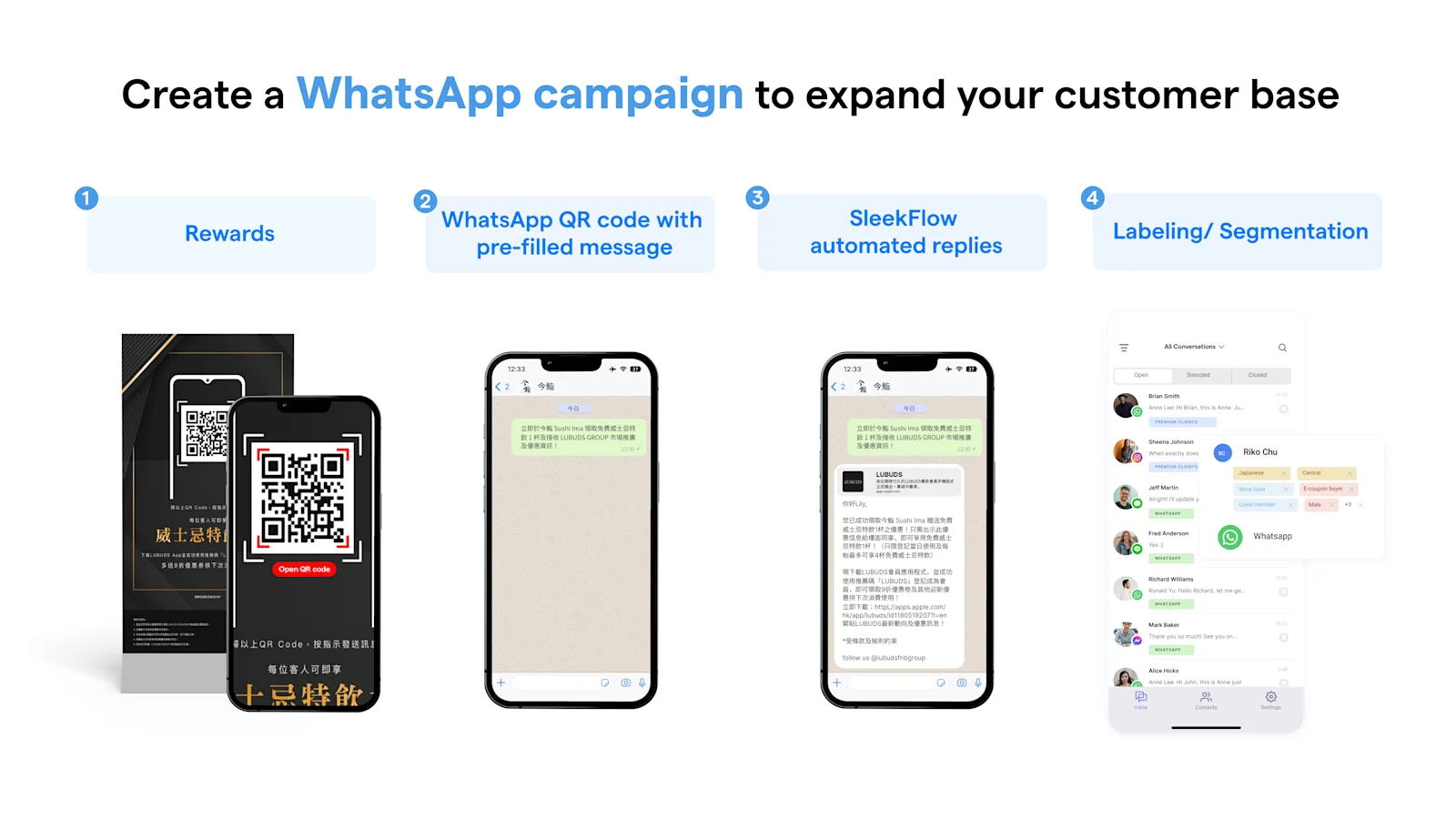
Walk-in customers scan QR codes to claim offers and join WhatsApp flows
Chatbots guide guests from menu discovery to booking and feedback
Data collected from chat and offline touchpoints fuel targeted broadcasts (welcome, birthday, and loyalty offers)
Results: improved engagement, faster response rates, reduced staff workload, and better campaign performance via segmentation and re-targeting.
Case study #3: Food tech startup drives MQL lift via WhatsApp marketing for restaurants
Green Rebel, a leading plant-based food technology startup in Indonesia, tested click-to-WhatsApp (CTWA) ads to drive warmer leads from paid socials. By sending ad clicks directly to WhatsApp, then nurturing through flows:
CTRs and MQLs increased; the brand saw ~4% MQL lift in the trial compared to other ad formats
Every lead flowed into the social CRM for follow-up broadcasts and remarketing
Result: higher quality leads and simpler lead management across channels
Uncover inspiring customer stories. Read now!
Don't take our word for it! See what our satisfied customers have said about us.
5 steps to implement omnichannel strategies for your restaurants
1. Assess your current communication channels
Start by analysing how customers contact you today. Are booking requests coming from WhatsApp, Instagram DMs, or even email? Many restaurants lose potential reservations simply because these messages are scattered across platforms.
To build a solid foundation for your omnichannel strategy, you should:
Map out all your current communication touchpoints.
Identify any bottlenecks, such as inconsistent replies, delays during busy periods, or missed follow-ups.
2. Set up WhatsApp Business API through a verified provider
Once you know where gaps exist, it’s time to professionalise your communication. The WhatsApp Business API gives your restaurant:
A verified business identity
Automated replies
Multi-agent access
Unlike the standard WhatsApp Business App, the API lets multiple staff across outlets handle chats simultaneously through a shared inbox. A verified provider like SleekFlow ensures compliance, onboarding support, and advanced features such as broadcast campaigns and AI chat flows that regular apps can’t offer.
Still using the free WhatsApp Business app? Check out this detailed guide on WhatsApp Business API on its differences and useful features.
3. Integrate with your social media accounts
Your guests might discover your brand on Instagram, ask questions on Facebook Messenger, and confirm reservations through WhatsApp, but they expect one consistent experience.
Integrating all popular social platforms into a single unified inbox offers several advantages:
Your staff can instantly view chat history, preferences, and booking details.
For multi-branch operations, messages can be automatically routed to the correct outlet based on location or customer intent.
This ensures no enquiry gets lost.
4. Automate messages and bookings using chatbots or AI agents
Restaurants handle hundreds of repetitive inquiries daily: “Is there a kids’ menu?”, “Do you take walk-ins?”, “What’s today’s lunch special?”
AI chatbots/AI agents can answer these in real-time, freeing your team to handle higher-value interactions. The key is balance:
Automation can handle FAQs, booking confirmations, and menu links.
Human agents should handle complex queries, such as large events.
Over time, the AI learns from conversations and can even offer predictive suggestions, from promoting a special dish to repeat customers to confirming a booking reminder before peak hours.
5. Train staff to manage conversations and track insights
Once your omnichannel for restaurant system is live, data becomes your best friend. Train your staff to track these key metrics:
Chat-to-booking conversion rate
Average response time per outlet
Broadcast campaign open and click-through rates
Repeat visit frequency
Use these insights to identify top-performing branches and replicate their strategies across the group. Remember that omnichannel for restaurants is an evolving framework that gets smarter with the improvements you make over time.
How SleekFlow solution creates an omnichannel experience with AI agents for restaurants
The F&B industry is full of tools that promise “automation” or “integration,” but very few are actually built for restaurants. Extraordinary providers like SleekFlow can offer solutions for:
High message volume
Multi-branch coordination
Personalized dining experiences
Instead of being just another messaging dashboard, SleekFlow can be your restaurant reservation booking system, greeting customers across WhatsApp, Instagram, Facebook, and even TikTok, while your teams manage everything from one place.
Here’s why leading restaurant groups across Asia choose SleekFlow to power their omnichannel communication:
1. Unified inbox that speaks every channel
From WhatsApp reservations to Instagram DMs about special menus, every message flows into a single collaborative inbox. With a unified inbox, your teams can:
Label chats by branch locations
Tag high-value guests
Assign messages based on customer interests
Managers get a real-time overview of branch performance and response times.
2. Smart workflows for restaurant bookings and orders
SleekFlow lets you design automated chat flows that match your restaurant’s workflow, including:
Booking confirmation
Menu sharing
Post-dining reviews
Each booking or order request can automatically generate a ticket in the system, ensuring that every enquiry is tracked and assigned to the right team, helping your staff stay organized and prevent missed messages for:
Table reservations
Delivery requests
Special catering orders
Customers can select a branch, date, and time directly in chat. The system then updates your internal CRM or restaurant reservation system automatically, minimising manual work and errors.
3. AI agents for restaurants trained to understand your brand
SleekFlow’s AI chatbots go beyond scripted replies. Using natural language processing (NLP), they can understand variations in how customers ask about menus, reservations, or allergies, and respond accordingly.
These AI chatbots are also:
Trainable to adopt your brand tone: Whether you run a fine dining restaurant or a casual café, the AI mirrors your style.
Able to escalate smoothly: When a situation requires a personal touch, it escalates smoothly to a live agent, keeping your brand’s warmth intact while saving manpower.
4. CRM and POS integration for personalised service
Every conversation syncs with your CRM and POS system, giving your team access to key customer details right within the chat. This includes:
The customer’s dining history
Their loyalty points
Personal preferences
Imagine greeting a repeat guest by name, knowing their favorite dish, and sending them a tailored offer right before their birthday, all completed automatically to win customers’ hearts.
5. Analytics and campaign performance at a glance
Through SleekFlow’s analytics dashboard, you can monitor:
Chat volumes
Campaign performance
Booking trends
Customer satisfaction scores
The visual reports make it easy to identify patterns showing peak booking times or successful promotions.
For decision-makers, these features translate into: faster bookings, lower staffing costs, better guest loyalty, and measurable marketing ROI. Your teams can adopt these features quickly on a single platform without being burnt out.
Ready to start? Let our professional team tailor a WhatsApp Business strategy for your restaurant.
Start for free!
Grow your revenue and turn chats into conversions with AI agents. Try SleekFlow for free, forever.


