Human AI integration: how the handoff works


TL; DR: Quick Summary
- Human AI integration assigns each conversation to whichever side handles it better, then engineers the handoff.
- Automating everything and reviewing everything by hand are both broken defaults for handling customer conversations.
- Three signals: sentiment shift, topic complexity, and task authority, tell an AI agent exactly when to hand off.
- The fastest way to start is a table mapping conversation types to whichever side should own them.
- SleekFlow customers such as BateriHub have cut response speed by up to 17x while keeping a human in the loop for anything that needs one.
What is human AI integration?
Human AI integration is an operating model for customer conversations that assigns each message to whichever side, AI or a person, handles it better, then engineers the handoff between them. Instead of full automation or an all-human team, defined categories of work go to AI, defined exceptions go to humans, and context moves with the conversation.
Neither side is doing the other's job by accident. IBM defines the wider discipline of human-AI collaboration as a partnership that lets people and AI systems accomplish tasks neither could do as well alone, AI for consistency and scale, humans for judgement, empathy, and accountability. Applied to customer conversations, that partnership needs an actual mechanism, not just a good intention. That mechanism is the handoff.
Where this creates the most value, and where most businesses get it wrong
Every inbound WhatsApp or Instagram message triggers an instant decision: AI or human. Most businesses never design that decision. They either automate broadly and hope, or route everything to people and watch response times collapse under volume.
Research from Brynjolfsson, Li, and Raymond at NBER found that giving customer support agents access to an AI assistant lifted issues resolved per hour by 14% on average, and by 34% for newer, less experienced agents, without hurting customer satisfaction. That gain came from AI handling the load agents don't need to carry alone, not from AI carrying the whole conversation.
McKinsey's research on agentic AI describes a utility company whose AI agents now handle around 40% of calls and resolve 80% of those without a human, but every one of the remaining calls transfers to a person with the customer's history attached. That last part is the part most rollouts skip. Gartner predicts agentic AI will resolve 80% of customer service issues without human involvement by 2029, cutting operational costs by 30%. Getting there safely depends entirely on how well the remaining 20% is handed off, not on how much gets automated.
What human-AI integration looks like in a real conversation
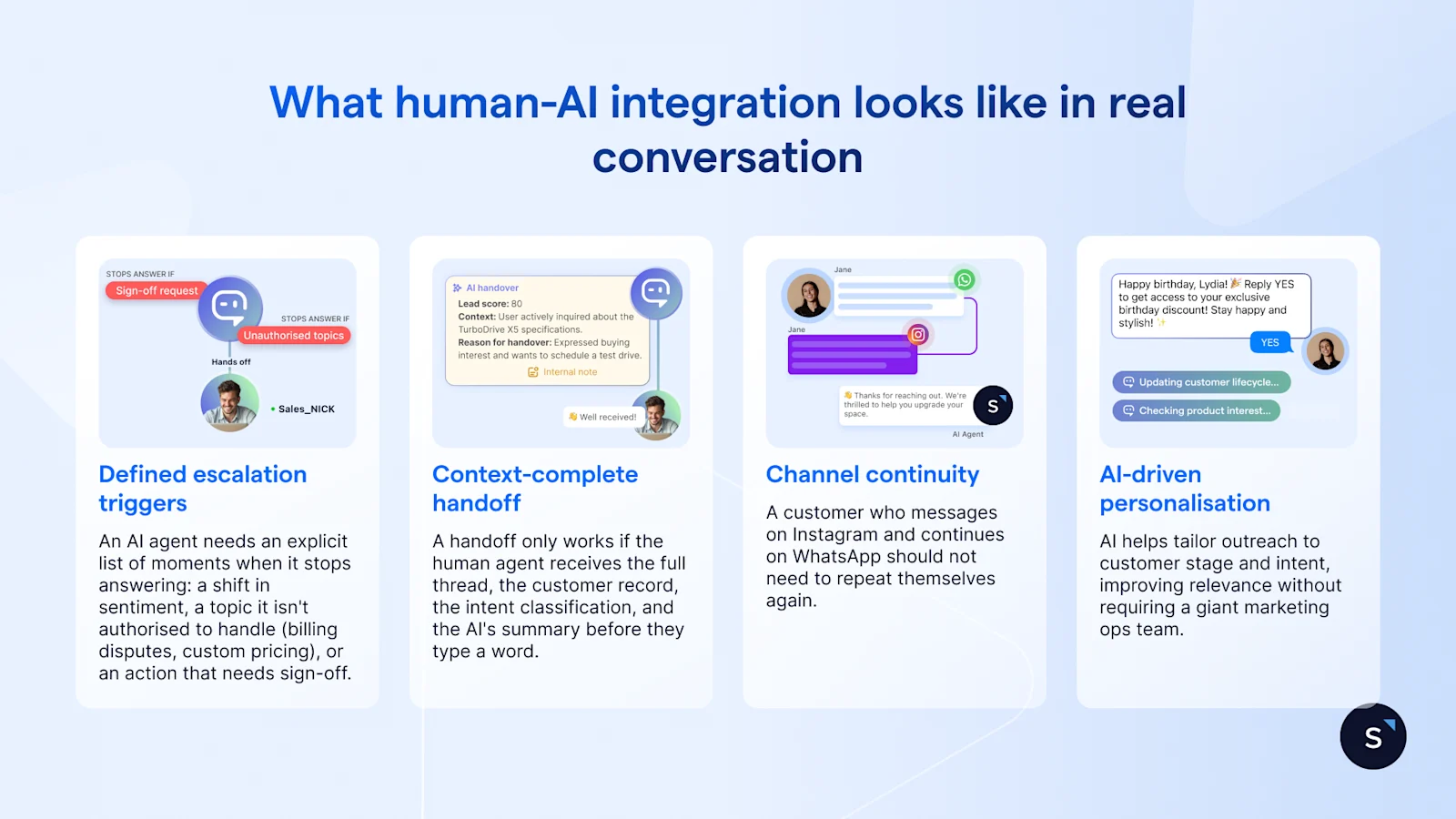
Picture a WhatsApp inquiry that starts simple. AI answers two product questions instantly, then the customer mentions a past billing problem and their tone shifts. The AI detects the signal, summarises the thread, and hands off to a human with full context. Resolution takes 3 minutes instead of 23, and the customer never repeats themselves.
The human agent didn't do less work because AI was involved. They did the part only a person can do: read the frustration, make the judgement call, close the account issue. The AI did the part it's built for: instant response, knowledge lookup, and a clean handover. Neither replaced the other.
Defined escalation triggers
An AI agent needs an explicit list of moments when it stops answering: a shift in sentiment, a topic it isn't authorised to handle (billing disputes, custom pricing), or an action that needs sign-off. Without that list, the agent either escalates too often, burying the team in easy tickets, or not often enough, and lets a frustrated customer sit in a bot loop.
Context-complete handoff
A handoff only works if the human agent receives the full thread, the customer record, the intent classification, and the AI's summary before they type a word. A blank screen forces the customer to repeat themselves and erases the time AI just saved. SleekFlow's AI engine shows its reasoning behind every reply, which is what makes that summary trustworthy enough for a human to act on without re-reading the whole thread.
Channel continuity
The conversation stays in the channel where it started. A customer who messages on Instagram and continues on WhatsApp should not need to repeat themselves. When a customer needs to repeat themselves on every channel, drop-offs happen as there is additional friction for them.
Designing your integration model: a decision framework
A working handoff model starts with a table, not a policy document. List every conversation type your business sees, name who handles it, and define what triggers a human takeover. 5 categories cover most B2C messaging.
Some frameworks group this into named collaboration models, tiered review, human-in-the-loop, and hybrid partnerships, each suited to a different risk level. Whichever label you use, the table below is the practical starting point.
Treat it as a starting draft. A "simple" FAQ category that keeps escalating usually means the knowledge base is thin, not that the category belongs somewhere else.
Best practices for designing the handoff model
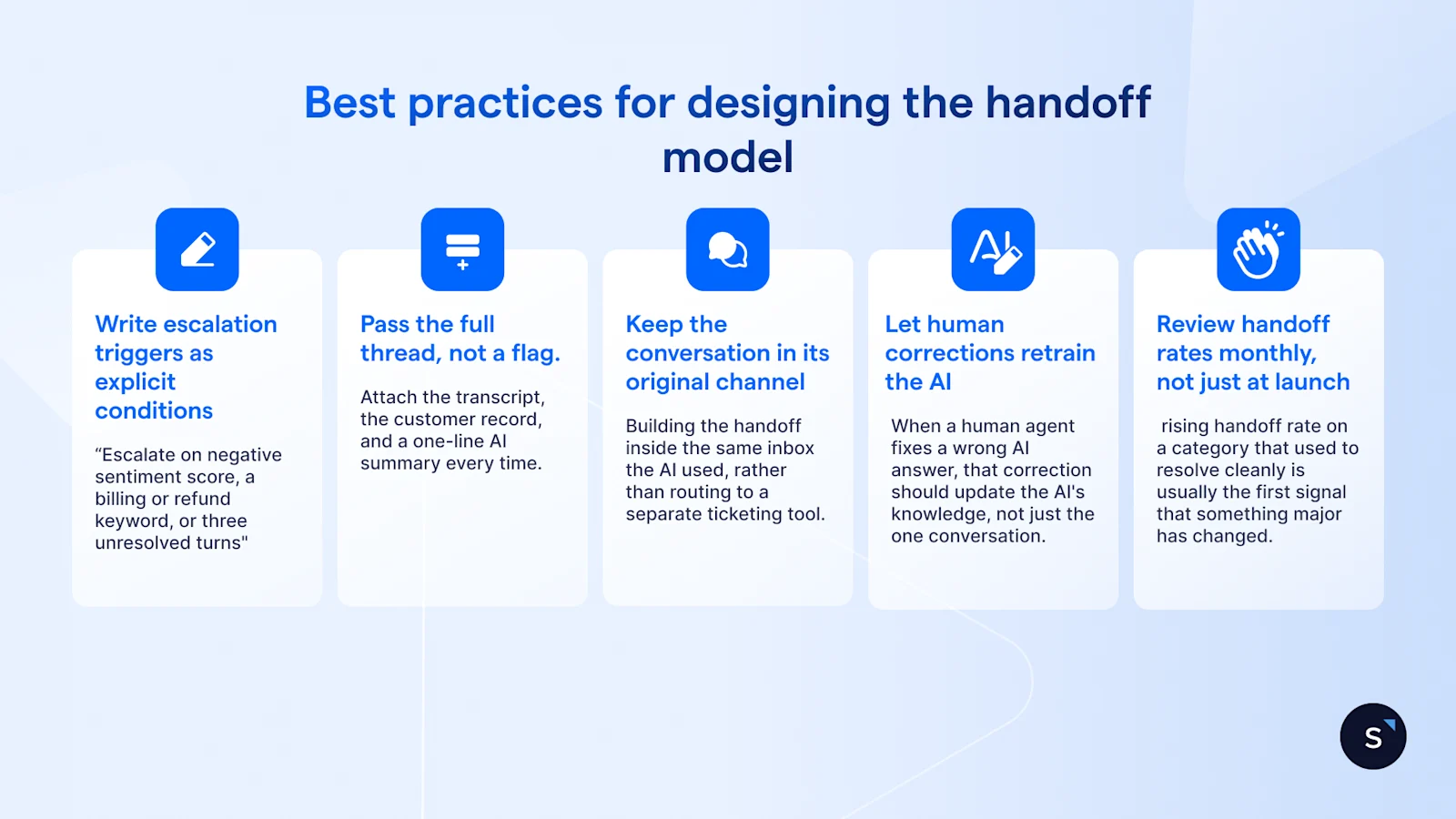
Write escalation triggers as explicit conditions, not vibes. "Escalate if the customer sounds upset" isn't a trigger a system can act on. "Escalate on negative sentiment score, a billing or refund keyword, or three unresolved turns" is.
Pass the full thread, not a flag. A notification that says "escalation needed" without the conversation attached forces the human to start from zero. Attach the transcript, the customer record, and a one-line AI summary every time.
Keep the conversation in its original channel. Building the handoff inside the same inbox the AI used, rather than routing to a separate ticketing tool, is what keeps the customer from repeating themselves.
Let human corrections retrain the AI. When a human agent fixes a wrong AI answer, that correction should update the AI's knowledge, not just the one conversation. Otherwise the same gap resurfaces next week.
Review handoff rates monthly, not just at launch. A rising handoff rate on a category that used to resolve cleanly is usually the first signal that something in the product, policy, or knowledge base changed.
How SleekFlow supports human AI integration
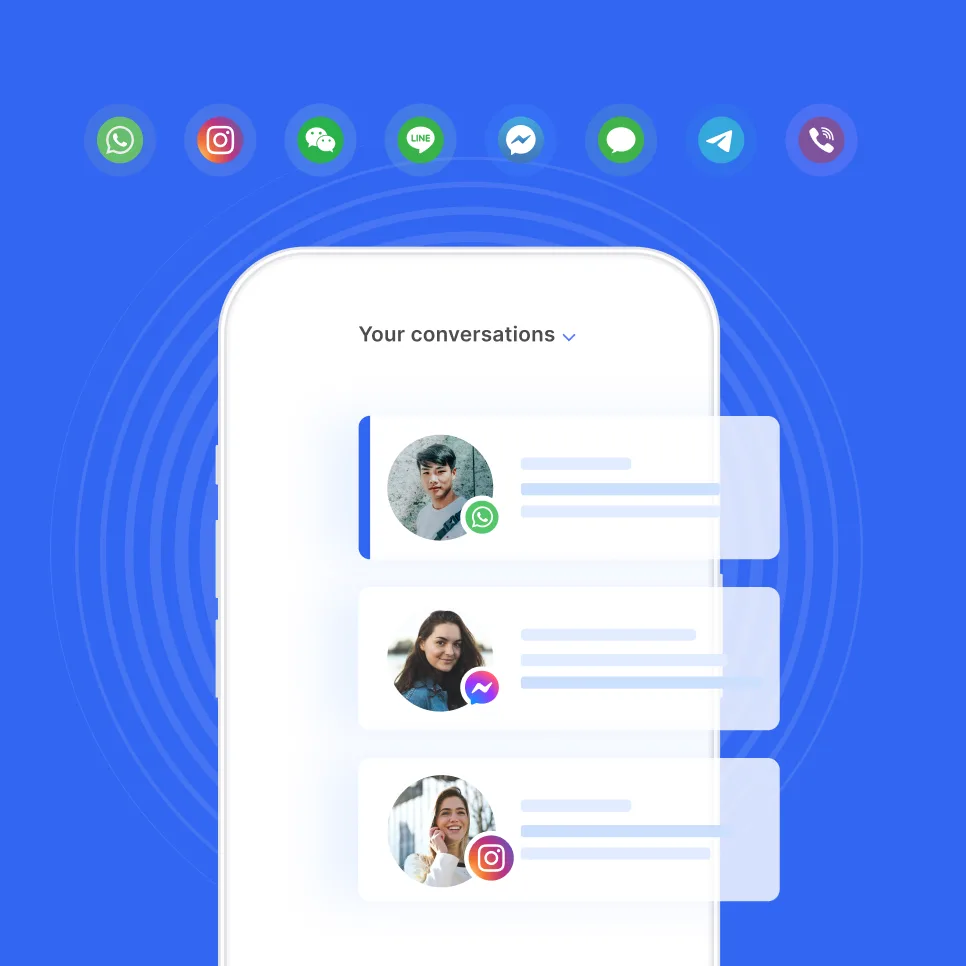
SleekFlow is an omnichannel AI messaging suite for revenue-driving conversations across WhatsApp, Instagram, Messenger, and more. AgentFlow is its AI agent product, built to answer, qualify, and act inside a conversation, then hand off with everything a human needs already attached.
BateriHub, a Malaysian car battery and roadside assistance provider with over 130 branches, built its handoff around one rule: AI collects the urgent details (location, car model, urgency), and a technician finishes the job with everything already in hand.
Results:
17x faster response speed after AI took over first contact
Spam leads cut to under 1%, so technicians only see real enquiries
22% increase in conversions within 3 months
Want to outcompete your peers with SleekFlow's help?
Book your personalised demo with SleekFlow today and unlock the potential of seamless communication


