Meta Business Agent vs AI agent: differences, cost and how to choose (2026)


TL; DR: Quick Summary
- Meta Business Agent has charged US$2.00 per million tokens, about 4 to 5 US cents a message, since 1 August 2026.
- Meta blocks 7 verticals outright, including finance and health, so regulated Singapore and Malaysia businesses often need a third-party AI agent instead.
- Meta's own comparison puts 1,000 AI replies at roughly US$40 to US$50, cheaper than a heavy third-party setup but pricier than a lean one.
- You can run Meta Business Agent and your own AI agent on the same WhatsApp number, with Meta as primary responder and yours on standby.
Author's note: this comparison reflects SleekFlow's assessment; details and pricing are accurate as of publication and may change, so verify with Meta directly. Full note below.
You switched on Meta's new WhatsApp agent when it was free, and it handled a summer's worth of chats without a fuss. Then an invoice showed up in Billing Hub.
Knowing what Meta Business Agent actually costs now, who it locks out, and when a third-party AI agent is the better call fixes both that problem and the one before it: whether to bother at all.
What is Meta Business Agent?
Meta Business Agent is Meta's own AI system for WhatsApp, and increasingly Messenger and Instagram, that answers customer questions, takes actions through a business's own connected systems, and hands off to a human, all in that business's brand voice. It launched globally in June 2026, with token-based billing following on 1 August 2026.
It comes in two forms that people talk about as one product. The Meta Business Agent App runs inside the WhatsApp Business app's Tools tab, needs no code, and learns from a business's past chats, Facebook Page, and website. The Meta Business Agent Platform is the developer-facing version, built for Cloud API numbers, where a business supplies knowledge through Business Info, FAQ, and file endpoints, and wires up its own actions through webhooks. Same agent underneath, different amount of control.
What is a third-party AI agent on WhatsApp?
A third-party AI agent on WhatsApp is a vendor-built assistant, such as SleekFlow's AgentFlow, that connects to a business's own WhatsApp Business API number and its other systems rather than routing through Meta's agent infrastructure. It is trained on the business's own content, reads and writes to its CRM or e-commerce platform, and is billed by the vendor, separately from Meta's own messaging fees.
That separation is the whole point. The agent can follow a customer from WhatsApp into a live chat widget or an Instagram DM, and it keeps working in verticals Meta's own agent doesn't serve at all.
Meta Business Agent vs a third-party AI agent: the full comparison
Meta Business Agent and a third-party AI agent differ across 8 practical dimensions: who replies, how it is billed, which channels it reaches, where its knowledge comes from, what it can do in other systems, how handover works, who can use it, and what a business can see afterwards.
Any eligible business that wants zero setup and only needs WhatsApp covered has little reason to look past the app. Everything past that, such as another channel, a deeper system action, or a blocked vertical, is where the third-party column starts to matter.
How much does Meta Business Agent cost in 2026?
Meta Business Agent costs US$2.00 per million tokens, which works out to roughly 4 to 5 US cents per message, and Meta has charged this rate since 1 August 2026. A payment method has to sit in Billing Hub before Meta will deliver a single agent reply, and the rules widen again on 1 October 2026.
Businesses could add a credit line from day one; a Visa or Mastercard option followed on 8 September 2026. Miss the deadline and Meta simply stops sending the agent's messages.
Meta's own published comparison of 1,000 AI-powered reply messages puts Meta Business Agent at roughly US$40 to US$50, against roughly US$27 for a lighter third-party AI setup and roughly US$97 for a heavier one. A lean third-party stack can beat Meta on cost; a feature-heavy one won't.
The math changes again from 1 October 2026, and not just for agent messages. Every service message a business sends inside the 24-hour window, human or AI, becomes billable at utility and authentication rates, with no volume discount.
Who can and cannot use Meta Business Agent?

Meta Business Agent is closed to 7 verticals outright: finance, government, health, alcohol, gambling, over-the-counter drugs, and matrimony services. Every other vertical qualifies only once the WhatsApp number clears 5 further checks, covering account standing, country, verification, and messaging setup. A business in a blocked vertical cannot buy or configure its way past the exclusion.
That list lands hard in Singapore and Malaysia. Banks, insurers, clinics, and diagnostic labs sit inside the finance and health exclusions, which rules out Meta's own agent for a large share of the region's most WhatsApp-heavy regulated sectors. For those teams, a third-party AI agent built on the standard WhatsApp Business API is the only route to AI automation on the channel, not a workaround.
When Meta Business Agent is the better choice
Meta Business Agent suits a business that wants a working WhatsApp AI agent without writing a line of code, is not in an excluded vertical, and mainly needs to answer questions, recommend products, and book appointments inside WhatsApp itself. It fits a solo operator or small team more than a multi-channel, multi-system operation.
It suits a single-location, single-channel business that only needs WhatsApp covered.
It handles a simple, repeatable query set well: hours, product questions, bookings.
It works as a reasonable stopgap while a business decides on a longer-term AI strategy.

When a third-party AI agent is the better choice
A third-party AI agent is the better choice once a business needs its AI agent to reach beyond WhatsApp, act inside its own CRM or e-commerce systems, or operate in one of Meta's excluded verticals. It also wins when a business wants to own its customer data and switch providers freely.
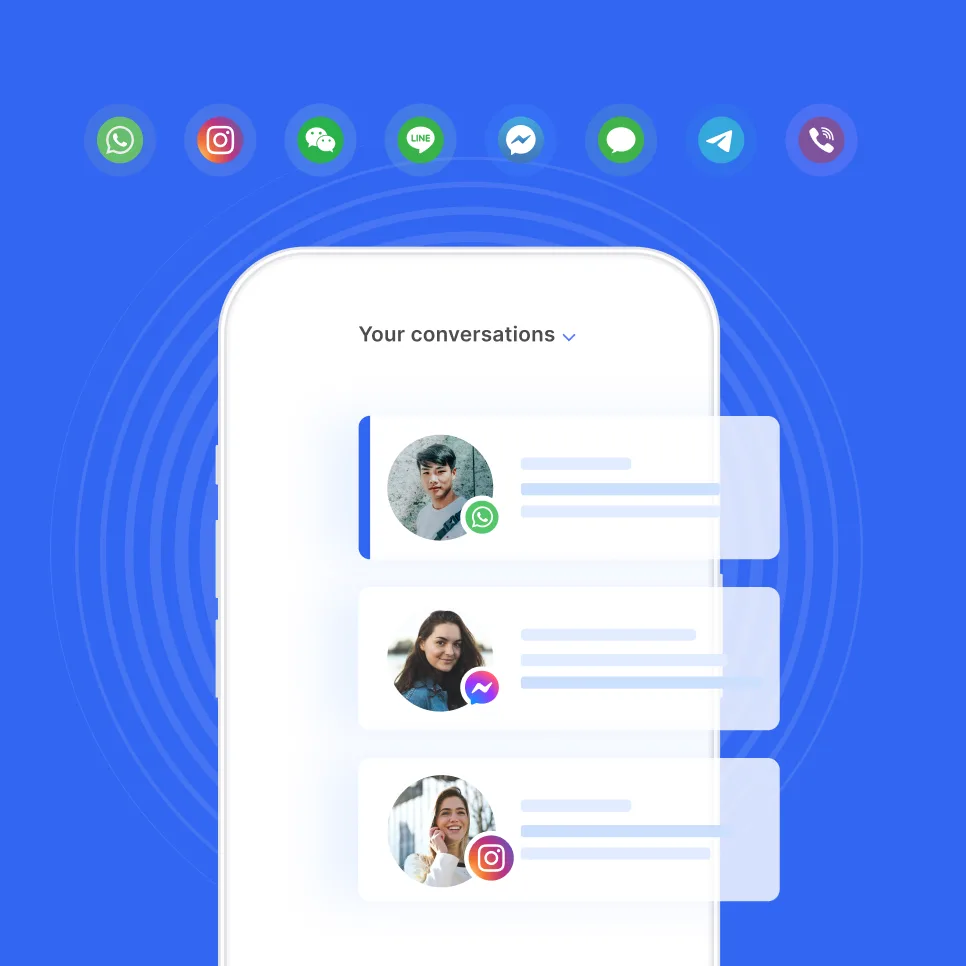
It reaches beyond WhatsApp, into Instagram, Messenger, SMS, or live chat, from one agent.
It takes deeper actions: bookings and order lookups against the business's own CRM or e-commerce stack.
It is the only compliant option across finance, health, and government sectors
It gives the business its own analytics and audit trail, not one locked inside Meta's dashboards.
Can you run both at once?
Yes. When Meta Business Agent is switched on, it becomes the primary responder, and a connected third-party platform drops to standby, still receiving every customer message and a copy of each reply. The third-party app takes control back by sending a message or through Meta's thread control endpoint if it holds the escalation role.
In practice, that lets a business run Meta's agent for simple WhatsApp queries and let a third-party agent step in for anything that touches its own systems or crosses into another channel.
Where SleekFlow fits in your WhatsApp strategy
SleekFlow is the AI suite for revenue-driving conversations. AgentFlow is its AI agent product, built to work across WhatsApp and beyond rather than inside one channel, and it connects to systems such as Shopify, HubSpot, and Salesforce.
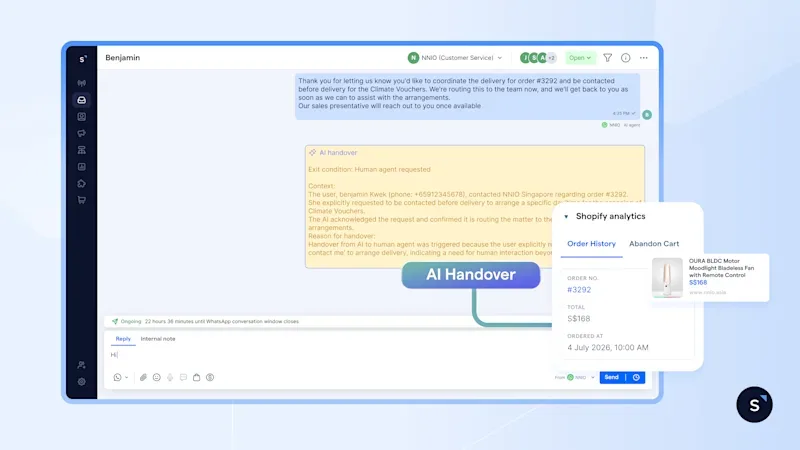
NNIO, a Singapore e-commerce business selling home appliances and cooling products, had enquiries split across four siloed teams, with up to 50 messages going unanswered after hours during peak campaigns. It put AgentFlow's AI Agents onto routine enquiries instead.
Results:
40% faster response time
30% of enquiries now handled by AI Agents
2.6x higher repurchase rate
Meta Business Agent is worth switching on if a business is eligible, wants zero setup, and only needs WhatsApp covered. Everything past that, such as another channel, a deeper system action, or a blocked vertical, is where a third-party AI agent earns its cost.
Want to outcompete your peers with SleekFlow's help?
Book your personalised demo with SleekFlow today and unlock the potential of seamless communication


