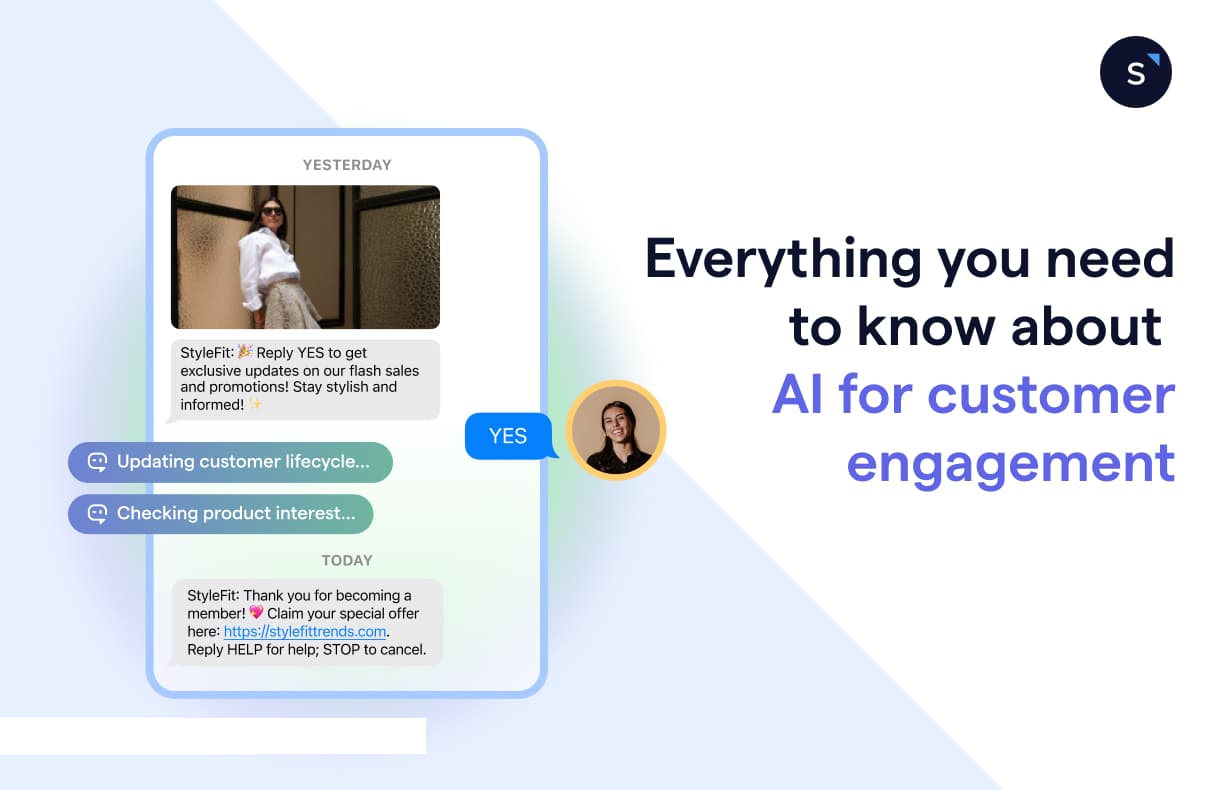
Everything you need to know about AI for customer engagement


and whether a product is in stock. They expect an “immediate” answer—and they also expect you to remember their context when they come back tomorrow. Salesforce research has found 83% of customers expect to interact with someone immediately when they contact a company.
That’s why AI for customer engagement is moving from “nice-to-have” to operational baseline: not to replace people, but to deliver fast, consistent, context-aware conversations at scale, across channels.
Quick summary for decision-makers (scan this first)
If you’re evaluating AI for customer engagement, prioritise:
Channel fit: In Singapore, messaging-first journeys (WhatsApp + social DMs + web chat) are often the fastest path to conversion.
Trust + control: Consumers still worry about AI reliability and responsible usage—so you need guardrails and easy human handover. (pega.com)
Data governance: Align your workflows to Singapore’s PDPA obligations (consent, purpose limitation, retention, access control). (pdpc.gov.sg)
Measurable ROI: Track response time, conversion, repeat purchase, and ticket resolution—not just “bot containment”.
AI roles in customer engagement
Think of AI as a set of “roles” that support your team across the customer lifecycle— marketing, sales, and support, without breaking the conversational experience.
Challenges of implementing AI in customer engagement


AI initiatives often fail for reasons that aren’t “AI problems”— they’re data, workflow, and governance problems.
1) Trust and customer experience risk
A 2026 Pega/YouGov study highlights that many consumers don’t yet trust how businesses use AI in customer service.
Mitigation: design for human-in-the-loop and “escape hatches”:
Clear escalation rules (“talk to an agent” always available)
AI confidence thresholds (low confidence → ask clarifying question or handover)
Conversation QA and coaching loops
2) Hallucinations and inconsistent answers
If AI can improvise, it can also invent.
Mitigation: use approved knowledge sources, guardrails, and testing workflows (e.g., knowledge upload + response behaviour settings + feedback cycles).
3) PDPA and consent management (Singapore)
Under Singapore’s PDPA, you must manage how personal data is collected, used, and disclosed— plus marketing consent and Do Not Call requirements where applicable.
Mitigation checklist (practical):
Map each AI use case to a purpose (support, fulfilment, marketing)
Store consent status and communication preferences in a single source of truth
Limit data access by role (need-to-know), and mask sensitive fields when needed
4) Lack of contextual knowledge
Customers expect any agent to understand them before beginning a conversation. This means that the AI should know the customer’s context: past orders, past tickets, prior conversations.
Mitigation: unify channels and sync customer data from your CRM/ E-commerce site so context sits alongside the conversation.
Benefits of implementing AI for customer engagement
When done well, the outcomes are tangible across speed, consistency, and revenue without sacrificing customer experience. The key is to tie AI for customer engagement to measurable KPIs (not “bot activity”).
Four AI customer engagement strategies

These strategies focus on what AI for customer engagement is best at: understanding intent, generating reliable responses with guardrails, assisting agents, personalising at scale, and improving quality over time. You don’t need all four— most teams start with 1–2 and expand.
1) AI concierge
What it is: AI handles repetitive questions (pricing basics, operating hours, booking steps, order status instructions) only from content you approve—FAQs, policy pages, product docs.
Where it works best:
WhatsApp, web chat, Instagram DMs
After-hours coverage and peak-hour spikes
FAQs that rarely change (or are easy to update)
How to implement safely (important):
Limit AI to approved knowledge sources (no free-form guessing)
Add confidence rules: low confidence → ask 1 clarifying question or escalate
Always include an “agent takeover” option
2) AI triage & smart routing (so the right team replies first)
What it is: AI classifies intent (sales vs support vs operations), detects urgency (complaints, cancellations), and routes to the right queue/agent with context.
Where it works best:
Teams handling multiple channels and multiple product lines
Businesses with separate Sales/Support/Operations inbox ownership
Any workflow where “wrong routing” wastes time
What AI actually does (realistic):
Suggests labels/tags based on message content
Prioritises “high-intent” signals (e.g., “quote”, “book”, “refund”)
Summarises the message for quick scanning
3) AI copilot
What it is: Instead of AI “talking to the customer” for everything, it supports agents inside the inbox:
Draft replies in your brand voice
Summarise long threads instantly
Suggest next best action (e.g., ask for order ID, propose time slots)
Where it works best:
Complex or sensitive conversations
New agent onboarding
Any team where tone consistency matters
Guardrails to keep it safe:
Agents approve before sending
Pre-set do-not-say rules (pricing promises, legal claims, sensitive advice)
Escalation prompts for risky topics
4) AI-driven personalisation (messages that match intent and stage)
What it is: AI helps tailor outreach to customer stage and intent, improving relevance without requiring a giant marketing ops team.
Where it works best:
Re-engagement (“dormant customers”)
Post-purchase support-to-repeat-buy journeys
Service businesses (booking reminders, rescheduling, waitlist)
What AI can do (and what it can’t):
✅ Generate message variants per segment and goal
✅ Suggest offers/angles based on your rules
❌ Decide pricing/discounts without your approval
❌ Use personal data beyond what customers consented to
How SleekFlow’s AI helps you shape your customer engagement strategies


Once you’ve decided which AI for customer engagement plays to run (faster replies, better qualification, more consistent answers), the next step is making them work across the channels your customers actually use—without creating new silos.
With our AI-powered omnichannel conversation suite, we help you:
Unify customer conversations in one place so teams can see context and collaborate in real time
Automate qualification and follow-ups with rule-based and event-based journeys
Deploy AI agents and AI assistance with guardrails so you can scale responses while keeping control (AgentFlow):
Turn chats into actions (e.g., booking, quotation, sign-up) using interactive forms.
BateriHub uses AI Smart Reply for 24/7 lead engagement


BateriHub is a car battery service provider with 130 branches across West Malaysia. As a roadside assistance provider, every second matters during emergencies like breakdowns or jump-starts, which often happen outside office hours. With SleekFlow’s AI Smart Reply, BateriHub responds immediately, collects key details (such as location and car type), and prepares the information for smooth human follow-up— so agents can focus on dispatch and logistics.
BateriHub also trained SleekFlow’s AI to handle complex battery specification enquiries. BateriHub uploaded its product catalogue and compatibility charts into our AI Knowledge Base, enabling the AI to cross-reference customer car details and recommend the right battery model at any time. The result is more consistent, higher-quality replies while freeing up staff for operational tasks.
What to do next
If you’re ready to apply AI for customer engagement in your business, start with these steps:
List your top 10 inbound intents (pricing, booking, order status, refunds, etc.) and decide what can be handled by AI vs humans.
Create an “approved knowledge set” (FAQs, policies, product/service rules) so AI stays accurate and consistent.
Design escalation rules and measure outcomes weekly (first response time, resolution time, conversion events from chat, and repeat contact rate).
When you’re ready, book a demo, and we’ll map these journeys to your channels and team structure.

Want to see how SleekFlow can enhance your sales process?
Book a demo today and experience the power of AI-driven conversational intelligence firsthand.
Frequently Asked Questions
Share Article


