AI guardrails: what they are, the types, and why they matter


TL; DR: Quick Summary
- AI guardrails are the rules and filters that keep an AI system's outputs safe, accurate and inside a defined scope.
- Five types cover most deployments: safety, ethical, technical, compliance and behavioural.
- Only 29% of Singapore businesses can produce an audit trail proving an AI-driven decision, against 38% across APAC.
- Input guardrails screen what goes into the model, and output guardrails check what comes out before a customer sees it.
- Grounding an agent in approved sources, plus a clean handover to a person, removes most wrong answers.
Your AI agent handled 600 conversations last week and 597 went fine. In the other three it quoted a discount that expired in March, agreed to a refund outside policy, and repeated a customer's NRIC into a transcript that landed in a shared inbox.
Nobody reviewed those three, because nothing flagged them.
That gap is what guardrails close. Below: the five types worth knowing, how input and output checks work, and what to put in place before an agent speaks to a customer.
What are AI guardrails?
AI guardrails are the rules, filters and constraints that keep an AI system's outputs safe, accurate and within defined boundaries. They govern what an AI can say and do, blocking harmful, biased, off-topic or non-compliant responses before they reach a user, and routing difficult cases to a human. They operate at the input, output and behavioural levels.
IBM describes them as safeguards that keep AI operating within defined boundaries, applied across four layers: data, model, application and infrastructure. Most teams building a customer-facing agent work at the application layer, where the rules are written in plain language rather than code.
One distinction saves a lot of confusion. Instructions tell an agent what role to play and how to sound. Guardrails set the limits: what to avoid, what to refuse, and when to hand over. Our guide to instructions vs guardrails has worked examples by industry.
Why do AI guardrails matter for businesses in Singapore?
The cost of a bad output has risen. An AI agent that quotes the wrong price, exposes personal data or agrees to something outside policy creates a commercial and a regulatory problem in one message. Singapore firms are adopting agents faster than they are building the controls to evidence them.
The Sumsub and Singapore Fintech Association benchmark published on 4 Aug 2026 found 94% of Singapore firms already use or pilot multi-step AI systems. Adoption is not the constraint. Proof is.
Security shows the same pattern. IBM's 2026 Cost of a Data Breach Report found one in four malicious breaches were AI-enabled, at an average cost of US$6 million, with over 20% of organisations reporting breaches that targeted AI models or applications.
Regulators here are specific. IMDA's updated Model AI Governance Framework for Agentic AI names access controls, guardrails, human approvals, logging and monitoring as core components of a safe agent. The PDPC's advisory guidelines on personal data in AI recommendation and decision systems set out how the PDPA applies when customer data feeds an AI system.
What are the main types of AI guardrails?
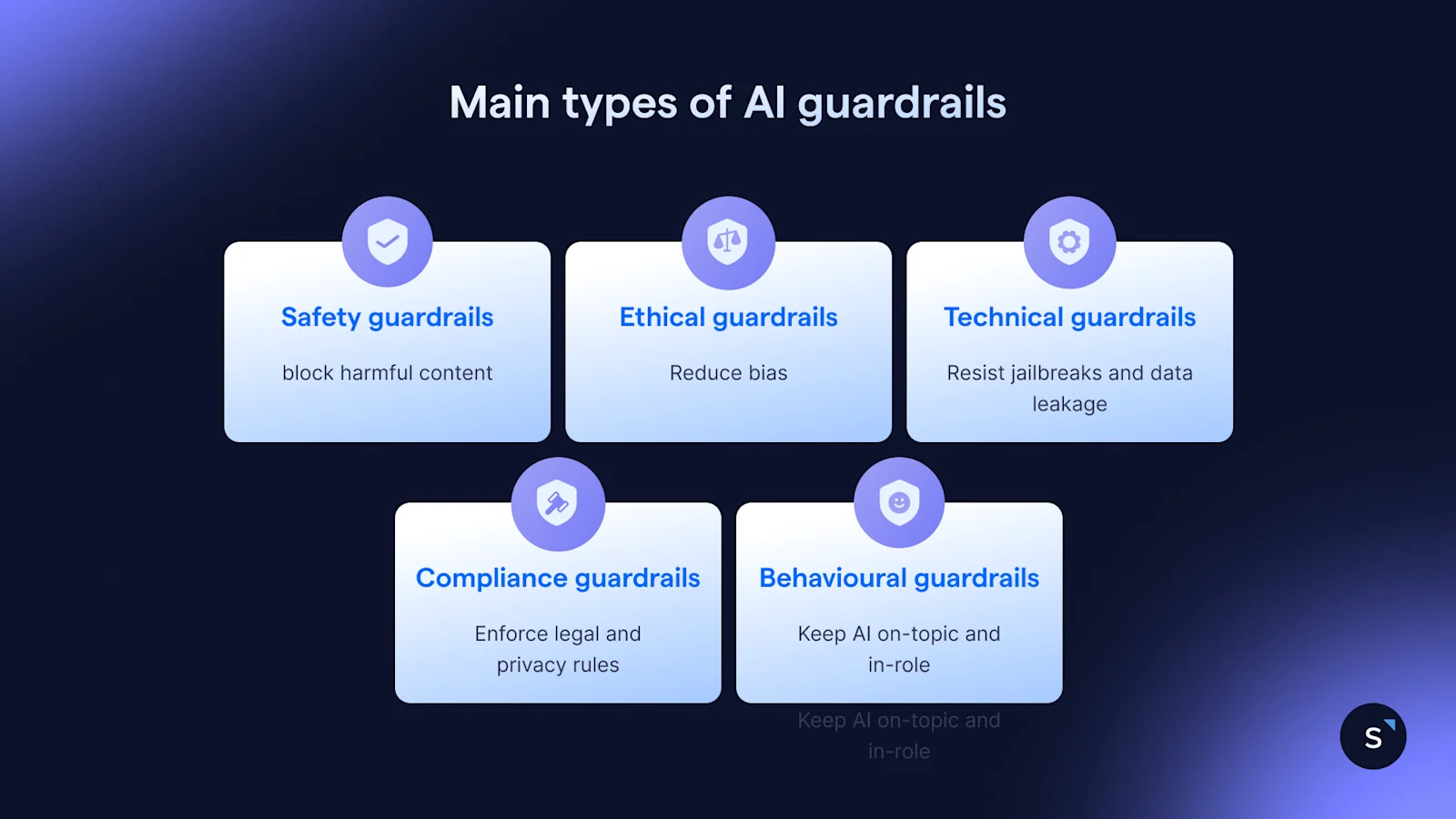
Five types cover most deployments: safety guardrails block harmful content, ethical guardrails reduce bias, technical guardrails resist jailbreaks and data leakage, compliance guardrails enforce legal and privacy rules, and behavioural guardrails keep the AI on-topic and in role. Real systems combine several layers rather than picking one.
The layers are not interchangeable. A compliance filter will not stop an agent inventing a delivery date, and a grounding rule will not stop a prompt-injection attempt. Treat this as a single switch and you find the missing layer in production.
How do AI guardrails work?
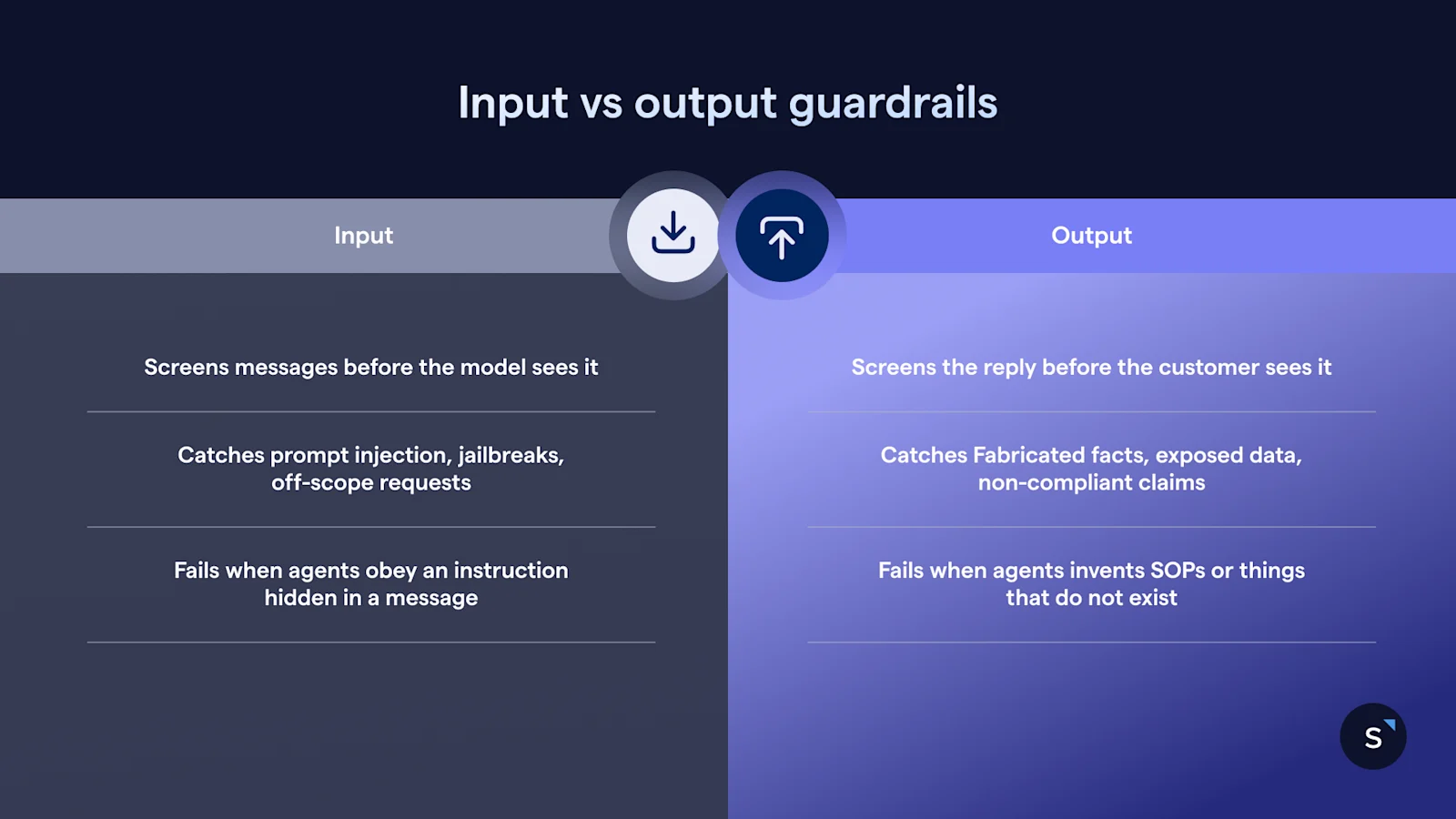
They work as a two-sided filter around the model. Input guardrails screen the incoming message, catching unsafe prompts, injection attempts and out-of-scope requests before processing. Output guardrails inspect the generated response before it reaches the customer, catching inaccurate, unsafe or off-brand replies. Behavioural rules sit across both, governing scope and escalation.
How guardrails stop a chatbot giving wrong answers
The most effective control is grounding: the agent answers only from approved sources such as your knowledge base and policy documents, rather than from open-ended training data. Fabricated answers drop sharply because there is nowhere to fabricate from.
Grounding needs a partner rule. When a question falls outside what the agent knows or is authorised to decide, a fallback sends it to a person with the thread attached. Escalation is a feature, not a failure.
How to implement AI guardrails
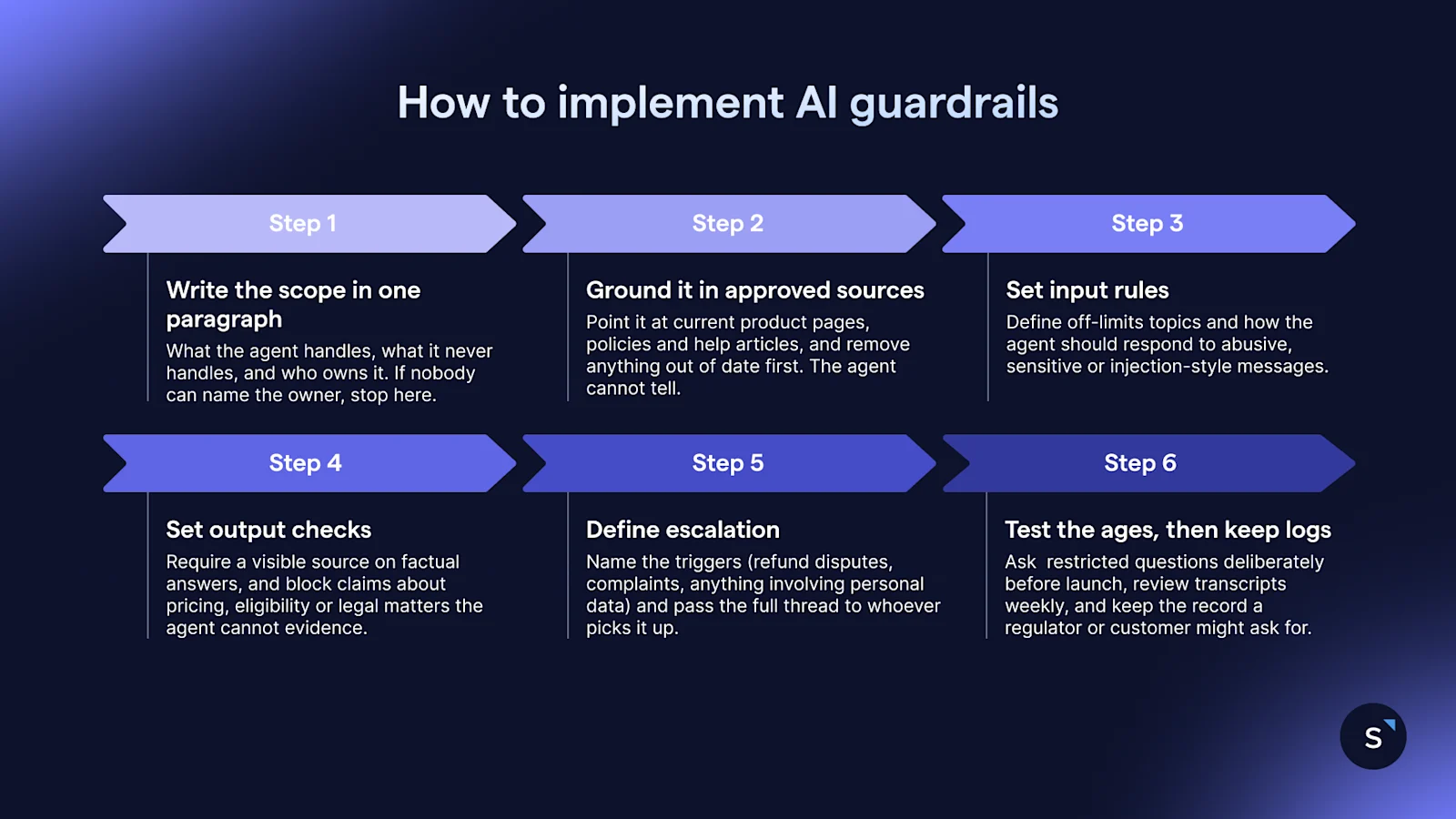
Most of the work is writing things down before you automate them. Define scope, ground the agent in approved content, add input and output checks, set escalation triggers, then log and review what it said. IMDA's framework asks for controls at design, development, pre-deployment and deployment, not bolted on afterwards.
Write the scope in one paragraph. What the agent handles, what it never handles, and who owns it. If nobody can name the owner, stop here.
Ground it in approved sources. Point it at current product pages, policies and help articles, and remove anything out of date first. The agent cannot tell.
Set input rules. Define off-limits topics and how the agent should respond to abusive, sensitive or injection-style messages.
Set output checks. Require a visible source on factual answers, and block claims about pricing, eligibility or legal matters the agent cannot evidence.
Define escalation. Name the triggers (refund disputes, complaints, anything involving personal data) and pass the full thread to whoever picks it up.
Test the edges, then keep logs. Ask the restricted questions deliberately before launch, review transcripts weekly, and keep the record a regulator or customer might ask for.
AI guardrails in practice: how NNIO keeps its AI in scope in SleekFlow
SleekFlow is the AI suite for revenue-driving conversations. AgentFlow is its AI agent product for sales, marketing and support across WhatsApp, Instagram and other channels.
Guardrails here are a configuration field, not a coding exercise. In AgentFlow you write instructions for the agent's role, separate guardrails for what it should avoid or escalate, and exit conditions for when a conversation should end. The best-practice documentation recommends testing edge cases before launch by asking sensitive and restricted questions deliberately.
NNIO, a Singapore e-commerce brand selling home appliances, ran support across four siloed teams and lost enquiries that arrived after hours.
Their AI agent is trained on one source: the information NNIO publishes on its own website. It answers product, warranty, stock and delivery questions from that content and nothing else. When a question cannot be answered from the site, the agent hands the conversation to a person rather than risking a wrong answer and harming consumer trust.
Results:
30% of enquiries resolved by the AI agent with no human involvement
40% faster response time
20% increase in completed checkouts
Start with the three conversations you would not want screenshotted
Pull last week's transcripts and find the three answers you would not want a customer to post publicly. Work out which control would have caught each one: an input filter, a grounding rule, or an escalation trigger. That is your build order.
See how AgentFlow shows its sources and hands over to a person mid-conversation. Book a demo and bring one of those transcripts.
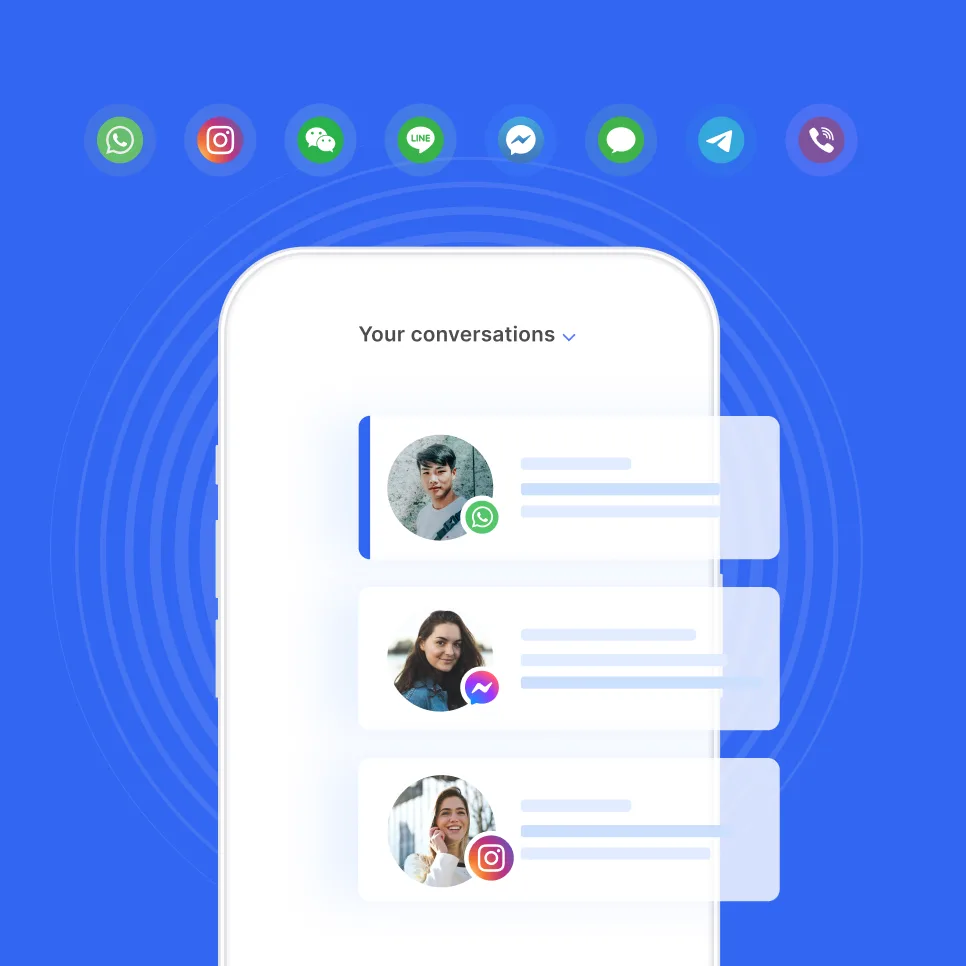
See how AgentFlow shows its sources and hands over to a person mid-conversation
Book your personalised demo with SleekFlow today and bring one of those transcripts.


