Choosing Cloud CRM solutions for small businesses


TL; DR: Quick Summary
- Small businesses in Singapore often outgrow spreadsheets, inboxes and basic contact tools when customer data, follow-ups and reporting become too fragmented to manage efficiently.
- The best cloud CRM solutions for small business should prioritise fast setup, easy adoption, low admin work, usable customer data, automation, analytics and compliance readiness.
- CRM selection should be based on business model, with different needs for chat-first businesses, sales-led B2B teams, service-led companies, ecommerce brands and growing multi-user teams.
- Among the cloud CRM platforms in Singapore, SleekFlow is the strongest fit for Singapore SMEs that manage customer journeys through messaging channels, while other tools suit more traditional CRM, support-led or WhatsApp-first use cases.
- Ultimately, choose a CRM that matches your current growth stage and helps you centralise conversations, customer records and workflows without adding unnecessary complexity.
Small businesses rarely hit a growth ceiling because they lack ambition. More often than not, they slow down because customer work is spread across too many systems. Salesforce found that sales teams use an average of 10 tools to close deals, and 66% of sales reps say they are overwhelmed by the number of tools they use. When leads, quotations and customer history live in different places, follow-ups slow down and visibility disappears. That is why cloud CRM solutions for small businesses matter. The right platform should help a lean team stay organised, follow up faster and grow without adding enterprise-level complexity.
Why small businesses outgrow spreadsheets and basic contact tools
Signs your current setup is slowing growth
Most small businesses do not start with a full CRM. They start with tools that are convenient at the time: spreadsheets, shared inboxes, WhatsApp Business, notes apps and manual reminders. The trouble starts when those tools no longer give the team a shared view of the customer.
Common warning signs include:
leads getting missed because nobody owns the follow-up
customer conversations spread across email, WhatsApp and social DMs
no clear view of deal stage, quote status or service history
reporting that takes hours of manual work
customer data that becomes outdated almost as soon as it is entered
What small businesses should prioritise when choosing a cloud CRM
A good small-business CRM should solve the operational mess before it tries to impress you with complexity. At minimum, it should give you one customer view, clearer ownership, faster follow-ups, useful reporting and enough automation to remove repetitive admin work.
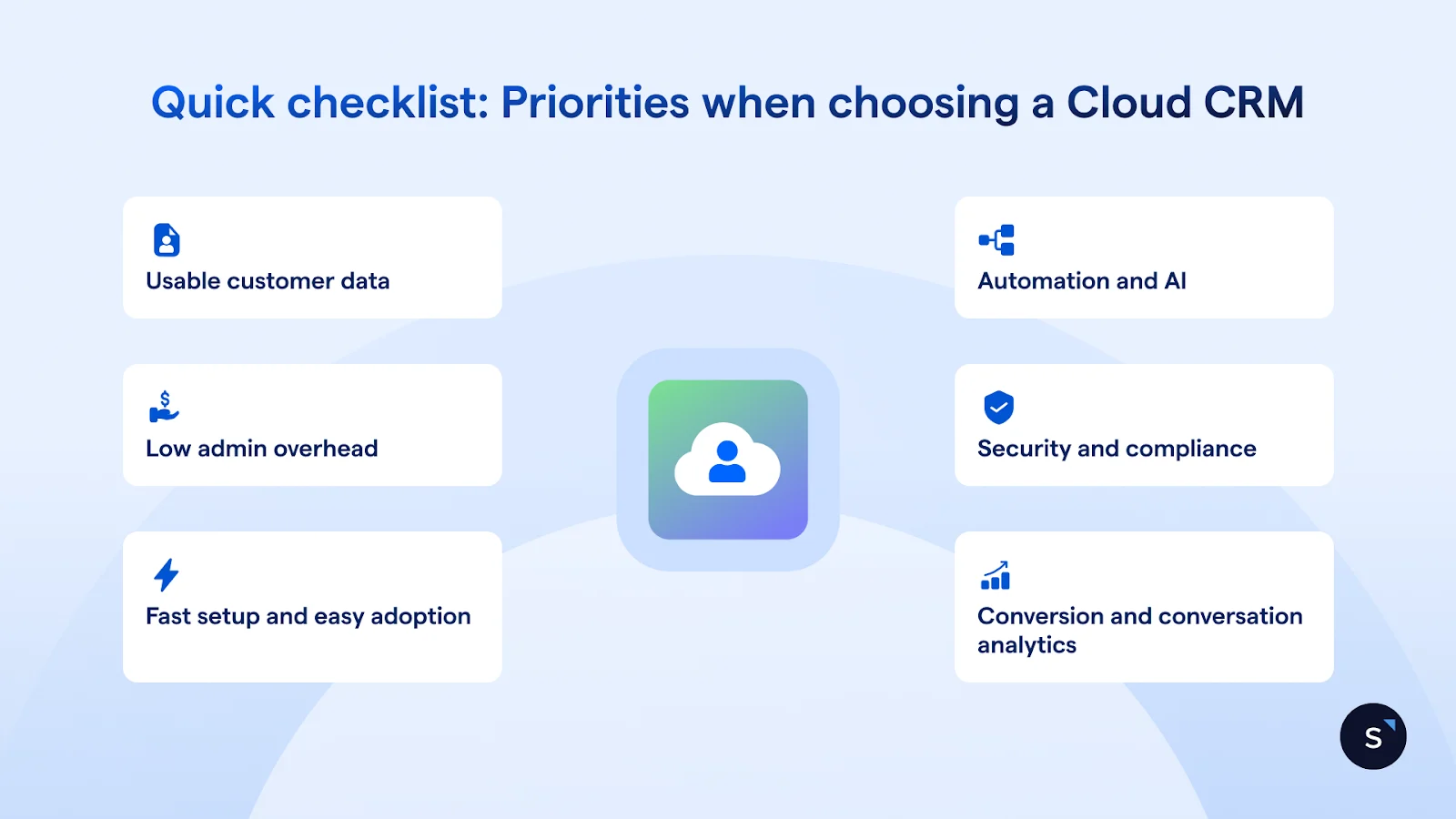
Fast setup and easy adoption
Small teams do not have time for a six-month rollout. Look for a platform that is intuitive, easy to configure and realistic for daily use. If the CRM feels hard to maintain, adoption will drop quickly.
Low admin overhead
The best CRM for a small business should reduce work, not create it. Prioritise simple workflows, clean data entry, fast search and automation that removes repetitive tasks.
Customer data that is actually usable
You need more than a contact list. Look for unified profiles, tags or custom fields, searchable records, conversation history and enough structure to help staff personalise follow-ups.
Automation and AI that save labour
Useful automation includes lead assignment, reminders, follow-up triggers, AI summaries and basic qualification support. In Singapore, that matters even more, as SMEs continue to increase AI adoption and seek tools that deliver measurable efficiency.
Analytics that support decisions
A CRM should help you answer practical questions: Which channel brings the best leads? Where are deals dropping off? How fast is the team replying? Which campaigns or agents are converting?
Security and compliance readiness
For Singapore businesses, compliance should be part of the shortlist from the start. The PDPC says organisations generally must not send marketing messages to Singapore telephone numbers listed on the DNC Registry unless they have clear and unambiguous consent, and opt-out requests must be honoured within 21 days. CSA also stresses that SaaS security follows a shared responsibility model, which means buyers still need good access controls, governance and data handling practices.
Which type of cloud CRM suits your small business best?
Not every CRM is built for the same operating model. The right fit depends less on brand popularity and more on how your team actually acquires, serves and retains customers.
For example, a business that closes most deals via WhatsApp and Instagram needs a CRM that integrates conversations and customer records. A quotation-heavy B2B firm will care more about pipeline structure and follow-up control. A service-led operation may need support workflows and ticketing just as much as sales features. That is why the smartest way to evaluate cloud CRM solutions for small business is by use case first, feature count second
For Singapore businesses that sell and support customers through messaging apps, SleekFlow is the strongest overall fit. Its omnichannel inbox keeps conversations from multiple channels in one place; Social CRM connects those conversations to customer records; AgentFlow adds AI for qualification and handoff; and Analytics plus Ticketing add the visibility many SMEs start needing as they scale.
How to choose a Cloud CRM based on your growth stage
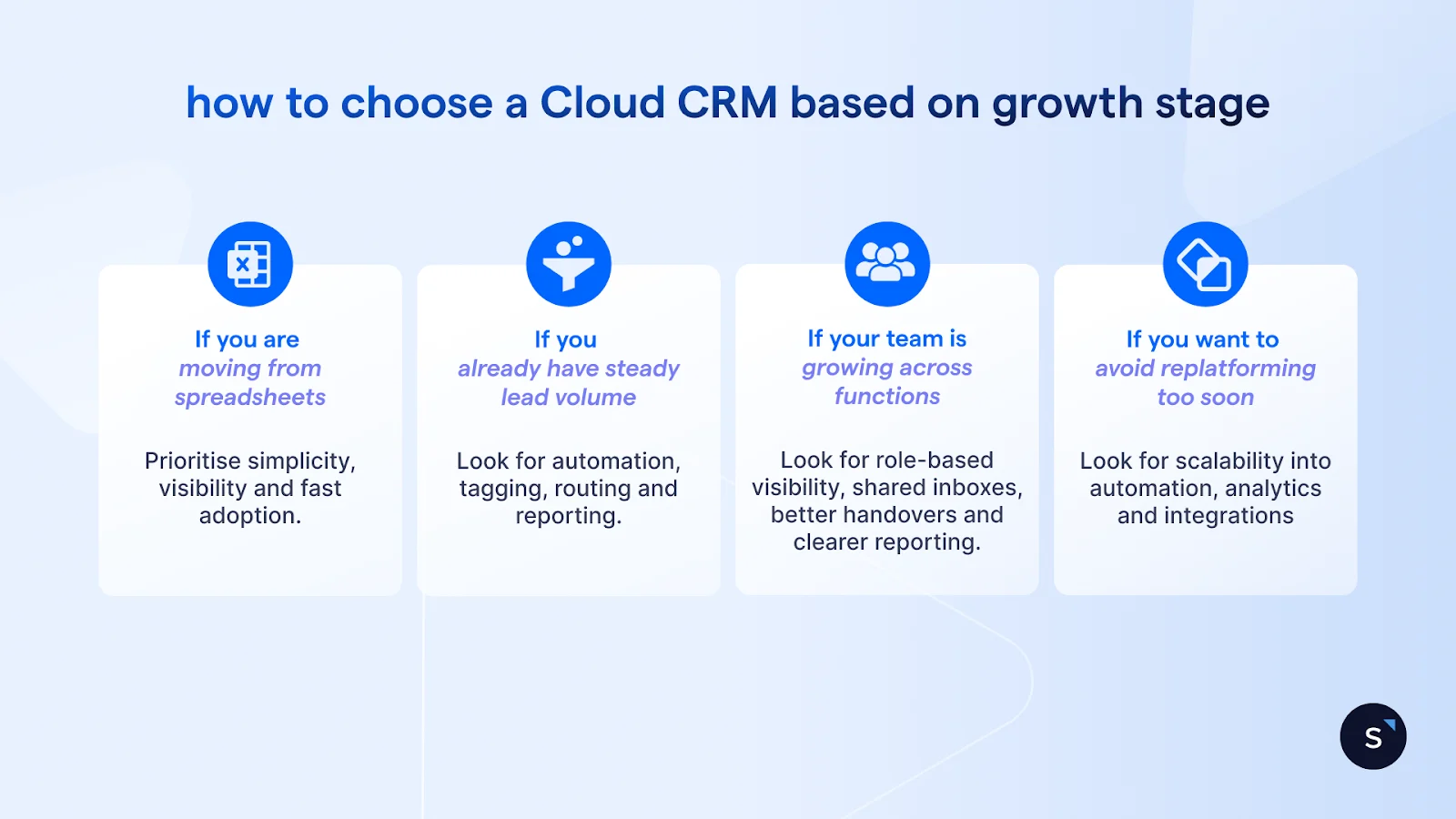
If you are moving from spreadsheets
Prioritise simplicity, visibility and fast adoption. You do not need an advanced build. You need a system your team will actually use.
If you already have steady lead volume
Look for automation, tagging, routing and reporting. At this stage, speed and consistency matter more than adding more channels.
If your team is growing across functions
Choose a platform with role-based visibility, shared inboxes, better handovers and clearer reporting. Cross-team confusion becomes expensive very quickly.
If you want to avoid replatforming too soon
Pick a CRM that can scale into automation, analytics and integrations without forcing you into a completely different stack 12 months later.
Choose a CRM that helps your business move faster
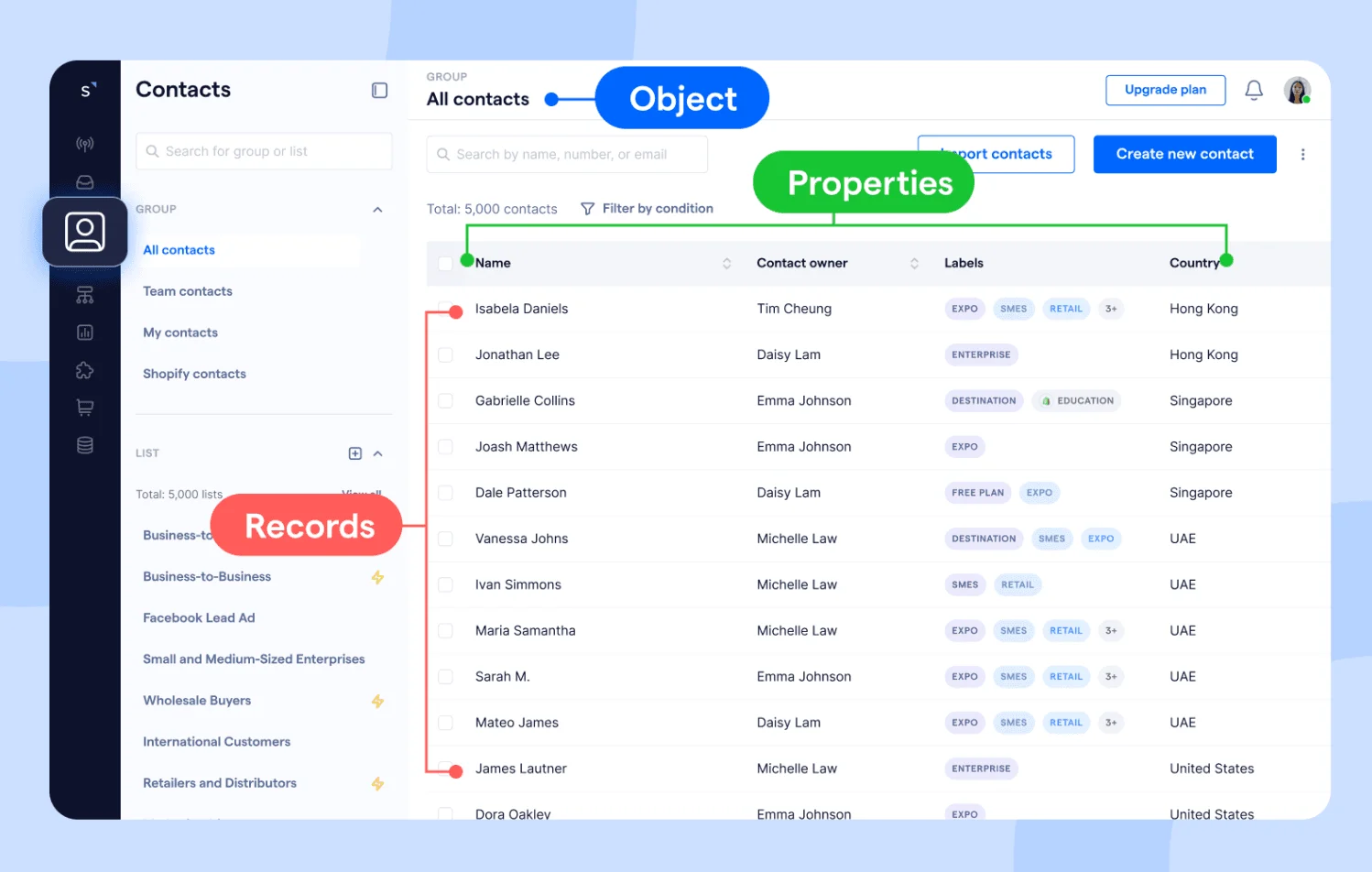
Small businesses in Singapore do not need a CRM built for enterprise complexity. They need a platform that brings customer conversations, contact data, automation, and reporting into one place so every enquiry is easier to manage and every follow-up is more likely to convert. That is where SleekFlow stands out. By combining omnichannel messaging, social CRM, AI workflows, and team collaboration in a single platform, SleekFlow helps growing businesses turn scattered chats into structured customer journeys and measurable revenue, without adding more operational friction.
For small teams that want to scale customer engagement without increasing manual work, SleekFlow offers a more practical way to manage relationships from the first message to repeat purchases.
Frequently Asked Questions
Can a small business use cloud CRM if different staff members handle sales, support and marketing?
What happens if a small business relies heavily on WhatsApp and then wants to add more channels later?
Is a cloud CRM still worth it for businesses with a short sales cycle?
Can a small business keep its existing tools and still adopt a cloud CRM gradually?
What should a small business do if it has messy or incomplete customer data before moving to a cloud CRM?

Start for free!
Grow your revenue and turn chats into conversions with AI agents. Try SleekFlow for free, forever.


