ChatGPT alternatives for customer service: what works, and what Meta no longer allows


TL; DR: Quick Summary
- ChatGPT alone was never built for live, multi-channel customer service: no case history, no escalation path, no audit trail.
- Since 15 January 2026, Meta's WhatsApp Business Platform terms ban general-purpose AI providers, including ChatGPT, Copilot and Perplexity, from operating as the primary service on the platform.
- That ban does not stop a business from using AI, including third-party models, inside its own scoped support bot. The restriction targets general-purpose assistants, not task-specific ones.
- Seven realistic ChatGPT alternatives for customer service split into three types: Meta's own agent, general models you build on, and dedicated support platforms.
- The right pick depends on which channels you need to cover, which industries you're regulated in, and whether you need the AI to act inside your own systems, not just answer questions.
Author's note: Meta's WhatsApp AI policy has changed three times in 2026 and differs by region. Details below are accurate as of publication; verify current rules with Meta before you build on them. Full note at the end.
A customer messages your WhatsApp number at 11pm asking where their order is. If you've been routing that through ChatGPT, plugged in yourself with a script and a prayer, you've probably already found the gap: no memory of the last conversation, no order lookup, and since January, a real chance Meta blocks it from WhatsApp altogether.
This article covers whether you can still use ChatGPT for support at all, why it usually falls short even where it's allowed, seven working alternatives, and what Meta's 2026 policy change actually restricts, so you're picking a tool based on the current rules, not last year's ones.
Can you use ChatGPT for customer service?
Yes, with a catch that depends on the channel. OpenAI's models are available through an API, so a business can build a support bot on top of ChatGPT for its website, app, or email, the same way many vendors build their own AI agents on a foundation model. What changed is what happens when that bot tries to run on WhatsApp.
What Meta's WhatsApp policy change actually restricts
Meta's WhatsApp Business Solution Terms added a clause, effective 15 January 2026, that bars providers of large language models, generative AI platforms and general-purpose AI assistants from using the WhatsApp Business Platform when that AI is the primary offering rather than a supporting feature. In plain terms: ChatGPT, Microsoft Copilot and Perplexity can no longer operate as their own product on WhatsApp.
The same clause carries a carve-out businesses often miss: a company can still retain an AI provider, including one built on ChatGPT, as a third-party service inside its own scoped support tool. The ban targets AI sold as the product itself, not AI used inside a business's own customer service setup.
The policy has also moved since January. The EU ordered Meta to restore access for the European Economic Area and Switzerland from 13 July 2026 after an antitrust finding, and reports point to a similar reversal for Brazil. Outside those markets, the ban remains in force with no announced end date. This is a live regulatory story, not a settled one, so confirm the current position for your market before you rely on it. The restriction is specific to the WhatsApp Business Platform (API); it hasn't been extended to Messenger or Instagram.
Why ChatGPT alone falls short for support
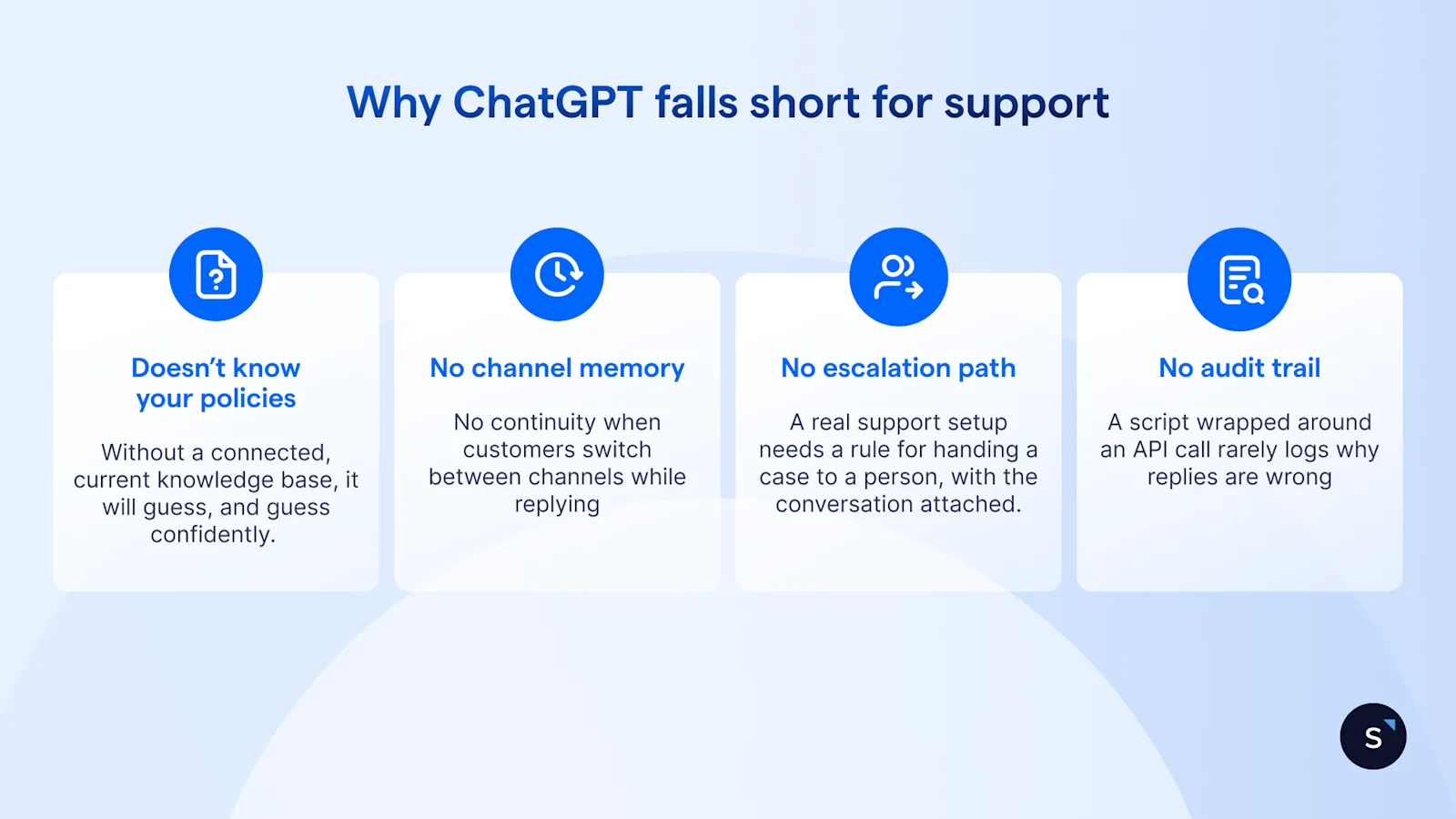
Even where it's technically allowed, a bare ChatGPT deployment struggles with four things purpose-built support tools handle by default.
It doesn't know your policies unless you feed it every one, every time. ChatGPT answers from its training data and whatever you paste into the prompt. Without a connected, current knowledge base, it will guess, and guess confidently.
It has no channel memory. A customer who messages on WhatsApp, then follows up on Instagram, starts over each time unless someone has built that continuity by hand.
It has no escalation path. A real support setup needs a rule for handing a case to a person, with the conversation attached. A raw model has no concept of "hand this off."
It leaves no audit trail. When a reply is wrong, you need to see what the model was told and why it answered the way it did. A script wrapped around an API call rarely logs that.
The clearest illustration is a real one. In 2024, a Canadian tribunal ordered Air Canada to refund a customer after its website chatbot invented a bereavement fare policy that didn't exist. The tribunal rejected the airline's argument that it wasn't responsible for what its own chatbot said, ruling the business liable regardless of whether the words came from a static page or an AI. The case wasn't ChatGPT specifically, but the failure mode, a fluent, confident, wrong answer with no grounding, is exactly what an ungrounded general-purpose model produces in a support context.
Gartner's own research backs this up at scale: only 14% of customer service issues are fully resolved in self-service, despite 73% of customers trying it first. A generic chatbot with no grounding, memory or escalation path is a large part of why that number is so low.
7 ChatGPT alternatives for customer service
These seven split into three groups: Meta's own agent (the default WhatsApp now steers you toward), general models you build on yourself, and dedicated support platforms that come with the workflow already built.
None of these is a straight ChatGPT swap. Meta Business Agent solves the WhatsApp problem specifically but excludes whole industries. The two foundation models give you the most control and the most building to do. The four dedicated platforms trade some of that control for a support workflow, knowledge grounding and escalation rules that already exist.
How to choose between ChatGPT alternatives
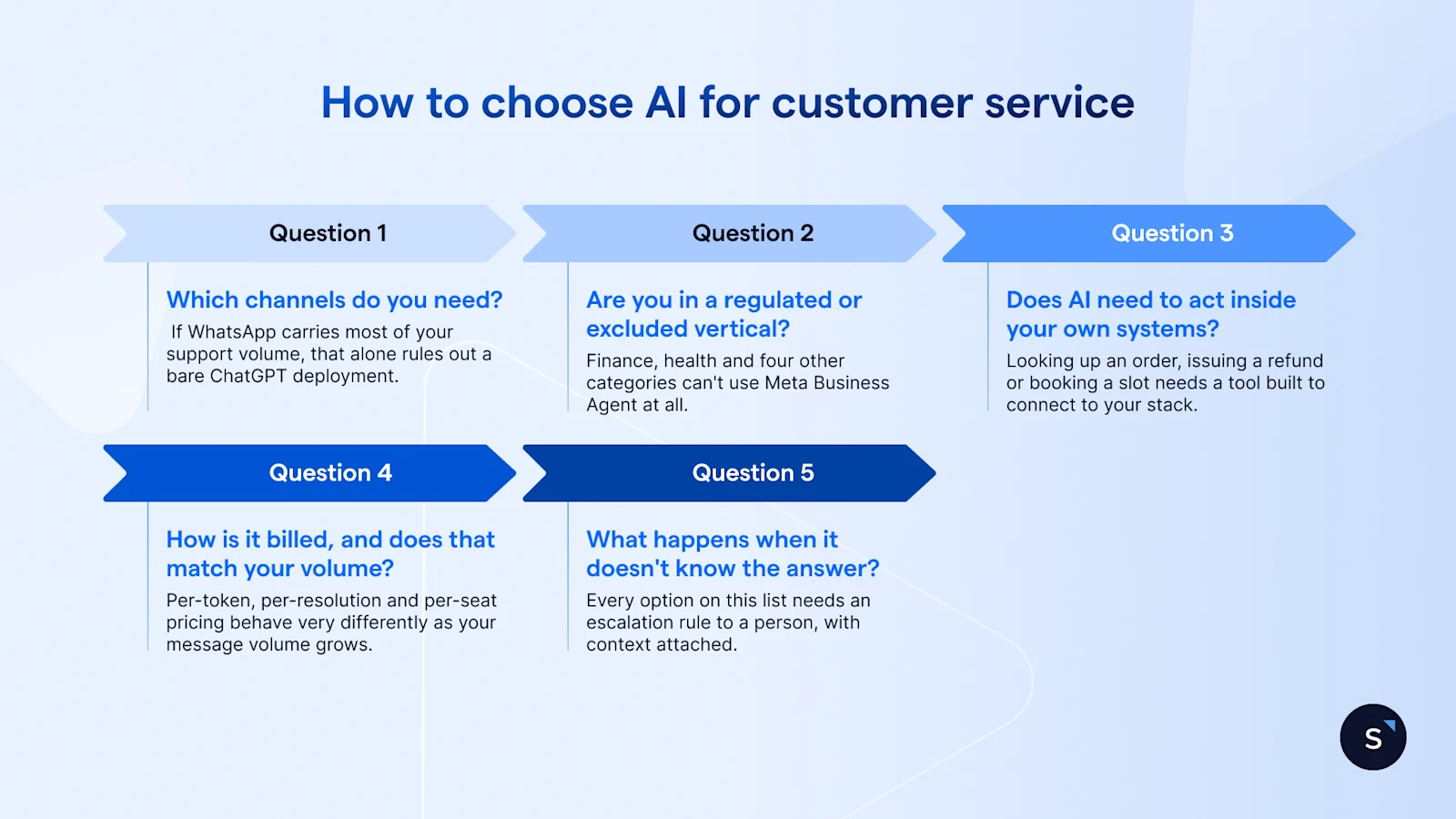
Work through these in order, since each one narrows the field:
Which channels do you actually need? If WhatsApp carries most of your support volume, that alone rules out a bare ChatGPT deployment and narrows you toward Meta's own agent or a multi-channel platform.
Are you in a regulated or excluded vertical? Finance, health and four other categories can't use Meta Business Agent at all, whatever else looks appealing.
Does the AI need to act inside your own systems? Looking up an order, issuing a refund or booking a slot needs a tool built to connect to your sales and e-commerce systems, not a model with no such connection.
How is it billed, and does that match your volume? Per-token, per-resolution and per-seat pricing behave very differently as your message volume grows. Model the cost at your real volume, not the vendor's example numbers.
What happens when it doesn't know the answer? Every option on this list needs an escalation rule to a person, with context attached. If a tool can't show you that path clearly, that's a real gap, not a detail to fix later.
What about running your own model?
Self-hosting an open-weight model, Llama, Mistral or DeepSeek among them, is a real option, mostly for businesses with data residency rules a hosted vendor can't satisfy, or a compliance team that needs full control over where customer messages go.
It comes with real costs most support teams underestimate. You still have to build everything a dedicated platform gives you for free: the channel connections, the knowledge grounding, the escalation logic, and ongoing upkeep as the model and your policies both change. That's an infrastructure and machine-learning operations commitment, not a weekend project, and it rarely pays off unless you're already running that team for other reasons. For most small and mid-market businesses in Singapore and Malaysia, a hosted platform with the workflow already built gets you to a working setup faster and cheaper than standing up your own model.
How SleekFlow can be your ChatGPT alternative for customer service
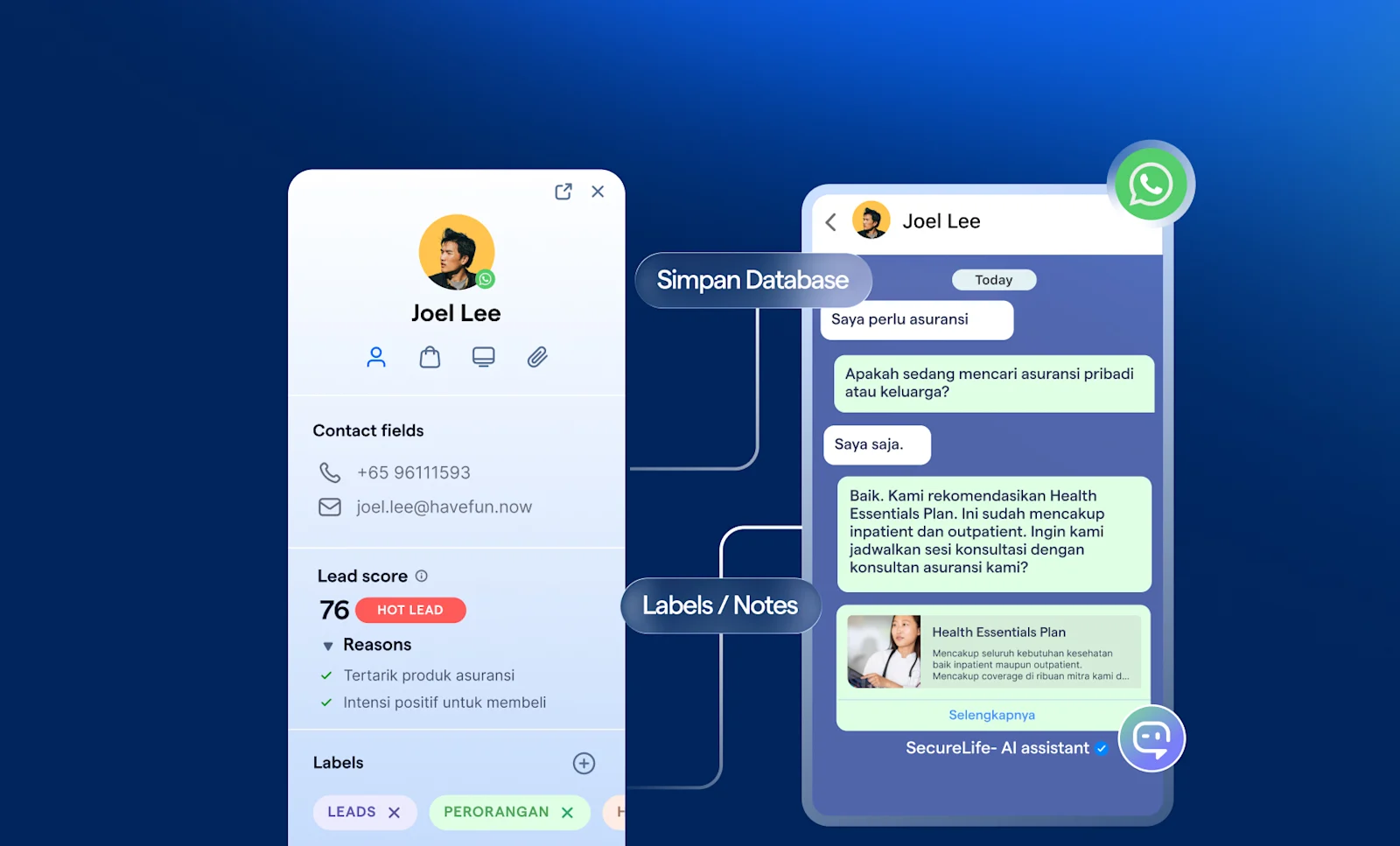
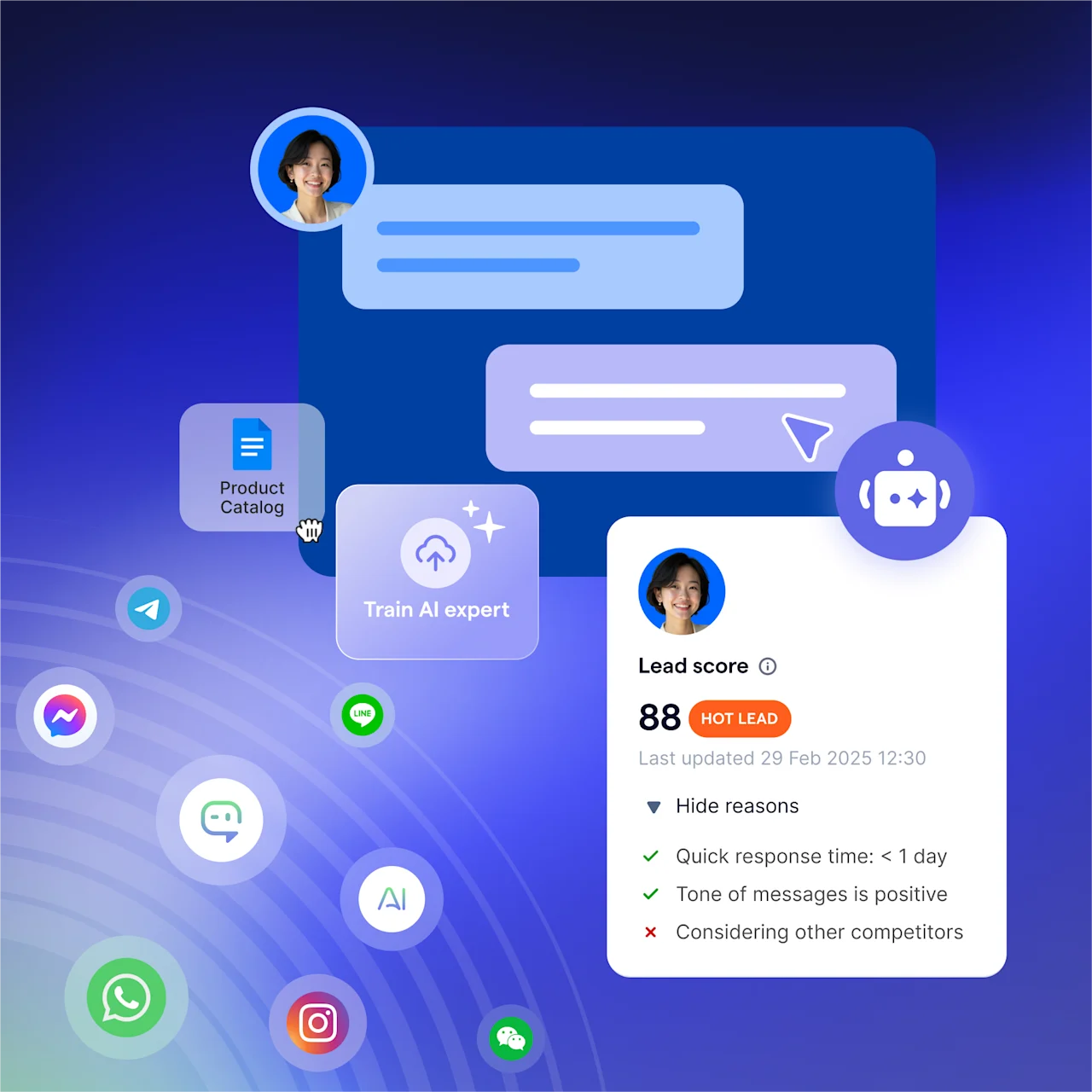
SleekFlow is an AI suite for revenue-driving conversations, and AgentFlow is the AI agent product inside it. It isn't tied to one model: it's grounded in your own knowledge base, so replies trace back to a document you approved rather than the model's general training data, and it runs across WhatsApp, Instagram, Messenger and website chat from one setup, not one channel at a time.
AgentFlow covers more ground than a single ChatGPT-powered bot, across sales, support and marketing:
Inbound Agent: qualifies leads, books appointments and resolves support enquiries end-to-end, without needing a human handover for routine cases.
Structured knowledge from your own content: crawls your website and internal documents to build a knowledge base it can cite, rather than relying on the model's general training data.
Full reasoning trace: shows what knowledge it used, how it read the customer's intent, and why it chose a given playbook, for every single reply.
Data Analyst Agent: monitors conversations across every channel, flags customer topic patterns, and surfaces performance insight for your team.
Self-improving memory: learns from flagged knowledge gaps and human corrections, so the same mistake doesn't repeat.
Native and custom integrations: connects to Shopify, HubSpot and Salesforce out of the box, or builds a custom integration from a plain-language description of what you need.
Escalation is a setting, not an afterthought. You decide when AgentFlow hands off, based on sentiment, topic or task completion, and whoever picks up the case gets a full summary, not a blank screen.
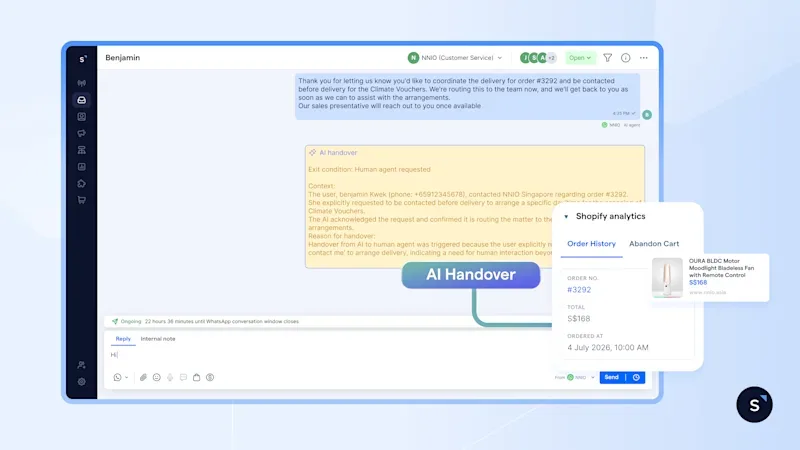
NNIO, a Singapore home appliance retailer, ran support across four separate teams with no shared view of who was asking what, and lost enquiries that came in after hours. It deployed AgentFlow with a knowledge base trained on its website.
Results:
30% of enquiries resolved by the AI agent
40% faster response time
260% increase in customer retention
Smart responses without compromising security
On governance, SleekFlow holds ISO/IEC 42001:2023 certification for AI management systems alongside SOC 2 Type II and ISO/IEC 27001:2022, documented in the Trust Center, and SleekFlow operates as an official WhatsApp Business Platform partner, so a support setup built on it stays inside Meta's current rules rather than testing the edge of them.
See it for yourself
See how SleekFlow's AI agents turn conversations into revenue with AgentFlow.


