How to Collect Customer Reviews on WhatsApp Without Breaking the Rules


TL; DR: Quick Summary
- Google, Trustpilot and most review platforms explicitly ban review gating, filtering who gets asked for a review based on their rating, their complaint history, or a staff member's judgement, and they enforce it with review removal or profile suspension.
- The compliant pattern is simple: trigger the ask from the order event itself, not from sentiment, and send the same link to every customer who completes one.
- Whether a WhatsApp review-request template counts as marketing or utility isn't fixed by the topic.
- Reviews and private feedback need separate paths. The public review link and the support channel should go to every customer side by side, not one gating the other.
- Track ask rate, the share of completed orders that actually received the request, rather than average rating. Ask rate is the number you control, and getting it right removes any temptation to filter.
A customer just gave a support agent five stars in a post-chat rating. The instinct is obvious: send this person the Google review link while the goodwill is fresh, and quietly skip the customer two rows up who filed a complaint last week.
That instinct is exactly what gets a Google Business Profile's reviews wiped and the listing suspended. It is also, unhelpfully, the flow most "how to get more reviews" guides walk businesses straight into.
This guide covers what's actually allowed, why the popular version of the flow isn't, and the WhatsApp review-request sequence Singapore and Malaysia businesses can run without gambling their Google Business Profile, their WhatsApp Business Platform account standing, or their standing on Trustpilot, Shopee, Lazada, or the app stores.
Can you ask for customer reviews on WhatsApp?
Yes. Nothing in Google's, Trustpilot's, or Meta's rules stops a business from inviting a genuine review. Google's own Prohibited and restricted content policy is explicit that merchants may solicit or encourage a review that reflects a real experience, provided no incentive is offered and the business doesn't try to shape which customers get asked or what the review says.
WhatsApp itself has no separate rule against review requests. The prohibition that matters here doesn't come from WhatsApp or Meta; it comes from wherever the review actually gets published, Google, Trustpilot, Shopee, Lazada, an app store. WhatsApp is simply the channel carrying the ask. That distinction matters for the rest of this article: the compliance risk lives in how you decide who gets asked, not in the act of asking over WhatsApp.
Why WhatsApp works for review requests
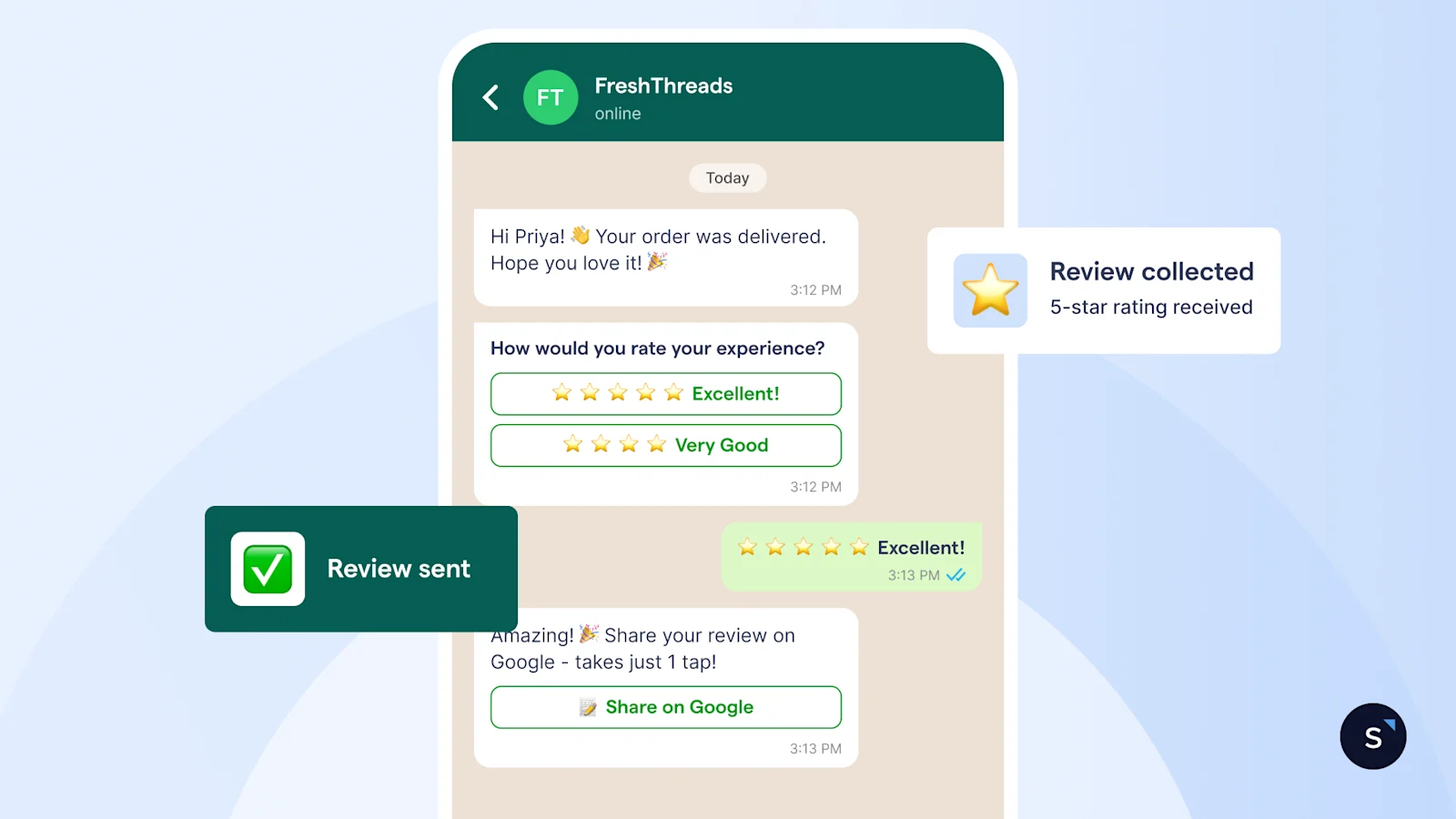
73.3% of consumers say they prefer messaging when communicating with a business, per Kantar research conducted for Meta across 22 markets including Singapore, so a review request arriving as a WhatsApp message meets customers on the channel they already default to.
Actual campaign data backs this up: an aggregated benchmark across 382 brands measured a 79.0% open rate on delivered messages between March and May 2026, well ahead of email. No independently audited, platform-wide open rate exists, so treat that figure as a directional benchmark and your own broadcast report as the number that actually matters for planning.
The flow most guides recommend, and why it's prohibited
The standard branching flow
Most review-generation playbooks describe some version of this:
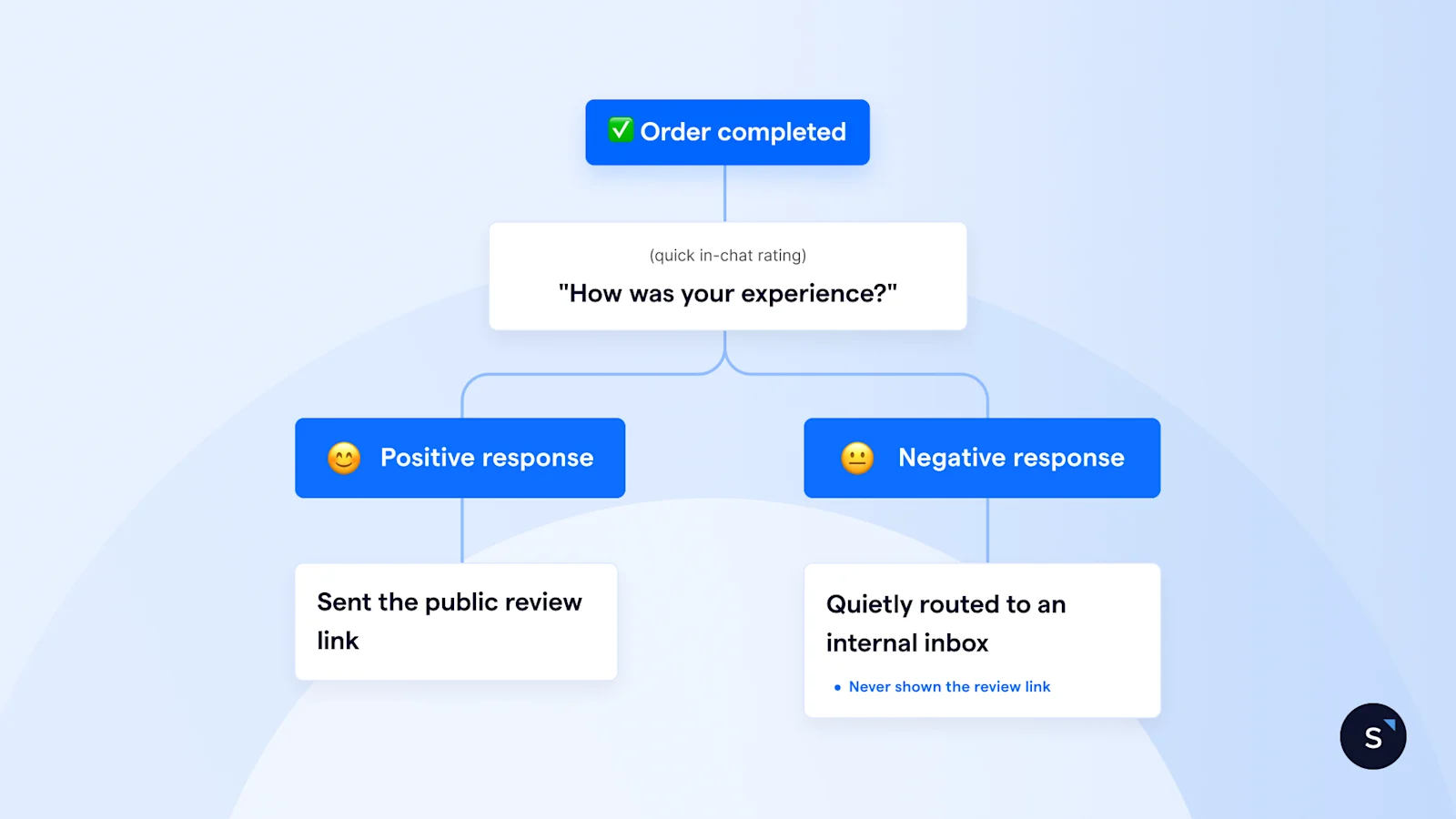
That branch point, a rating gate sitting in front of the review link, is the exact mechanism Google's policy targets. Google's Prohibited and restricted content policy states plainly that merchants must not "discourage or prohibit negative reviews, or selectively solicit positive reviews from customers." Trustpilot's own guidance runs parallel: offering incentives for reviews, or asking for them selectively, can bias the TrustScore, which it treats as a breach of its guidelines.
The specific patterns Google names
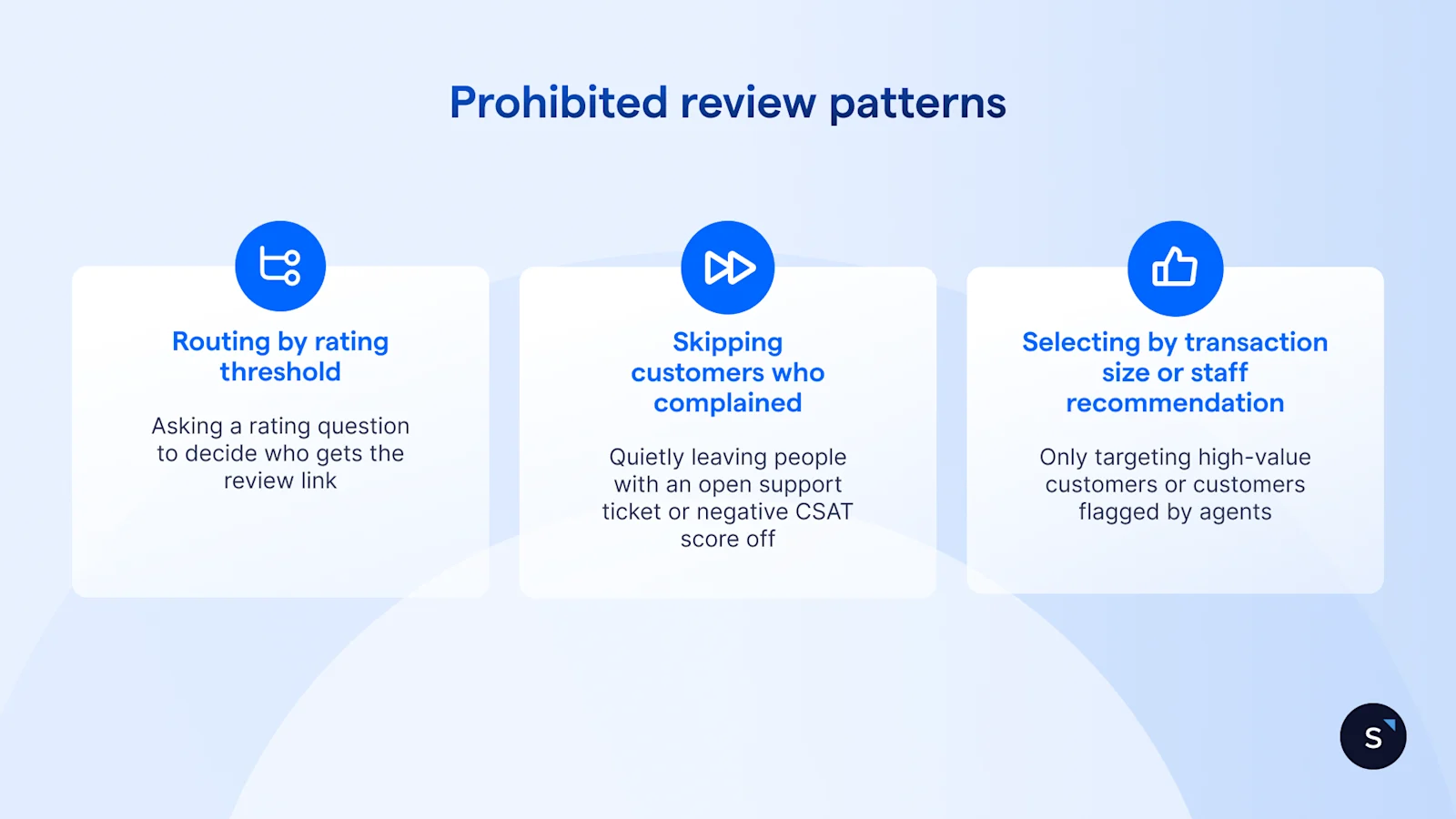
Beyond the general rule, Google's policy separately calls out related conduct: businesses may not direct staff to hit a review quota, and may not ask customers to include specific content, including naming a staff member, in exchange for anything. Neither requires a rating gate to violate the policy; both are about influencing what gets said or who gets asked.
What Google bans, and what it looks like on WhatsApp
The patterns below aren't hypothetical. They're the WhatsApp-native version of the general "selectively solicit" prohibition above.
Case study: what enforcement actually looks like
The Competition and Consumer Commission of Singapore has treated misleading reviews as an unfair practice under the Consumer Protection (Fair Trading) Act 2003. In its 3 July 2025 action against Quantum Globe, the operator of car detailing brand Lambency Detailing, CCCS found the company had used a Sgcarmart QR-code feedback system to post fake five-star reviews under real customers' names, vehicle registration numbers, and vehicle photos, without their consent, with the review text generated by ChatGPT. Quantum Globe admitted to the practice and gave undertakings to stop, notify the affected customers, and open a channel for customers to report fake reviews. Both cases involve outright fabrication or suppression rather than selective solicitation of genuine reviews, which is the narrower issue this guide addresses; a compliant WhatsApp flow avoids both problems by not filtering at all. For anything beyond that general read, confirm your specific set-up with a lawyer familiar with Singapore consumer protection law, since CCCS enforcement in this area is active and still developing.
The compliant WhatsApp review flow, step by step
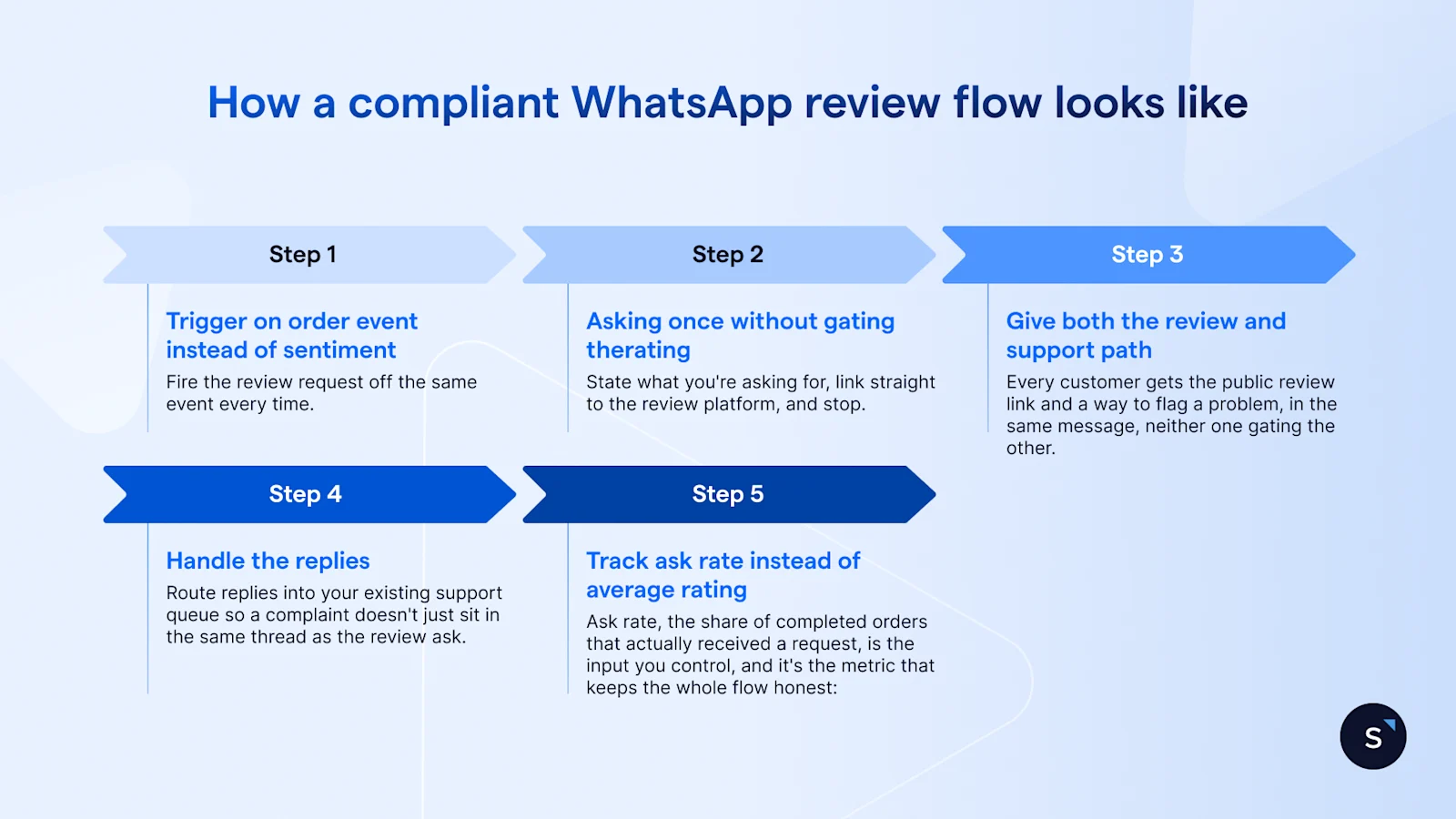
1. Trigger on the order event, not on sentiment
Fire the review request off the same event every time, an order marked complete, a booking fulfilled, a case closed, rather than off a satisfaction score. Every customer who completes the triggering event gets the same message, on the same timing. There's no decision point left for anyone to influence.
2. Ask once, clearly, with no rating gate in front of the link
One message. State what you're asking for, link straight to the review platform, and stop. Don't precede it with an in-chat star rating that decides whether the link even gets sent; that pre-question is the branch point Google's policy targets.
3. Give the review link to everyone, and the support path to everyone alongside it
Every customer gets the public review link and a way to flag a problem, in the same message, neither one gating the other. A customer with a genuine complaint should be able to use both: leave an honest review and get their issue resolved.
4. Handle the replies
Most people will answer the message directly rather than click the link. A "how do I change my review" or "actually, item arrived damaged" reply needs a real person or a routed workflow behind it, not silence. Route replies into your existing support queue so a complaint doesn't just sit in the same thread as the review ask.
5. Track ask rate, not average rating
Average rating is the outcome. Ask rate, the share of completed orders that actually received a request, is the input you control, and it's the metric that keeps the whole flow honest: if ask rate ever starts moving with satisfaction scores, something upstream is filtering.
Is a review request a marketing or a utility message?
This decides your per-message rate, whether Meta's per-user marketing cap applies, and which volume-discount tier you can reach, so it's worth getting right rather than guessing.
Meta's own template categorisation guidelines set a two-part test for the utility category: a template must be non-promotional, and it must also be either specific to or requested by the user, or essential to them. A review request sits close to that boundary. It's tied to a specific order, which leans utility, but the ask itself is a call to action rather than information about the transaction, which is the kind of persuasive intent Meta's guidelines associate with marketing. Meta has also stated it will automatically reclassify a template if it disagrees with the category a business selected.
Don't assume; check your own template's assigned category in WhatsApp Manager. What each answer costs:
The constraint runs one direction only: selecting a category to lower the rate, rather than because the message genuinely meets Meta's utility test, is a policy violation, and Meta's periodic re-review can reclassify (and re-bill) the template regardless of what you originally chose. For more on how this reclassification risk plays out at broadcast-list scale, see SleekFlow's guide to WhatsApp broadcast segmentation.
Reviews and private feedback are different jobs
A public review and a support ticket exist to do different work. The review tells future customers what to expect; the ticket fixes what went wrong for this one. Folding them into a single sentiment-gated flow, where only happy customers see the review link and everyone else gets diverted, is precisely how both jobs get done badly at once: the review profile stops representing real experience, and unhappy customers stop getting routed anywhere useful. Running them as two parallel, always-on paths inside the same message is what keeps both jobs intact.
Where to send reviews in Singapore and Malaysia
The right destination depends on what was bought, and each platform sets its own rules about how reviews may be solicited.
How SleekFlow helps you gather customer reviews on WhatsApp
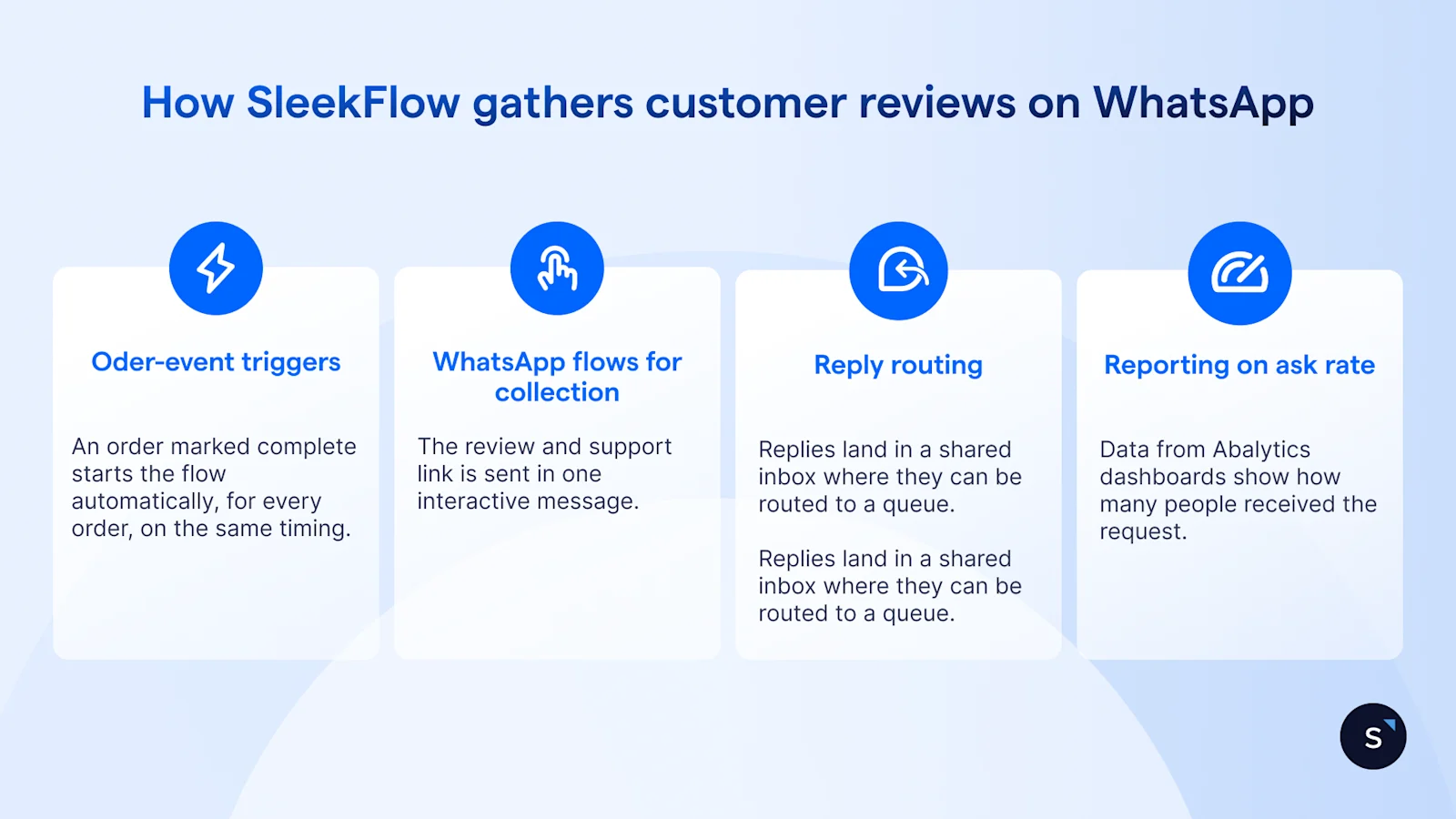
Building the flow above by hand across order platforms, templates, and reply threads is where most teams end up cutting the corner that becomes review gating. SleekFlow's Shopify integration and its order-created trigger nodes fire the review request off the order event itself, with no sentiment step in between:
Order-event triggers. A Shopify (or other connected) order marked complete starts the flow automatically, for every order, on the same timing.
WhatsApp Flows for the collection step. Send the review link and the support option in one interactive message instead of a multi-message back-and-forth.
Reply routing. Replies that come back as text rather than a click land in SleekFlow's shared inbox, where they can be routed into an existing support queue instead of sitting unanswered in the review thread.
Reporting on ask rate. Delivery and read data from Analytics shows how many completed orders actually received the request, the number this whole flow depends on getting right.
Want to outcompete your peers with SleekFlow's help?
Book your personalised demo with SleekFlow today and unlock the potential of seamless communication


