Customer experience software: best platforms, features, and how to choose the right one


TL; DR: Quick Summary
- Customer experience software helps businesses unify conversations across WhatsApp, Instagram, live chat, email, phone, websites, and stores so teams can respond faster with full customer context.
- Singapore businesses need CX platforms because customers expect speed, continuity, and personalisation across both online and offline touchpoints.
- The best CX software combines omnichannel messaging, AI automation, unified customer profiles, workflow routing, analytics, and security controls in one platform.
- AI improves CX operations by qualifying leads, suggesting replies, summarising conversations, routing cases, detecting urgency, and automating repetitive follow-ups.
- SleekFlow is the strongest fit for messaging-led customer experience, especially for businesses that rely on WhatsApp, Instagram, live chat, CRM-connected conversations, automation, analytics, and revenue workflows.
Customers in Singapore no longer think in “support channels”. They move between WhatsApp, Instagram, live chat, email, phone, websites, and stores, and they expect the business to keep up. For growing teams, customer experience software is the operating layer that connects these touchpoints, keeps customer context visible, and helps teams respond faster without losing personalisation.
The urgency is clear. Salesforce reported that 81% of service professionals in Singapore say customers are more demanding than ever, while 65% expect higher case volumes in the coming year. Globally, PwC found that 29% of consumers have stopped buying from a brand because of poor customer experience.
Why customer experience software matters now
Customer experience software has moved from a service tool to a business growth system. Singapore shoppers already behave in an omnichannel way: IMDA highlighted that 68.3% of shoppers in Singapore use both online and physical stores to seek the best value deals, while omnichannel retail accounted for more than half of retail expenditure in 2022 and is projected to grow further by 2026.
That shift creates four business pressures:
Speed: Customers expect quick answers, especially on messaging channels.
Continuity: Customers do not want to repeat their issue when moving from chatbot to agent or from online to offline.
Personalisation: Zendesk reports that 76% of customers expect personalisation, and 70% expect the person they interact with to have full context of their situation.
Efficiency: Higher enquiry volumes make manual routing, copy-paste replies, and disconnected spreadsheets unsustainable.
The strongest CX platforms now combine channels, support, sales, marketing, and automation. By unifying communication channels in an omnichannel CRM, the right CX platform can automate lead qualification, sales, and support, and connect conversations with CRM and e-commerce systems.
Must-have features in customer experience software
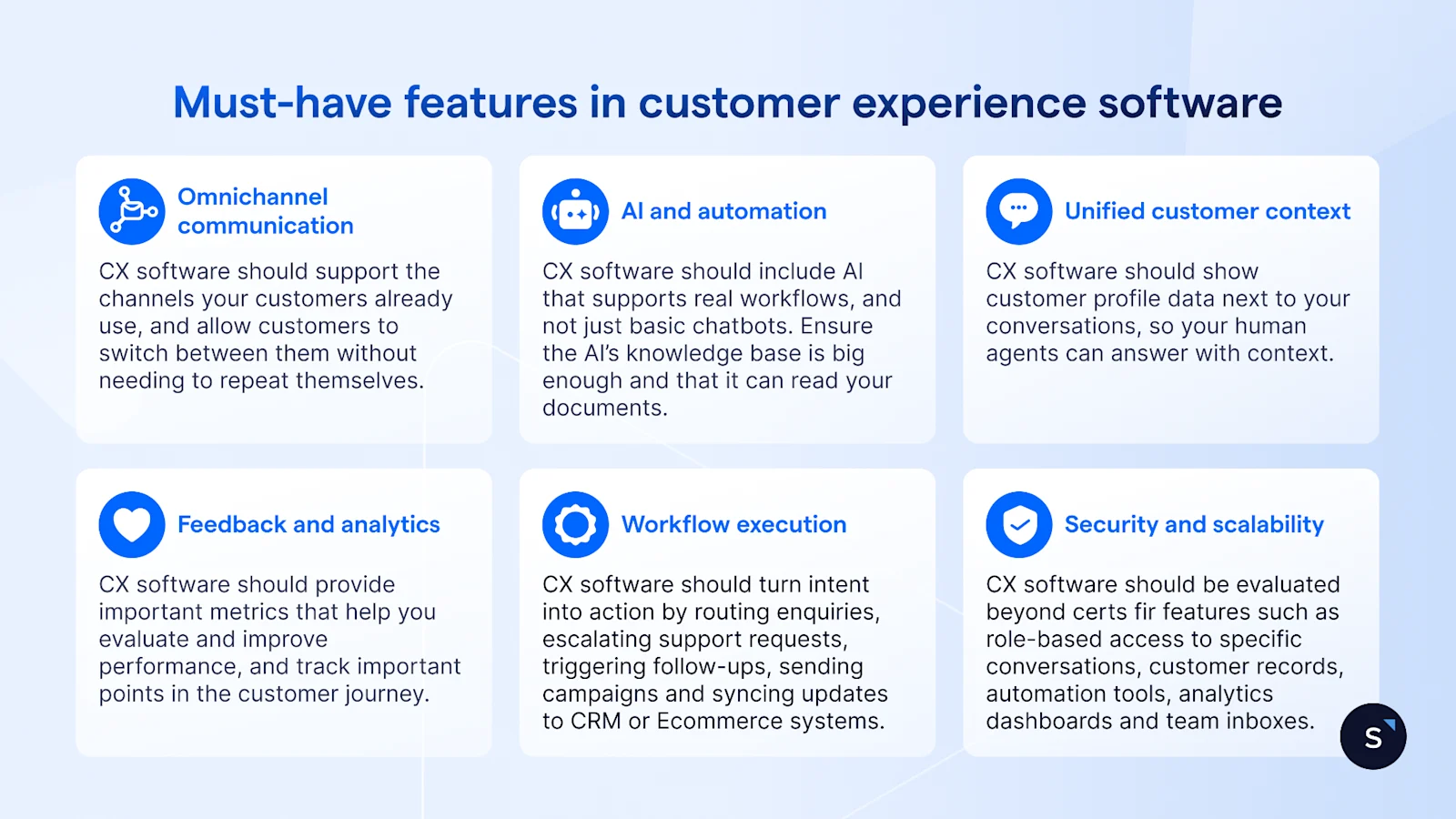
Omnichannel communication
A strong CX platform should not just support the channels your customers already use, but also support when customers switch between them. For Singapore businesses, WhatsApp, Instagram, Facebook Messenger, Telegram, and live chat are especially important for sales-led and service-led conversations.
AI and automation
Modern CX software should include AI that supports real workflows, not just a basic chatbot. Look for:
AI agents for lead qualification, FAQs, routing, and order updates
Reply suggestions and writing assistance for agents
Conversation summaries for handovers
Sentiment detection to prioritise urgent cases
Workflow automation for follow-ups, reminders, and escalations
It is also paramount to evaluate the platform’s AI Knowledge Base. A reliable AI agent is only as useful as the information it can access. Check what types of business content the platform can learn from, such as files, live websites, tables, and more. The size of the knowledge base also matters, as a small or limited knowledge base may only handle basic FAQs, which can lead to generic answers, repeated human handovers, and inconsistent customer experiences. A larger, more flexible knowledge base allows the AI agent to reference a wider range of approved business information, which is especially important for businesses with multiple product lines, markets, languages, or customer journeys.
Unified customer context
The right platform should show customer profile data next to the conversation. This includes conversation history, lifecycle stage, orders, tickets, preferences, owner, labels, and CRM records.
This matters because customer experience software should help agents answer with context. By linking conversations to contact profiles, contact properties, tickets, custom object records, Ecommerce data, and shared media, agents can generate personalised replies without needing the customer to repeat themselves.
Feedback and analytics
CX leaders need more than inbox volume. Your platform should track:
CSAT and NPS
sentiment trends
first response time
average resolution time
conversation volume by channel
campaign performance
conversion and revenue impact
With analytics, teams can monitor response times, conversation volume, team performance, campaign engagement and conversion events across channels. Filters and exportable reports make it easier to compare performance by channel, team, assignee, time period, customer segment or campaign.
The real value comes from using this data to improve day-to-day decisions. For example, sales managers can see which channels generate the most qualified conversations, and where customers drop off in the journey.
Workflow execution
Good customer experience management software should turn intent into action. That means routing enquiries, escalating support requests, triggering follow-ups, sending campaigns, and syncing updates to CRM or e-commerce systems.
A strong workflow layer should help teams turn customer intent into the next best action. This includes automating routine replies, routing enquiries to the right team, updating customer records, triggering follow-ups and escalating cases when human support is needed. For support teams, ticketing should also make it easy to separate service requests from general conversations, assign ownership, prioritise urgent cases and track resolution progress by status, channel or team.
Security and scalability
Security should be evaluated at both the user and data level. The platform should give administrators control over who can access specific conversations, customer records, automation tools, analytics dashboards and team inboxes. This is especially important for businesses with multiple departments, branches, markets or external partners using the same customer experience software.
Look for security features such as role-based access control, team-based permissions, audit logs, two-factor authentication, IP restrictions and data masking for sensitive customer information. These controls help teams collaborate without giving every user unrestricted access to customer data.
Best customer experience software for Singapore businesses
The right platform depends on whether your business is support-led, sales-led, messaging-led or enterprise-service-led. TechnologyAdvice’s buyer guide also shows that the CX software category includes different tool types, from service platforms to feedback and customer engagement systems.
How to choose the right customer experience software
Start with the customer journey, not the tool category. The best customer experience software should match where your customers talk, how your teams work, and how your business measures success.
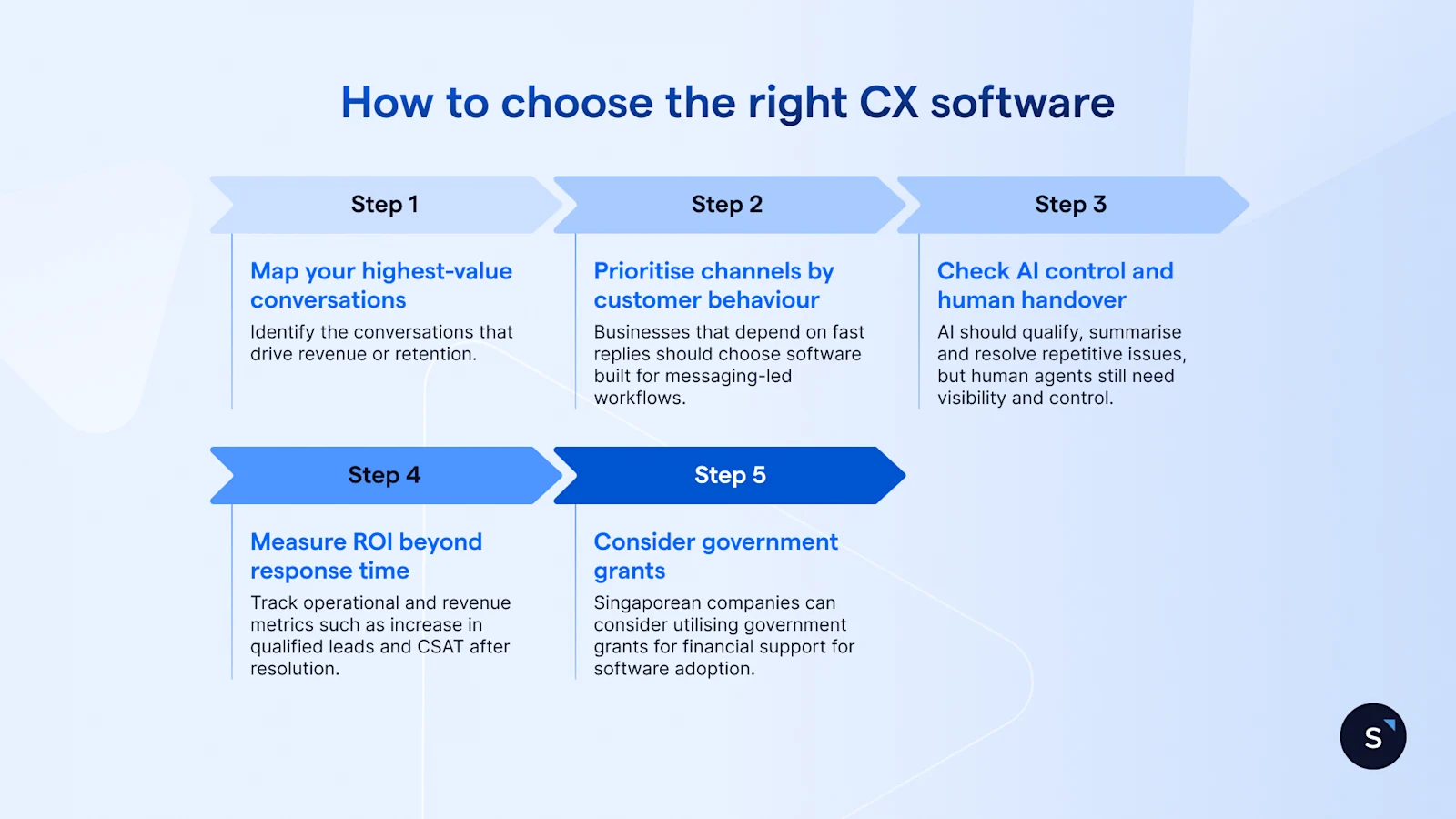
1. Map your highest-value conversations
Identify the conversations that drive revenue or retention: enquiries, appointment bookings, contract renewals, abandoned carts, support tickets, feedback requests, and loyalty campaigns.
2. Prioritise channels by customer behaviour
For Singapore, WhatsApp, Instagram, live chat, and web enquiries often matter more than traditional web forms alone. Businesses that depend on fast replies should choose software built for messaging-led workflows.
3. Check AI control and human handover
AI should qualify, summarise, and resolve repetitive issues, but human agents still need visibility and control. Look for clear handover rules, agent assignment, and conversation history.
4. Measure ROI beyond response time
Track operational and revenue metrics such as:
reduction in first response time
increase in qualified leads
conversion from chat to purchase
CSAT after resolution
agent capacity
campaign read and reply rates
retention or renewal uplift
5. Consider government grants
Singaporean companies can consider utilising government grants such as the Productivity Solutions Grant (PSG) for GenAI Customer Engagement Chatbot, which enables SMEs to claim up to 50% grant support for a customer experience software.
Frequently Asked Questions
What is customer experience software?
What is the difference between CX software and CRM?
What features should I look for in customer experience software?
How do I measure CX software ROI?
What is the best customer experience software for omnichannel support?
Can customer experience software improve sales and retention?
Is AI necessary in customer experience software?
Start for free!
Grow your revenue and turn chats into conversions with AI agents. Try SleekFlow for free, forever.


