EDG vs PSG Singapore: which one is a better fit?


TL; DR: Quick Summary
- PSG and EDG both fund up to 50% of qualifying costs for SMEs, so the deciding factor is scope, not percentage.
- Several guides still quote PSG at 80% and EDG at 70%, rates that expired on 31 Mar 2023.
- Check the GoBusiness solutions directory first. A listed match usually makes PSG the faster, more affordable route.
- Both schemes reject retrospective applications, so never pay a vendor or start work before you submit.
- The EDGE grant, launching in the second half of 2026, will fold EDG, PSG and MRA into one scheme.
SMEs are eligible for up to 50% Productivity Solutions Grant (PSG) support for the adoption of SleekFlow, a Pre-Approved Solution under the IMDA SMEs Go Digital programme.
You've got a vendor quote in one hand and a grant consultant's pitch in the other, and both are telling you their scheme covers 50% of your project cost. That's true of the Productivity Solutions Grant (PSG) and the Enterprise Development Grant (EDG) alike, which is exactly why comparing them by percentage gets you nowhere.
PSG funds pre-approved, off-the-shelf solutions from a fixed vendor list, with a light application and a capped award. EDG funds bespoke, project-based transformation work, with a written proposal, a certified consultant, and no fixed cap. Since 1 Apr 2023, both sit at up to 50% of qualifying costs for SMEs, assessed case by case rather than guaranteed. The deciding factor is whether a suitable solution already sits on the PSG list.
What is the PSG grant?
The Productivity Solutions Grant (PSG) is a Singapore government scheme that funds up to 50% of the cost of pre-approved, off-the-shelf IT solutions and equipment listed on the GoBusiness solutions directory, capped at S$30,000 per company each financial year.
The list covers sector-specific and generic solutions: point-of-sale systems, HR software, digital marketing tools, and AI customer engagement chatbots. You pick a vendor from the list, get a quotation, and apply before you pay a cent.
PSG is only open to local SMEs: Singapore-registered, at least 30% local shareholding, and either group turnover under S$100 million or fewer than 200 employees. There's no non-SME tier.
What is the EDG grant?
The Enterprise Development Grant (EDG) is a Singapore government scheme that funds bespoke, project-based transformation work, up to 50% of qualifying costs for SMEs and up to 30% for non-SMEs, with no fixed cap and support assessed project by project.
EDG covers three pillars: core capabilities (finance, HR, strategy), innovation and productivity, and market access (overseas expansion, franchising). Qualifying costs stretch across third-party consultancy fees, software and equipment, and internal manpower.
Because there's no pre-approved list, you write the case yourself. That's the trade for a grant with no ceiling.
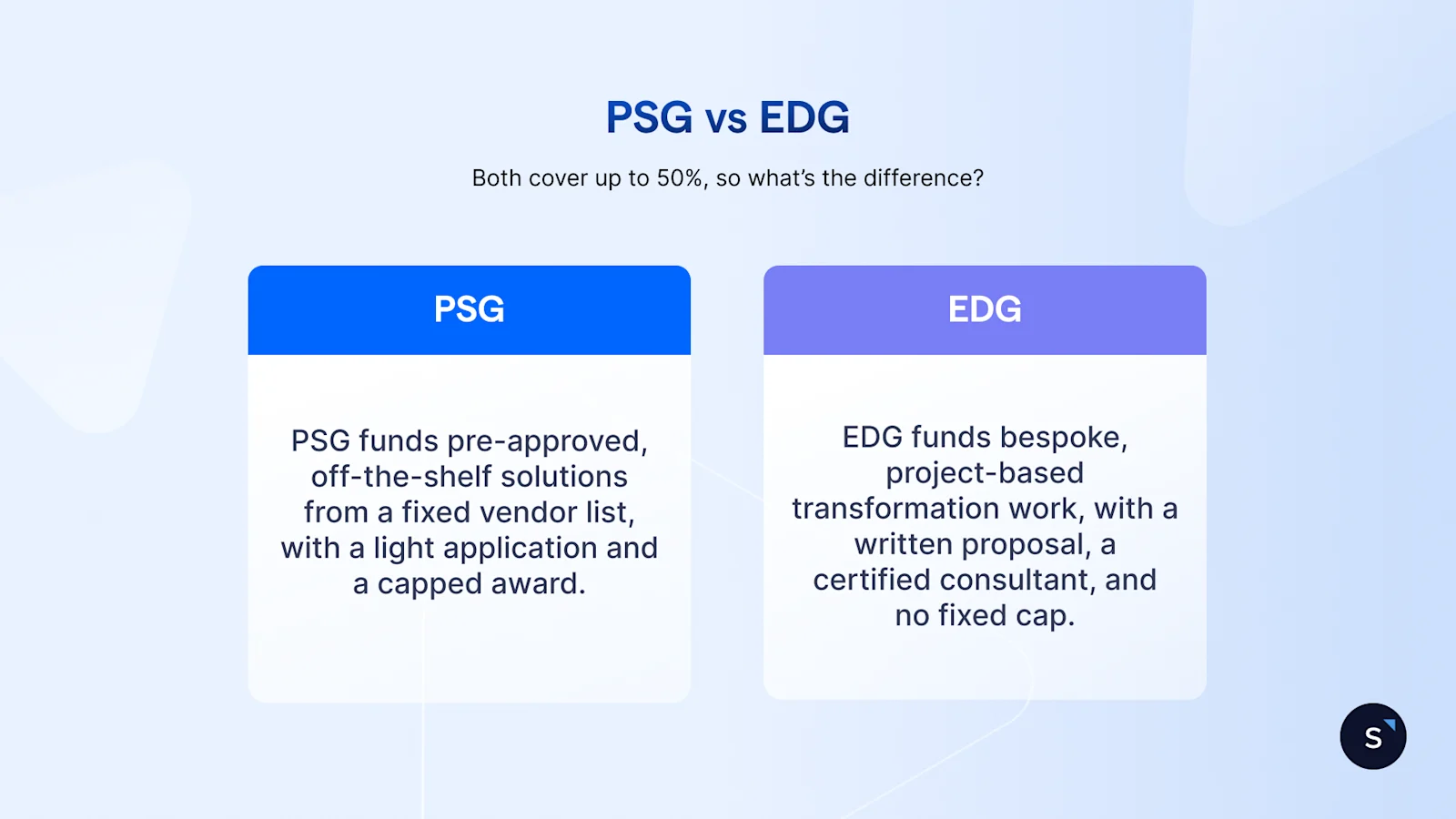
The gap that matters most is row one. PSG hands you a menu, EDG hands you a blank page. Everything else on this table (timelines, consultants, claims) follows from that single choice.
Which grant fits your project?
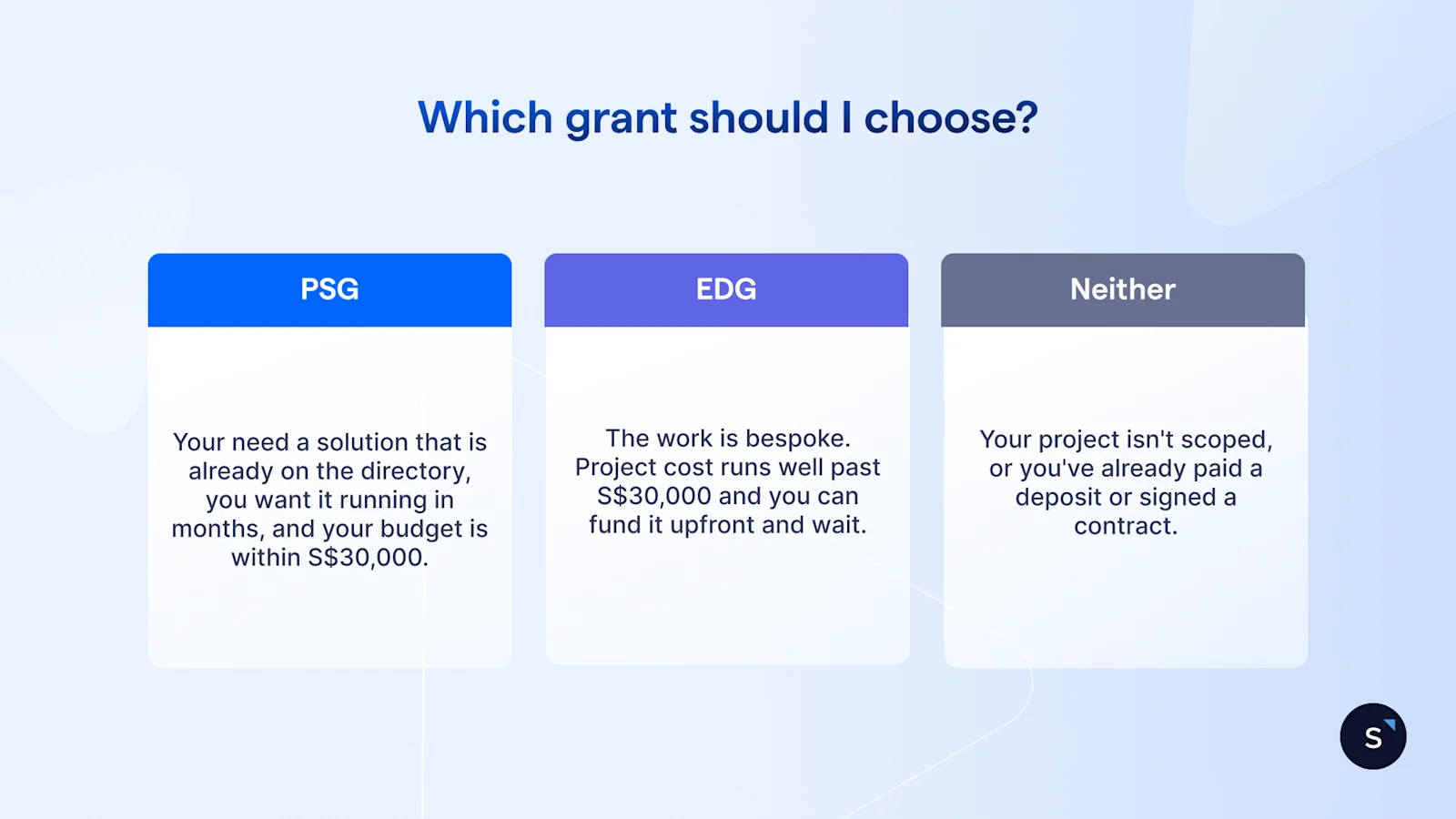
Check the GoBusiness solutions directory first. If a solution that fits your need is already listed, PSG is almost always the faster and cheaper route. If nothing listed fits, or the work is genuinely custom, EDG is the path.
Choose PSG when
Your need a solution that is already on the directory, you want it running in months rather than quarters, and your budget sits comfortably inside a S$30,000 award.
Choose EDG when
The work is bespoke: process redesign, a custom system build, overseas expansion, or brand and strategy work. Project cost runs well past what PSG could cover, and you're prepared to fund it upfront and wait through milestone claims and an audit.
Choose neither yet when
Your project isn't scoped, or you've already paid a deposit or signed a contract. Both schemes reject retrospective applications: no payment before submission for PSG, no work commenced before approval for EDG. This is the failure mode that costs SMEs the most, and it's the one most guides skip.
Can you use both the EDG and PSG grants?
Yes. They're separate schemes with separate applications, so one company can hold both at once. The same cost can't be claimed under both; EDG requires the project not to have started, and PSG requires no payment or contract signed before submission, so sequencing matters more than eligibility.
Worth a mention while you're planning cash flow: eligible employers can also draw on the SkillsFuture Enterprise Credit (SFEC), a one-off S$10,000 credit covering up to 90% of out-of-pocket costs on top of existing scheme support. Final claims close on 30 Nov 2026, so check your own eligibility window rather than assume it.
What does the EDGE grant change?
The EDGE is a confirmed, announced scheme from Enterprise Singapore's Business Refresh Package, consolidating EDG, PSG and MRA into one activity-based application, targeted for the second half of 2026. It has a S$100,000-a-year cap for eligible activities (subject to case-by-case review), and is open to all Singapore-registered businesses, including non-SMEs, and overseas expansion support rising from 50% to 70% for SMEs and 30% to 50% for non-SMEs.
The practical answer: don't wait and waste the opportunity. Enterprise Singapore states existing schemes remain accessible until EDGE launches, and approved projects are honoured under existing terms.
A project you can scope now is better filed now than held for a scheme whose full criteria aren't public.
How SleekFlow helps you get more from a PSG or EDG-funded project
SleekFlow is the AI suite for revenue-driving conversations, listed on the GoBusiness directory for GenAI customer engagement solutions.
NNIO, a Singapore retailer of home appliances and cooling products, ran four disconnected teams answering customers across social media, its website, retail stores and the phone, and enquiries kept falling between them.
They consolidated every channel into one shared inbox, added AgentFlow AI agents for after-hours enquiries, and used Flow Builder to capture WhatsApp warranty registrations. The rollout itself drew PSG support for a GenAI customer engagement chatbot.
Results:
40% faster response times
2.6x repurchase rate
20% increase in completed checkouts
Read the full NNIO case study →
Getting your project grant-ready
Whichever grant fits, the paperwork rewards founders who scope the project before they touch a vendor or a proposal template. Get that sequencing wrong, PSG or EDG, and you're filing under "choose neither yet" no matter how good the project is.


