Enterprise AI chatbot: What it is, how it works, and how enterprises utilise it


TL; DR: Quick Summary
- Enterprise AI chatbots help large businesses manage high conversation volumes across channels like websites, WhatsApp, Instagram, and internal tools, so customers and employees can get instant support without waiting for a human agent.
- Unlike basic chatbots, enterprise AI chatbots understand intent, remember context, pull live data from CRMs, Ecommerce platforms, helpdesks, and internal systems, and take action based on business workflows.
- They improve efficiency by handling routine enquiries such as order tracking, appointment booking, password resets, FAQs, and ticket routing, reducing pressure on support teams.
- They also support revenue growth by qualifying leads, recommending products, following up on abandoned carts, and moving customers through the sales funnel faster.
- The strongest enterprise AI chatbot platforms combine omnichannel deployment, multilingual support, analytics, human escalation, privacy controls, and continuous improvement so businesses can scale customer engagement safely and effectively.
Every enterprise has the same problem: too many conversations, too few agents, and customers who expect answers immediately— at midnight on a Sunday.
Enterprise AI chatbots solve this at scale. Deployed across websites, WhatsApp, Instagram, and internal tools, they handle enquiries, qualify leads, resolve tickets, and trigger backend workflows without requiring a human to be online. According to Gartner, by 2027, chatbots will become the primary customer service channel for around 25% of organisations globally.
But not all chatbots are built for this. A basic chatbot answering FAQs on a small business website is a fundamentally different tool from what a regional bank, e-commerce platform, or healthcare provider actually needs. The difference lies in depth, flexibility, and how well the system connects to the rest of the business.
This blog breaks down exactly what an enterprise AI chatbot is, how it works, why enterprises are deploying them, and what to look for when choosing a platform.
What Is an Enterprise AI Chatbot?
An enterprise AI chatbot is an AI-powered conversational system built for large organisations to automate customer and employee interactions, connect with business systems, and support workflows at scale.
Where a basic chatbot follows rigid decision trees and breaks under anything unexpected, enterprise AI chatbots understand natural language, retain conversation context, pull live data from integrated systems, and route or escalate intelligently based on business logic.
What Makes an AI Chatbot Enterprise-Ready?
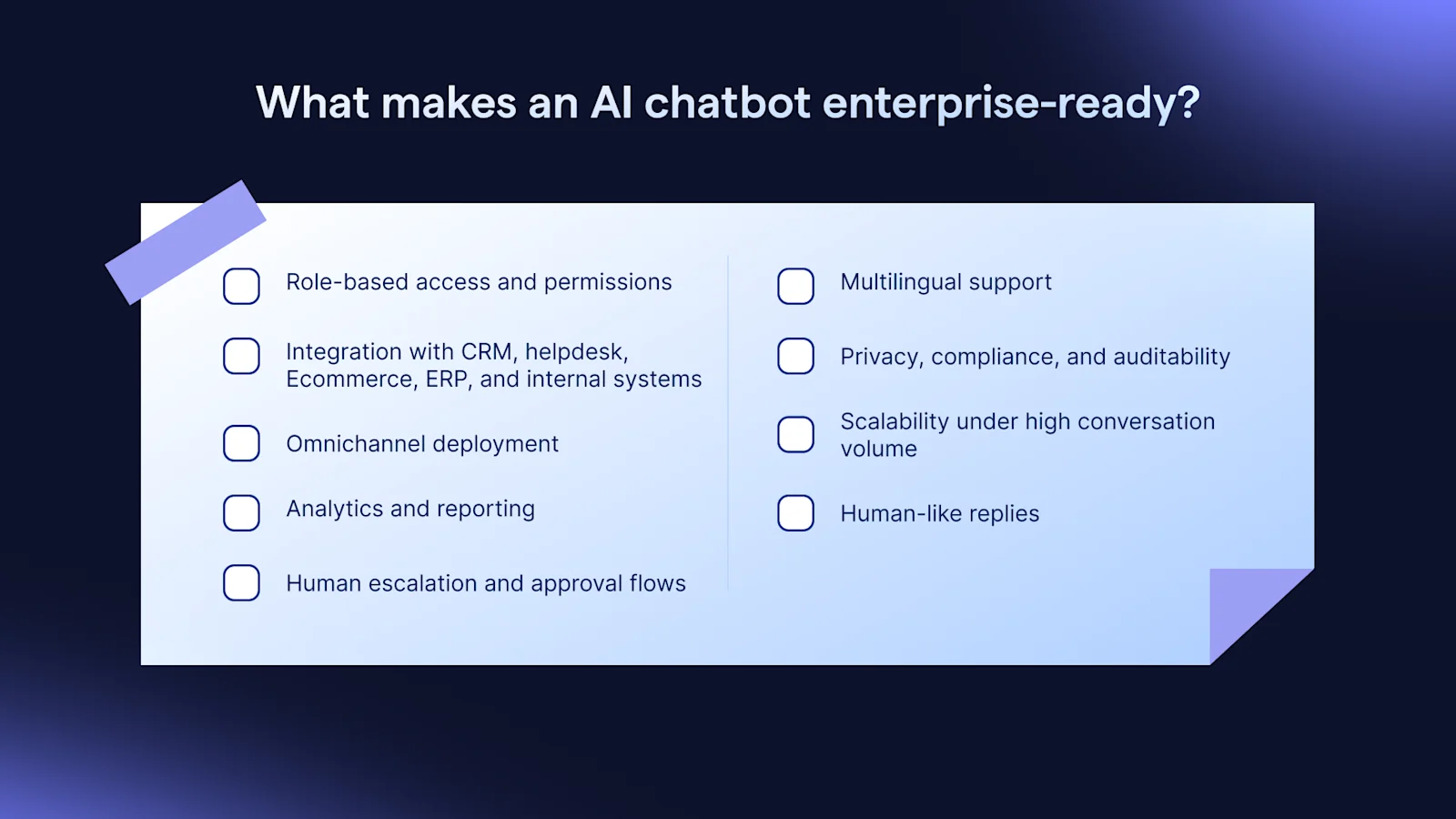
Enterprise readiness is not just about sophistication, but about reliability, security, and deep integration with how a business actually operates. An enterprise-grade AI chatbot must support:
Role-based access and permissions — Different teams should only see what they need to. Agents, managers, and admins require separate access levels.
Integration with CRM, helpdesk, Ecommerce, ERP, and internal systems — The chatbot must be able to integrate with CRMs such as Salesforce, HubSpot, Shopify, and relevant internal databases to give contextually relevant answers.
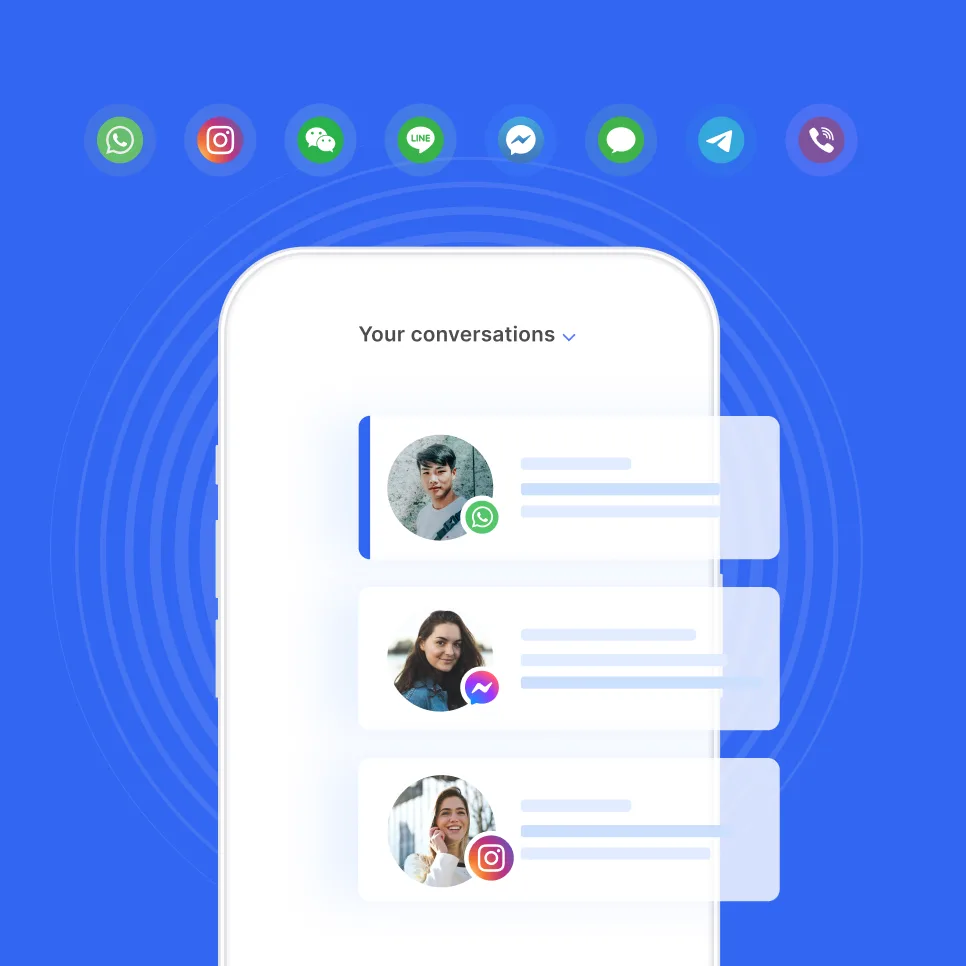
Omnichannel deployment — Customers interact on WhatsApp, Instagram DMs, Facebook Messenger, your website, and your app. The chatbot must work across all of them from a single workflow.
Analytics and reporting — Conversation volumes, resolution rates, escalation rates, CSAT scores, and conversion metrics must be tracked and accessible.
Human escalation and approval flows — AI should know when to step aside and route conversations to the right agent, with full context transferred.
Multilingual support — Especially critical in Southeast Asia, where customer bases may span Mandarin, Malay, Bahasa Indonesia, Thai, and English.
Privacy, compliance, and auditability — Data handling must comply with PDPA (Singapore), GDPR where applicable, and internal governance policies.
Scalability under high conversation volume — During campaigns, launches, or crises, conversation volume can spike 10x overnight. The platform must handle it without degradation.
Human-like replies — Responses should feel natural and on-brand, not robotic.
How Enterprise AI Chatbots Work
Every enterprise AI chatbot follows the same core sequence from the moment a user sends a message to the moment a resolution is reached.
Stage 1: The User Triggers a Conversation or Workflow
A customer sends a WhatsApp message asking about a delayed order. A prospective buyer starts a chat on the website. An employee queries the internal HR bot about leave entitlements.
These conversations begin across websites, WhatsApp, Instagram, Facebook Messenger, email, apps, or internal tools— and the enterprise AI chatbot picks up all of them from a single platform.
Stage 2: The Chatbot Understands Intent and Context
Using natural language processing (NLP) and machine learning, the chatbot identifies what the user is asking — and why. It reads intent signals, checks conversation history, references the user's profile (returning customer? VIP account? previous complaint?), and pulls from relevant knowledge sources to understand the full context before responding.
Stage 3: The AI Retrieves Knowledge or Live Data
This is where enterprise integrations matter. The chatbot reaches into your help centre, queries your CRM for customer order history, pulls live inventory data, checks policy documents, or retrieves employee records— depending on what the conversation requires. Without these integrations, the chatbot is guessing. With them, it becomes genuinely useful.
Stage 4: The Chatbot Responds, Routes, or Acts
Based on what it knows, the chatbot either generates an accurate reply, qualifies the lead and routes them to sales, escalates to a live agent, triggers an automation (such as sending a refund or updating a record), or recommends a product. Enterprise AI chatbots do not just talk — they execute.
Stage 5: Analytics and Feedback Continuously Improve Performance
Every conversation generates data. Unresolved intents reveal gaps. CSAT scores highlight friction points. Escalation patterns show where the AI is uncertain. Conversion metrics tie chatbot activity to revenue. This feedback loop is what allows an enterprise AI chatbot to improve over time rather than stagnate.
Why enterprises use AI chatbots
Efficiency
Enterprise AI chatbots resolve the majority of routine enquiries such as order tracking, password resets, appointment booking, policy FAQs without agent involvement. According to IBM, businesses spend over $1.3 trillion annually on customer service interactions. AI chatbots can deflect up to 80% of routine enquiries, dramatically reducing support costs.
Customer Experience
Response time drops from hours to seconds. Service is available 24/7. Answers are consistent, on-brand, and accurate. For customers in Singapore and across Southeast Asia who are increasingly engaging with businesses via WhatsApp and other messaging channels, this responsiveness is a competitive differentiator. SleekFlow's customers consistently report improved CSAT scores after deploying AI-assisted conversations via WhatsApp Business API.
Revenue
Enterprise AI chatbots are not just cost-cutting tools, but rather, revenue generators. They qualify inbound leads at the moment of intent, make product recommendations based on purchase history or browsing behaviour, send follow-up messages for abandoned carts, and support conversion throughout the sales funnel. A well-deployed chatbot is, effectively, a top-performing sales rep who never sleeps.
Employee Productivity
Internally, AI chatbots give employees instant access to HR policies, IT support, onboarding documents, and internal knowledge bases without waiting for a colleague to respond. McKinsey research estimates that generative AI could automate up to 70% of the time spent on employee-facing knowledge tasks.
Scalability
During peak periods such as sales campaigns, product launches, and service outages, conversation volumes surge. Enterprise AI chatbots absorb that volume without linear headcount growth. You do not need to hire 20 new agents for Q4. You scale the AI.
Best Practices for Enterprise AI Chatbot Deployment
Getting enterprise AI chatbot deployment right requires discipline. Here is what separates successful implementations from expensive failures:
Design around real problems, not vanity demos: Start with your highest-volume, most predictable conversations. Master those before expanding.
Keep answers grounded in verified knowledge: Ungrounded AI hallucinations are a reputational and legal risk. All chatbot responses should be anchored to reviewed, approved content.
Make human handoff seamless: Customers should never feel abandoned mid-conversation. Escalation must include full context so agents do not make customers repeat themselves.
Deploy on the channels customers already use: In Singapore, WhatsApp dominates. Do not force customers to a channel they did not choose.
Support multilingual experiences: A chatbot that only speaks English fails large segments of the Southeast Asian market.
Log, monitor, and retrain continuously: A chatbot is not a deploy-and-forget system. Review conversation logs weekly, at the minimum.
Limit access to sensitive data: Apply least-privilege principles. The chatbot should only access the data it needs for the task at hand.
Test for failure states and edge cases: What happens when a user goes off-script? When the CRM is down? When translation is ambiguous? Plan for these before go-live.
SleekFlow's enterprise AI chatbot platform is built to meet every criterion on this list, with a particular focus on WhatsApp-native deployment and Southeast Asian market requirements.
The Future of Enterprise AI Chatbots
Enterprise AI chatbots are already powerful. What comes next is considerably more transformative:
More agentic workflows: Chatbots that do not just respond, but take multi-step actions autonomously: checking inventory, issuing refunds, updating CRM records, and sending follow-ups — all within a single conversation.
Proactive customer engagement: AI that initiates conversations based on behavioural triggers: an abandoned cart, a flight cancellation, a product restock. Moving from reactive to anticipatory.
Multimodal support: Conversations that incorporate voice, images, and documents, not just text.
Better human–AI orchestration: Smoother handoffs, shared context, and AI that assists agents in real time rather than replacing them entirely.
Revenue analytics integration: Linking chatbot conversation data directly to pipeline and revenue metrics, making the ROI of every interaction measurable.
At SleekFlow, we are actively building toward this future, connecting conversational AI to the full customer lifecycle, from first message to closed deal. See what's next on our platform.
Want to outcompete your peers with SleekFlow's help?
Book your personalised demo with SleekFlow today and unlock the potential of seamless communication


