Google Ads vs Facebook Ads: how to actually decide between them


TL; DR: Quick Summary
- Google Ads captures demand that already exists; Facebook Ads (Meta Ads) creates demand where none was visible yet. The right platform depends on which one matches your category.
- Cost per click is the wrong first comparison. Compare cost per acquisition against the same conversion event, since Google clicks tend to convert at a higher rate.
- Google recommends judging Smart Bidding over at least 30 conversions, and Meta's own guidance points to roughly 50 optimisation events in 7 days. Underfunded tests never clear either bar.
- A Click-to-WhatsApp ad opens a free messaging window once you reply within 24 hours, which removes the landing page and its drop-off entirely.
- Singapore and Malaysia both now tax digital ad spend from overseas platforms; the commonly cited Malaysian rate is out of date.
Most marketing teams ask which platform is better before they've asked a more useful question: does demand for what I sell already exist, or does it need to be created?
Google Ads vs Facebook Ads isn't really a competition between two ad platforms. It's a decision about where your buyer already is in their head. Someone typing "waterproofing contractor Bishan" into Google has a problem and a budget. Someone scrolling Instagram has neither, yet, until your ad gives them one.
Get that distinction wrong and the symptoms look identical regardless of platform: decent click volume, thin conversions, a media buyer insisting the account "just needs more time." This guide breaks down how each platform actually works, when to lead with which one, how to split a budget across both without starving either, and what changes when you're setting up from Singapore or Malaysia.
What's the difference between Google Ads and Facebook Ads?
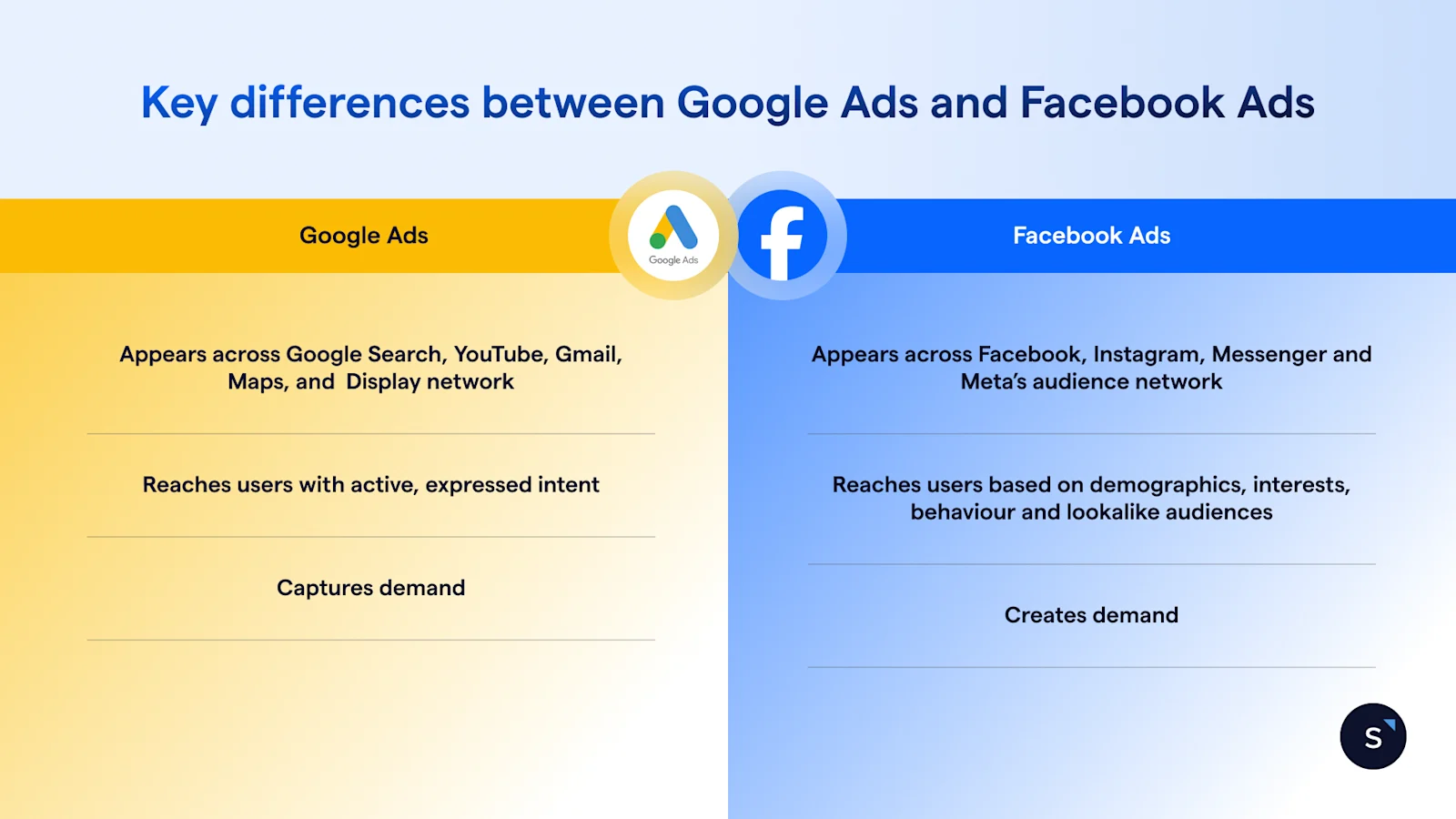
Google Ads is Google's auction-based advertising platform. Advertisers bid on keywords and creative slots to appear across Search, YouTube, Gmail, Maps and the Display Network, mostly paying when someone clicks, calls or converts. Because the ad shows in response to a search, it's reaching someone with active, expressed intent.
Facebook Ads, run through Meta Ads Manager, places ads across Facebook, Instagram, Messenger and Meta's Audience Network. Instead of matching a search query, Meta's algorithm matches your ad to people based on demographics, interests, behaviour and lookalike audiences built from your existing customers. Nobody searched for your product; the ad interrupts a scroll to introduce it.
That's the core split: Google Ads captures demand, Facebook Ads creates it. Neither is the stronger platform in the abstract. The stronger platform is whichever one matches how your category actually gets bought.
How each platform actually works
Google Ads: an auction triggered by a search
Every time someone searches, eligible advertisers enter a real-time auction. Google scores each ad on bid amount and Ad Rank, a combination of expected click-through rate, ad relevance and landing page experience, then ranks the winners. A high-relevance ad with a modest bid can outrank a higher bid with a poorly matched keyword, which is why match type and landing page quality move cost per click as much as the bid itself does.
Google Ads spans several campaign types (Search, Performance Max, Shopping, Demand Gen, Display, Video), but Search is the one built around expressed intent: someone typed a query, and your ad answered it. That's covered step by step in SleekFlow's Google Ads setup guide.
Facebook Ads: an algorithm predicting who will respond
Meta doesn't wait for a query. You choose an objective (Awareness, Traffic, Engagement, Leads, Sales, or Messages for Click-to-WhatsApp), define an audience by interest, behaviour or a lookalike of your existing customers, and Meta's delivery system tests placements and creative variants to find who responds. The system needs a threshold volume of conversions to stabilise; below that, it's still guessing at who your buyer is.
Because there's no query to match against, creative carries far more of the weight on Meta than on Google. The image or video is the entire pitch, not a supporting element next to a headline someone already searched for.
Google Ads vs Facebook Ads: side by side
A note on that cost-per-click row: it's the one line worth reading carefully rather than skimming. Comparing platforms on cost per click alone is misleading, because a Google click usually comes from someone closer to purchase and converts at a higher rate. Judge both platforms on cost per acquisition against the same conversion event, not on what the click itself costs.
When to choose Google Ads
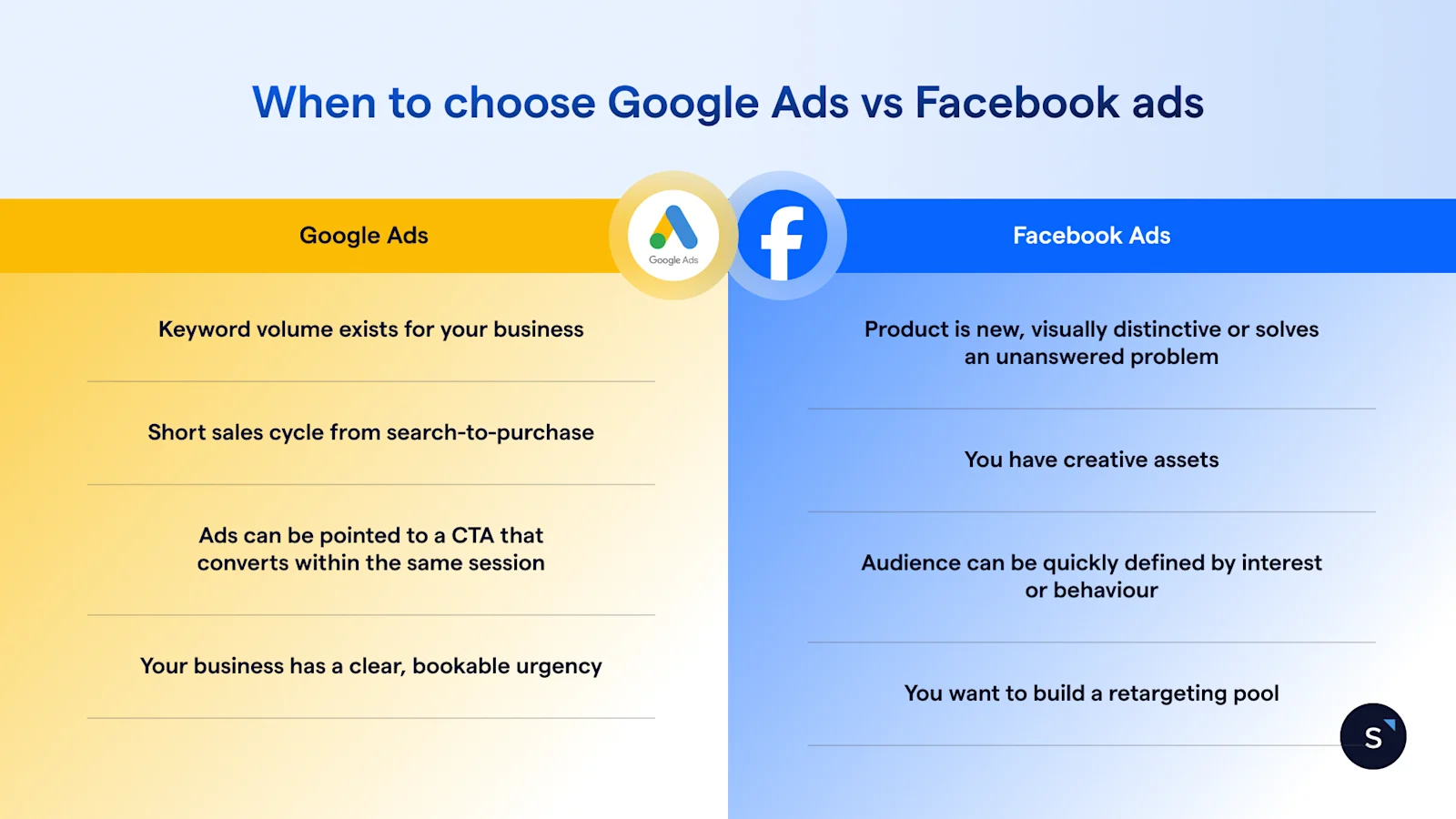
Lead with Google Ads when people already search for what you sell. Signals worth checking before you commit budget:
Keyword volume exists for your product or service, not just your brand name.
Your sales cycle is short enough that a single search-to-purchase journey is realistic.
You can point ads at a landing page, call, or WhatsApp click that converts within the same session.
Your category has clear, bookable urgency (repairs, emergency services, bookings, professional services).
Google Ads suits businesses selling something with an established, searchable name. A waterproofing contractor, an immigration lawyer, or a used-car dealer are all categories people already type into Google before they buy.
When to choose Facebook Ads
Lead with Facebook Ads when your product needs to be seen before it can be searched for. Signals worth checking:
Your product is new, visually distinctive, or solves a problem people don't yet have a name for.
You have (or can quickly build) creative assets: photos, video, testimonials.
Your audience can be defined by interest or behaviour more precisely than by keyword.
You want to build a retargeting pool before a launch or sale, not just react to demand.
A direct-to-consumer skincare brand, a new F&B concept, or a course nobody's searching for by name yet all fit this pattern. The ad's job is to manufacture the first moment of interest, not answer a question someone already asked.
How to split a budget across both
Running both platforms from day one, split evenly, is usually a mistake. It spreads spend thin enough that neither ad set clears its learning threshold, which means every early result is noise rather than signal.
A steadier sequence:
Run one platform properly first. Pick whichever platform matches your buyer's current mindset (see the two sections above), and fund it enough to exit its learning period within days rather than weeks.
Establish a cost per acquisition you trust. Give it enough of a sample, the conversion thresholds in the table above, before judging it.
Test the second platform against the same conversion event. Not a different goal, not a softer metric. The point is a fair comparison, not a reason to keep the first platform's number.
Rebalance based on blended CPA, not platform preference. If Facebook Ads brings in cheaper leads but Google Ads' leads close at a higher rate, the winner depends on your sales team's capacity to work lower-intent volume, not on cost per lead alone.
Once both platforms are funded and stable, a common split for SG-MY SMEs is weighting spend toward whichever platform delivers the lower cost per acquisition, then keeping 15 to 20% of budget on the other to protect against a single platform's algorithm changes or auction pressure.
Additional fees and steps for Google and Meta ads in Singapore and Malaysia
A few things change once billing address moves to Singapore or Malaysia, and both trip up teams who haven't checked their rates recently.
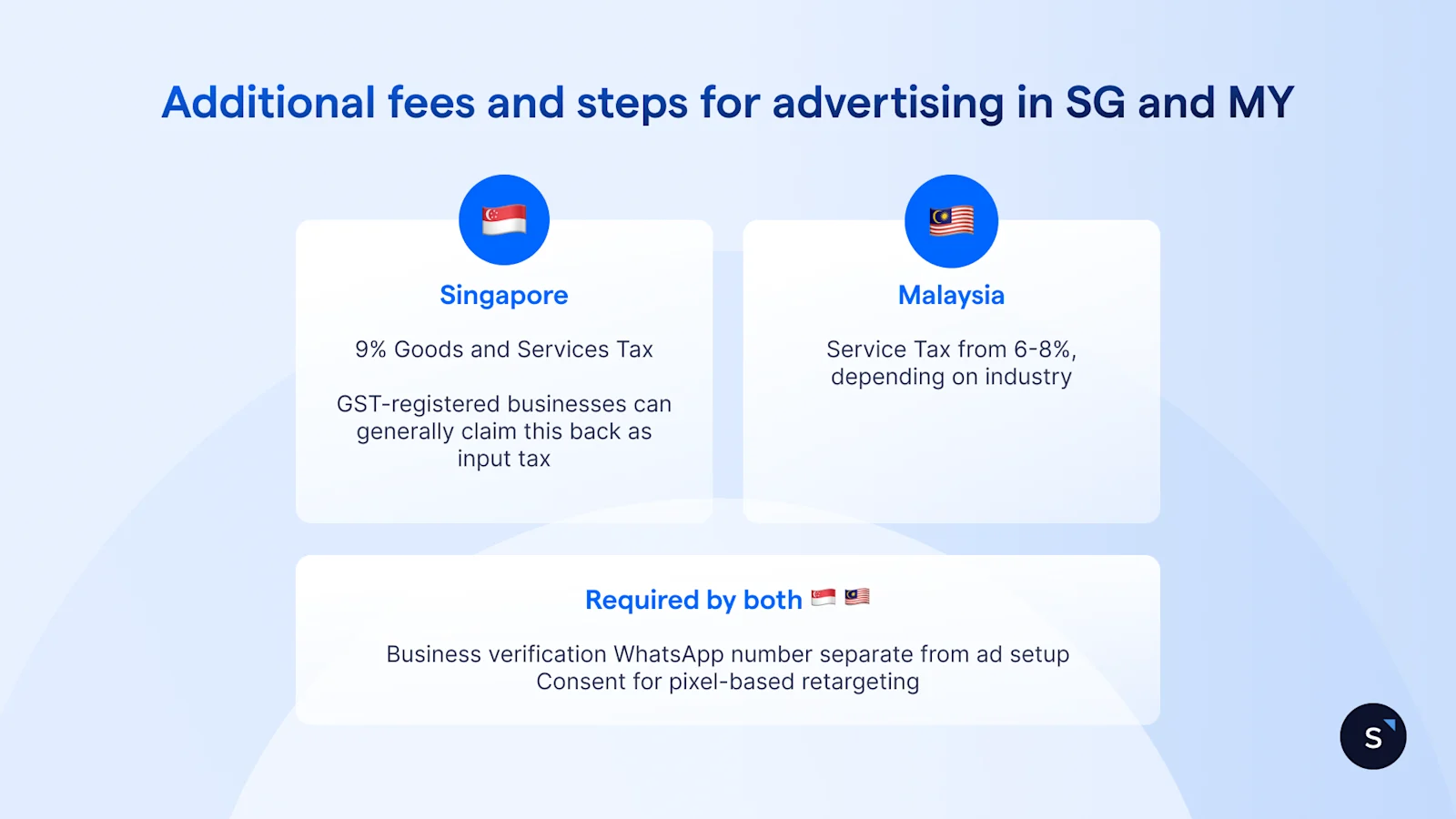
Singapore: GST is charged at 9%, the rate that's applied since 1 January 2024. Google Asia Pacific Pte. Ltd. and Meta's Singapore entity both add GST directly to your ad invoices; GST-registered businesses can generally claim this back as input tax.
Malaysia: digital advertising from Google and Meta is subject to Service Tax on imported digital services. The 6% figure that still circulates widely online is out of date. Malaysia's Royal Malaysian Customs Department (RMCD) confirmed the rate for digital services provided by foreign registered persons rose from 6% to 8%, effective 1 March 2024. The lower 6% rate now only applies to a short exception list (food and beverage, telecommunications, logistics, and parking), which digital advertising does not fall under. Budget on 8%.
Beyond tax, three practical steps apply to both markets:
Business verification. Meta Business Manager and Google Ads both ask for a registered business name and address; have your UEN (Singapore) or SSM registration (Malaysia) ready before setup, not mid-campaign.
WhatsApp number separate from ad setup. If you're running Click-to-WhatsApp ads, the WhatsApp Business number needs its own verification through Meta, independent of the ad account itself.
Consent for pixel-based retargeting. PDPA obligations in both countries apply to data collected through ad pixels and Conversions API integrations, so cookie and consent notices need to cover ad tracking specifically, not just the website generally.
How SleekFlow helps handle the enquiries Google Ads and Facebook Ads bring in
Both platforms end at the same handoff point: a lead exists, and now someone has to reply to it before the intent cools. That's the part most budgets quietly leak through, not the click itself.
A Click-to-WhatsApp ad built with the Messages objective sends the tap straight into a WhatsApp conversation instead of a landing page form. SleekFlow's shared inbox routes that conversation to the right agent or team automatically, so a Facebook lead and a Google-to-WhatsApp lead land in the same place, tagged by which ad and campaign sent them. AI-powered lead qualification can triage and score the conversation before a human ever touches it, so a sales team isn't manually sorting warm leads from tyre-kickers across two separate ad platforms.
Don’t waste your ad budget on slow replies to enquiries
The gap between click and reply is where most ad budget actually gets wasted. SACES, a Singapore home services company, deployed SleekFlow’s AI agents to qualify enquiries landing across WhatsApp, Facebook and Instagram.
By using AI agents to qualify leads round the clock instantly, the home services company saw a 75% enquiry-to-booking conversion rate on AI-qualified leads. Ad platform aside, that's the mechanism: a lead qualified and replied to fast converts at a different rate than one sitting in an inbox until someone checks it. (Read the SACES case study.)