Personalised customer service in retail: how to deliver it on every channel


TL; DR: Quick Summary
- Personalised customer service in retail means whoever replies next, human or AI, already knows the shopper's history.
- 46% of Singapore consumers expect a joined-up experience across a retailer's channels, and 72% now use AI when they shop.
- Singapore shoppers still call, with 80% preferring the ph83%one even though 83% try self-service first.
- Personalisation breaks at the handover, when the next person to reply starts from nothing.
- Fix the shared view of the shopper across store, site, and messaging before adding recommendations.
A customer buys a coffee machine in your store in March. In August, the milk frother stops working, so she messages your Instagram. Whoever picks it up asks for her order number, then the model, then whether she bought it online or in store.
All three answers already sit in your systems. None are on the screen where the reply gets written.
That gap is what shoppers mean when they say service felt impersonal. Below: what the term covers, where it happens, and 7 ways to close it.
What is personalised customer service in retail?
Personalised customer service in retail is support tailored to the individual shopper, using their purchase history, preferences, and past conversations rather than the same reply for everyone. It applies in-store and across digital channels, and it depends on whoever responds next, human or AI, having that context in front of them.
Two things get mistaken for it. A first name dropped into a promotional message is formatting, and shoppers read the difference straight away. A recommendation engine on your product pages is merchandising, useful on its own terms, but it stops the moment someone asks a question.
Service personalisation shows up in what a shopper never has to repeat.
Why personalised customer service matters for retailers in 2026
Personalised service drives repeat purchase and protects revenue. Roughly 7 in 10 shoppers prefer retailers that personalise across every channel, and two-thirds say being recognised by name and purchase history makes them more likely to shop again, per 2024 research from Incisiv and Talkdesk.
The expectation is now built into how Singaporeans shop. Adyen's July 2026 index, run with YouGov across 1,041 Singapore consumers, found 46% expect a seamless experience across a retailer's channels and 72% already use AI while shopping.
Most retailers want to do this. What stops them is where the information sits. The ServiceNow survey linked above, covering 1,485 Singaporeans in March 2026, found service representatives use more than 4 systems on average, leaving 35% of their time for the customer's actual problem. In the same study, 52% would switch brands after a poor experience.
In-store vs digital: where personalised retail service happens
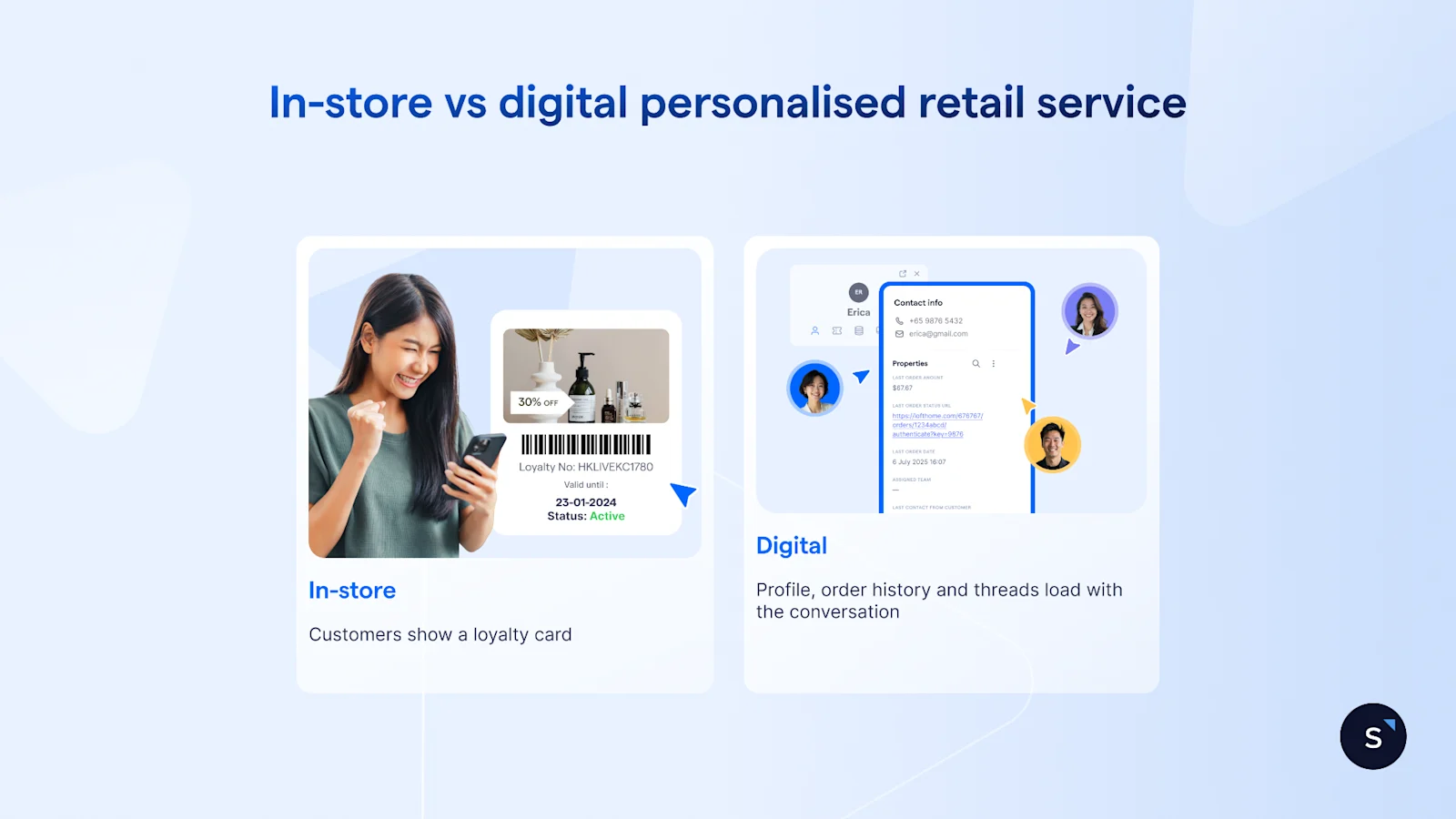
In-store personalisation depends on an associate recognising a shopper face-to-face, or through details stored in a loyalty card. Digital personalisation delivers the same recognition through messaging, live chat, and AI agents, at any hour and any volume. The strongest retailers connect both, so a shopper's context follows them whether they walk in or send a message.
Connecting the two
Someone who buys in store and asks about the warranty on WhatsApp is one customer with one history, unless your systems record two. The retail strategy work that joins up inventory and channels often stops short of the service layer, so the shopper still gets asked for a receipt nobody needed.
How AI agents personalise retail customer service
AI agents personalise retail service by recognising a returning shopper and their order history, answering product, stock, and returns questions instantly on the channel the shopper chose, and suggesting relevant items from past purchases. Anything complex goes to a human with the full thread attached.
Recognition matters more than the automation rate. In that same ServiceNow survey, 47% of Singapore customers said current chatbots don't understand their questions.
So decide the escalation rule before you set an automation target. An agent that clears half the queue and passes the rest on with the thread attached will serve shoppers better than one that clears more and leaves the hard cases circling.
7 ways to deliver personalised customer service in retail
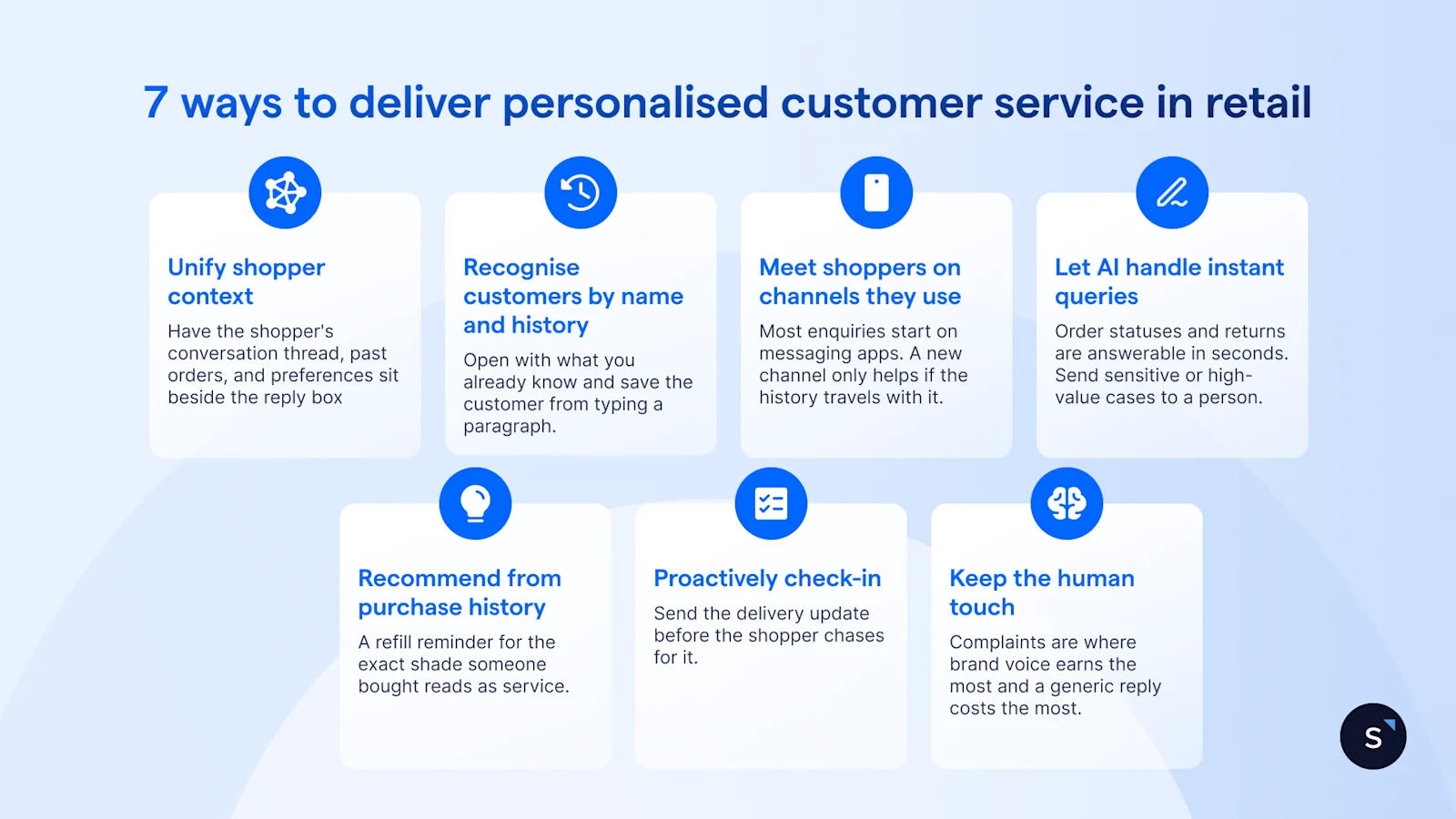
Unify shopper context across store, site, and messaging. Recognise returning customers by name and history. Meet them on the channels they already use. Let AI answer instantly and escalate with context. Recommend from purchase history. Be proactive about orders and restocks. Keep a human on complaints and returns.
1. Unify shopper context across store, site, and messaging
One inbox where a shopper's WhatsApp thread, past orders, and preferences sit beside the reply box, so nothing is re-explained when the conversation changes hands.
2. Recognise returning customers by name and history
Open with what you already know. "Your order from 14 Jul shipped on Friday" saves the shopper a paragraph.
3. Meet shoppers on the channels they already use
Plenty of retail enquiries in Singapore start on WhatsApp or Instagram. A new channel only helps if the history travels with it.
4. Let AI handle instant queries, escalate the rest with context
Stock, order status, and returns policy are answerable in seconds. Send sensitive or high-value cases to a person, with the conversation attached.
5. Recommend from purchase history, service-led rather than spammy
A refill reminder for the exact shade someone bought reads as service. The same message to your whole list reads as a broadcast.
6. Be proactive about orders, restocks, and check-ins
Send the delivery update before the shopper chases it. Flag the restock to the people who asked, not to everyone.
7. Keep the human touch on complaints and returns
Automate the lookup, not the apology. Complaints are where brand voice earns the most and a generic reply costs the most.
How SleekFlow helps retailers deliver personalised customer service
SleekFlow is the AI suite for revenue-driving conversations. In retail service, the useful part is plumbing rather than intelligence: a shopper's orders and past threads have to load beside the reply box, on whichever channel they picked, for the store team, the support agent, and the AI agent alike.
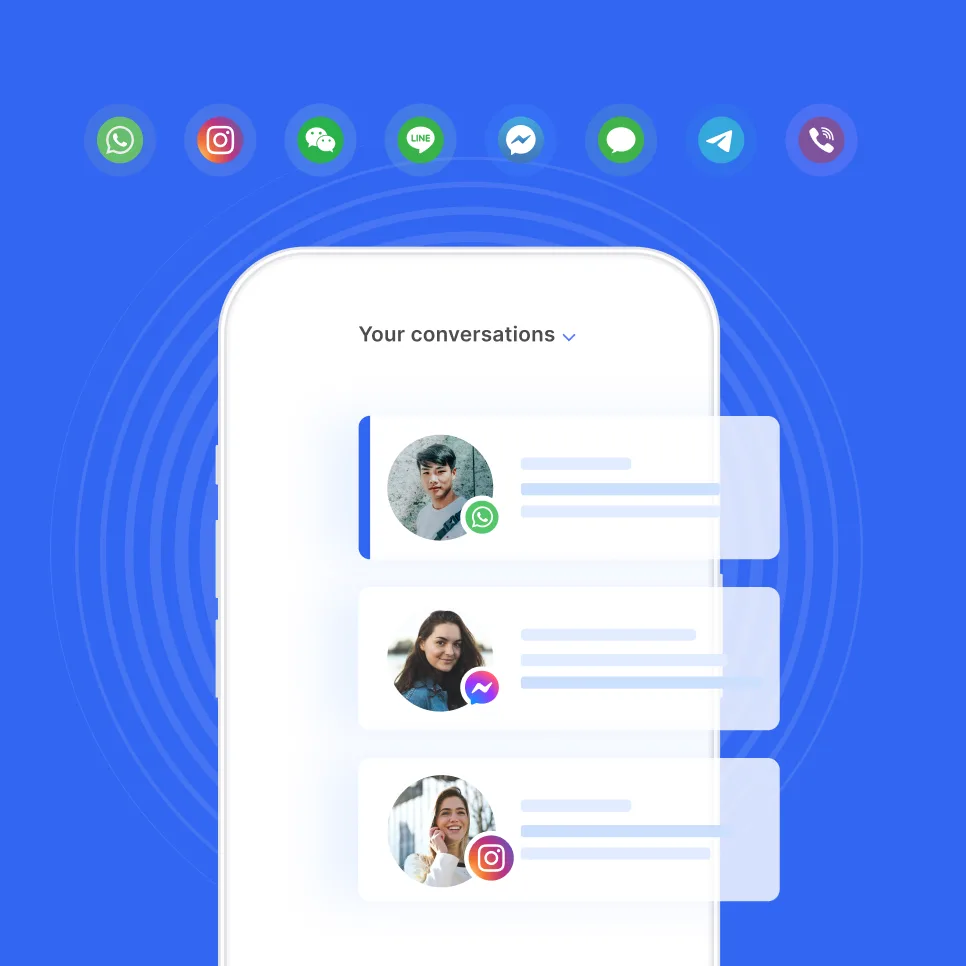
The Inbox brings WhatsApp, Instagram, email, SMS, TikTok, and calls into one place, builds a customer profile alongside the conversation, and keeps history across channels so shoppers don't repeat themselves.
AgentFlow covers the AI side. Its inbound agent answers from your own content and completes tasks like checkout or booking. You control escalation "based on sentiment, topic, or task completion," and on handover, the human agent receives a full summary.
Real life examples of personalised customer service in retail
BateriHub, a car battery retailer with 130 or more branches across Malaysia, sends a personalised reminder timed to when each customer's battery is due for replacement, with a complimentary check-up offered alongside it. Response time dropped from roughly 17 minutes to near-instant on urgent enquiries, and conversions rose 22% in three months.
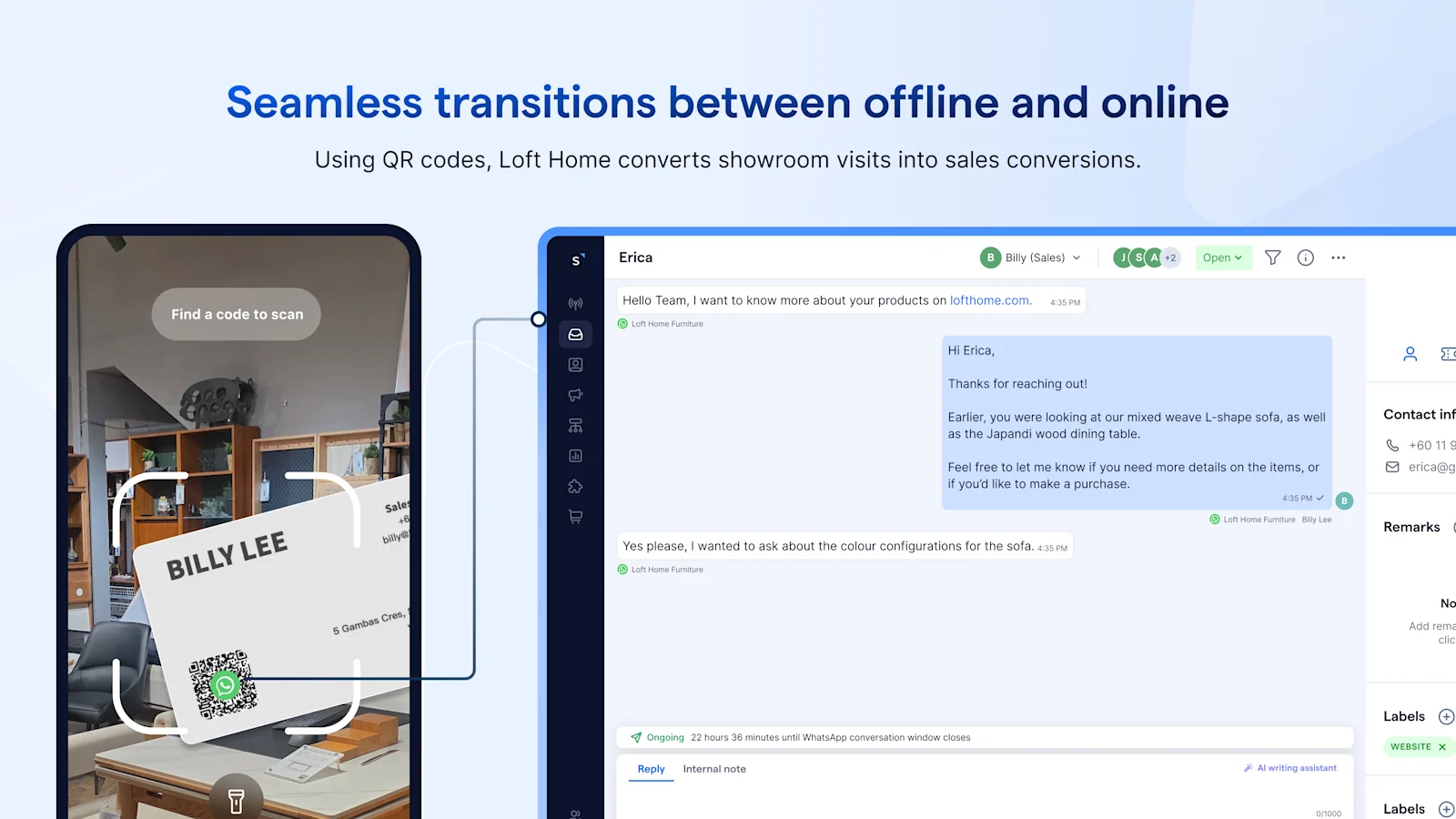
Loft Home, a Singapore furniture retailer, prints a unique QR code on each salesperson's name card, so a shopper who scans it after leaving the store reaches the same person they spoke to on the floor. The change cut daily manual operational time by 40%.
NNIO, a Singapore home appliance retailer, has its AI agent ask customers about room size, budget, and preferred features before it recommends a product, or offers an alternative when the first choice is out of stock. Retention rose 260%, and 30% of enquiries are now handled by AI.
Achieve better personalisation with SleekFlow
The best retail personalisation is invisible to the shopper. It reads as a fast answer rather than a clever one, because whoever replied already had what they needed.
Make your next conversation personalised
Most teams already hold the data that personalisation needs. What's missing is one profile per customer and an agent allowed to act on it. Book a demo and see how an inbound AI agent handles a live enquiry.
