SMS Compliance: A Complete Guide to Laws, TCPA Rules & Best Practices


TL;DR: Quick Summary
- SMS compliance ensures texts are legal, transparent, and privacy-safe; TCPA fines of $500–$1,500 per message make mistakes financially and reputationally costly.
- Core rules come from TCPA, CAN-SPAM, CTIA, GDPR, and PDPA, plus local telecom laws, all governing consent, disclosure, data use, and opt-out rights.
- A good framework requires explicit opt-in, clear brand ID, easy STOP instructions, respectful sending hours, secure data handling, and archived consent records.
- Keep campaigns compliant with regular audits, updated policies, SMS archiving, and automation for opt-ins, opt-outs, consent updates, and cross-channel consistency.
- Avoid sending without consent, hiding your identity, delaying STOP requests, using misleading copy, or failing to log consent; tools like SleekFlow help automate safeguards.
SMS marketing remains one of the highest-engagement communication channels for businesses, but it comes with strict regulatory requirements. SMS compliance refers to the set of regulations, guidelines, and best practices that ensure every text message you send is legal, transparent, and respectful of user privacy. Staying compliant isn't optional: regulators enforce penalties for improper consent, misleading messages, or failure to provide opt-outs. Under the TCPA alone, fines can range from $500 to $1,500 per message, meaning one non-compliant SMS campaign can quickly escalate into major financial and reputational damage.
Then move directly to the third paragraph, which adds genuine value by discussing scalable frameworks:
For organizations building scalable messaging programs, keeping a clear SMS compliance checklist, maintaining accurate records, and developing a strong privacy standard are essential steps. As rules evolve, adhering to up-to-date, verified guidelines ensures both legal safety and long-term customer confidence, especially in an era where digital communication is under increasing scrutiny.
Why SMS Compliance Is Important for Businesses
For any business using SMS marketing or transactional messaging, following SMS compliance laws isn’t just a legal formality, it’s essential for building trust and protecting your brand. When customers know that you ask for proper consent, provide clear opt-outs, and respect their privacy, they are far more likely to engage with your messages. This directly improves customer experience and strengthens long-term loyalty.
Strong compliance practices also help companies avoid costly penalties. Under TCPA compliance for SMS, a single non-compliant message can lead to fines between $500 and $1,500 per text, resulting in severe financial and reputational damage. Maintaining an internal compliance framework , using SMS archiving for mobile compliance, and keeping your SMS compliance privacy policy updated can significantly reduce these risks.
Most importantly, compliance extends across all communication channels, not just SMS. Whether you use email, WhatsApp, iMessage, or push notifications, customers expect consistent transparency and responsible data handling. A unified compliance approach ensures your entire messaging ecosystem remains safe, trustworthy, and legally sound.
Key SMS Compliance Laws You Should Know
Businesses sending SMS in the U.S. must follow a range of federal and industry regulations. These laws define how you obtain consent, store data, send messages, and handle opt-outs. Below are the most important frameworks to understand:
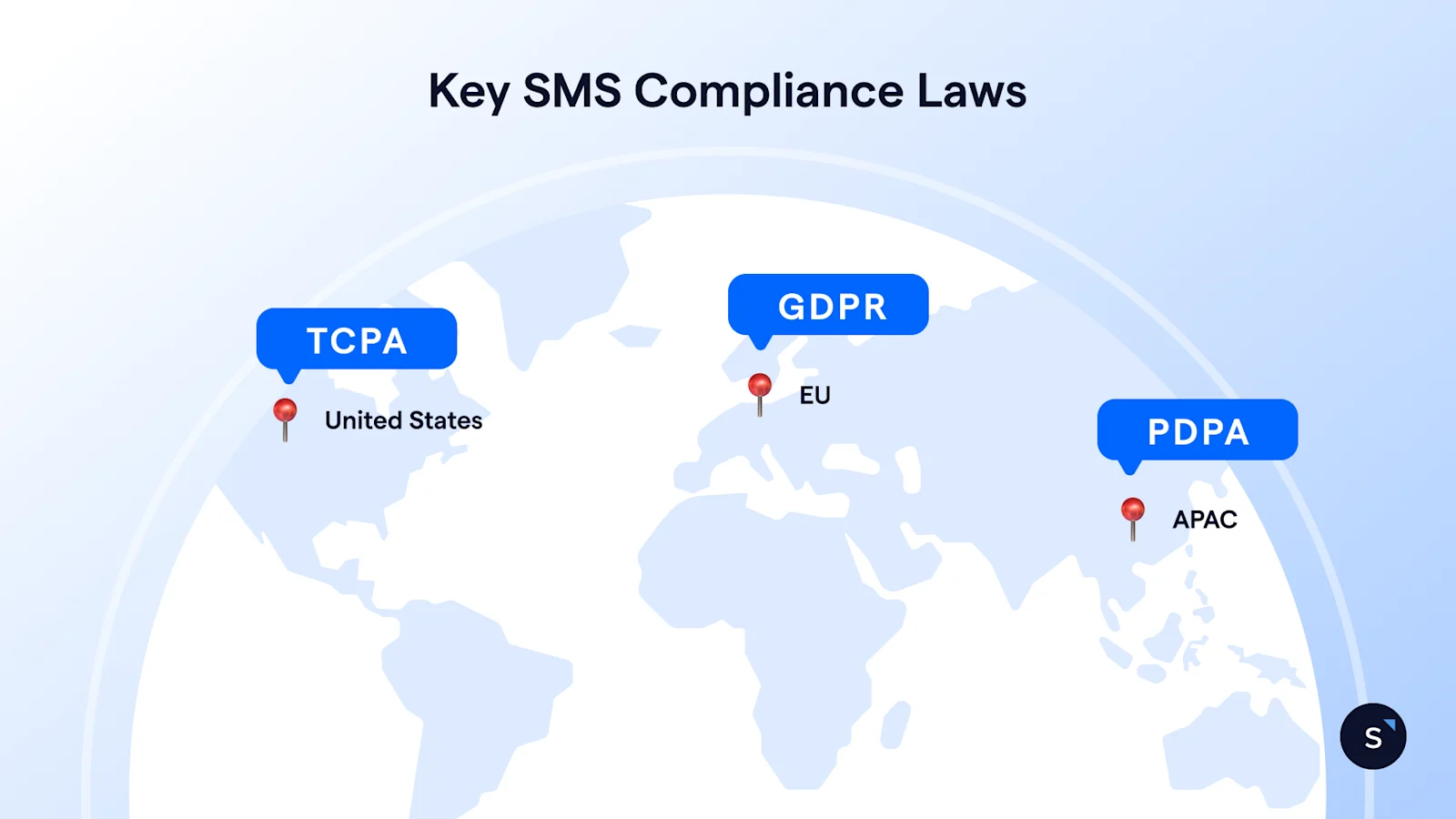
1. TCPA (Telephone Consumer Protection Act)
Region: United States (Federal Law)
Governs SMS and telemarketing practices across all U.S. states and territories.
Enforced by the FCC (Federal Communications Commission).
The core law governing TCPA SMS compliance. It requires:
Prior express written consent for marketing messages
Clear identification of the sender
Easy opt-out options
No use of autodialers without permission
Authoritative resource: FCC (Federal Communications Commission)
2. CAN-SPAM Act
Region: United States (Federal Law)
Applies primarily to email but also extends to commercial SMS messages.
Enforced by the FTC (Federal Trade Commission).
Although originally designed for email, CAN-SPAM also affects SMS marketing. It requires:
Truthful message content
Clear identification as an advertisement
Honoring opt-out requests promptly
3. CTIA Guidelines
Region: United States (Industry Standards)
Not a law, but U.S. mobile carriers use CTIA rules to enforce SMS best practices.
Applies across all U.S. carrier networks (AT&T, Verizon, T-Mobile, etc.).
Violations can lead to carrier filtering or blocking.
CTIA includes rules for:
Message transparency
Opt-in and opt-out flows
Avoiding SHAFT content (U.S. mobile carriers restrict or completely prohibit in SMS campaigns)
4. GDPR (General Data Protection Regulation)
GDPR applies to businesses handling EU customer data. For SMS:
Data processing must be lawful and transparent
Customers must consent before receiving messages
Businesses must provide data access and deletion options
5. PDPA (Personal Data Protection Acts)
Countries like Singapore and Thailand enforce PDPA rules that regulate:
How customer data is collected
Consent requirements
Privacy disclosures for SMS communication
Comparison Summary: Key SMS Compliance Laws
Important Note for International Readers
If your business operates outside the U.S., always refer to local telecom and privacy laws. Regulations differ widely, and compliance frameworks like TCPA may not cover your region.
TCPA Compliance for SMS Marketing
The Telephone Consumer Protection Act (TCPA) is the cornerstone of TCPA SMS compliance in the United States. Enacted to protect consumers from unwanted communications, it sets strict rules for businesses sending SMS messages. Key requirements include obtaining prior express written consent, clearly identifying the sender, providing simple opt-out mechanisms, and maintaining proper records of consent.
Violating the TCPA can be costly. For instance, sending marketing texts without consent can result in fines ranging from $500 to $1,500 per message, and multiple violations can escalate into class-action lawsuits. Examples include companies penalized for sending promotional SMS to non-consenting recipients or failing to honor opt-out requests promptly.
Best Practices:
Always collect and store explicit consent before sending marketing SMS.
Include clear opt-out instructions in every message.
Maintain a detailed compliance framework and archival records.
Regularly audit messaging campaigns to ensure ongoing compliance.
SMS Compliance Checklist for Marketers
A practical SMS compliance checklist helps marketers stay legal, build trust, and avoid fines. Key items include:
Obtain explicit opt-in before sending messages
Clearly identify your brand in every SMS
Include STOP opt-out instructions for easy unsubscribe
Record and archive consent for auditing purposes
Send messages during appropriate hours
Secure customer data according to privacy regulations
Note: Platforms like SleekFlow simplify compliance by automating opt-ins, managing consent records, and supporting SMS archiving for mobile compliance, ensuring your campaigns stay lawful and efficient.
What Proper, Compliant SMS Consent Looks Like
Example of Compliant SMS Opt-In Language (Meets TCPA + CTIA Standards)
“By submitting this form, you agree to receive marketing text messages from [Brand Name] at the number provided. Message & data rates may apply. Message frequency varies. Reply STOP to unsubscribe, HELP for help. View our Privacy Policy at [link].”
Why this works:
Explicit consent statement (TCPA requirement)
Brand clearly identified
Disclosure of message frequency (CTIA guideline)
STOP & HELP instructions required by U.S. carriers
Link to privacy policy (GDPR + PDPA alignment)
How to Maintain SMS Compliance Across Campaigns
Maintaining SMS compliance is an ongoing, active process that goes beyond a single setup. Start by conducting regular compliance audits across all campaigns to ensure every message meets legal standards for consent, timing, and content. Continuously update and verify consent records, especially when customers change preferences, unsubscribe, or re-opt in.
Use SMS archiving for mobile compliance to securely store opt-ins, opt-outs, message logs, and delivery data. These archives serve as essential proof during audits or legal reviews and ensure your team maintains full transparency. Automated archiving also helps reduce human error and keeps record-keeping consistent across high-volume campaigns.
Automating key compliance workflows - such as opt-in confirmation, STOP opt-out handling, and consent tracking, further reduces risk. Platforms like SleekFlow streamline these tasks, making it easier for businesses to scale messaging while staying aligned with TCPA requirements and other global regulations. Maintaining a unified compliance approach across SMS, WhatsApp, email, and other messaging channels ensures a consistent, legally sound customer experience.
SMS Compliance & Privacy Policy Integration
A strong SMS compliance privacy policy is the foundation of transparent and lawful messaging. It connects your SMS practices with your broader data protection responsibilities, helping customers understand how their information is handled. When clearly communicated, it reinforces trust, supports legal compliance, and ensures consistency across all messaging channels.
What your SMS privacy policy must include:
Data collection: What customer data you gather during opt-ins and interactions
Data use: How SMS content and personal information are processed and stored
User rights: How users can withdraw consent, access, correct, or delete their data
Security measures: How you protect personal data from misuse or unauthorized access
Retention rules: How long SMS and consent records are kept for compliance
Common SMS Compliance Mistakes to Avoid
Many compliance failures stem from simple oversights that escalate into legal or reputational risks. Understanding these mistakes helps businesses strengthen their SMS programs and maintain a legally sound communication strategy.
Common mistakes businesses should avoid:
Sending SMS without explicit opt-in
Failing to provide clear brand identification
Ignoring or delaying STOP opt-out responses
Not maintaining accurate consent records
Sending messages outside legally allowed hours
Using misleading or non-compliant message content
Real-World Evidence: What Compliance Success Looks Like in Practice
Businesses across retail, finance, healthcare, and logistics have significantly reduced compliance risk by standardizing consent capture, maintaining accurate records, and automating opt-out workflows.
For example, the FCC reports that many TCPA lawsuits arise from poor record-keeping or unclear consent flows, meaning companies that implement structured consent management reduce their litigation exposure dramatically.
Case studies from leading messaging platforms show consistent patterns:
Industry guidance and platform data consistently show that double or confirmed opt-in reduces spam complaints, unsubscribes, and compliance risk by ensuring only truly interested subscribers join your list.
Compliance resources emphasize that clear, automated STOP handling and visible opt-out instructions in every SMS are considered minimum best practice and significantly lower the risk of carrier blocking and consumer complaints.
Legal and SMS compliance guides highlight that keeping verifiable, timestamped consent records is one of the most important defenses in TCPA disputes and materially reduces legal exposure.
How SleekFlow Helps You Stay Compliant
SleekFlow makes SMS compliance simple and reliable. I The platform automatically tracks consent, manages opt-out requests in real time, and securely archives SMS conversations to support auditing needs. It also offers smart opt-in/opt-out management, ensuring TCPA compliance with subscription controls that respect customer preferences and automate the entire process. By centralizing these features, businesses can scale messaging campaigns without risking fines or reputational damage. Learn more about how SleekFlow supports secure, compliant SMS communication on our dedicated SMS Channels page.
Conclusion
SMS compliance is essential for building trust, protecting your business, and avoiding costly penalties. By following consent, opt-in, opt-out, and record-keeping best practices, you can run safe, effective SMS campaigns. Review your SMS policies regularly, and explore SleekFlow’s compliant solutions to simplify messaging and ensure legal adherence.
Still switching between apps?
Integrate all-in-one with SleekFlow.


