Everything you need to know about a WhatsApp AI chatbot


TL;DR: Quick Summary
WhatsApp AI chatbot combines WhatsApp’s business messaging channel with AI that can understand free-form questions and respond contextually.
It goes beyond a rule-based bot by qualifying leads, recommending products, updating CRM records, and intelligently handing off chats.
For businesses in Singapore, the strongest setup combines official WhatsApp access, AI, guardrails, CRM sync, and human takeover.
Globally, WhatsApp remains one of the most important messaging platforms, with more than 2 billion users. Meta also says that 1 billion people message businesses each week across WhatsApp, Messenger, and Instagram Direct, and more than 175 million people message WhatsApp Business accounts every day. For businesses, that means customers are already comfortable starting sales and support conversations in chat, and they expect fast, useful replies when they do.
What is a WhatsApp AI chatbot?
A WhatsApp AI chatbot is an AI-powered conversational system deployed on the WhatsApp Business Platform. Unlike a static FAQ bot, it can interpret natural language, retrieve information from a knowledge base, generate dynamic replies, and complete simple tasks in chat. AWS describes AI chatbots as systems that use natural language processing to understand human language and engage in automated tasks, while Microsoft similarly frames AI chatbots as systems that can understand language, automate tasks, and anticipate needs.
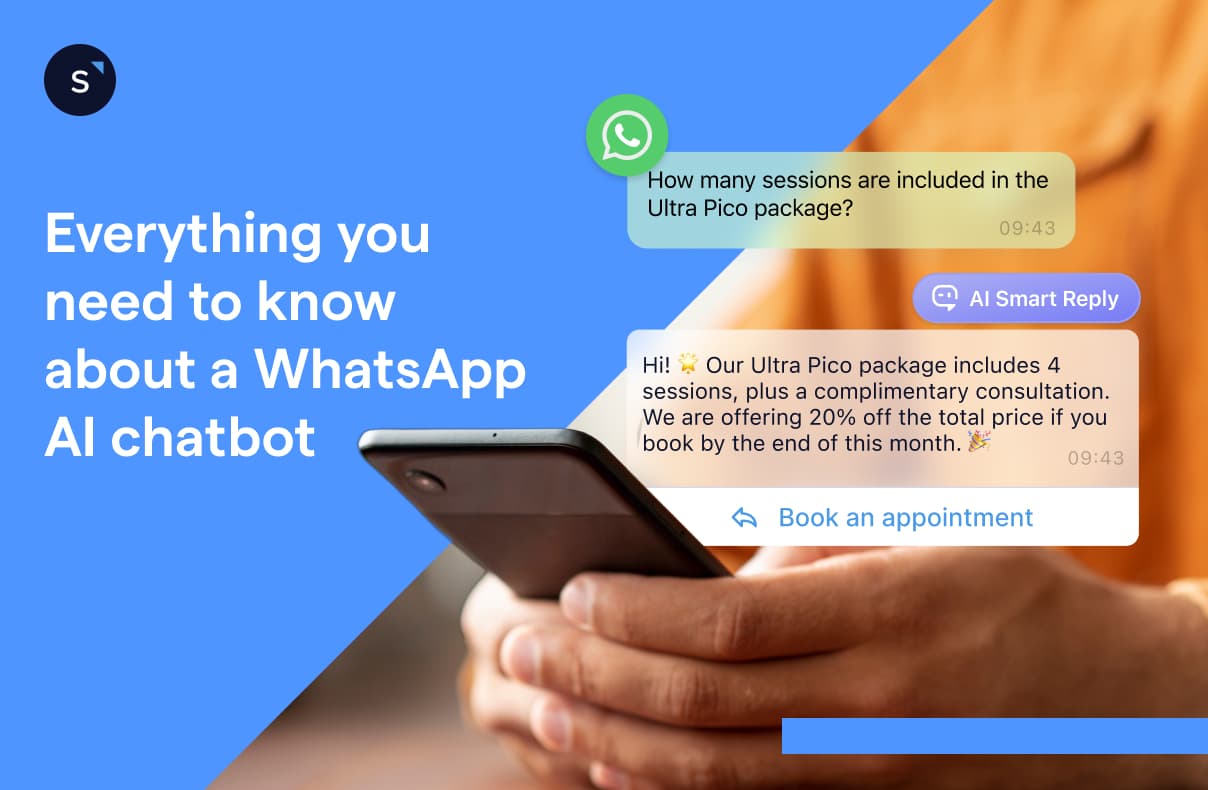
In practical business terms, a WhatsApp AI chatbot sits between your customer and your operations. A prospect can ask about pricing, availability, delivery lead time, or booking options on WhatsApp, and the bot can respond instantly using approved business knowledge. If the chat becomes more nuanced, the AI can collect more context, assess intent, update the customer profile, and hand off the conversation to a sales or support agent.
What is the difference between a WhatsApp AI chatbot and a normal one?
This distinction is where many articles become fuzzy. Not every chatbot on WhatsApp is an AI chatbot. A traditional WhatsApp chatbot is usually rule-based. It relies on buttons, keyword triggers, and fixed decision trees. That makes it useful for simple journeys such as store hours, branch locations, or basic order status updates. But it tends to struggle when customers ask questions in unexpected ways, switch topics midway, or need personalised guidance.
A WhatsApp AI chatbot, by contrast, is better suited for open-ended conversations. It can interpret intent, draw from uploaded business knowledge, adapt replies, and continue a conversation without forcing the customer back into a rigid menu. On platforms that combine AI with workflow automation, it can also enrich contact profiles, update CRM records, trigger downstream actions, and summarise the conversation before handover.
However, this does not mean that AI is automatically better in every case. For highly regulated micro-flows, such as collecting a fixed data point or confirming a standard policy, an automated workflow is often safer. The best WhatsApp AI chatbot strategy is usually a hybrid: use structured flows when precision matters, then bring in AI when customers need flexible answers or guided selling, and finally hand over to humans when they are ready to purchase.
Benefits for businesses when switching to a WhatsApp AI chatbot


1. Faster responses, even outside working hours
One of the clearest benefits is speed. WhatsApp is a real-time channel, so slow replies create friction quickly. A WhatsApp AI chatbot can answer common questions instantly and continue handling enquiries outside operating hours, reducing drop-off from customers who are ready to act.
2. Better lead qualification before sales get involved
AI is especially useful when the first part of the conversation is repetitive. Instead of having a sales rep manually ask the same five questions every time, the chatbot can identify intent, collect details, and pass higher-quality enquiries to the right person.
3. Lower operational workload
A strong chatbot setup reduces manual effort on repetitive conversations while still preserving a human handover for nuance and exceptions. This matters when teams are handling high message volumes across branches, campaigns, or multiple product lines.
4. Higher conversion potential across campaigns and customer journeys
Because WhatsApp now supports richer business interactions, businesses can use AI not only to answer questions but also to move customers through action-oriented journeys such as bookings, quote requests, registrations, and guided product discovery.
How do AI WhatsApp chatbots work?
A business-ready WhatsApp AI chatbot usually works across several layers.
First, the customer starts the conversation through an entry point such as a click-to-WhatsApp ad, QR code, website chat button, or direct inbound message. Next, the AI interprets the message and identifies what the customer is trying to do. Then it checks an approved knowledge source or workflow, replies in context, and decides whether to keep the interaction automated or route it elsewhere. On more mature setups, it may also log the contact, update internal systems, or trigger follow-up actions.
This only works well when the AI is grounded in the business’s actual information. Otherwise, the risk is that the chatbot sounds fluent but gives the wrong answer. That is why the knowledge layer, escalation rules, and testing process matter as much as the language model itself.
What you need to have in your WhatsApp AI chatbot
Not every chatbot setup is business-ready. For most businesses, these are the essentials:

Official WhatsApp Business Platform access
Businesses should avoid unofficial workarounds. Meta’s official WhatsApp Business Platform is built for messaging at scale and supports templates, automation, structured flows, and integrations.
A real knowledge base
The chatbot should answer from business-approved sources such as FAQs, policy documents, product details, pricing logic, and service workflows. This reduces hallucination risk and improves consistency.
Guardrails and handover rules
The AI should know what it can answer, what it should not answer, and when to escalate to a human agent. This is especially important for regulated, high-stakes, or complaint-related scenarios.
Workflow and CRM integration
A chatbot becomes far more valuable when it can update records, trigger actions, and pass context to human teams rather than exist as a disconnected widget.
Where SleekFlow’s AgentFlow fits in your business


A platform for WhatsApp-led customer journeys
SleekFlow AgentFlow is built for businesses that use WhatsApp as a sales and support channel. It allows teams to create specialised AI agents, connect them to a business knowledge base, apply guardrails, and combine AI with automation through Flow Builder. It also supports structured journeys through WhatsApp Flows and broader WhatsApp Business API workflows.
Built for more than FAQ automation
The value of a platform like AgentFlow lies in its ability to go beyond simple auto-replies. Instead of handling only basic FAQs, it can support lead qualification, guided conversations, follow-up actions, and handovers to human agents when the situation calls for it. That makes it more useful for businesses that want WhatsApp to support both customer service and conversion.
Technical setup that supports flexibility
Launched in July 2025, AgentFlow is built on a multi-agent architecture and graph database approach. It runs on Azure OpenAI and can work across models such as GPT-4o, 4o-mini, and Gemini. Customer data is not used to train public models, which is an important consideration for businesses handling sensitive or proprietary information.
What businesses should actually evaluate
Those technical details matter, but they should not be the main reason to choose a platform. When assessing any WhatsApp AI chatbot solution, the more important questions are whether it can ground responses in reliable knowledge, hand over conversations properly, support flexible workflows, provide useful analytics, and fit compliance requirements. In practice, the operating model matters more than the label.
Real-life example: Checkmob uses SleekFlow’s WhatsApp AI chatbot for lead qualification


Checkmob, a sales software solution, used SleekFlow’s AgentFlow to automate first contact, qualify leads, and schedule demos without losing the human touch. Instead of relying on SDRs to manually handle every new enquiry, AI helped respond faster, collect key qualification details, and move sales-ready leads to the next stage.
Results:
70% reduction in response time
20% increase in qualified demo bookings
30% time savings for the sales team
This shows how a WhatsApp AI chatbot can support sales teams by reducing repetitive work and improving lead conversion efficiency.

Start for free!
Grow your revenue and turn chats into conversions with AI agents. Try SleekFlow for free, forever.