WhatsApp Business Chatbot: A Practical Guide for Businesses


TL; DR: Quick Summary
- WhatsApp chatbots automate FAQs, order tracking, and sales around the clock, with fast, consistent response times.
- Chatbots can handle multiple conversations simultaneously, improving response time and customer satisfaction.
- Chatbots can boost conversions by guiding customers through the sales funnel, offering personalised engagement, and automating follow-ups.
- Seamless integration with CRM systems and e-commerce platforms ensures a smooth experience, from order updates to payments.
- Personalization, AI-driven responses, and real-time analytics help refine chatbot performance and provide a tailored experience for customers.
- SleekFlow clients like De’Longhi and Mudah.my showcase chatbot success, improving engagement, automating processes, and increasing customer satisfaction.
What is a WhatsApp chatbot?
A WhatsApp chatbot is a tool that automates customer conversations on WhatsApp. Businesses use chatbots to handle FAQs, process orders, provide customer support, and even drive sales, 24/7, without human intervention.
Unlike a regular WhatsApp Business account, a chatbot can manage multiple conversations simultaneously, integrate with CRM systems, and deliver a seamless, automated customer experience.
Customers are open to it. In Meta's 2026 consumer research across 22 markets, including Singapore, 67.7% of consumers agreed that getting a response from an AI chatbot is helpful, and 72.4% said they're more likely to buy from a brand that offers messaging.
Meta AI, Meta Business Agent, or your own chatbot: which do you need?
"WhatsApp chatbot" can mean four different things. Meta AI is the assistant built into WhatsApp for personal use. Meta Business Agent is Meta's own AI agent that answers customers for a business. A chatbot from a provider like SleekFlow runs on the WhatsApp Business API, and you can also build your own on Meta's Cloud API.
One rule applies to all of them. Since 15 Jan 2026, Meta doesn't allow general-purpose AI assistants, such as ChatGPT, to run on the WhatsApp Business API. AI is still allowed when it supports a business's own customer service, sales, or bookings, which covers every chatbot in this guide.
WhatsApp Business app vs Business Platform (API) vs chatbot layer
A quick way to think about it: the WhatsApp Business app is for manual 1:1 messaging, while a WhatsApp chatbot is typically built on the WhatsApp Business Platform (API) to enable automation, integrations, and team workflows at scale.
WhatsApp Business app (good for very small teams)
The WhatsApp Business app is designed for small businesses that mainly reply to customers manually. It includes lightweight productivity features like:
Greeting messages (welcome message automation)
Away messages (out-of-hours auto-replies)
Quick replies (shortcuts for frequently used responses)
Labels (organize chats)
SleekFlow's WhatsApp chatbot platform combines all three, with no-code flows, AI agents, and human handover in one inbox.
This is ideal if you have low message volume and don’t need deep automation or system integrations.
WhatsApp Business Platform (API) (built for automation + scale)
The WhatsApp Business Platform (often referred to as “WhatsApp API”) is what businesses use when they want:
Automation (chatbots, routing, self-serve flows)
Multi-agent inbox and operational workflows (sales/support teams)
Integrations (CRM, helpdesk, e-commerce, ticketing, etc.)
Approved message templates for business-initiated messaging and compliance controls
Pricing is also structured differently: the platform is charged per delivered message, and messages fall into marketing, utility, authentication, and service categories (with rates varying by market).
Chatbot Layer
A WhatsApp chatbot isn’t a separate WhatsApp product, it's an automation experience you run on top of WhatsApp (most commonly via the Business Platform). It can be:
Rule-based (menus, buttons, keyword routing)
AI-assisted (answer FAQs, qualify leads, summarize intent)
Hybrid (AI + structured flows + human handover)
Watch how WhatsApp automation works in action:
WhatsApp chatbot rules and compliance (opt-in, templates, 24-hour window, handover)
WhatsApp is a high-trust channel, so automation is allowed, but it’s regulated. Here are some rules outlined by WhatsApp’s Business Messaging policy.
Data & consent (Singapore PDPA baseline)
If you’re messaging customers in Singapore, treat PDPA as the baseline standard: you should collect, use, and disclose personal data only with valid consent and for purposes a reasonable person would consider appropriate (purpose limitation). You should also notify users of the purpose(s) for collecting/using their data (e.g., “order updates”, “support”, “marketing”) and make it easy to withdraw consent (e.g., “Reply STOP to opt out of promotions”)
1) Get opt-in (and make opt-out easy)
You may only message users on WhatsApp if you’ve received opt-in permission, and you must respect requests to stop messaging (opt-out), on or off WhatsApp.
WhatsApp also recommends aligning opt-in to the types of messages you’ll send (e.g., order updates vs promotions) and providing clear opt-out instructions.
Practical tip: ask for consent at the moment of intent (checkout, lead form, appointment booking) and store what the user consented to (e.g., “order updates + support”, separate from “promotions”).
2) Use approved message templates to start conversations
On the WhatsApp Business Platform, businesses may only initiate conversations using an approved Message Template. WhatsApp can review, approve, pause, or reject templates, and templates must be used for their intended purpose.
Practical tip: keep templates specific (what the user will receive + why), avoid spammy language, and map each template to a compliant use case (utility vs marketing).
3) Follow the 24-hour customer service window
WhatsApp allows you to reply with free-form messages within 24 hours of the user’s last message. Outside the 24-hour window, you can only message using approved templates.
Practical tip: design your chatbot to (1) solve most queries inside the window, and (2) if follow-up is needed later, send a compliant template (e.g., appointment reminder, delivery update).
4) Provide a clear human handover path
WhatsApp explicitly allows automation during the 24-hour window, but you must provide “prompt, clear, and direct escalation paths,” such as:
In-chat human agent transfer
Phone number
Email
Web support
In-store visits
Support form
Practical tip: add a persistent “Talk to an agent” option and route by intent (sales vs support), business hours, and language.
5) Avoid spam and protect your quality rating
WhatsApp can limit accounts that generate negative feedback (blocks/reports). They also prohibit misleading, spammy, or surprising communications.
Practical tip: throttle outbound messaging, keep marketing opt-in separate, and monitor block/report rates per campaign/template.
WhatsApp chatbot costs (Meta messaging fees + budgeting tips)
WhatsApp Business Platform charges businesses per delivered message (not per message sent). Pricing varies based on the recipient’s market and the message category: Marketing, Utility, Authentication, or Service.
A few important pricing fundamentals for budgeting:
Service messages are your replies to customers who message you first, whether a person or a chatbot sends them. Since 1 Oct 2026, Meta charges for them after the first 1,000 a month for each phone number, so automated replies inside the 24-hour customer service window now have a cost.
When a customer starts a chat from a click to WhatsApp ad, replies inside the free entry point window are free. Meta's pricing page says that window can last a maximum of 7 days. For chats that start from a Facebook Page call-to-action button, it's 72 hours.
If you use Meta Business Agent, Meta's own AI agent, its replies have been billed by token use since 1 Aug 2026, instead of as service messages.
As you scale, WhatsApp provides volume tiers that can unlock more attractive pricing for Utility and Authentication messaging.
In practice, your total “WhatsApp chatbot cost” usually has two parts:
Meta messaging fees (the per-delivered-message rates above), plus
The cost of your messaging/automation platform (inbox, bot builder, integrations, analytics, governance).
To estimate spend before launch, use the official pricing rate cards for your target markets, then run your volumes through SleekFlow’s WhatsApp Pricing Calculator (especially useful if you message across multiple countries).
WhatsApp chatbot use cases (sales, support marketing + templates)
A WhatsApp chatbot delivers the best ROI when it’s built around clear outcomes (qualify, convert, resolve, re-engage) and designed as a hybrid: automation for speed + human handover for edge cases.
Sales use cases (capture and convert demand faster)
Best for: inbound lead capture, product matching, booking, quote follow-up
Primary KPIs: first response time, qualified lead rate, booked meetings, conversion rate
Sales templates (copy-paste)
Lead qualification menu (marketing)
Hi {{1}} 👋 Thanks for messaging {{2}}.
What can I help with today?
Pricing / plans
Product info
Book a demo
Talk to an agent
Reply 1–4. To stop messages, reply STOP.
Variable mapping:
{{1}} = first_name
{{2}} = company_name
Demo confirmation (utility)
Hi {{1}} your session with {{2}} is confirmed ✅
Date: {{3}} | Time: {{4}} ({{5}})
Link: {{6}}
To reschedule, reply RESCHEDULE. For a human agent, reply AGENT.
Variable mapping:
{{1}} = first_name
{{2}} = company_name
{{3}} = demo_date
{{4}} = demo_time
{{5}} = timezone
{{6}} = meeting_link
Quote follow-up (utility or marketing depending on consent)
Hi {{1}}, here’s your quote from {{2}}.
Quote ID: {{3}} | Total: {{4}}
Review here: {{5}}
Questions before you decide? Reply AGENT and we’ll help.
Variable mapping:
{{1}} = first_name
{{2}} = company_name
{{3}} = quote_id
{{4}} = quote_total
{{5}} = quote_link
Support use cases (deflect repetitive tickets, speed up resolution)
Best for: FAQs, order status, returns, appointment changes, troubleshooting triage
Primary KPIs: resolution time, containment rate, CSAT, agent workload reduction
Support templates (copy-paste)
Order confirmation (utility)
Thanks {{1}} we’ve received your order ✅
Order ID: {{2}} | Items: {{3}} | Total: {{4}}
Track your delivery: {{5}}
Need help? Reply AGENT.
Variable mapping:
{{1}} = first_name
{{2}} = order_id
{{3}} = items_summary
{{4}} = order_total
{{5}} = tracking_link
Delivery update / delay notice (utility)
Hi {{1}}, quick update from {{2}} 📦
Order: {{3}} | Status: {{4}} | ETA: {{5}}
Track here: {{6}}
Need help? Reply AGENT.
Variable mapping:
{{1}} = first_name
{{2}} = company_name
{{3}} = order_id
{{4}} = delivery_status
{{5}} = delivery_eta
{{6}} = tracking_link
Support ticket update (utility)
Hi {{1}}, here’s an update on your request ✅
Ticket: {{2}} | Status: {{3}}
Latest note: {{4}}
Reply AGENT if you want a specialist to take over.
Variable mapping:
{{1}} = first_name
{{2}} = ticket_id
{{3}} = ticket_status
{{4}} = agent_note_summary
Human handover prompt (utility)
I can help with common questions, but a specialist may be faster here.
Reply AGENT and share your issue in one message (order ID / email if relevant).
Marketing use cases (re-engage opted-in audiences and drive repeat revenue)
Best for: cart recovery, back-in-stock, promotions, renewals, win-back
Primary KPIs: read rate, click-through rate, conversion rate, STOP/unsubscribe rate
Marketing templates (copy-paste)
Abandoned cart reminder (marketing)
Hi {{1}}, you left items in your cart at {{2}} 🛒
Complete your order here: {{3}}
Need help choosing? Reply HELP.
To stop messages, reply STOP.
Variable mapping:
{{1}} = first_name
{{2}} = company_name
{{3}} = cart_link
Back-in-stock alert (marketing)
Good news, {{1}} {{2}} is back in stock 🎉
Get it here: {{3}}
Want similar picks? Reply REC.
To stop messages, reply STOP.
Variable mapping:
{{1}} = first_name
{{2}} = product_name
{{3}} = product_link
Win-back offer (marketing)
Hi {{1}}, we miss you at {{2}} 😊
Here’s an offer for you: {{3}} (valid until {{4}})
Reply 1 to redeem, or AGENT for help.
To stop messages, reply STOP.
Variable mapping:
{{1}} = first_name
{{2}} = company_name
{{3}} = offer_details
{{4}} = offer_expiry_date
Chatbots vs AI agents: what’s the difference?
A WhatsApp chatbot follows predefined conversation flows, automating tasks like FAQs, order tracking, and appointment scheduling using rule-based or decision-tree logic. It enhances efficiency by handling high-volume queries instantly but operates within set parameters.
An AI agent, on the other hand, is more advanced, leveraging AI reasoning and adaptability to engage in context-aware, dynamic conversations. Unlike a chatbot, an AI agent can understand complex queries, learn from interactions, and provide personalised responses without strict scripting. It can also autonomously complete tasks like processing orders, retrieving CRM data, or managing follow-ups with minimal human intervention.
How to set up a WhatsApp chatbot in 6 steps
Choose whether you need the WhatsApp Business app (basic productivity tools) or WhatsApp Business Platform (automation + scale).
Choose your path: the free app's auto-replies, Meta Business Agent, or the WhatsApp Business API with a provider. The comparison above shows which fits.
Get a WhatsApp Business account and number. On the API, you'll connect a number that can receive an SMS or voice call, and get your display name approved.
Pick one job for the bot first, such as answering FAQs, qualifying leads, or booking appointments, and decide when it should hand over to a person.
Build the flow. Use menus and buttons for structured steps, and train AI answers on your own FAQs, policies, and product information.
Test with real customer questions, including vague ones, and test the handover to an agent.
Launch, then review conversations every week. Fix wrong answers, add missing FAQs, and track how many chats the bot resolves and how many it hands over.
For a full step-by-step chatbot setup walkthrough, read our tutorial on how to create a WhatsApp chatbot.
Best practices for a successful WhatsApp chatbot
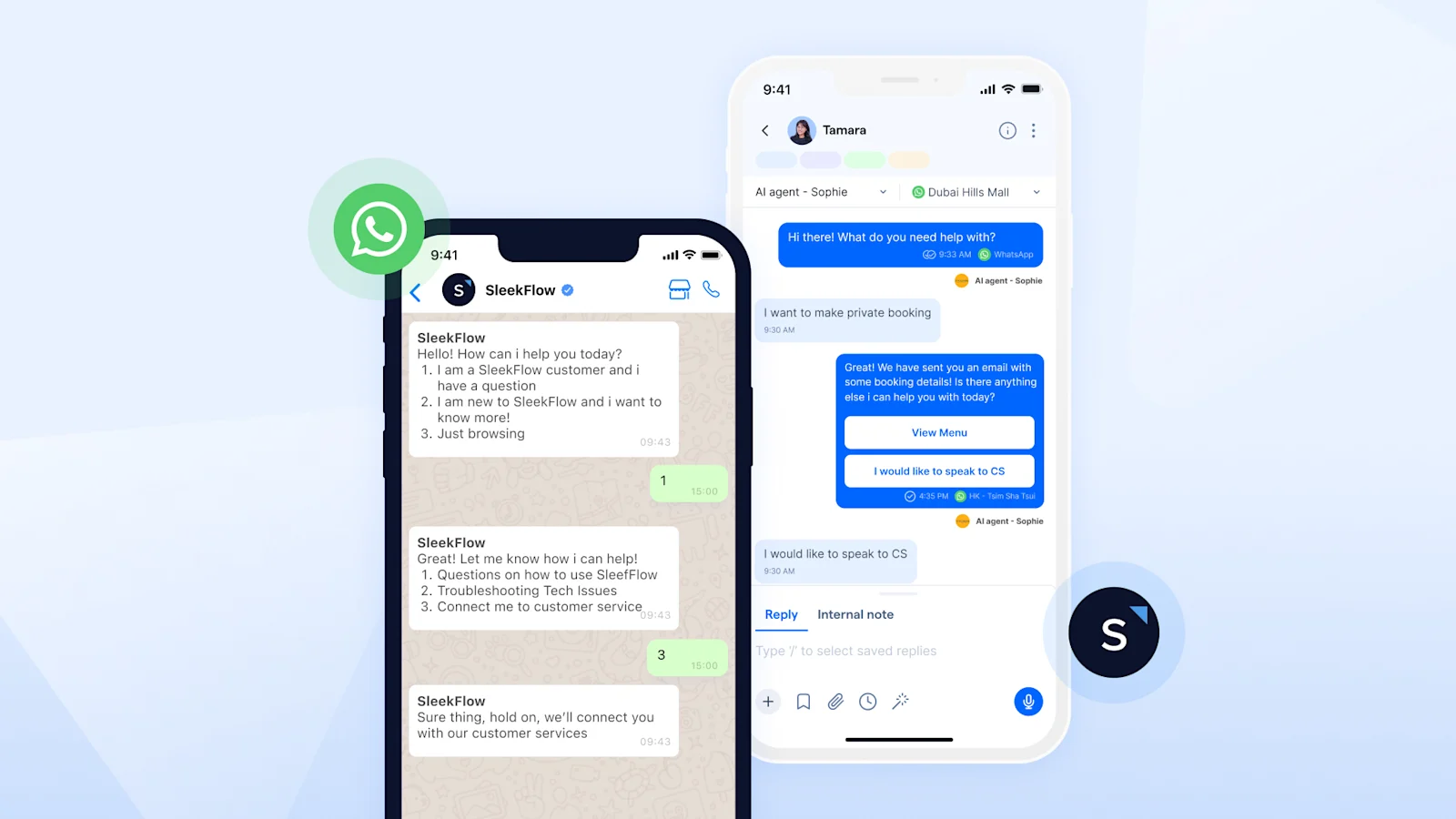
1. Use a natural, conversational tone
Your chatbot should feel like an extension of your brand’s customer service, not a robotic, one-size-fits-all responder.
How to implement:
Keep responses short and engaging.
Use emojis sparingly to add personality without overwhelming the user.
If appropriate, include casual greetings like “Hey there! How can I help you today?” instead of formal phrases like “How may I assist you?”
Example:
❌ "Thank you for reaching out. Your query has been noted and will be processed accordingly."
✅ "Hey! Got your message. Let me sort that out for you in a sec!"
2. Set clear expectations
Users should know what your chatbot can and cannot do. If it can’t handle complex queries, it should inform users upfront and offer alternatives.
How to implement:
Include a welcome message that outlines what the chatbot can help with.
Provide menu options or quick-reply buttons to guide users.
If necessary, clearly state when human support is available.
Example:
"Hi! I’m your virtual assistant. I can help you with order tracking, product recommendations, and appointment bookings. Need help with something else? Type ‘agent’ to chat with a real person!"
3. Personalise responses based on user data
A chatbot should feel tailored to the user’s experience. Use customer data to offer relevant recommendations and a more human-like conversation.
How to implement:
Greet users by name (if available).
Reference past interactions (e.g., previous purchases or inquiries).
Use customer segmentation to provide relevant recommendations.
Example:
❌ "Here are some products you may like!"
✅ "Hey Sarah! Based on your last order, you might love our new skincare bundle. Want to check it out?"
4. Offer a human handover when necessary
While chatbots can handle most inquiries, some customers prefer speaking to a human, especially for complex issues.
How to implement:
Add a “Talk to a human” option in the chatbot menu.
Set triggers that escalate conversations when the chatbot detects frustration or confusion.
Route priority queries (e.g., billing issues) directly to an agent.
Example:
"I’m here to help! But if you’d prefer to chat with a human, just type ‘agent’ and I’ll connect you with one of our team members."
5. Regularly update and optimise the chatbot
A chatbot is not a “set it and forget it” tool. You need to continuously improve its responses based on customer interactions and feedback.
How to implement:
Monitor chatbot analytics (e.g., response rates, drop-off points).
Update conversation flows to include FAQs that come up frequently.
Test new chatbot features and refine responses to improve user experience.
Example:
If analytics show that users frequently ask about refund policies, add a pre-programmed response like:
"Need a refund? No problem! Here’s our refund policy: [link]. If you need help with a refund request, type ‘refund’!"
Real-world examples of WhatsApp chatbots from SleekFlow clients
De’Longhi leverages WhatsApp chatbots to stay available to customers around the clock
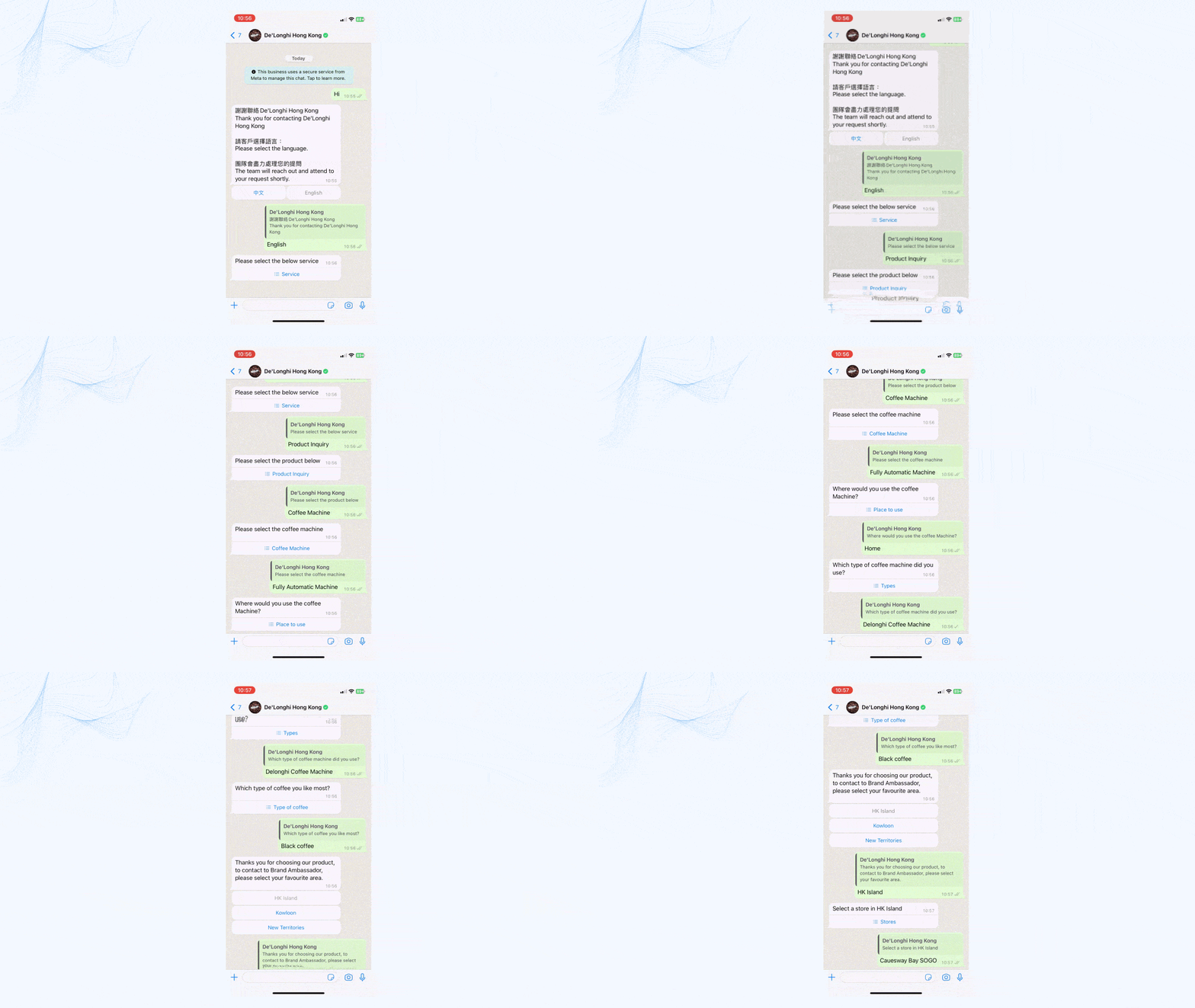
Italian home appliance brand De’Longhi, enhances customer engagement with a 24/7 WhatsApp chatbot, automating responses for product inquiries, roadshow details, and after-sales service. The chatbot also features seamless language switching, allowing customers to interact in their preferred language, ensuring a smooth and personalised experience. Whether customers engage during or outside office hours, the chatbot delivers instant, accurate information, improving accessibility and customer satisfaction without requiring human intervention. Additionally De'Longhi uses features from SleekFlow's WhatsApp business solution, such as:
Unified WhatsApp communication for multiple Home Coffee kiosks
A multi-entry approach to showcase WhatsApp number for reservations, such as WhatsApp buttons, links, and QR code
Mudah.my uses WhatsApp chatbot to automate car test drive bookings and follow up with customers
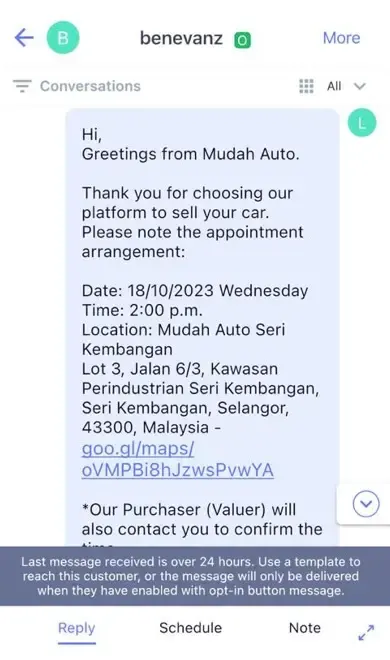
As Malaysia’s largest re-commerce marketplace, Mudah.my provides a seamless buying and selling experience for various categories, including automobiles. With the introduction of Mudah Certified, a program that guarantees inspected secondhand vehicles, the brand implemented a WhatsApp chatbot to automate test drive scheduling. Interested buyers can easily book appointments through WhatsApp, eliminating the need for back-and-forth coordination.
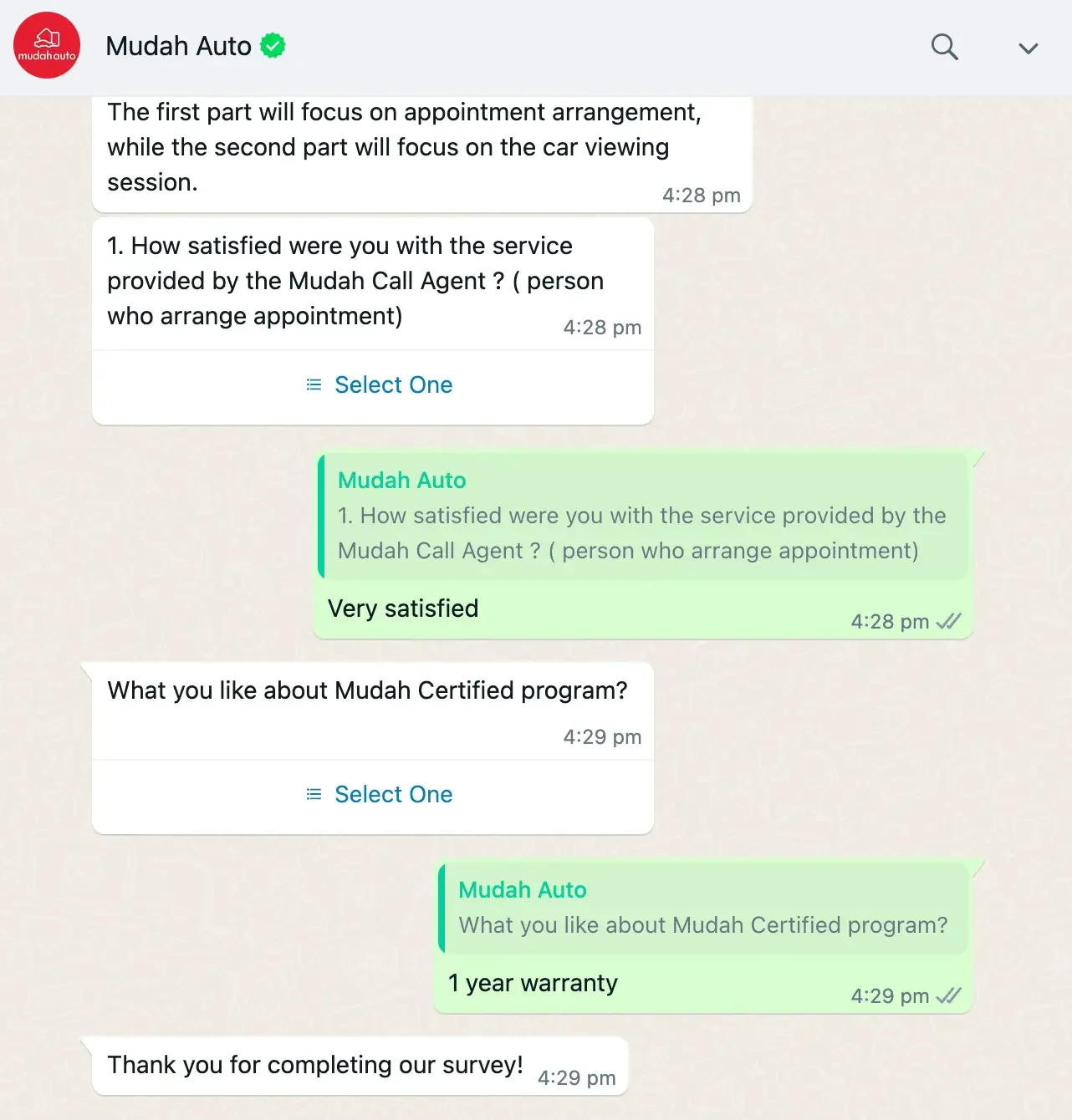
After the test drive, the chatbot also automatically sends follow-up messages, gathering customer feedback effortlessly. This automation not only saves time and operational costs but also fosters long-term trust and loyalty among customers. As a result, Mudah.my has:
250x New leads
3x Reply rate
70% Read rate
Learn more about Mudah.my's WhatsApp strategy.
Sun and Moon Massage: Enhancing appointment scheduling with chatbot automation
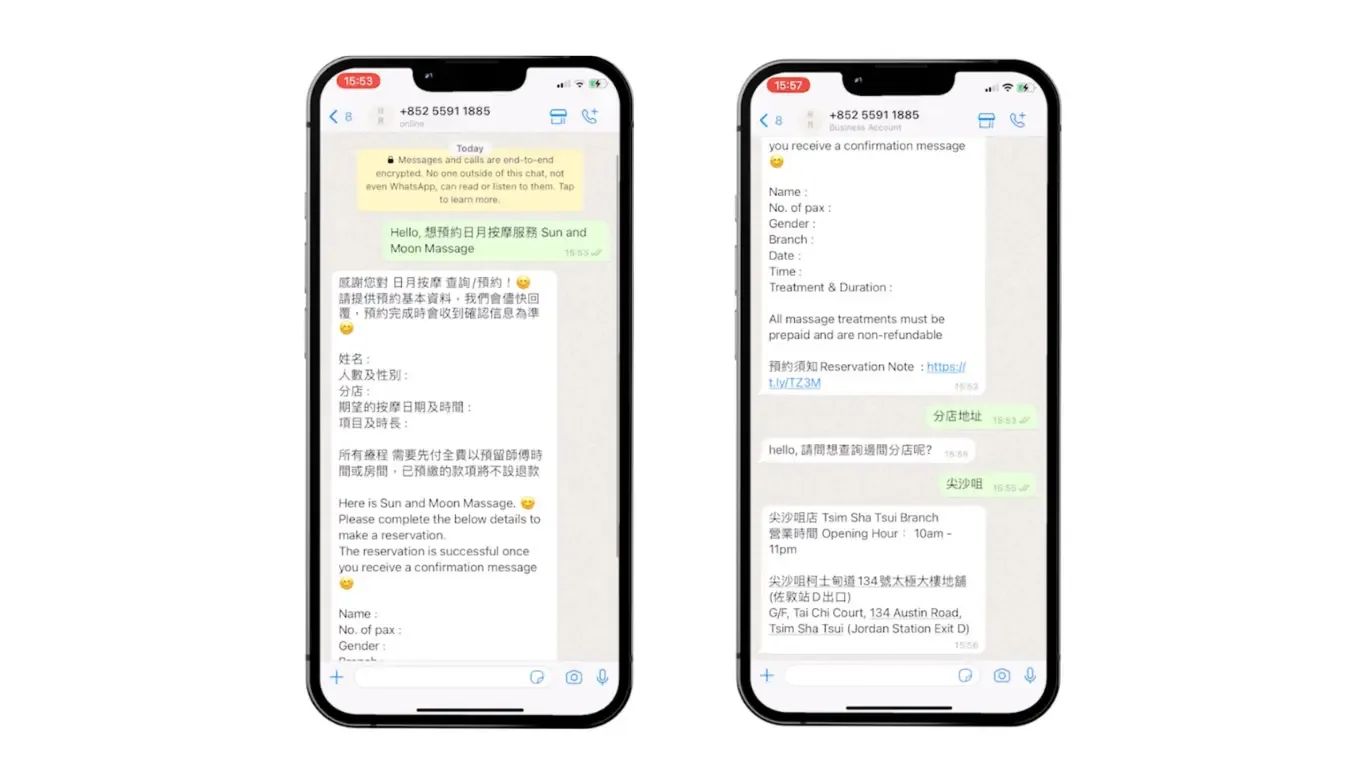
In Hong Kong, Sun and Moon Massage integrates a no-code WhatsApp chatbot to handle frequently asked questions (FAQs) and streamline appointment bookings. The chatbot automatically provides details on services, pricing, and branch locations, allowing staff to focus on the final steps of appointment scheduling, including payment and confirmation. Customers can navigate the booking process seamlessly, entering their details when prompted by the chatbot. By automating routine inquiries, Sun and Moon ensures a smoother customer journey while reducing manual workload for staff.
By using SleekFlow, Sun and Moon massage produces results such as:
30% increase in conversion rate
1,500 new contacts per month
Learn how Sun and Moon Massage uses SleekFlow for efficient appointment booking.
Awfully Chocolate automates replies with WhatsApp chatbot for answering common FAQs
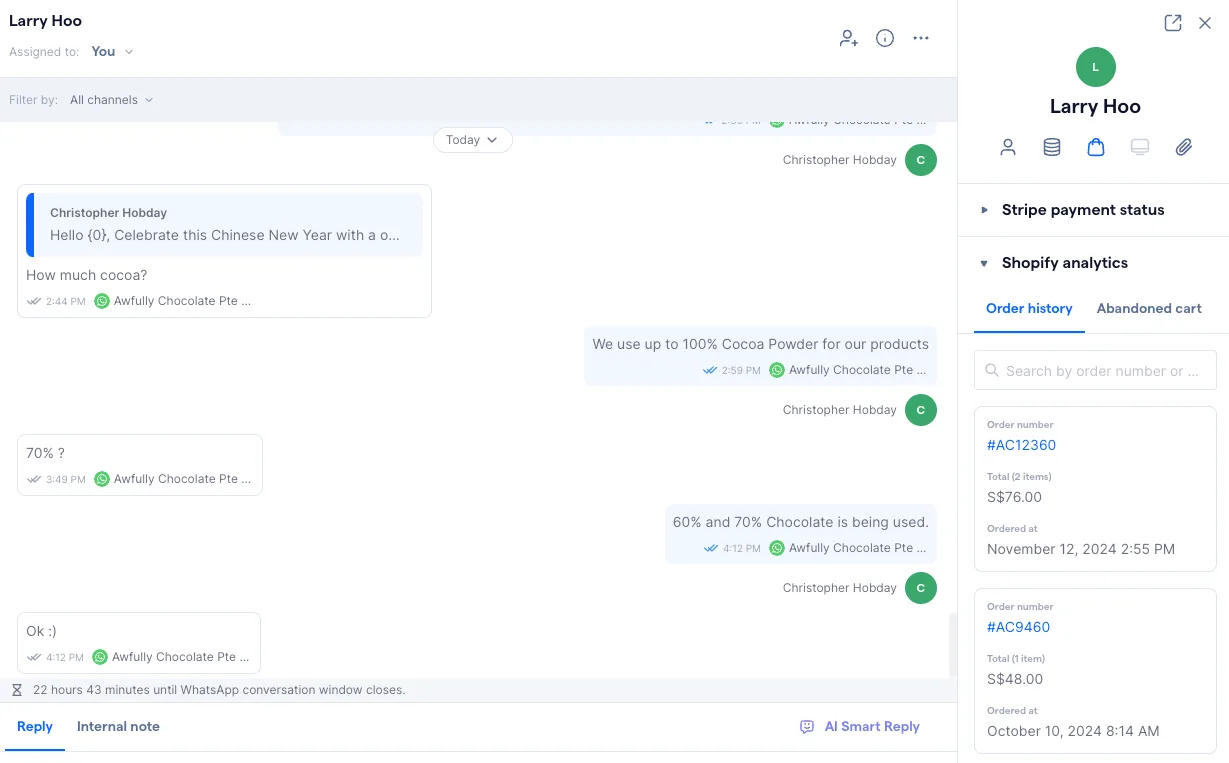
In Singapore, Awfully Chocolate uses automated responses to common queries such as store opening hours, order enquiries, membership enquiries, etc. Enabling WhatsApp chatbot allowed customer service agents to focus on handling more complex customer queries, especially during peak seasons, doubling their customer service response speed.
Here are their results:
2x Faster response
2.000+ new enquiries monthly
90% read rate
See what we can do for your business with WhatsApp
Book a personalised demo with SleekFlow and see how you can turn WhatsApp into your #1 revenue machine


