Is WhatsApp secure? What changes when a business is on the other end


TL; DR: Quick Summary
- WhatsApp encrypts personal chats end to end by default, but a shared business inbox runs on different rules.
- WhatsApp is the most-used platform in both Singapore and Malaysia, so this question affects almost every local business.
- Meta's Cloud API holds the encryption keys for business messages, since one device cannot serve a whole team.
- Ask any WhatsApp Business API provider where messages are stored after delivery, who can read them, and whether a DPA exists.
- Personal WhatsApp stays end-to-end encrypted, but business conversations split responsibility between Meta, your provider and your business.
Your team just moved customer support onto WhatsApp, and a client asks a fair question: is this actually private? You want to say yes, because personal WhatsApp is famous for its encryption. But the moment three teammates and an AI agent can all open the same thread, a flat yes stops being the honest answer.
It is not a small question, either. WhatsApp is Singapore's most-used online platform, with about 84% of internet users on it, and it ranks first in Malaysia too. Most local businesses in both markets are already having this conversation, whether they have asked it out loud or not.
This article breaks down what end-to-end encryption actually covers, what changes once a WhatsApp Business API account and multiple agents get involved, who is responsible for your customers' data once it leaves WhatsApp, and what Singapore's and Malaysia's data protection laws expect from you regardless of what Meta promises.
Is WhatsApp secure?
WhatsApp is a messaging app that end-to-end encrypts personal chats by default, using the Signal Protocol, so only the sender and recipient can read the content, not even WhatsApp itself. That protection holds up well on its own terms. It does not automatically carry over to a business account built on the WhatsApp Business API, which works on a genuinely different model.
Privacy advocates, including a widely shared Proton blog post, raise a fair point alongside this: WhatsApp collects substantial metadata, such as who you talk to, how often, and your device details. Separately, a former WhatsApp security executive has filed a lawsuit alleging Meta ignored internal security warnings, which Meta disputes. Neither point is evidence that Meta has decrypted content. Both are reasons to treat encrypted as necessary, not sufficient, once a business account is involved.
Encryption terms, and why they get confused
Three different guarantees get flattened into one word, encrypted.
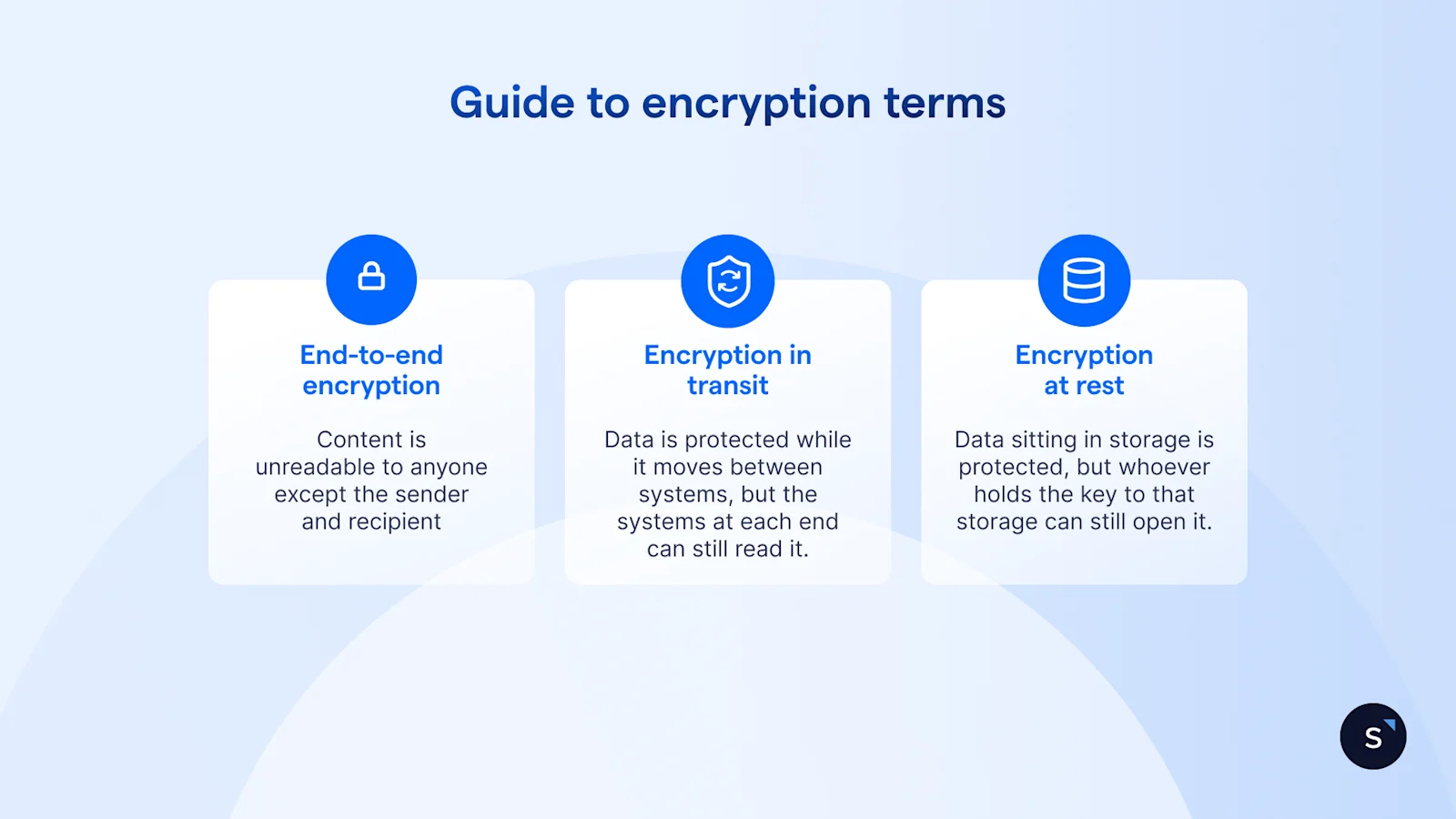
End-to-end encryption
Content is unreadable to anyone except the sender and recipient, including the platform in the middle.
Encryption in transit
Data is protected while it moves between systems, but the systems at each end can still read it.
Encryption at rest
Data sitting in storage is protected, but whoever holds the key to that storage can still open it.
WhatsApp Business API messages get the second and third of these. Only personal WhatsApp chats reliably get the first.
Is the WhatsApp Business API end-to-end encrypted?
Yes, just not end-to-end in the strict, one-device-only sense consumers expect, and for good reason. Meta's own developer documentation states that Cloud API manages the encryption and decryption keys on behalf of the business, which is what lets a shared team inbox with multiple agents, or an AI agent, work off the same number in the first place. Messages stay encrypted in transit and at rest throughout.
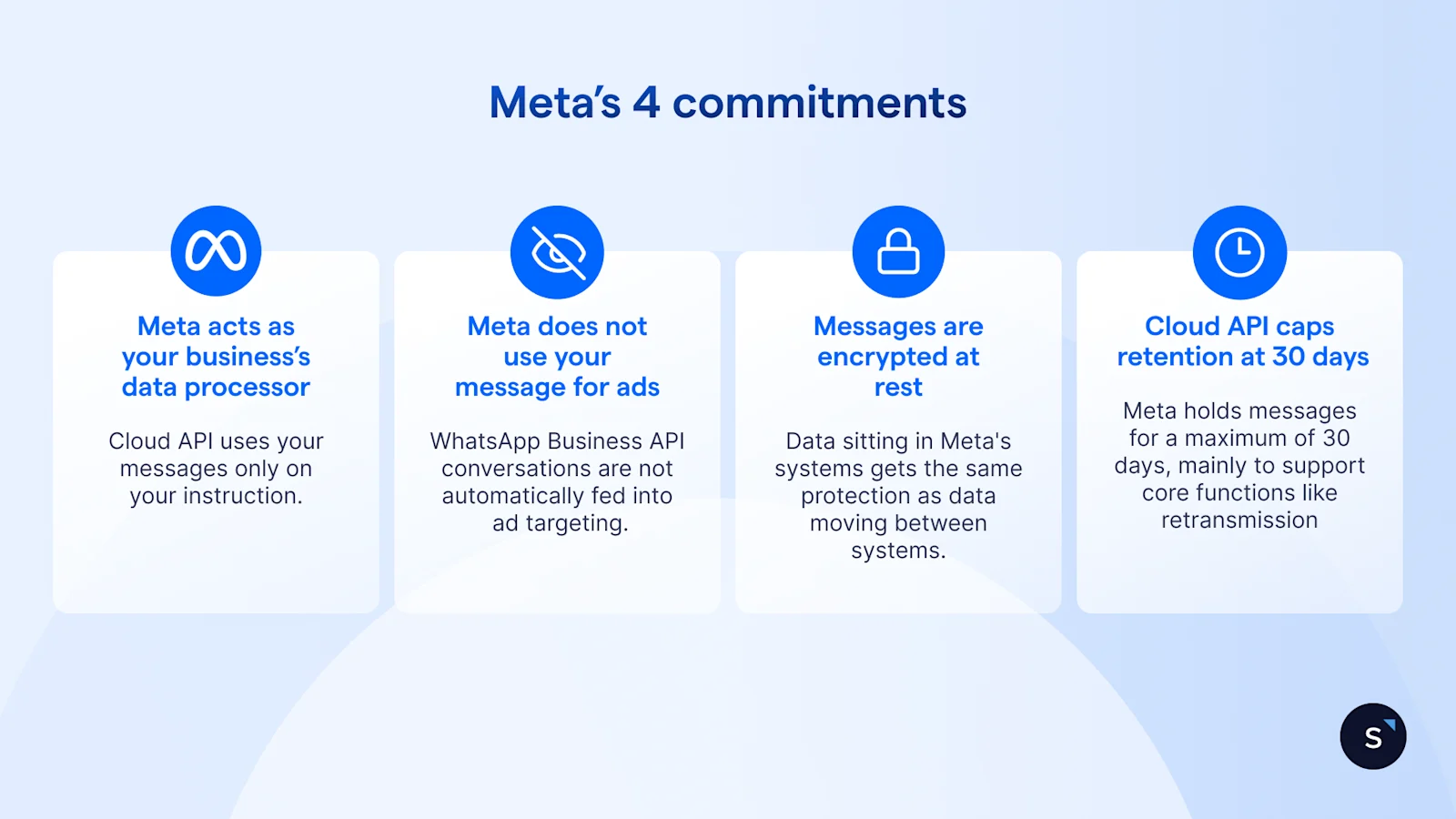
Meta backs this setup with four specific commitments:
Meta acts as your business's data processor
Cloud API uses your messages only on your instruction, giving your business, not Meta, the say over how they're handled.
Meta commits to not using your messages for ads
WhatsApp Business API conversations are not automatically fed into the ad targeting a person sees elsewhere on Meta's platforms.
Messages are encrypted at rest, not just in transit
Data sitting in Meta's systems gets the same protection as data moving between systems, so storage is covered too.
Cloud API caps its own retention at 30 days
Meta holds messages for a maximum of 30 days, mainly to support core functions such as retransmission, well short of indefinite storage.
Who is responsible for what
No single party controls your WhatsApp Business API data end to end. Meta, your messaging provider, and your own business each hold a different piece of the responsibility, and knowing which piece is whose is what actually determines your exposure.
Where WhatsApp Business API data actually sits after delivery
Once a message reaches your business through the WhatsApp Business API, Meta's job is done. What happens to it next is entirely down to your provider, the business solution provider (BSP) running your WhatsApp Business API setup, not WhatsApp itself.
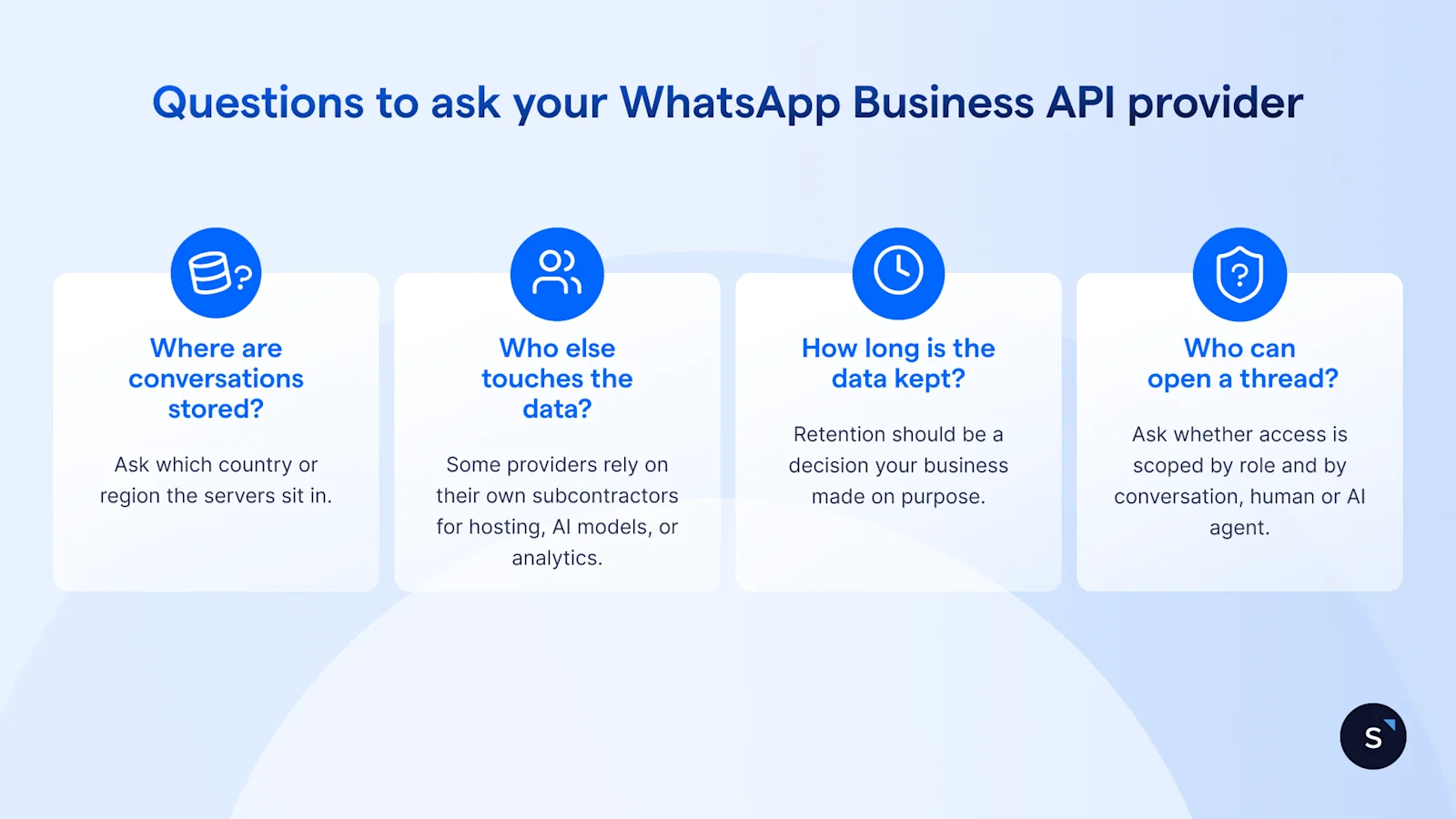
If you're choosing or reviewing a WhatsApp Business API provider, put these four questions to them directly. How they answer tells you more than any feature list.
Where does your provider store conversations?
Ask which country or region the servers sit in, and whether that satisfies any data residency rule your sector faces.
Who else touches that data?
Most providers rely on their own subcontractors for hosting, AI models, or analytics. Ask for the actual list, not just the assurance.
How long is it kept?
Retention should be a decision your business made on purpose, not a default nobody has looked at.
Who can actually open a thread?
Ask whether access is scoped by role and by conversation, human or AI agent, or whether anyone with a login can open any conversation.
A provider that cannot answer these plainly is telling you something.
Does Meta Business Agent change the picture?
Meta Business Agent is Meta's own AI system that can answer customers on a business's behalf directly inside WhatsApp. When it is switched on, Meta's AI is the one reading the conversation to generate a reply, which is a different arrangement from a third-party AI agent that runs on the business's own infrastructure and answers only from content the business controls.
WhatsApp already discloses this trade-off for its consumer-facing Meta AI assistant: using Meta AI in a chat means that specific exchange is not end-to-end encrypted, because Meta's own systems have to read the message to answer it. The same mechanical logic, an AI system needs to process content in order to respond to it, reasonably extends to Meta Business Agent, though a business should confirm the current wording directly with Meta before making that claim to its own customers. "This is fundamentally a Meta Business Agent vs AI agent question, and it plays out in cost, eligibility, and control too."
Business obligations in Singapore and Malaysia when WhatsApp customer data is breached
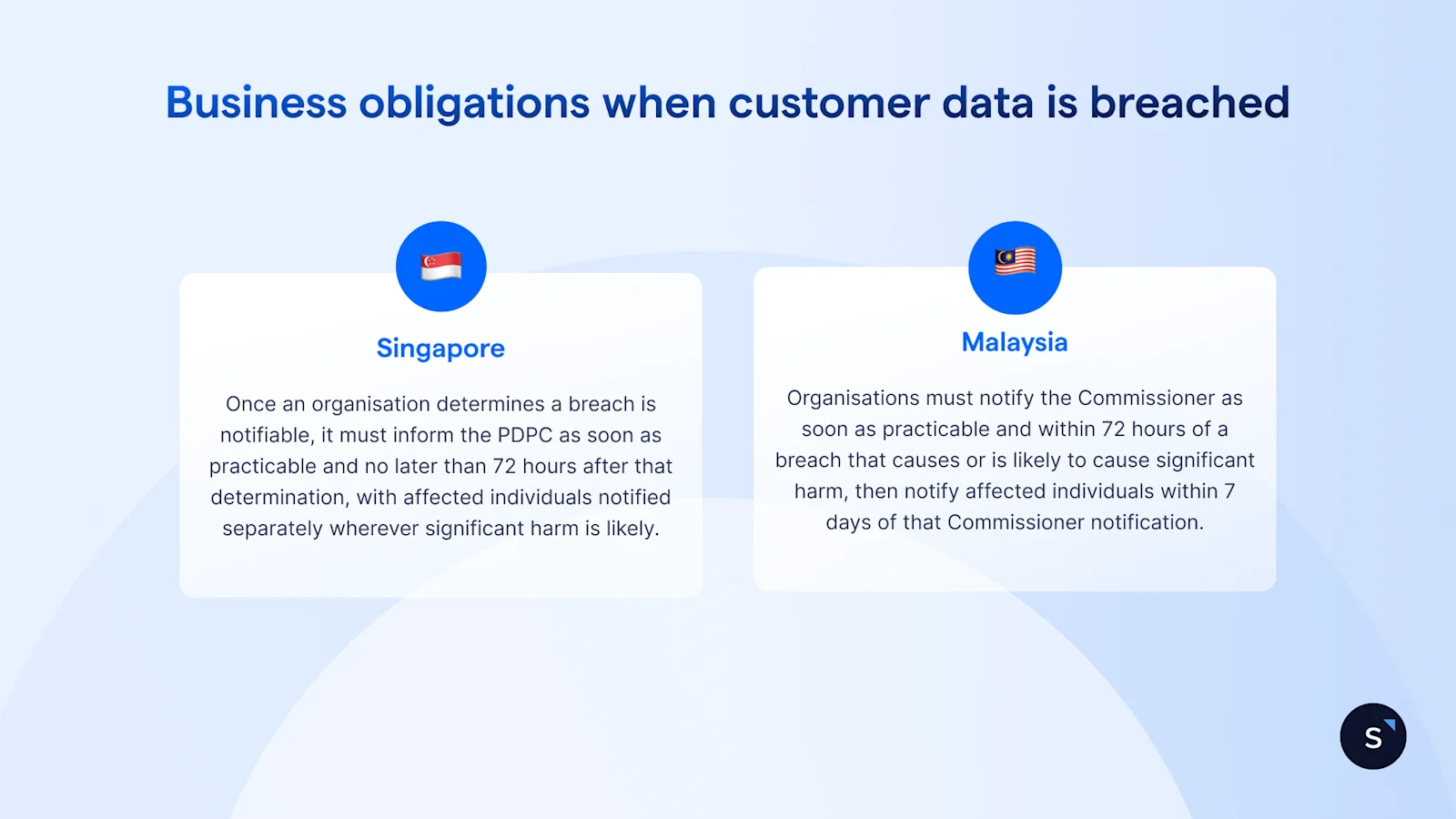
Meta's encryption commitments do not change who is legally accountable for customer data under Singapore's or Malaysia's PDPA. That responsibility sits with the business collecting the data, whichever WhatsApp provider or AI agent it uses to do so.
Singapore
Singapore's PDPA has required mandatory data breach notification since 1 Feb 2021. A breach is notifiable when it results in, or is likely to result in, significant harm to affected individuals, or when it affects 500 or more people. Once an organisation determines a breach is notifiable, it must inform the PDPC as soon as practicable and no later than 72 hours after that determination, with affected individuals notified separately wherever significant harm is likely.
Malaysia
Malaysia's Personal Data Protection (Amendment) Act 2024 introduced its own mandatory breach notification duty, with the data breach notification provisions taking effect from 1 Jun 2025. Organisations must notify the Commissioner as soon as practicable and within 72 hours of a breach that causes or is likely to cause significant harm, then notify affected individuals within 7 days of that Commissioner notification. Failing to notify the Commissioner carries penalties of up to RM250,000, imprisonment of up to two years, or both.
How SleekFlow handles this
SleekFlow acts as a data processor for its customers' WhatsApp Business API conversations, under written instructions, so your business keeps ownership of its own data throughout.
On certification, SleekFlow holds SOC 2 Type II, ISO/IEC 27001:2022 and ISO/IEC 42001:2023, alongside compliance coverage for the PDPA, GDPR and other regional regimes, all documented in the Trust Center.
On access, conversations sit behind role-based access control, two-factor authentication, IP allow-listing, and permissions that can be scoped down to specific teams or individual conversations, not a blanket default where everyone in the inbox can see everything.
None of this replaces asking your own compliance team the questions in the FAQ below, but it does mean the answers are documented rather than assumed. AgentFlow and SleekFlow's Inbox apply these same controls to every conversation, human-handled or AI-handled.
Ask better questions than whether it's encrypted
Is WhatsApp secure is the wrong-sized question for a business account. The better ones are narrower: who holds the keys, where does the data go after delivery, and who on your team, or which AI, can actually open a thread. Put those three questions to any provider before you put customer conversations in front of it.
See how SleekFlow protects your data
Book your personalised demo with SleekFlow today and see how we handle encryption, access control and data residency for your WhatsApp.


